What Is Candidiasis? The Yeast Infection Guide Explained

Updated: 3 days ago
Medically reviewed by Dr. Baraa Alnahhal, MD · Last reviewed: October 17, 2026
Quick Answer: What is candidiasis?
Candidiasis is a fungal infection caused by overgrowth of Candida albicans yeast, most often on the skin, mouth and vagina. [4] It results from an imbalance between healthy bacteria and yeast, triggered by weakened immunity, diabetes, hormonal changes or medications such as antibiotics. [4] Antifungal medications usually clear it within two days to two weeks. [4]
Key takeaways
Candidiasis is a yeast overgrowth caused by Candida albicans, which naturally lives on your skin, mouth, and vagina. [4]
Healthy bacteria normally keep yeast balanced; stress, illness, hormones, and some medications can disrupt that balance. [4]
The four common types are cutaneous (skin), nail, oral (thrush), and vaginal candidiasis, plus the serious invasive form. [4]
Antifungal treatment — cream, pill, lozenge, liquid, or IV — clears most infections in two days to two weeks. [4]
Invasive candidiasis is life-threatening and most often affects hospitalized people and those with weakened immune systems. [4]
Good hygiene, stress management, and less refined sugar help prevent recurrent infections. [4]
What the research says
Recurrent vaginal yeast infections affect a very large number of women worldwide. A systematic review of 8 population-based studies (17,365 patients from 11 countries) estimated that recurrent vulvovaginal candidiasis (four or more episodes a year) affects about 138 million women annually (range 103–172 million) and 372 million over a lifetime, with the highest prevalence (9%) in women aged 25 to 34 (Denning et al., Lancet Infect Dis, 2018) [1].
Candida infections range from common and mild to life-threatening. A modeling study of serious fungal disease in India estimated 24.3 million people with recurrent vulvovaginal candidiasis, about 266,600 new cases of esophageal candidiasis in people with HIV each year, and about 188,000 cases of candidemia (Candida in the bloodstream) each year (Ray et al., Open Forum Infect Dis, 2022) [2].
Treatment choice for bloodstream infection involves trade-offs. A meta-analysis of 3 randomized trials found conventional amphotericin B had slightly higher treatment success than azoles (relative risk 0.90, 95% CI 0.82–1.00) with no significant difference in mortality, but renal disorders were far less common with azoles (relative risk 0.26) (Osa et al., J Infect Chemother, 2020) [3].
What Is Candidiasis?

Candidiasis is a fungal infection caused by an overgrowth of a type of yeast that lives on your body called Candida albicans. A candidiasis infection often appears where Candida naturally lives in small amounts, like your skin, mouth, or vagina. [4]
Normally, healthy bacteria on your body prevent yeast overgrowth. [4] Imagine a two-armed scale with healthy bacteria on one side and yeast on the other. The scale stays balanced until something disrupts it, such as certain medical conditions, stress, unhealthy eating patterns, or a weakened immune system. [4] When something disrupts your scale, a candidiasis infection can occur.
Candidiasis causes discomfort, itching, and irritation until you find treatment, but it is not a major threat to your overall health. Like any other infection, you should treat it right away to relieve your symptoms. Left untreated, severe infections could spread to other parts of your body, including your blood, heart, and brain. [4]
Types of Candidiasis
Since yeast naturally lives on your body, there are different types of candidiasis based on the location of the infection.
Type | Where it occurs | What you may notice |
Cutaneous candidiasis (skin) | Skin folds: underarms, under breasts, near buttocks (diaper rash) | Red, raised patches in the folds of your skin |
Nail candidiasis (candidal paronychia) | Nail folds and cuticles | Redness, pain, and swelling around your nails; severe cases may cause the nail plate to separate from the nail bed (onycholysis) |
Oral candidiasis (thrush) | Mouth, throat, tongue, or esophagus | Raised, white sores along with mouth pain, irritation, and redness |
Vaginal candidiasis (vaginal yeast infection) | Vulva and vagina; a type of vaginitis | Burning, itching, and redness in your vulva plus changes to your vaginal discharge |
A serious type of candidiasis is called invasive candidiasis. Invasive candidiasis is a life-threatening infection that occurs when Candida gets into your bloodstream and spreads to your internal organs. It most often affects people in hospitals and people with weakened immune systems. [4]
Symptoms: What a Candidiasis Infection Looks Like
Candidiasis symptoms vary depending on the type and location of the infection. Because the infection can appear on the skin, in the mouth, or in the vagina, the signs you notice depend on where the yeast overgrowth happens.
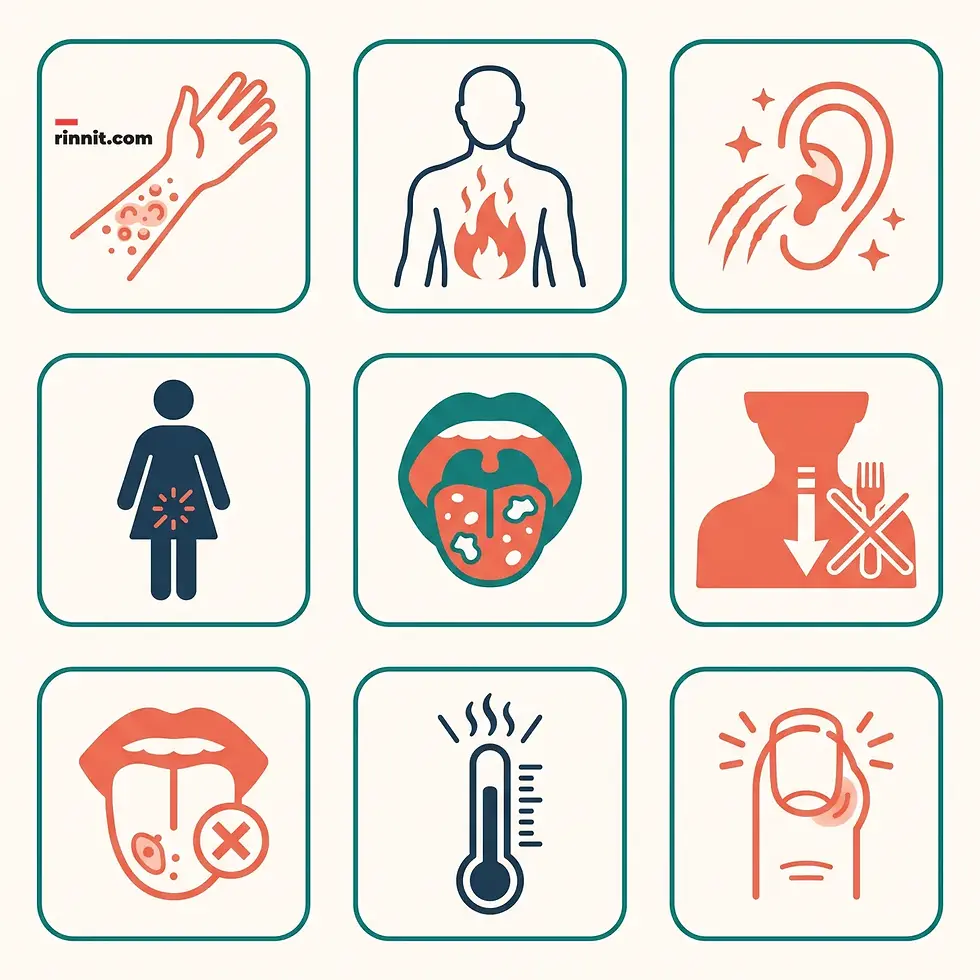
Symptoms of candidiasis may include abnormal vaginal discharge, a burning sensation, difficulty swallowing (dysphagia), itching (pruritus), loss of taste (ageusia), pain and soreness, a skin rash with small raised bumps, and white patches or sores in your mouth and throat. [4]
Symptom | What you may notice |
Abnormal vaginal discharge | Changes in the amount or appearance of discharge |
Burning sensation | A hot, uncomfortable feeling on the affected area |
Difficulty swallowing (dysphagia) | Food or liquid is hard to move down your throat |
Itching (pruritus) | Persistent irritation on skin, in the vulva, or around nails |
Loss of taste (ageusia) | Foods taste different or less strong |
Pain and soreness | Aching or tenderness where the infection sits |
Skin rash | Red rash with small, raised bumps |
White patches or sores | Raised white sores in your mouth and throat |
Many people who develop invasive candidiasis are already ill. So it can be difficult to determine which symptoms are from their original conditions and which are from the infection. But as the infection spreads throughout your body, you may experience fever and chills. [4]
What Causes Candidiasis?
An overgrowth of Candida yeast causes candidiasis infections. This occurs when there is an imbalance between healthy bacteria and Candida yeast on your body. Triggers that can disrupt this balance include being immunocompromised, eating foods high in refined carbohydrates, sugar, or yeast, experiencing hormonal changes like pregnancy or menopause, feeling stressed, having certain medical conditions including cancer, diabetes, and HIV/AIDS, and taking certain medications including antibiotics, oral contraceptives, and steroids. [4]
Trigger | How it disrupts the balance |
Weakened immune system | The body loses its ability to keep yeast growth in check |
High-sugar, refined-carb, or yeast-heavy diet | Feeds yeast growth on and inside the body |
Hormonal changes | Pregnancy and menopause shift the body's natural environment |
Stress | Disrupts the balance between healthy bacteria and yeast |
Medical conditions | Cancer, diabetes, and HIV/AIDS raise infection risk |
Certain medications | Antibiotics, oral contraceptives, and steroids upset the balance |
Risk Factors
Candidiasis can affect anyone because yeast naturally lives on your body, and it is easy to upset the balance of healthy bacteria and yeast. But there are certain groups of people who are more likely to develop an infection. Candidiasis most often affects catheter users, denture users, newborns and infants, people in hospitals, people with diabetes, and pregnant women. [4]
Higher-risk group | Why the risk is higher |
Catheter users | Medical devices can let the fungus enter from the outside |
Denture users | Dentures create an environment where oral yeast can thrive |
Newborns and infants | Immature immune systems and developing microbiomes |
People in hospitals | Illness, devices, and treatments disrupt natural balance |
People with diabetes | Elevated blood sugar feeds yeast overgrowth |
Pregnant women | Hormonal changes shift the body's natural environment |
Diagnosis: How Is Candidiasis Diagnosed?
Your healthcare provider will perform a physical examination of the affected area and ask you about your medical history. They will also ask you questions about your symptoms, including their severity and how long you have had them.
Your provider may be able to diagnose oral candidiasis by the appearance of your mouth or throat. For other types of candidiasis, they will likely request testing to confirm a diagnosis. [4] A culture test of the infection helps identify the specific type of yeast so your provider can build a specific treatment plan.
Diagnostic step | What happens |
Physical examination | Provider inspects the affected skin, mouth, or vagina |
Medical history review | Discussion of symptoms, severity, and duration |
Visual diagnosis (oral) | Thrush can often be diagnosed by the appearance of the mouth or throat |
Testing (other types) | Likely culture or lab testing to confirm the diagnosis |
Treatment: How Is Candidiasis Treated?
The number one treatment option for a candidiasis yeast infection is an antifungal medication. Depending on the type and severity of the infection, your healthcare provider may prescribe an antifungal that is topical (cream or ointment) or oral (pill, lozenge, or liquid). For severe infections, you may need to receive an antifungal intravenously (through a vein). [4]
Invasive candidiasis will require more intensive treatment. Your provider will likely start with an intravenous antifungal like an echinocandin. [4]

Can You Use Over-the-Counter Medications?
Yes, you can take an over-the-counter (OTC) antifungal medication. But the success of OTC medicine depends on knowing which type of yeast you are trying to treat. [4] This can be difficult to identify without visiting your healthcare provider. They can perform a culture test of the infection and give you a specific plan to treat your infection. If you are pregnant, talk to your provider before treating a vaginal yeast infection; creams or suppositories are usually used, and oral fluconazole is generally avoided.
How Long Does Candidiasis Last?
Most mild to moderate cases of candidiasis will clear up in two to three days after you complete treatment. [4] More severe cases may take a couple of weeks to clear up completely after treatment. [4]
Treatment route | When it is used |
Topical antifungal (cream or ointment) | Skin, vulvar, and surface infections |
Oral antifungal (pill, lozenge, or liquid) | Oral thrush and moderate infections |
Intravenous (IV) antifungal | Severe infections and invasive candidiasis, often starting with an echinocandin |
Over-the-counter (OTC) antifungal | An option, but success depends on correctly identifying the yeast type — a provider's culture test makes treatment more precise |
When Should You See Your Healthcare Provider?
You should contact your healthcare provider when you notice any symptoms of candidiasis, including itchiness, pain, rash, or swelling. Untreated candidiasis symptoms could become worse over time. So it is best to visit your provider at the first sign of infection to start treatment. [4]
Note worth remembering: Although candidiasis can cause uncomfortable symptoms like itching and soreness, it is not usually a serious infection. Treatment with an antifungal medication should clear up your symptoms quickly. Each antifungal has specific instructions, so make sure you ask your healthcare provider to explain how to apply or take the medication and how long you should take it. Even if your symptoms stop, continue taking the antifungal as advised by your provider — this completely clears the infection and prevents it from coming back. [4]
Outlook: What Happens After Treatment?
Treatment for candidiasis is extremely effective. Symptoms are bothersome but should start to fade after treatment begins. Infections usually clear up completely between two days and two weeks, depending on the type and severity. [4]
If left untreated, symptoms of candidiasis can cause irritation and discomfort and could increase in severity over time. Sometimes candidiasis returns after treatment, [4] so it is best to work with your healthcare provider on a treatment plan. They can target the specific type of yeast that caused the overgrowth on your body.
Can Candidiasis Be Prevented?
You may be able to prevent candidiasis by maintaining good physical and oral hygiene, managing your stress, reducing the amount of refined carbohydrates and sugar you eat, talking with your healthcare provider about medications you are taking, and treating current medical conditions. [4]
Prevention step | How it helps |
Good physical and oral hygiene | Keeps the body's natural balance intact |
Stress management | Removes a key trigger of yeast overgrowth |
Less refined sugar and carbs | Starves yeast of one of its favorite fuel sources |
Medication review | Provider can weigh antibiotic, contraceptive, or steroid effects |
Treating current conditions | Managing diabetes and other conditions lowers risk |
Conclusion
Candidiasis is one of the most common yeast infections, caused when Candida albicans — a yeast that already lives on your body — grows out of control. It favors the same places where the yeast naturally lives: the skin folds, the mouth, the nails, and the vagina. The good news is that candidiasis is usually not serious and responds very well to antifungal treatment, with most cases clearing within two days to two weeks. The key is acting early, finishing the full course of medication, and working with your provider to address the underlying triggers if the infection keeps returning.
Want to explain health topics like this one visually? Infographics make complex concepts easy for readers of every age. Rinnit's infographic templates help you build clear, professional visuals for your own audience.
Frequently Asked Questions
What is candidiasis?
Candidiasis is a fungal infection caused by an overgrowth of Candida albicans, a yeast that naturally lives on your body. It most often affects the mouth, skin, and vagina. [4]
What causes candidiasis?
An overgrowth of Candida yeast caused by an imbalance between healthy bacteria and yeast on your body. Triggers include stress, weakened immunity, hormonal changes, high-sugar diets, and certain medications. [4]
Is candidiasis the same as a yeast infection?
Yes. Candidiasis is the medical name for a yeast infection caused by Candida albicans. [4]
Where does candidiasis usually occur?
It usually appears where Candida naturally lives in small amounts: the skin, mouth, nails, and vagina. [4]
Is candidiasis serious?
Usually not. Candidiasis is not usually a major threat to your overall health, but left untreated, severe infections could spread to your blood, heart, and brain. [4]
What are the four common types of candidiasis?
Cutaneous (skin), nail (candidal paronychia), oral (thrush), and vaginal candidiasis. A fifth, more serious form is invasive candidiasis. [4]
What is cutaneous candidiasis?
A skin infection that causes red, raised patches in the folds of your skin, like your underarms, under your breasts, and near your buttocks (diaper rash). [4]
What is nail candidiasis?
Also called candidal paronychia, it is an infection of the nail folds or cuticles that causes redness, pain, and swelling. In severe cases, the nail plate may separate from the nail bed (onycholysis). [4]
What is oral candidiasis?
Also called thrush, it is an infection of the mouth, throat, tongue, or esophagus that causes raised white sores, mouth pain, irritation, and redness. [4]
What is vaginal candidiasis?
A vaginal yeast infection causing burning, itching, and redness in the vulva and changes in vaginal discharge. It is a type of vaginitis. [4]
What is invasive candidiasis?
A life-threatening infection that occurs when Candida enters your bloodstream and spreads to your internal organs. It most often affects people in hospitals and people with weakened immune systems. [4]
What does candidiasis feel like?
It commonly causes itching, burning, pain and soreness, and irritation at the affected site. [4]
What symptoms show up on the skin?
Red, raised patches in skin folds and a skin rash with small, raised bumps. [4]
Can candidiasis affect swallowing?
Yes. Oral candidiasis can cause difficulty swallowing (dysphagia). [4]
Can candidiasis affect taste?
Yes. Loss of taste (ageusia) is one possible symptom. [4]
Can candidiasis cause a fever?
Yes, when the infection becomes invasive and spreads through your body, you may experience fever and chills. [4]
How do you get candidiasis?
It develops when the balance between healthy bacteria and yeast that already live on your body is disrupted, allowing the yeast to overgrow. [4]
Who is most at risk for candidiasis?
Catheter users, denture users, newborns and infants, people in hospitals, people with diabetes, and pregnant women. [4]
Do antibiotics cause candidiasis?
Antibiotics are one trigger that can disrupt the balance of healthy bacteria and yeast, making an overgrowth possible. [4]
Can diabetes cause candidiasis?
Diabetes is a risk factor that makes a candidiasis infection more likely, which is why managing your condition helps prevent it. [4]
Does stress cause candidiasis?
Stress is one of the factors that can disrupt the bacteria-yeast balance and contribute to an infection. [4]
Can sugar make candidiasis worse?
Foods high in refined carbohydrates, sugar, or yeast are listed as triggers that can disrupt your body's balance and fuel overgrowth. [4]
How is candidiasis diagnosed?
Through a physical examination of the affected area, a review of your medical history, and — for most types — lab testing to confirm the diagnosis. [4]
Can thrush be diagnosed just by looking?
Often, yes. A provider may be able to diagnose oral candidiasis by the appearance of your mouth or throat. [4]
What is the best treatment for candidiasis?
An antifungal medication — topical (cream or ointment), oral (pill, lozenge, or liquid), or intravenous for severe cases. [4]
Can I buy candidiasis medication over the counter?
Yes, OTC antifungals exist, but their success depends on knowing which type of yeast you are treating — something a provider can confirm with a culture test. [4]
How long does candidiasis last with treatment?
Mild to moderate cases usually clear up two to three days after you complete treatment; more severe cases may take a couple of weeks. [4]
How long does candidiasis last without treatment?
Untreated, symptoms can cause irritation and discomfort and increase in severity over time, and severe infections can spread to the blood, heart, and brain. [4]
Can candidiasis come back after treatment?
Yes. Sometimes candidiasis returns after treatment, so working with your provider on a plan targeting the specific yeast type is important. [4]
Should I finish all my antifungal medication?
Yes. Even if your symptoms stop, continue the antifungal as advised — this completely clears the infection and helps prevent it from coming back. [4]
How can I prevent candidiasis?
Maintain good physical and oral hygiene, manage stress, reduce refined carbohydrates and sugar, discuss your medications with your provider, and treat current medical conditions. [4]
When should I contact a provider about candidiasis?
At the first sign of itchiness, pain, rash, or swelling, since untreated symptoms worsen over time. [4]
Is invasive candidiasis curable?
It requires intensive treatment, usually starting with an intravenous antifungal like an echinocandin, and is most often seen in hospitalized patients and people with weakened immune systems. [4]
Is candidiasis contagious?
Candidiasis is an overgrowth of yeast that already lives on your body, triggered when the balance of healthy bacteria and yeast is disrupted. [4] If you have questions about your own situation, ask your healthcare provider.
Related Reading
Oral Thrush: Symptoms, Causes, Diagnosis, Treatment and Prevention
Esophageal Candidiasis: What a Fungal Infection in Your Esophagus Means and What Comes Next
Yeast Diaper Rash (Candida): Symptoms, Treatment, and Prevention Guide
What Is a Belly Button Yeast Infection? Symptoms, Causes, and Treatment
Anal Yeast Infection: Why It Itches So Intensely, Who Is Most at Risk, and How Treatment Works
Nail Fungus: What Causes It, and What Treatment Can — and Can't — Do
Candida Parapsilosis: The Harmless Fungus That Can Cause Serious Infection
Diabetes: Symptoms, Types, Causes, Diagnosis & Treatment — Complete Guide
Bacterial Vaginosis (BV) Test: How It's Done, Types and What Results Mean explains how BV is tested and what results mean.
References
Denning DW, Kneale M, Sobel JD, et al. Global burden of recurrent vulvovaginal candidiasis: a systematic review. Lancet Infect Dis. 2018;18(11):e339-e347. PMID: 30078662. https://doi.org/10.1016/S1473-3099(18)30103-8
Ray A, Aayilliath KA, Banerjee S, et al. Burden of serious fungal infections in India. Open Forum Infect Dis. 2022;9(12):ofac603. PMID: 36589484. https://doi.org/10.1093/ofid/ofac603
Osa S, Tashiro S, Igarashi Y, et al. Azoles versus conventional amphotericin B for the treatment of candidemia: a meta-analysis of randomized controlled trials. J Infect Chemother. 2020;26(11):1232-1236. PMID: 32828679. https://doi.org/10.1016/j.jiac.2020.07.019
Cleveland Clinic. Candidiasis. Cleveland Clinic. Last updated May 13, 2025. https://my.clevelandclinic.org/health/diseases/23198-candidiasis
Medical disclaimer
This article is for general informational purposes only and is not a substitute for professional medical advice, diagnosis, or treatment. Always seek the advice of a qualified healthcare provider with any questions about a medical condition.



Comments