What Is an Armpit Yeast Infection? A Plain-Language Guide to the Itchy Red Rash That Takes Over Your Underarms

Updated: 2 days ago
Medically reviewed by Dr. Baraa Alnahhal, MD · Last reviewed: October 17, 2026
Quick Answer
An armpit yeast infection is a fungal skin infection caused by overgrowth of Candida, a yeast that lives on the skin and thrives in warm, moist folds. [1] [2] It causes a bright red, intensely itchy rash that may burn. [1] [2] Risk is higher with obesity, pregnancy or weakened immunity. [1] [2] Antifungal creams and keeping the area dry usually clear it within two weeks. [1]
What the research says
Topical antifungals work better than placebo for yeast and fungal skin infections. A systematic review and meta-analysis screened 4,424 studies and pooled 49 randomized trials of topical antifungals in cutaneous candidiasis and several tinea infections. Antifungals beat placebo in every infection type, with odds ratios ranging from 2.05 (95% CI 1.18–3.54) to 67.53 (95% CI 11.43–398.86) (Rotta et al., Rev Assoc Med Bras, 2012) [4].
Diabetes makes skin yeast infections more likely. A review of 178 articles published between 2010 and 2025 reported that up to 70% of people with diabetes have skin lesions, and that diabetes raises the risk of superficial fungal infections, including candidiasis (Elizondo-Elizondo et al., Future Microbiol, 2025) [5].
Drying powder may speed up healing in skin folds. In an open-label randomized trial of 67 people with fungal skin infections in skin-fold areas (32 with Candida), adding 1% clotrimazole powder to 1% clotrimazole cream gave significantly higher complete-cure rates within four weeks than cream alone (p = 0.01) (Desomchoke et al., J Med Assoc Thai, 2016) [6].
What Is an Armpit Yeast Infection?
While you may think of a yeast infection as something that happens down below, it can actually occur all over your body — including your armpits. An armpit yeast infection, also called candidiasis, is a fungal infection caused by a yeast called Candida. [1] Yeast is a type of fungus. [1]
Your skin naturally carries many types of yeast, including Candida. [1] [2] In healthy people, this normally doesn't cause any problems. But when there's an overgrowth of Candida, it can dig beneath the surface of your skin. This can cause a rash or skin infection. [1]
Candidiasis can occur almost anywhere on the surface of your body. But it's most commonly found in the moist, creased areas of your skin — including under your arms. [1] [3]
What Does an Armpit Yeast Infection Look Like?
The most common symptom of an armpit yeast infection is a bright red rash in the skin folds of your armpit. [1] [2] The rash may appear in patches of different shapes and sizes. [1]
The rash is usually intensely itchy, and you may feel a burning sensation. [1] [2] The area surrounding the rash may have small, pimple-like spots. [1] [2] You may also notice scaling and swelling. [1]
Here is a quick summary of what to look for:
Interestingly, armpit yeast infections don't normally cause a smell or odor. [1] But if your yeast infection is due to a skin condition called intertrigo — a common inflammatory skin condition caused by your skin folds rubbing together, along with heat and moisture — you may notice a musty smell. [1]

What Causes an Armpit Yeast Infection?
A yeast called Candida causes armpit yeast infections, or candidiasis. Candida grows and thrives in moist, warm environments. [1] [3] Conditions that allow Candida to grow include hot, humid weather; tight clothing; poor hygiene; infrequent undergarment changes; and skin conditions such as psoriasis and intertrigo. [1]
Who Gets Armpit Yeast Infections Most Often?
Yeast infections are more common in certain groups of people. Here's who's most at risk:
Risk group | Why the risk is higher |
Higher rates are seen in pregnancy | |
More skin folds and moisture where Candida thrives | |
Antibiotics kill bacteria that normally live on your body — this allows Candida to grow out of control [1] | |
Treatment can weaken the body's defenses | |
People with weakened immune systems |
There's an important detail about diabetes: high blood sugar levels can act as food for yeast and help it grow. [1] This is one reason your healthcare provider may recommend testing for diabetes when an armpit yeast infection shows up. [1] [3]
Are Armpit Yeast Infections Contagious?
Armpit yeast infections aren't usually contagious. [1] [3] But people with weakened immune systems do have a greater risk of catching an infection. [1] [3]
Can Babies Get Armpit Yeast Infections?
Yes, babies can get candidiasis. [1] Candidiasis develops when the yeast Candida grows in warm, moist environments — and that includes the chubby rolls of your baby's underarms. In addition, your baby's immune system is still new and developing. Your baby may not have enough good bacteria to prevent yeast from growing out of control.
If your baby develops an armpit yeast infection, call their healthcare provider. They can help diagnose the condition. Depending on your baby's symptoms, they may recommend an antifungal cream or ointment to apply to the infected area.

How Is an Armpit Yeast Infection Diagnosed?
Your healthcare provider will perform a physical examination. They may be able to diagnose a yeast infection simply by looking at the skin under your armpit. [1] [3] If you have a bright red rash, a yeast infection is a common diagnosis.
Your provider may also want to collect a sample of the infected area for testing. Here's how that works:
Step | What happens |
Physical exam | Provider looks at the skin under your armpit; a bright red rash commonly indicates a yeast infection |
Skin scraping | |
Microscope check | |
Culture | |
Diabetes testing |
How Is an Armpit Yeast Infection Treated?
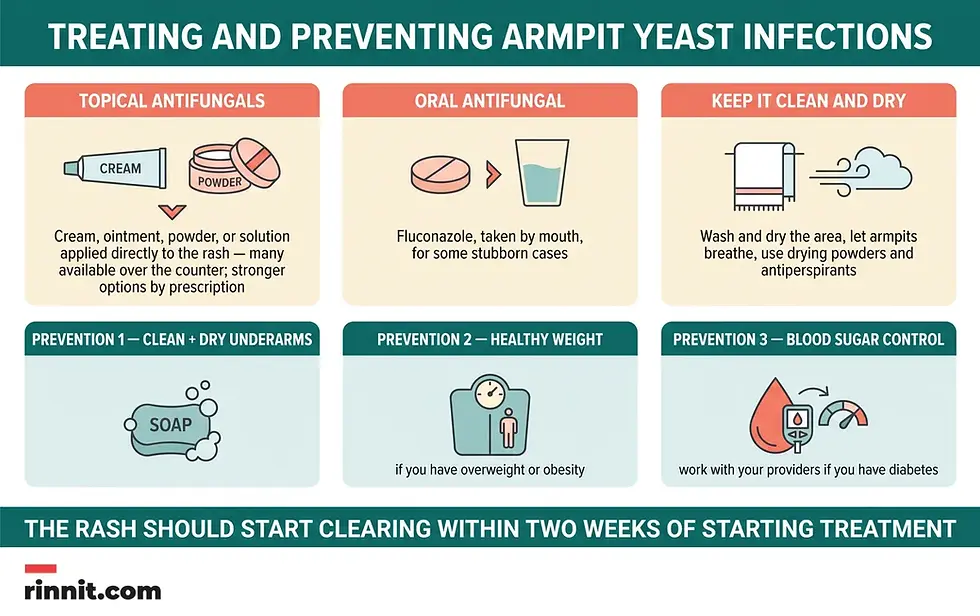
Treatment for your armpit yeast infection may include an antifungal — a medication that fights fungus. Your healthcare provider may recommend an antifungal cream, ointment, powder, or other solution. [1] [2] You apply the antifungal directly onto the infected area of your skin. [1]
Many antifungal creams and other medications are available over the counter. [1] Your healthcare provider may prescribe a stronger antifungal option if necessary. [1]
It's important to keep your underarm area clean and dry as part of your yeast infection treatment — this can also help prevent a yeast infection from returning. [1] [2] Exposing your armpits to air may help. [1] [3] Drying powders and topical antiperspirants may help dry out your skin and prevent future infections. [1] [2]
In some cases, your provider may recommend an antifungal medication taken by mouth. This includes medications such as fluconazole (an oral antifungal drug). [1] [2]
Treatment approach | How it works | Notes |
Antifungal cream, ointment, powder, or solution | Many options available over the counter [1] | |
Stronger prescription antifungal | Prescribed when over-the-counter options aren't enough | Recommended by your provider if necessary |
Taken by mouth for more stubborn cases | Used in some cases at your provider's recommendation | |
Keep the area clean and dry | Core part of treatment and recovery | |
Air exposure | May help the skin heal | |
Drying powders and topical antiperspirants | Help dry out your skin |
How Long Does It Last?
After you start antifungal treatment for your armpit yeast infection, the rash should start to clear within two weeks. [1]
What Can I Expect in the Long Run?
Armpit yeast infections may go away on their own by simply keeping the area clean and dry. [1] Healthy people can easily treat underarm yeast infections with an antifungal medication.
The main complication is that armpit yeast infections commonly return, especially if the area isn't kept healthy and dry. [1] [3] In people with weakened immune systems, yeast infections are more likely to return and spread.
How Can I Prevent an Armpit Yeast Infection?
You can prevent armpit yeast infections by keeping your underarm area clean and dry. [1] You can also use drying powders and topical antiperspirants to prevent yeast infections. [1]
If you have overweight/obesity, achieving a weight that's healthy for you may help prevent yeast infections in your armpits. [1] [3] If you have diabetes, work with your providers to maintain proper blood sugar control. [1]
How Should You Prepare for Your Appointment?
If your underarm rash isn't improving within two weeks of home treatment, or it keeps coming back, see your healthcare provider. Before your visit, make a list of everything that could help your provider make sense of the rash: whether you're pregnant, your current medications (especially antibiotics), any skin conditions like psoriasis, your blood sugar or diabetes status, and how you've been caring for your underarms (clothing, hygiene routine, products used).
It may also be helpful to ask: Could this be something other than a yeast infection? Should I be tested for diabetes? Would a prescription antifungal work better for me? What can I do to stop it from coming back?
The Bottom Line
An armpit yeast infection — candidiasis — is a common, highly treatable fungal rash caused by an overgrowth of Candida, the yeast that naturally lives on your skin. It flourishes in the warm, moist skin folds of your underarms, showing up as a bright red, intensely itchy rash with pimple-like spots, scaling, and swelling. Hot humid weather, tight clothing, antibiotics, pregnancy, obesity, chemotherapy, and weakened immune systems all raise the risk. It's rarely contagious, babies can get it too, and the fix is straightforward: an antifungal cream, ointment, or powder (many over the counter) applied to the skin, combined with keeping the area clean and dry. The rash should start clearing within two weeks. The catch? It commonly comes back if the area isn't kept healthy and dry — so prevention is just as important as treatment: dry powders, antiperspirants, air exposure, a healthy weight, and good blood sugar control if you have diabetes. If the rash doesn't improve, keeps returning, or you have a weakened immune system, see your provider — a simple skin scrape can confirm the diagnosis, and a prescription or oral treatment like fluconazole can clear stubborn cases.
Take the Next Step
If you have a bright red, intensely itchy rash under your arms, start by keeping the area clean and dry and consider an over-the-counter antifungal cream. If the rash hasn't started to clear within two weeks, is spreading, or keeps coming back — or if you're pregnant, have diabetes, or have a weakened immune system — call your healthcare provider. They can confirm the diagnosis with a quick skin scrape, prescribe a stronger antifungal or oral medication like fluconazole if needed, and help you stop it from returning.
Frequently Asked Questions
What is an armpit yeast infection?
It's a fungal skin infection, also called candidiasis, caused by a yeast called Candida — a type of fungus that naturally lives on your skin. When Candida overgrows in warm, moist environments, it digs beneath the surface of your skin and causes a rash.
Where else can candidiasis occur?
Almost anywhere on the surface of your body, but it's most commonly found in the moist, creased areas of your skin, including under your arms.
What are the main symptoms?
A bright red rash in the skin folds of your armpit (in patches of different shapes and sizes), intense itchiness, a possible burning sensation, small pimple-like spots around the rash, scaling, and swelling. It doesn't normally cause an odor unless it's due to intertrigo, which can produce a musty smell.
What is intertrigo?
A common inflammatory skin condition caused by your skin folds rubbing together, along with heat and moisture. If your yeast infection is due to intertrigo, you may notice a musty smell.
What makes Candida grow out of control?
Conditions that allow Candida to grow include hot, humid weather; tight clothing; poor hygiene; infrequent undergarment changes; and skin conditions such as psoriasis and intertrigo.
Who is most at risk?
People who are pregnant, have overweight or obesity, take antibiotics (which kill the bacteria that normally live on your body, allowing Candida to grow out of control), receive chemotherapy, or have weakened immune systems due to conditions like HIV/AIDS or diabetes, or from immune-suppressing medications.
Why does diabetes raise the risk?
High blood sugar levels can act as food for yeast and help it grow. Your provider may even recommend testing for diabetes when diagnosing an armpit yeast infection.
Are armpit yeast infections contagious?
No — they aren't usually contagious. But people with weakened immune systems do have a greater risk of catching an infection.
Can babies get armpit yeast infections?
Yes. Candida grows in warm, moist environments — including the chubby rolls of a baby's underarms. A baby's immune system is still new and developing, and they may not have enough good bacteria to keep yeast in check. Call your baby's healthcare provider for diagnosis and an appropriate antifungal cream or ointment.
How is it diagnosed?
Usually by a physical examination — a bright red rash under the arm commonly indicates a yeast infection. Your provider may also scrape some skin from the infected area with a scalpel or tongue depressor so a pathologist can examine the sample under a microscope, or place it in a culture (a substance that allows microorganisms to grow and be identified).
How is it treated?
With an antifungal cream, ointment, powder, or other solution applied directly to the infected skin — many are available over the counter. Your provider may prescribe a stronger antifungal, or in some cases an oral medication such as fluconazole.
How long until it clears up?
After you start antifungal treatment, the rash should start to clear within two weeks. It may even go away on its own by simply keeping the area clean and dry.
Can it come back?
Yes — armpit yeast infections commonly return, especially if the area isn't kept healthy and dry. In people with weakened immune systems, yeast infections are more likely to return and spread.
How do I prevent it?
Keep your underarm area clean and dry, use drying powders and topical antiperspirants, achieve a healthy weight if you have overweight/obesity, and work with your providers to maintain proper blood sugar control if you have diabetes.
When should I see a healthcare provider?
If you have symptoms of an armpit yeast infection, call your healthcare provider. They'll properly diagnose your condition and give you treatment options so you're feeling better soon — especially if the rash persists beyond two weeks, spreads, or keeps returning.
Medical Disclaimer
This guide is for general information only and is not a substitute for professional medical advice, diagnosis, or treatment. If you have a persistent or recurring rash under your arms, see a healthcare provider for an accurate diagnosis. Always seek the advice of a physician or other qualified health provider with any questions about a medical condition. Never disregard professional medical advice or delay seeking it because of something you have read here.
Related Reading
Intertrigo: Causes, Symptoms, and Effective Treatment Strategies explains the skin-fold rash that often sets the stage for yeast.
What Is Candidiasis? The Yeast Infection Guide Explained explains the Candida yeast infections that affect skin and other areas.
Erythrasma: Symptoms, Types, Causes, Diagnosis, Treatment and Prevention — What You Need to Know covers a bacterial skin-fold rash often mistaken for yeast.
Hidradenitis Suppurativa: Symptoms, Causes, and Treatment Options explains a chronic condition causing painful lumps in the armpits.
References
Cleveland Clinic. Armpit Yeast Infection. Cleveland Clinic. Last updated April 29, 2022. https://my.clevelandclinic.org/health/diseases/22908-armpit-yeast-infection
Aaron DM. Candidiasis (Yeast Infection). Merck Manual Consumer Version. Last updated October 2025. https://www.merckmanuals.com/home/skin-disorders/fungal-skin-infections/candidiasis-yeast-infection
Vorvick LJ. Candida infection of the skin. MedlinePlus. Reviewed October 9, 2024. https://medlineplus.gov/ency/article/000880.htm
Rotta I, et al. Efficacy of topical antifungal drugs in different dermatomycoses: a systematic review with meta-analysis. Rev Assoc Med Bras (1992). 2012;58(3):308-18. PMID 22735222. https://pubmed.ncbi.nlm.nih.gov/22735222/
Elizondo-Elizondo M, et al. Superficial fungal infections in patients with diabetes. Is hyperglycemia the only associated factor? Future Microbiol. 2025;21(1):59-72. PMID 41472504. https://doi.org/10.1080/17460913.2025.2607353
Desomchoke R, et al. Efficacy and Safety in 1% Clotrimazole Powder, Adjuvant Therapy in Patients with Superficial Fungal Cutaneous Infection in Intertriginous Areas. J Med Assoc Thai. 2016;99(12):1355-9. PMID 29953171. https://pubmed.ncbi.nlm.nih.gov/29953171/



Comments