What Is a Belly Button Yeast Infection? Symptoms, Causes, and Treatment

Updated: 3 days ago
Medically reviewed by Dr. Baraa Alnahhal, MD · Last reviewed: October 2026
Quick Answer: What is a belly button yeast infection and is it treatable?
A belly button yeast infection, or candidiasis, is a fungal skin infection of the navel caused by Candida yeast overgrowing in a warm, moist environment. It causes a bright red, itchy, sometimes burning rash that may scale or leak white discharge. It is highly treatable with antifungal creams or powders and usually improves within two weeks. [1]
Key takeaways
A belly button yeast infection is candidiasis of the navel, caused by Candida yeast growing in warm, damp skin folds. [1]
The signature sign is a bright red, extremely itchy rash in the skin folds of the navel, sometimes with scaling, swelling, or white discharge. [1]
Risk factors include tight clothing, hot and humid weather, poor hygiene, antibiotics, pregnancy, obesity, chemotherapy, and weakened immunity. [1]
It is usually not contagious, and a provider can often diagnose it just by looking at the rash. [1]
Treatment is an antifungal cream, ointment, or powder applied directly to the navel, combined with keeping the area clean and dry; oral antifungals are used in certain cases. [1]
The infection should start to clear within two weeks, but it frequently returns if the area is not kept healthy and dry. [1]
What the research says
Common antifungal creams cure most skin candidiasis, and one drug works as well as combinations. A review of 44 clinical trials (41 on 19 topical therapies and 4 on 3 oral therapies) found that clotrimazole, nystatin, and miconazole, the most studied topical drugs, had similar efficacy, with complete cure rates of 73% to 100%. Single-drug therapy was as effective as combinations of antifungal, antibacterial, and topical corticosteroid, and oral fluconazole was as effective as topical clotrimazole. (Taudorf et al., J Eur Acad Dermatol Venereol, 2019) [2]
Treatment is usually short, and recurring infections call for a search for the cause. Japanese clinical guidelines state that topical antifungal therapy dominates the treatment of cutaneous candidiasis, with azole creams the most effective, and that it usually needs a shorter course (1 to 2 weeks) than superficial dermatophyte infections. Because Candida lives normally on skin, a positive culture does not always mean infection, and predisposing factors should be checked in patients with recurrent infection. (Katoh, Nihon Ishinkin Gakkai Zasshi, 2009) [3]
Skin-fold (intertrigo) infection is the most frequent form of cutaneous candidiasis. An epidemiological survey in Japan found candidiasis accounted for 8.4% of cutaneous fungal infections (dermatophytosis 89.1%, Malassezia infections 2.4%). Among cutaneous candidiasis, intertrigo was the most frequent clinical form, and topical application was the first-line therapy for most dermatomycoses. (Watanabe, Nihon Rinsho, 2008) [4]
What Is a Belly Button Yeast Infection?

Yeast infections are not limited to one area of the body. They can show up almost anywhere, including the belly button. A belly button yeast infection is a yeast infection within the skin of the navel, and a yeast infection of the skin is called candidiasis, a fungal infection caused by a yeast called Candida. [1]
Your skin naturally carries many types of fungi and yeast, Candida included. In healthy people, this normally does not cause harm. But when Candida collects in damp, dark areas, it can dig under the surface of your skin and cause a skin infection. Candidiasis can happen almost anywhere on your body, but it most frequently appears in the warm, moist crevices of the skin, like the belly button. [1]
What Does a Belly Button Yeast Infection Look Like?

The most common symptom is a bright red rash in the skin folds of your navel. The rash is typically extremely itchy, and it may burn. [5] You may also see scaling, swelling, or a white discharge. [1]
Symptom | What you might notice |
Red rash | A bright red rash in the skin folds of the navel [1] |
Itching | The rash is typically extremely itchy [1] |
Burning | The rash may burn [1] |
Scaling | Flaky skin around the navel [1] |
Swelling | Puffiness around the navel [1] |
White discharge | Fluid or discharge from the infected area [1] |
Musty smell | Uncommon, but possible when the infection is linked to intertrigo [1] |
Belly button yeast infections do not usually cause a smell or odor. You may notice a musty smell if your yeast infection is due to a skin condition called intertrigo, a very common condition that occurs when heat, moisture, and skin rubbing together combine. [1]
What Causes a Belly Button Yeast Infection?
Candida yeast grows and thrives in warm, damp environments. [1] Several everyday conditions create exactly the kind of environment Candida favors.
Condition or risk factor | How it helps Candida grow |
Wearing tight clothing | Traps heat and moisture against the navel |
Not changing clothing often | Leaves damp, yeast-friendly conditions in place |
Humid and hot weather | Creates a warm, moist environment on the skin |
Poor hygiene | Allows moisture and yeast to collect in the navel crevice |
Skin conditions (intertrigo, psoriasis) | Disrupt the skin and create vulnerable, moist crevices |
Certain groups of people are also more likely to develop this infection. [1]
Higher-risk group | Why the risk is higher |
Pregnant people | Body changes increase susceptibility |
People with overweight or obesity | Deeper skin folds hold warmth and moisture |
People taking antibiotics | Antibiotics kill the bacteria that normally live on your skin, allowing Candida to grow and thrive [1] |
People receiving cancer treatment like chemotherapy | Treatment weakens the immune system |
People with weakened immune systems | Conditions such as HIV/AIDS or diabetes greatly increase the chance of developing a yeast infection [1] |
Are belly button yeast infections contagious?
They are not usually contagious. People with weakened immune systems should be more cautious around people with yeast infections, since they have a greater risk of catching an infection. [1]
How Is It Diagnosed?
A healthcare provider may perform a physical examination and often can tell you have a yeast infection simply by looking at the skin of the navel area, since a bright red rash is a common sign. [1]
If you do have a yeast infection, your provider may recommend testing for diabetes. High blood sugar levels in people with diabetes act as food for yeast and help it grow. [1]
How Is a Belly Button Yeast Infection Treated?
Treatment centers on an antifungal medication applied directly to the skin. Many antifungal creams are available over the counter, and your provider may offer a prescription antifungal medicine if necessary. [1]
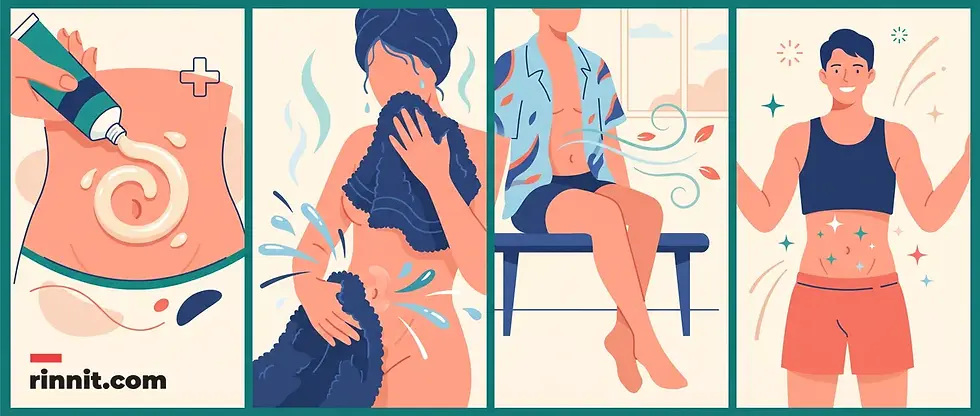
Treatment option | Details |
Antifungal cream | Applied directly onto the skin of the belly button; many are available over the counter [1] |
Antifungal ointment | A prescription alternative applied directly to the navel |
Antifungal powder | A third topical form applied to the navel area [1] |
Keep the area clean and dry | Part of treatment and helps prevent the infection from returning [1] |
Expose the navel to air | Letting air reach the area may help [1] |
Oral antifungal medication | Used in certain cases; medications such as fluconazole are taken by mouth [1] |
What Can I Expect?
Belly button yeast infections often get better on their own when you keep your navel area clean and dry. Healthy people can usually treat the infection with an antifungal medication. [1]
How long does it last? The infection should start to clear up within two weeks of starting an antifungal treatment. [1]
Can it come back? Belly button yeast infections frequently return, especially if your navel area is not kept healthy and dry. Yeast infections are more likely to return in people with weakened immune systems. [1]
Can It Be Prevented?
You may be able to prevent belly button yeast infections by keeping your navel area clean and dry. Losing weight may help prevent the overgrowth of yeast in your navel region. If you have diabetes, be sure to maintain proper blood sugar control. [1]
Prevention step | Why it works |
Keep the navel clean | Removes the moisture and residue yeast feed on |
Keep the navel dry | Yeast cannot thrive without dampness |
Lose weight if applicable | Reduces skin folds where yeast overgrows |
Control blood sugar if diabetic | High blood sugar feeds yeast growth [1] |
Conclusion
A belly button yeast infection can be itchy and unpleasant, but it is easily treatable. The key is recognizing the bright red, itchy rash early, applying an antifungal treatment, and keeping the navel clean and dry so the yeast has nowhere to grow. If you have symptoms of a belly button yeast infection, call your healthcare provider. They will be able to correctly diagnose your condition and recommend an antifungal treatment so you will be feeling better soon.
If you found these visual guides helpful, explore Rinnit's infographic templates to turn more health topics into clear, shareable visuals for your own content.
Frequently Asked Questions
What is a belly button yeast infection?
A belly button yeast infection is a yeast infection within the skin of your belly button (navel). A yeast infection of the skin is called candidiasis, a fungal infection caused by a yeast called Candida. [1]
Is a belly button yeast infection serious?
Usually not. It is easily treatable, and healthy people can generally clear it with an antifungal medication. [1] It becomes a bigger concern for people with weakened immune systems, such as those with HIV/AIDS or diabetes.
What does a belly button yeast infection look like?
The most common symptom is a bright red rash in the skin folds of your navel. The rash is typically extremely itchy, may burn, and may show scaling, swelling, or a white discharge. [1]
Why does yeast grow in the belly button?
Candida grows and thrives in warm, damp environments. Your skin naturally carries Candida without problems, but when it collects in damp, dark areas like the navel crevice, it can dig under the skin surface and cause an infection. [1]
Can you smell a belly button yeast infection?
Belly button yeast infections do not usually cause a smell or odor. You may notice a musty smell if the yeast infection is due to intertrigo, a skin condition caused by heat, moisture, and skin rubbing together. [1]
Is a belly button yeast infection contagious?
A belly button yeast infection is not usually contagious. People with weakened immune systems should be more cautious around people with yeast infections because they have a greater risk of catching one. [1]
What causes a belly button yeast infection?
Conditions that allow Candida to grow include wearing tight clothing, not changing clothing often, hot and humid weather, poor hygiene, and skin conditions such as intertrigo and psoriasis. Pregnancy, obesity, antibiotic use, and chemotherapy also raise the risk. [1]
Can antibiotics cause a belly button yeast infection?
Yes. Antibiotics can kill the bacteria that normally live on your skin, which allows Candida to grow and thrive. [1]
How is a belly button yeast infection diagnosed?
A provider often diagnoses it by looking at the skin of the navel area, since a bright red rash is a common sign. They may also scrape a small skin sample and examine it under a microscope or place it in a culture to identify the fungus. [1]
Do I need a diabetes test if I have a belly button yeast infection?
Your provider may recommend testing for diabetes, because high blood sugar levels act as food for yeast and help it grow. [1]
How is a belly button yeast infection treated?
Treatment usually involves an antifungal cream, ointment, or powder applied directly onto the skin of your belly button. Many antifungal creams are available over the counter, and a provider may prescribe a stronger option or an oral medication such as fluconazole in certain cases. [1]
How long does a belly button yeast infection last?
A belly button yeast infection should start to clear up within two weeks of starting an antifungal treatment. Keeping the navel area clean and dry is part of treatment and helps it heal. [1]
Can a belly button yeast infection come back?
Yes. Belly button yeast infections frequently return, especially if the navel area is not kept healthy and dry. They are more likely to return in people with weakened immune systems. [1]
How can I prevent a belly button yeast infection?
Keep your navel area clean and dry, change clothing regularly, lose weight if it helps reduce skin folds, and maintain proper blood sugar control if you have diabetes.
Related Reading
References
Cleveland Clinic. Belly Button Yeast Infection. Cleveland Clinic Health Library. Last updated April 29, 2022. Accessed October 15, 2026. https://my.clevelandclinic.org/health/diseases/22909-belly-button-yeast-infection
Taudorf EH, Jemec GBE, Hay RJ, et al. Cutaneous candidiasis: an evidence-based review of topical and systemic treatments to inform clinical practice. J Eur Acad Dermatol Venereol. 2019;33(10):1863-1873. PMID: 31287594. https://doi.org/10.1111/jdv.15782
Katoh T. Guidelines for diagnosis and treatment of mucocutaneous candidiasis [in Japanese]. Nihon Ishinkin Gakkai Zasshi. 2009;50(4):207-212. PMID: 19942790. https://doi.org/10.3314/jjmm.50.207
Watanabe S. Dermatomycosis: classification, etiology, pathogenesis, and treatment [in Japanese]. Nihon Rinsho. 2008;66(12):2285-2289. PMID: 19069093. https://pubmed.ncbi.nlm.nih.gov/19069093/
Aaron DM. Candidiasis (Yeast Infection). Merck Manual Consumer Version. Last updated October 2025. Accessed October 15, 2026. https://www.merckmanuals.com/home/skin-disorders/fungal-skin-infections/candidiasis-yeast-infection
Vorvick LJ; reviewed by Dugdale DC, Conaway B. Candida infection of the skin. MedlinePlus Medical Encyclopedia. Review date October 9, 2024. Accessed October 15, 2026. https://medlineplus.gov/ency/article/000880.htm
National Organization for Rare Disorders. Candidiasis. NORD Rare Disease Database. Last updated May 18, 2009. Accessed October 15, 2026. https://rarediseases.org/rare-diseases/candidiasis/
Medical disclaimer
The information provided in this article is for educational purposes only and is not intended as medical advice. Always seek the advice of your physician or other qualified health provider with any questions you may have regarding a medical condition. If you have symptoms of a belly button yeast infection, if the rash keeps returning, or if you have diabetes or a weakened immune system, contact your healthcare provider.



Comments