Oral Thrush: Symptoms, Causes, Diagnosis, Treatment and Prevention

Updated: 2 days ago
Medically reviewed by Dr. Baraa Alnahhal, MD · Last reviewed: October 2026
Creamy white patches inside your mouth are often oral thrush, a fungal infection caused by too much Candida yeast. It is usually minor in healthy people but can be a sign of something else going on, and it can be more serious in babies, older adults, and anyone with weakened immunity. This guide explains the symptoms, causes, diagnosis, treatment, and prevention.
Quick Answer: What is oral thrush?
Oral thrush (oral candidiasis) is a fungal infection caused by overgrowth of Candida albicans yeast in the mouth, producing creamy white, sore patches on the tongue and inner cheeks. It most often affects babies, older adults and people with weakened immunity, diabetes or certain medicines. Treatment is an antifungal medicine plus addressing the underlying cause. Painful swallowing needs medical care.
What the research says
Steroid inhalers raise the risk of oral thrush. A pairwise and network meta-analysis of 129 trials (120,900 adults with asthma or COPD) found that inhaled corticosteroids were associated with a higher risk of oral candidiasis than control treatment (relative risk 2.29, 95% CI 2.01-2.60) (Pu et al., BMJ Evid Based Med, 2026) [3].
Weakened immunity after an organ transplant increases the risk. A systematic review and meta-analysis found that immunosuppressed people who had received solid organ transplants had higher odds of oral candidiasis than controls (pooled odds ratio 3.52; 95% CI 1.92-6.46), with moderate certainty of evidence (Shah et al., Spec Care Dentist, 2026) [4].
Probiotics may be an add-on, not a replacement, for antifungal treatment. An umbrella review of 7 systematic reviews (5 with meta-analyses) found that probiotics reduced Candida counts in the mouth (odds ratios from 0.06 to 0.71 across the individual meta-analyses), but the certainty of the evidence was low to very low, and the authors say standalone use is not recommended yet (Mehta et al., Syst Rev, 2026) [5].
Study details retrieved from PubMed.
What Is Oral Thrush?
Oral thrush, also called oral candidiasis, is a condition in which the fungus Candida albicans builds up in the mouth. Candida is a yeast, and it is natural for it to live in the mouth. Symptoms appear only when it grows too much. [1]
The infection produces slightly raised, creamy white, sore patches or spots, most often on the tongue or inner cheeks. Sometimes it spreads to the roof of the mouth, gums, tonsils, or the back of the throat. [1]
Oral thrush can affect anyone, but it is more likely in babies and older adults because they have lower immunity. It is also more likely in people with weakened immune systems, certain health conditions, or certain medicines. It is a minor problem if you are healthy, but if your immune system is weakened, symptoms may be more serious and harder to control. [1]
Quick fact | Detail |
Also known as | Oral candidiasis |
Cause | Overgrowth of Candida albicans yeast in the mouth |
Typical appearance | Slightly raised, creamy white patches that can look like cottage cheese |
Common locations | Tongue, inner cheeks, roof of the mouth, gums, tonsils, back of the throat |
Who is most at risk | Babies, older adults, people with weakened immunity, people with diabetes |
Outlook if you are healthy | A minor problem that is usually easily treated |

What are the symptoms of oral thrush?
Oral thrush symptoms range from mild irritation to trouble eating and swallowing, and severe cases can spread into the esophagus.
Children and Adults
Symptoms range from mild irritation to trouble eating and swallowing. [1]
Symptom | What it looks or feels like |
White patches or spots | On the tongue and inner cheeks, and sometimes on the roof of the mouth, gums, and tonsils |
Patch appearance | Slightly raised, like cottage cheese |
Burning and soreness | Can be bad enough to make eating or swallowing hard |
Bleeding | Slight bleeding if the patches are rubbed or scraped |
Cracked mouth corners | Cracking and redness at the corners of your mouth |
Cottony feeling | A cottony feeling in your mouth |
Taste changes | Loss of taste |
Denture irritation | Redness, irritation, and pain under dentures |
In severe cases, usually related to cancer or a weakened immune system from HIV/AIDS, the patches may spread down into the esophagus, the long, muscular tube from the back of your mouth to your stomach. This is called Candida esophagitis. You may have trouble swallowing, feel pain, or feel as if food is getting stuck in your throat. [1]
Babies and Breastfeeding Mothers
Along with the white mouth spots, babies may have trouble feeding or be fussy and irritable. Babies can pass the infection to their mothers during breastfeeding, and it may pass back and forth between the mother's nipples and the baby's mouth. [1]
Women whose breasts are infected with Candida may have: [1]
Unusually red, sensitive, cracked, or itchy nipples
Shiny or flaky skin on the darker, circular area around the nipple (the areola)
Unusual pain during nursing, or painful nipples between feedings
Stabbing pains deep within the breast
Some breastfeeding organizations note that nipple and breast thrush is much less common than once thought. La Leche League GB says other causes of nipple pain, such as a shallow latch, should be investigated first, so see a healthcare professional to work out the cause. [6]
When should you see a doctor about oral thrush?
If you or your child gets white patches or spots inside the mouth, see your medical or dental professional. Thrush is uncommon in healthy older children, teenagers, and adults, so a healthcare professional can find out whether you need to be checked for an underlying medical condition or another cause. [1]
What Causes Oral Thrush?
A healthy immune system works to get rid of harmful invading organisms such as viruses, bacteria, and fungi, and keeps a balance between "good" and "bad" microbes in your body. When these protective measures fail, Candida grows and an oral thrush infection takes hold. The most common type of Candida fungus is Candida albicans, and several factors, most notably a weakened immune system, can raise your risk. [1]
What are the risk factors for oral thrush?
Oral thrush is common among denture wearers, and Candida may flourish after antibiotic treatment reduces the normal bacteria in the mouth.
Risk factor | Why it raises risk |
Weakened immunity | Babies and older adults have lower immunity. Cancer and its treatments, organ transplant, immune-weakening medicines, and HIV/AIDS also weaken defenses. |
Diabetes | If diabetes is untreated or poorly controlled, saliva can contain large amounts of sugar, which encourages Candida to grow. |
Vaginal yeast infections | The same fungus causes both, and the infection can be passed to a baby. |
Medicines | Prednisone, inhaled corticosteroids, or antibiotics can disturb the natural balance of microorganisms in the body. |
Other oral conditions | Wearing dentures, especially upper dentures, or conditions that cause dry mouth. |
The American Dental Association adds that thrush is common among denture wearers and that Candida may flourish after antibiotic treatment, which can reduce the normal bacteria in the mouth. [7]
What complications can oral thrush cause?
Oral thrush usually is not a big concern for healthy children and adults. For people with lowered immunity, such as from cancer treatment or HIV/AIDS, it can be more serious. Untreated oral thrush can lead to more serious systemic Candida infections, and with a weakened immune system it may spread to the esophagus or other parts of the body. [1]
How can oral thrush be prevented?
These habits may help lower your risk of Candida infections: [1]
Prevention step | What to do |
Rinse after inhalers | If you use a corticosteroid inhaler, rinse your mouth with water or brush your teeth after each use. |
Daily oral hygiene | Brush at least twice a day and floss daily, or as often as your dentist recommends. |
Denture care | Remove dentures at night, make sure they fit properly, and clean them daily. |
Regular dental visits | See your dentist regularly, especially if you have diabetes or wear dentures. |
Limit sugar | Try limiting how much sugar you eat, since sugary foods may help Candida grow. |
Control blood sugar | If you have diabetes, well-controlled blood sugar lowers the sugar in your saliva. |
Treat yeast infections | Treat a vaginal yeast infection as soon as possible. |
Treat dry mouth | Ask your healthcare professional about ways to avoid or treat dry mouth. |

How is oral thrush diagnosed?
How it is diagnosed depends partly on whether thrush is limited to your mouth or may have spread to your esophagus. [2]
If Thrush Is Limited to Your Mouth
Your medical or dental professional may look in your mouth to see the white patches or spots and may take a small scraping of the area to study under a microscope. If needed, they will do a physical exam and order blood tests to look for any underlying medical condition that may be causing the thrush. [2]
If Symptoms Also Seem to Come From Your Esophagus
If you have trouble swallowing and feel pain or feel as if food is getting stuck in your throat, your healthcare professional can check whether thrush has spread to the esophagus. [2]
Test | What it involves |
Endoscopic exam | A lighted, flexible tube with a camera on the tip (an endoscope) is used to check the esophagus, stomach, and upper part of the small intestine. |
Biopsy | If the exam shows thrush or other unusual findings, a tissue sample is sent to the lab to find out which bacteria or fungi, if any, are causing symptoms. |
Physical exam and more tests | If the biopsy shows thrush, further tests look for an underlying condition that could cause thrush in the esophagus. |
How is oral thrush treated?
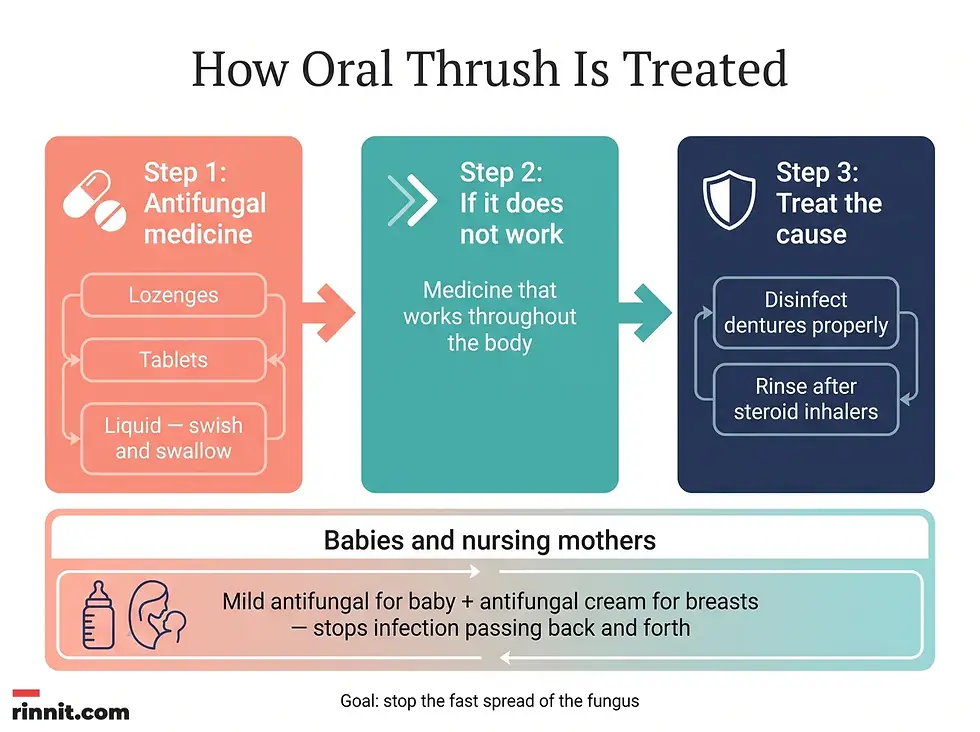
The goal of any oral thrush treatment is to stop the fast spread of the fungus. The best approach depends on your age, overall health, and what is causing the infection. Eliminating underlying causes, when possible, can prevent thrush from returning. [2]
Group | Typical treatment |
Healthy adults and children | Antifungal medicine as lozenges, tablets, or a liquid you swish in your mouth and then swallow. If these do not work, medicine that works throughout the body may be given. |
Babies and nursing mothers | A mild antifungal medicine for the baby and an antifungal cream for the mother's breasts, to stop the infection passing back and forth. |
Adults with weakened immune systems | Antifungal medicine in most cases. |
Thrush may return even after treatment if you do not deal with the underlying cause, such as poorly disinfected dentures or inhaled steroid use. [2] The Centers for Disease Control and Prevention notes that antifungal medicines come in different forms, including lozenges, oral rinses, and pills, and that the type, dose, and length of treatment depend on the type and severity of the infection. [8]
What lifestyle and home remedies help oral thrush?
These suggestions may help during an outbreak of oral thrush: [2]
Home care step | Details |
Practice good oral care | Brush and floss regularly. Replace your toothbrush often until the infection clears, and do not share toothbrushes. |
Disinfect dentures | Ask your dental professional for the best way to disinfect your dentures to avoid reinfection. |
Try warm saltwater rinses | Dissolve about 1/2 teaspoon (2.5 milliliters) of salt in 1 cup (237 milliliters) of warm water. Swish, then spit it out. Do not swallow it. |
Use nursing pads | If you are breastfeeding with a fungal infection, use pads without a plastic barrier, wear a clean bra every day, and ask your healthcare professional how to clean nipples, bottle nipples, pacifiers, and breast pump parts. |
The Oral Cancer Foundation advises talking to your doctor before using a health store remedy for Candida, because such remedies are not as potent as prescription medication. [9]
What is the bottom line on oral thrush?
Oral thrush is a common and usually minor fungal infection, but the white patches are a signal worth acting on. For healthy people, treatment is typically quick with antifungal medicine. For babies, breastfeeding mothers, and people with weakened immunity, catching it early helps stop the infection from spreading to the esophagus. Talk to your healthcare professional if you notice white patches inside your mouth, and ask what is causing it, whether you need tests for an underlying condition, and which treatment fits you. If you wear dentures, use an inhaled steroid, or have diabetes, share that history, because it often holds the key to stopping thrush from coming back.
Frequently Asked Questions
What exactly is oral thrush?
Oral thrush, or oral candidiasis, is a fungal infection that happens when Candida albicans yeast builds up in the mouth. The yeast naturally lives in the mouth, but when it grows too much it causes slightly raised, creamy white, sore patches, most often on the tongue or inner cheeks.
What does oral thrush look like?
It appears as slightly raised, creamy white patches or spots that can look like cottage cheese. They usually form on the tongue or inner cheeks and can spread to the roof of the mouth, gums, tonsils, or the back of the throat. The patches may bleed slightly if they are rubbed or scraped.
Who is most likely to get oral thrush?
Babies and older adults are most likely to get it because they have lower immunity. People with weakened immune systems (from cancer treatment, organ transplant, HIV/AIDS, or immune-weakening medicines), poorly controlled diabetes, dry mouth, or dentures are also at higher risk, as are people who take antibiotics, prednisone, or inhaled corticosteroids.
Can oral thrush spread to the throat or body?
Yes. In severe cases, usually related to cancer or a weakened immune system from HIV/AIDS, the patches can spread into the esophagus, the tube from your mouth to your stomach. This is called Candida esophagitis. Untreated thrush in people with lowered immunity can also lead to more serious systemic Candida infections.
Is oral thrush serious in healthy adults?
Usually not. For healthy children and adults it is a minor problem that is easily treated. However, thrush is uncommon in healthy older children, teenagers, and adults, so a healthcare professional may check for an underlying medical condition or another cause.
How is oral thrush diagnosed?
Diagnosis is usually simple. A medical or dental professional looks at the white patches and may take a small scraping to study under a microscope. If an underlying condition is suspected, a physical exam and blood tests may follow. If the infection may have reached the esophagus, an endoscopic exam and a biopsy may be used.
What medicines treat oral thrush?
Treatment is usually antifungal medicine, which comes as lozenges, tablets, or a liquid that you swish in your mouth and then swallow. If these do not work, a medicine that works throughout your body may be prescribed. Babies may be given a mild antifungal medicine, and nursing mothers may be given an antifungal cream for the breasts.
Can oral thrush pass between a breastfeeding mother and baby?
Mayo Clinic says it can: babies can pass the infection to their mothers during breastfeeding, and it may pass back and forth between the mother's nipples and the baby's mouth. Healthcare professionals may therefore treat the baby and the mother at the same time. Some breastfeeding organizations, such as La Leche League GB, note that nipple and breast thrush is less common than once thought and that other causes of nipple pain should be checked first, so see a healthcare professional to find the cause.
Does oral thrush come back after treatment?
It can. Thrush may return even after treatment if the underlying cause is not dealt with, such as poorly disinfected dentures or ongoing use of an inhaled steroid. Treating the underlying cause, when possible, helps keep it from coming back.
How can I prevent oral thrush if I use a steroid inhaler?
If you use a corticosteroid inhaler, rinse your mouth with water or brush your teeth after each dose. Inhaled steroids can disturb the natural balance of microorganisms in the mouth, which raises the risk of thrush.
What home care helps during an oral thrush outbreak?
Brush and floss regularly, replace your toothbrush often until the infection clears, and do not share toothbrushes. You can try warm saltwater rinses (about 1/2 teaspoon of salt in 1 cup of warm water, swished and spat out, not swallowed). If you wear dentures, disinfect them. If you are breastfeeding, use nursing pads without a plastic barrier and wear a clean bra every day.
Related Resources
Related Reading
What Is Candidiasis? The Yeast Infection Guide Explained explains yeast infections caused by Candida throughout the body.
Esophageal Candidiasis: What a Fungal Infection in Your Esophagus Means and What Comes Next explains yeast infection of the esophagus and how it is treated.
Dry Mouth: Symptoms, Causes, Diagnosis and Treatment — What You Need to Know explains dry mouth, a common risk factor for thrush, and its treatment.
Leukoplakia Symptoms, Causes, and Treatment: What White Mouth Patches Mean explains white mouth patches that do not wipe away and why they matter.
References
Mayo Clinic Staff. Oral thrush: symptoms and causes. Mayo Clinic. Dec. 20, 2024. https://www.mayoclinic.org/diseases-conditions/oral-thrush/symptoms-causes/syc-20353533
Mayo Clinic Staff. Oral thrush: diagnosis and treatment. Mayo Clinic. Dec. 20, 2024. https://www.mayoclinic.org/diseases-conditions/oral-thrush/diagnosis-treatment/drc-20353539
Pu X, Zhang Y, Peng L, et al. Adverse events of inhaled corticosteroids in adult patients with asthma or chronic obstructive pulmonary disease: pairwise, network and dose-response meta-analyses. BMJ Evid Based Med. 2026;31(1):23-35. PMID: 41241409. DOI: 10.1136/bmjebm-2024-113216
Shah N, Sinha S, Sonthalia A, et al. Association between solid organ transplantation and oral candidiasis: a systematic review and meta-analysis. Spec Care Dentist. 2026;46(2):e70157. PMID: 41870030. DOI: 10.1111/scd.70157
Mehta V, Galletti C, Mathur A, et al. Efficacy of probiotics in the management of oral candidiasis: an umbrella review of systematic reviews and meta-analyses. Syst Rev. 2026;15(1):246. PMID 42343426. https://doi.org/10.1186/s13643-026-03249-z
La Leche League GB. Thrush and breastfeeding. La Leche League GB. Written May 2025; last modified April 26, 2026. https://www.laleche.org.uk/thrush/
American Dental Association. Thrush. MouthHealthy (American Dental Association). Accessed October 30, 2026. https://www.mouthhealthy.org/all-topics-a-z/thrush
Centers for Disease Control and Prevention. Candidiasis basics. CDC. Last reviewed October 5, 2026. https://www.cdc.gov/candidiasis/about/index.html
Oral Cancer Foundation. Candida infection. Oral Cancer Foundation. Last modified March 16, 2023. https://oralcancerfoundation.org/complications/candida/
Medical disclaimer
This article is for general informational purposes only and is not a substitute for professional medical advice, diagnosis, or treatment. Always consult a qualified healthcare professional about your health.



Comments