STD Testing (STI Testing): Who Needs It, Test Types and What Results Mean

Updated: 4 days ago
Written and medically reviewed by Dr. Baraa Alnahhal, MD · Last reviewed: November 2026 · How we review
Quick Answer: What is STD testing?
STD testing (also called STI testing) is a group of tests that check whether you have a sexually transmitted infection. Depending on the infection, your provider may use a blood sample, a urine sample, a swab or a physical exam. Many STIs cause no symptoms, so testing is often the only way to know your status and get treated early. [1]
What the research says
Swabs you collect yourself work well for chlamydia. Across 21 studies with more than 6,100 paired samples, self-collected vaginal swabs picked up 92% of chlamydia infections found by clinician-collected cervical swabs, with 98% specificity (few false positives). Men's self-collected urine found 92% of gonorrhea cases. (Lunny et al., PLoS One, 2015) [2]
Self-sampling is widely accepted and reaches new testers. In a review of 45 studies, 80% to 100% of participants found self-sampling for chlamydia and gonorrhea acceptable. It reached 51% to 70% first-time testers, and 89% to 100% of people who tested positive were linked to care. (Vialard et al., Sexually Transmitted Infections, 2023) [3]
HIV self-tests roughly triple testing uptake. In a meta-analysis of seven trials, offering HIV self-tests led to about 3.1 times more people getting tested than standard testing services. Linking people to treatment after a self-test was slightly lower, a gap the authors flag for follow-up. (Njau et al., PLoS One, 2021) [4]
Key takeaways
STD testing uses blood, urine, swabs or a physical exam, depending on which infection is being checked. [1]
Many STIs have no symptoms, so testing is often the only way to know if you have one. [1]
STI tests are usually not part of a routine checkup, so you may need to ask for them. [1]
How often you should test depends on your age, sex, pregnancy and sexual activity. [1]
Self-collected swabs and home kits can be accurate options when used correctly. [1][2]
A positive result means you can start treatment and help protect your partners. [1]
What is STD testing?
STD testing is a set of lab tests and exams that look for sexually transmitted infections (STIs), which used to be called sexually transmitted diseases (STDs). You can be tested at a provider's office, at a community clinic or with a kit at home. [1]
There is no single test for every STI. Your provider chooses tests based on the infections you may have been exposed to, the type of sexual contact you've had and any symptoms you notice. [1]
Why is STD testing done?
Testing finds infections early, often before they cause problems. Knowing your status helps you get the right treatment, protect your sexual partners and support a healthy pregnancy. [1]
Your provider may recommend testing if you: [1]
Are sexually active
Have symptoms such as sores, rashes or unusual discharge
Have a partner who has been diagnosed with an STI
Are pregnant
Age matters too. About half of all STI diagnoses happen in people between 15 and 24 years old. [1]
Who should get tested, and how often?
Screening advice depends on your age, sex, pregnancy status and sexual activity. The schedule below summarizes common public health recommendations, but it isn't a complete list. Your provider may suggest a different plan based on your history. [1]
Group | Suggested screening |
Everyone ages 13 to 64 | HIV at least once |
Sexually active females under 25 | Chlamydia and gonorrhea every year |
Females 25 and older with a new partner, several partners or a partner with an STI | Chlamydia and gonorrhea every year |
Pregnant people | Syphilis, HIV, hepatitis B and hepatitis C early in pregnancy (sometimes repeated); chlamydia and gonorrhea early in pregnancy if at risk |
Men who have sex with men | Syphilis, chlamydia and gonorrhea at least yearly (every 3 to 6 months with several partners); HIV at least yearly; hepatitis C yearly if living with HIV |
Anyone with HIV risk factors, such as condomless sex or shared needles | HIV at least yearly |
Sources: [1]

What types of STD tests are there?
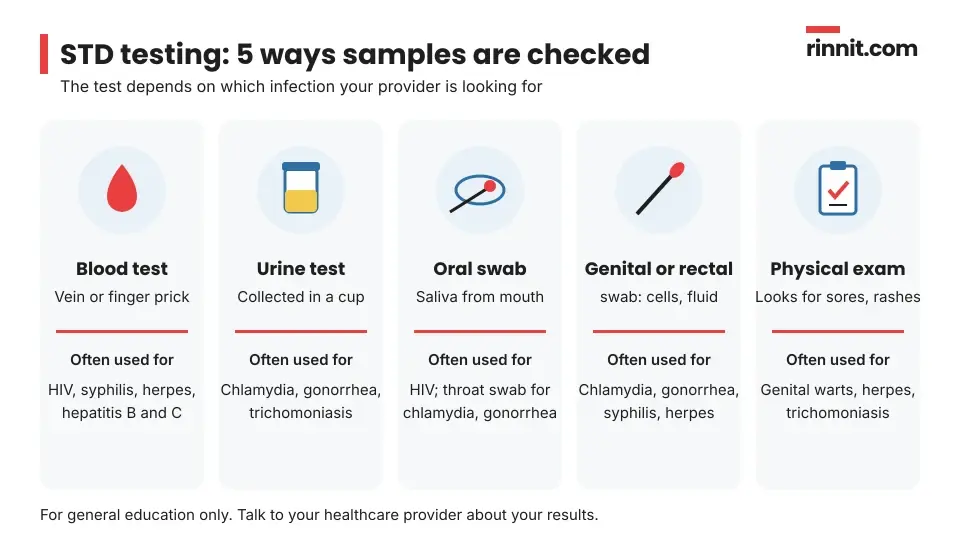
Most STI testing uses one or more of these sample types: [1]
Blood test: A small sample taken from a vein in your arm or from a finger prick.
Urine test: You collect urine in a cup, in private.
Oral swab: A swab collects saliva or cells from your mouth or throat.
Genital or rectal swab: A swab collects discharge, cells or fluid from a sore or blister.
Physical exam: Your provider looks for signs such as sores, warts or rashes.
Which test checks for which STI?
Infection | Common tests |
Chlamydia | Urine test or genital swab; throat or rectal swab if you've had oral or anal sex |
Gonorrhea | Urine test or genital swab; throat or rectal swab if you've had oral or anal sex |
Syphilis | Blood test, genital swab |
HIV | Blood test, oral swab |
Hepatitis B and C | Blood test |
Genital herpes | Physical exam, swab of a sore, blood test (shows past exposure, not an active outbreak) |
Genital warts | Physical exam |
HPV | Pap smear and other HPV tests |
Trichomoniasis | Physical exam, urine test, genital swab |
Sources: [1]
Can you test for STDs at home?
Yes. At-home STI kits are available from pharmacies and some health clinics. Some check for one infection, while others check for several. You collect your own sample (blood, urine or a swab) following the kit's instructions, then mail it to a lab. [1]
Home kits offer privacy and convenience, and they can be safe and accurate when you follow the directions closely. Some people still prefer testing with a provider, who can examine any symptoms and answer questions in person. [1]
Research backs up self-collection. In one large review, self-collected vaginal swabs found 92% of chlamydia infections that clinician-collected swabs detected. [2] A newer review found most people find self-sampling acceptable, and it often reaches people who have never been tested before. [3]
How should you prepare for STD testing?
Blood tests usually need no special preparation. For urine or swab tests, avoid using vaginal creams or douches beforehand. Follow any extra instructions your provider gives you. [1]
It's also normal to feel nervous. Talking to a trusted friend, partner or counselor before your appointment can help you feel more at ease. [1]
What your provider may ask
To choose the right tests, your provider will likely ask about your sexual health. Honest answers help you get the most accurate testing. Questions may cover: [1]
The types of sexual contact you've had (oral, vaginal or anal)
Whether you use condoms or other protection
How many partners you've had
Any past STIs for you or your partners
Any symptoms you've noticed
What happens during STD testing?
Testing is usually quick and causes little or no pain. Depending on your tests, you may give a blood sample, provide urine in a cup, have a swab taken or have a brief exam. [1]
Your provider should ask for your permission before examining or touching you. [1] Feeling uneasy during a genital exam is common, and you can ask questions at any time.
How long do STD test results take?
It depends on the test. Some results are ready during your visit, while others take a few days or weeks. Some clinics offer rapid HIV tests with results in about 20 minutes. [1]
Your provider will tell you when to expect results. You should always get your results, even when they're negative, so follow up if you haven't heard back. [1]
What do STD test results mean?
Some STIs don't show up on tests right after exposure. If you were tested soon after possible contact, your provider may suggest repeating the test in a few weeks or months. [1]

What happens after a positive result?
Your provider will recommend treatment for the specific infection. Take the full course exactly as prescribed, even if you feel better. Treatment cures some STIs; for others, it controls symptoms and lowers the chance of passing the infection on. [1]
You may need more tests to check for other STIs or complications. It's also important to tell your sexual partners so they can get tested and treated too. [1]
What are the risks of not getting tested?
The tests themselves are low-risk, with at most brief discomfort. The bigger risk is an infection that goes unnoticed. Untreated STIs can lead to serious problems, including infertility, organ damage, vision loss and, in some cases, death. During pregnancy, untreated STIs can harm both the pregnant person and the fetus. [1]
Where can you get tested?
You can ask your primary care provider or gynecologist for STI testing. Community health clinics also offer confidential testing, which may be free or low-cost. [1]
Talking openly with partners about testing, sexual history and protection can make the process easier. Framing testing as a way to look after each other helps keep the conversation supportive. [1]
When should you call your healthcare provider?
Contact your provider if: [1]
You aren't sure whether you need testing or which tests to get
You get a positive result on an at-home test
You have questions about your treatment plan
You notice new symptoms such as sores, rashes or unusual discharge
Questions to ask your provider
Which STIs should I be tested for, based on my history?
Do I need throat or rectal swabs in addition to a urine test?
How long will my results take, and how will I receive them?
Should I repeat any tests in a few weeks or months?
How often should I get screened going forward?
Is an at-home test a good option for me?
If a result is positive, how should I tell my partners?
Conclusion
STD testing is a routine, low-risk part of looking after your sexual health. Because many infections cause no symptoms, regular screening is often the only way to catch them early. [1]
Talk openly with your provider about your history so you get the right tests, and follow up on every result. Whether you test in a clinic or at home, knowing your status lets you get treated sooner and protect the people you care about. [1]
Keep learning: Read our guides to sexually transmitted diseases (STDs), chlamydia and HIV/AIDS. For more, see MedlinePlus's page on sexually transmitted infection (STI) tests.
FAQ
What is STD testing?
STD testing is a group of tests that check for sexually transmitted infections using blood, urine, swabs or a physical exam. [1]
Why should I get tested for STDs?
Many STIs cause no symptoms, so testing is often the only way to know. Early diagnosis means earlier treatment and protects your partners. [1]
How do I prepare for an STD test?
Blood tests need no preparation. Avoid vaginal creams and douches before urine or swab tests, and follow your provider's instructions. [1]
Does STD testing hurt?
Testing is usually quick and relatively painless. [1]
How long do STD test results take?
Some results are ready during your visit, others take days or weeks. Rapid HIV tests at some clinics take about 20 minutes. [1]
What does a positive STD test mean?
A positive result means you have that infection. Your provider will recommend treatment and suggest telling your partners. [1]
Can an STD test be negative right after exposure?
Yes. Some STIs don't show up right away, so your provider may suggest retesting in a few weeks or months. [1]
How often should I get tested for STDs?
It depends on your age, sex, pregnancy and sexual activity. For example, sexually active females under 25 should test for chlamydia and gonorrhea yearly. [1]
Are at-home STD tests accurate?
Home kits can be safe and accurate when you follow the instructions. Studies show self-collected swabs perform well for chlamydia. [1][2]
When should I call my provider about STD testing?
Call if you're unsure which tests you need, get a positive home test result or have questions about treatment. [1]
Related Reading
Post-Exposure Prophylaxis (PEP): How It Works and When to Start explains emergency HIV prevention after a possible exposure.
Learn more in our guide to Sexually Transmitted Diseases (STDs) Guide: Symptoms, Causes, Diagnosis, and Treatment.
Learn more in our guide to Chlamydia: Symptoms, Causes, Treatment, and How to Protect Yourself.
Learn more in our guide to Trichomoniasis: Symptoms, Causes, Diagnosis and Treatment — What You Need to Know.
Learn more in our guide to HIV/AIDS: Symptoms, Causes, and How It Is Diagnosed and Treated.
Learn more in our guide to HPV Infection: What It Is, the Four Types of Warts, and How It Is Treated.
Learn more in our guide to Hepatitis B: Symptoms, Causes, Prevention, Diagnosis and Treatment.
References
Cleveland Clinic. STD/STI Testing: What To Expect. Cleveland Clinic. Last updated December 1, 2023. https://my.clevelandclinic.org/health/diagnostics/std-testing
Lunny C, Taylor D, Hoang L, et al. Self-Collected versus Clinician-Collected Sampling for Chlamydia and Gonorrhea Screening: A Systemic Review and Meta-Analysis. PLoS One. 2015;10(7):e0132776. PMID 26168051. https://doi.org/10.1371/journal.pone.0132776
Vialard F, Anand A, Leung Soo C, et al. Self-sampling strategies (with/without digital innovations) in populations at risk of Chlamydia trachomatis and Neisseria gonorrhoeae: a systematic review and meta-analyses. Sex Transm Infect. 2023;99(6):420-428. PMID 36990696. https://doi.org/10.1136/sextrans-2022-055557
Njau B, Damian DJ, Abdullahi L, et al. The effects of HIV self-testing on the uptake of HIV testing, linkage to antiretroviral treatment and social harms among adults in Africa: A systematic review and meta-analysis. PLoS One. 2021;16(1):e0245498. PMID 33503050. https://doi.org/10.1371/journal.pone.0245498
Medical disclaimer
This article is for general education only and does not replace advice from a qualified healthcare professional. Talk to your doctor about your own diagnosis and treatment, and seek emergency care right away for severe or sudden symptoms.



Comments