Post-Exposure Prophylaxis (PEP): How It Works and When to Start

Updated: 2 days ago
Written and medically reviewed by Dr. Baraa Alnahhal, MD · Last reviewed: November 2026 · How we review
Quick Answer
Post-exposure prophylaxis (PEP) is a short course of HIV medicines taken after a possible exposure to HIV to keep the virus from taking hold. You must start within 72 hours, the sooner the better, and take the pills every day for 28 days. Treat any possible HIV exposure as an emergency and get care right away.
What the research says
Early treatment after a needlestick lowered HIV risk: in a study of health workers exposed to HIV through needlesticks, the average infection risk per exposure was 0.3%, and taking an HIV medicine afterward was linked to about 81% lower odds of infection (Cardo DM et al., N Engl J Med, 1997) [2]
Many people don't finish PEP: across 97 studies of 21,462 PEP courses, only about 57% of people finished all 28 days, and completion was lowest after sexual assault (40%) and in teens (37%) (Ford N et al., AIDS, 2014) [3]
Key takeaways
PEP is emergency HIV prevention after a possible exposure.
Start within 72 hours; sooner is better.
Take it every day for 28 days.
It lowers HIV risk by more than 80%.
PEP isn't for ongoing protection; ask about PrEP for that.
What is PEP?
PEP uses antiretroviral medicines, the same kinds used to treat HIV, to stop the virus from copying itself before an infection becomes permanent. Once HIV takes hold, it's a lifelong condition, so starting PEP quickly matters. PEP is different from PrEP (pre-exposure prophylaxis), which people at ongoing risk take before any exposure. Sources: [1]
When PEP is used
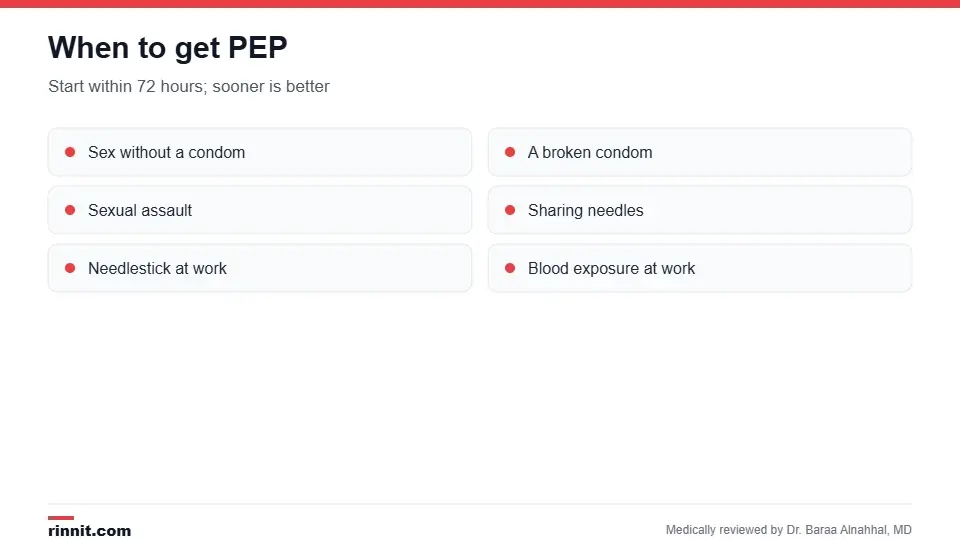
Start PEP within 72 hours; sooner is better.
Vaginal or anal sex without a condom, or a condom that broke, with someone who has or may have HIV.
Sexual assault.
Sharing needles or other drug equipment.
A needlestick or other exposure to blood at work. Sources: [1]
PEP usually isn't recommended if more than 72 hours have passed, if you already take PrEP consistently, or if the risk is very low, such as oral sex or contact with saliva, sweat or tears. Sources: [1]
PEP medicines
Part of regimen | Options |
Backbone (two drugs in one pill) | Emtricitabine with tenofovir (Truvada or Descovy) |
Third drug | Dolutegravir (Tivicay). A preferred all-in-one option is bictegravir/emtricitabine/tenofovir alafenamide (Biktarvy), one pill a day |
Depending on the drugs, you take them once or twice a day. Your provider may adjust them for other health conditions. Sources: [1]
How to take PEP
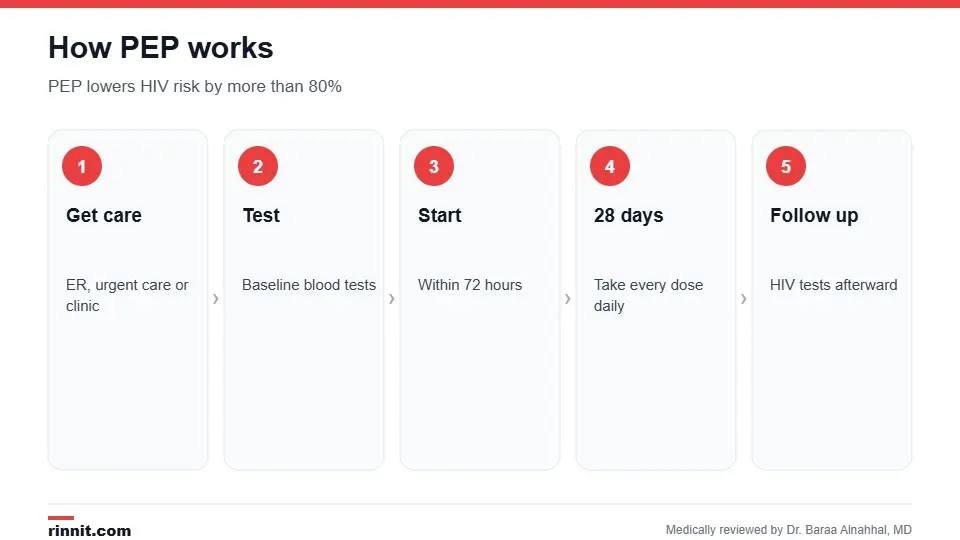
PEP lowers HIV risk by more than 80%.
Go to an emergency room, urgent care, sexual health clinic or a provider who prescribes PEP as soon as possible.
Get blood and urine tests for HIV, hepatitis B and C, pregnancy, and kidney and liver function; you may be tested or treated for other STIs.
Start PEP within 72 hours of exposure.
Take every dose, every day, for 28 days.
Use condoms during sex until you know your HIV status. Sources: [1]
Missing doses or stopping early raises your risk of infection. Set reminders and ask your provider what to do if you miss a dose. Sources: [1, 3]
Side effects
Side effect | What helps |
Nausea, vomiting or diarrhea | Ask which over-the-counter medicines are safe |
Tiredness | Rest; usually mild |
Headache | Over-the-counter pain relievers if your provider approves |
Side effects are usually mild and manageable. Don't stop PEP because of side effects without talking to your provider. Sources: [1]
Follow-up testing
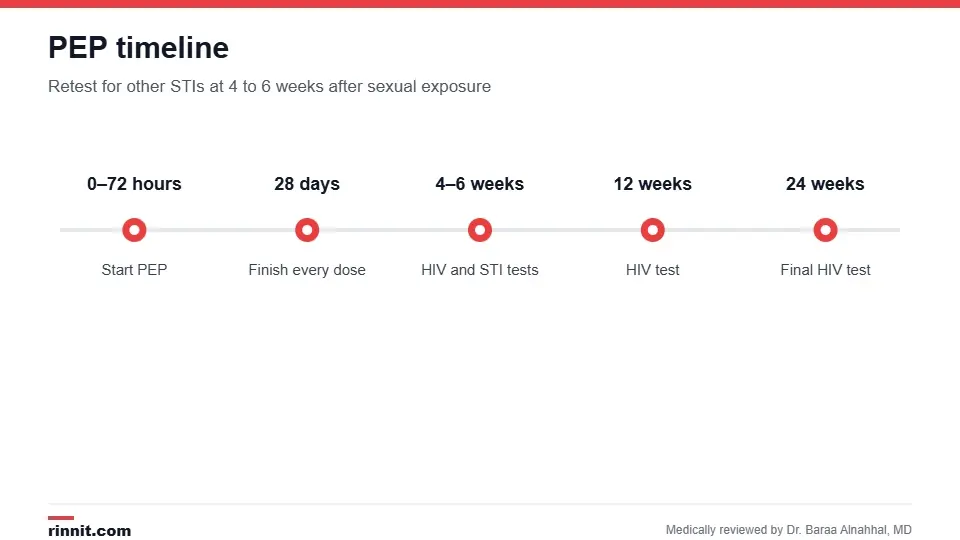
Retest for other STIs at 4 to 6 weeks after sexual exposure.
When | Test |
4 to 6 weeks after exposure | HIV test; STI tests after sexual exposure |
12 weeks | Final HIV test (lab antigen/antibody test plus HIV RNA test) |
Work-related exposure | Your provider may advise a different schedule |
Sources: [1]
How well PEP works
Studies suggest PEP lowers the risk of HIV by more than 80%. It works less well if you start late, miss doses, don't finish all 28 days, are exposed again during treatment or the virus is resistant to the drugs. If you're often at risk, ask your provider about PrEP and regular STD testing. Sources: [1, 2]
Where to get help
Treat a possible HIV exposure as a medical emergency.
Go to an emergency room, urgent care, sexual health clinic or a provider who prescribes PEP.
After sexual assault, ask for a sexual assault nurse examiner; most emergency departments have one.
Seek care even if more than 72 hours have passed, since you may still need testing and support. Sources: [1]
Conclusion
PEP is a safe, effective way to prevent HIV after a possible exposure, but timing is everything. Get care within 72 hours, take every dose for 28 days and complete your follow-up tests.
Keep learning: read about HIV and AIDS and sexually transmitted infections.
Frequently asked questions
What is PEP?
A 28-day course of HIV medicines taken after a possible exposure.
How soon do I need to start PEP?
Within 72 hours; the sooner, the better.
How long do I take PEP?
Every day for 28 days.
How effective is PEP?
Studies suggest it lowers HIV risk by more than 80%.
What's the difference between PEP and PrEP?
PEP is taken after an exposure; PrEP is taken before, for ongoing protection.
What are the side effects?
Usually mild nausea, tiredness, diarrhea or headache.
Where can I get PEP?
An emergency room, urgent care, sexual health clinic or a provider who prescribes it.
What if I miss a dose?
Take it as soon as you can and ask your provider; missed doses lower protection.
Do I need HIV tests afterward?
Yes, usually at 4 to 6 weeks and a final test at 12 weeks. Work-related exposures may follow a different schedule.
Can I take PEP after more than 72 hours?
It usually isn't recommended, but still get care and testing.
Related Reading
Protease Inhibitors: Types, How They Work and Side Effects explains protease inhibitor medicines.
Antiretroviral Therapy (ART) for HIV: How It Works and Side Effects explains antiretroviral therapy for HIV.
HIV/AIDS: Symptoms, Causes, and How It Is Diagnosed and Treated the infection PEP prevents.
HIV Test: Types, Window Periods, How It Works and Results how HIV is diagnosed.
HIV Viral Load: Test, Normal Range, Results and What They Mean a test that measures HIV in the blood.
STD Testing (STI Testing): Who Needs It, Test Types and What Results Mean testing for sexually transmitted infections.
What Is Syphilis? Symptoms, Stages, Testing, and Treatment Explained (2026 Guide) another infection to test for after exposure.
References
Cleveland Clinic. Post-Exposure Prophylaxis (PEP): Benefits & Side Effects. Cleveland Clinic. Last updated September 28, 2023. https://my.clevelandclinic.org/health/treatments/post-exposure-prophylaxis
Cardo DM, Culver DH, Ciesielski CA, et al. A case-control study of HIV seroconversion in health care workers after percutaneous exposure. N Engl J Med. 1997;337(21):1485-1490. PMID 9366579. https://doi.org/10.1056/NEJM199711203372101
Ford N, Irvine C, Shubber Z, et al. Adherence to HIV postexposure prophylaxis: a systematic review and meta-analysis. AIDS. 2014;28(18):2721-2727. PMID 25493598. https://doi.org/10.1097/QAD.0000000000000505
Medical disclaimer
This article is for general education only and does not replace advice from a qualified healthcare professional. Talk to your doctor about your own diagnosis and treatment, and seek emergency care right away for severe or sudden symptoms.



Comments