HIV Viral Load: Test, Normal Range, Results and What They Mean

Updated: 2 days ago
Written and medically reviewed by Dr. Baraa Alnahhal, MD · Last reviewed: November 2026 · How we review
Quick Answer: What is an HIV viral load test?
An HIV viral load test is a blood test that measures how much HIV is in the blood. It's the main way to check how well antiretroviral therapy (ART) is working. The goal is a falling viral load and, ideally, an undetectable result, which means below 20 to 50 copies/mL depending on the lab. [1]
What the research says
Sexual transmission is almost zero when viral load is low. A systematic review of 8 studies covering 7,762 couples in 25 countries, where one partner had HIV and the other did not, found no transmission in three studies when the partner with HIV had a viral load below 200 copies/mL. Across four other studies with 323 transmissions, none came from people who were stably suppressed on ART. The authors concluded the risk is almost zero below 1,000 copies/mL. (Broyles et al., The Lancet, 2023) [2]
No partner infections occurred when viral load was suppressed. In a study of 782 male couples followed for 1,593 couple-years, with about 76,000 reported acts of condomless anal sex, there were zero HIV transmissions within couples while the partner with HIV had a viral load below 200 copies/mL. (Rodger et al., The Lancet, 2019) [3]
Starting treatment early protects partners. In a trial of 1,763 people with HIV and their partners, starting ART early lowered the risk of passing HIV to a partner by 93% compared with delaying treatment. No linked infections were seen while the virus was stably suppressed. (Cohen et al., The New England Journal of Medicine, 2016) [4]
Key takeaways
An HIV viral load test measures the amount of HIV RNA in your blood and shows how well treatment is working. [1]
No special preparation is needed, and the test is a simple blood draw from your arm. [1]
It is done at diagnosis, 2 to 3 months after starting ART and then usually every 3 to 6 months. [1]
Undetectable means below 20 to 50 copies/mL, depending on the lab; viral suppression means below 200 copies/mL. [1]
Trends matter more than a single result: a falling number suggests ART is working. [1]
A viral load that stays below 200 copies/mL means HIV is not passed on through sex, as long as ART keeps working. [1] [2] [3]
What is an HIV viral load test?
Viral load is the amount of HIV in your blood that a test can detect. HIV is a lifelong viral infection that weakens the immune system. An HIV viral load test looks for the virus's genetic material, called RNA. [1]
The test uses nucleic acid amplification tests (NAATs), which can find even very small amounts of the virus. A high viral load means HIV is present and usually actively copying itself. A low viral load means only a little virus is circulating. The goal of antiretroviral therapy (ART) is to lower the virus to a level current tests cannot detect. [1]
Why is an HIV viral load test done?
Providers use viral load results to monitor HIV and decide whether treatment needs to change. HIV is usually diagnosed with other HIV tests, but a viral load test may be used after a recent high-risk exposure, or a possible exposure along with symptoms. [1]
Reason for testing | What it helps with |
Monitor treatment | Shows how well ART is working |
Guide treatment decisions | Helps decide whether medicines need to change |
Check medicine use | Shows how consistently medicines are being taken |
Confirm early infection | Helps confirm HIV soon after infection |
Test babies | Helps diagnose HIV in babies born to people with HIV |
Sources: [1]
How often do you need an HIV viral load test?
Viral load is usually checked along with your CD4 count to track how you respond to treatment. A typical schedule looks like this, though your provider may change it based on your needs: [1]

When | Why |
At diagnosis | Sets your starting (baseline) viral load |
2 to 3 months after starting ART | Checks that treatment is lowering the virus |
Every 3 to 6 months after that | Confirms the virus stays under control |
Sources: [1]
How do you prepare for an HIV viral load test?
No special preparation is needed. You can eat and take your medicines as usual before the test. It can help to ask your provider when your results will be ready. [1]
What happens during an HIV viral load test?
The test is a standard blood draw from your arm. [1]
A provider uses a small needle to draw blood from a vein in your arm.
You may feel brief pain or discomfort when the needle goes in and comes out.
The blood sample is sent to a lab.
A lab technician runs the test to measure the amount of HIV RNA in the liquid part of your blood (plasma).
Sources: [1]
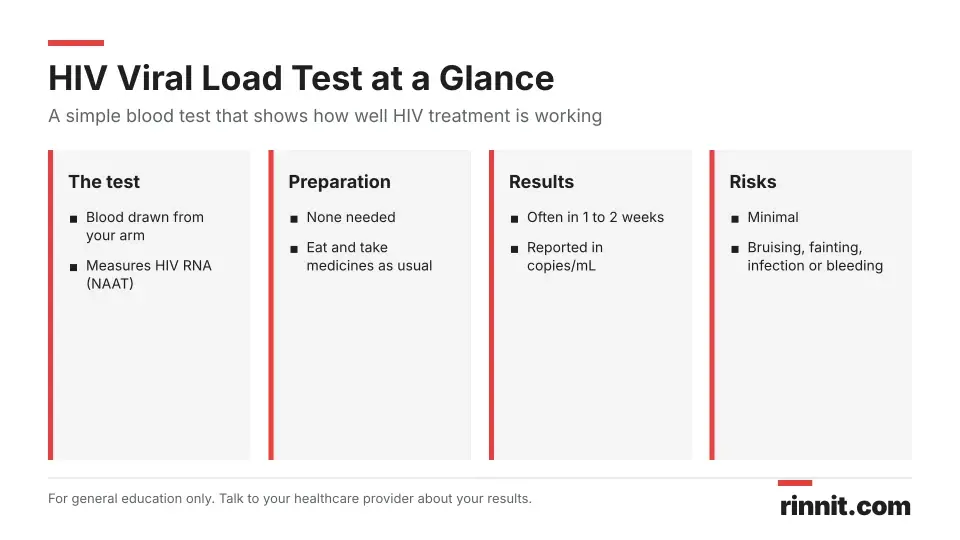
HIV viral load test at a glance
Item | Typical detail |
Sample | Blood drawn from a vein in your arm |
What it measures | HIV RNA, using nucleic acid amplification tests (NAATs) |
Preparation | None; eat and take medicines as usual |
Units | Copies per milliliter of plasma (copies/mL) |
Results | Often in one to two weeks |
Repeat testing | Usually every 3 to 6 months once on ART |
Sources: [1]
What happens after an HIV viral load test?
Results often take one to two weeks. Your provider will compare the new result with your earlier ones and explain whether your treatment plan should stay the same or change. [1]
What do HIV viral load results mean?
Results are reported as copies of HIV RNA per milliliter of blood plasma, written as copies/mL. A milliliter is about 20 drops. Results can range from less than 20 copies/mL to more than 100,000 copies/mL. A negative result means the test could not detect HIV RNA. [1]

There is no single "normal" viral load. What matters most is the trend over time. A falling viral load suggests ART is working, while a rising one may mean your medicines need to be adjusted. Labs use slightly different cutoffs, so ask your provider what your numbers mean. [1]
Result | What it usually means |
Below 20 to 50 copies/mL (varies by lab) | Undetectable; ART is working well |
Below 200 copies/mL | Viral suppression; very little HIV in the blood |
Falling over time | Treatment is likely working |
Rising over time | Medicines may need to be adjusted |
Up to more than 100,000 copies/mL | A high level of virus that is usually actively copying itself |
Sources: [1]
What does undetectable mean?
Undetectable means the virus is below 20 to 50 copies/mL, depending on the lab. Older guidance treated anything under 200 copies/mL as undetectable, but newer tests can find lower levels. An undetectable result does not mean HIV is cured. HIV tests will still be positive, and the virus can stay inactive in cells and become active again if you stop ART. [1]
If ART stops working or becomes less effective, other treatment options may bring your viral load back down. [1]
Viral load and protecting partners
Studies suggest that when your viral load stays below 200 copies/mL, HIV cannot be passed on through sex, as long as the virus stays suppressed and ART keeps working. [1] [2] [3]
For a partner without HIV, pre-exposure prophylaxis (PrEP) is the safest choice, especially if your viral load is sometimes detectable or you sometimes miss doses. If your viral load is consistently undetectable and you take ART reliably, PrEP may be optional, but you need to keep taking ART and having regular viral load tests. Ask your providers for guidance. [1]
What are the risks of an HIV viral load test?
The risks of an HIV viral load test are minimal. Sometimes more than one needle stick is needed to find a vein, which can be uncomfortable. Possible problems include: [1]
Possible problem | What it means |
Discomfort | Brief pain when the needle goes in and out, or from extra sticks |
Lightheadedness or fainting | Feeling dizzy or faint during or after the draw |
Bruise or hematoma | Blood collecting under the skin at the needle site |
Infection | Germs entering the skin where the needle went in |
Excessive bleeding | More bleeding than usual from the needle site |
Sources: [1]
When should you call your provider?
Contact your provider if you have questions about your results or your treatment plan. Go to the emergency room if you notice signs of infection where your blood was drawn, such as: [1]
Pain
Swelling
Pus
Fever
Questions to ask your provider
What was my viral load, and how does it compare with my last result?
Is my viral load undetectable or suppressed?
How often should I have my viral load checked?
Do my medicines need to change based on this result?
Does my partner need PrEP?
Conclusion
An HIV viral load test is a simple blood test that shows how much HIV is in your blood and how well ART is working. It needs no preparation, is repeated every few months once you start treatment and is read as a trend rather than a single number. [1]
Reaching and keeping an undetectable viral load protects your health and means HIV is not passed on through sex. Taking ART every day and keeping up with regular testing are the best ways to stay there. [1] [2] [3] [4]
Keep learning: Read our guides to HIV/AIDS, sexually transmitted diseases and Kaposi sarcoma. For more on this test, see the MedlinePlus guide to the HIV viral load test.
FAQ
What is an HIV viral load test?
It is a blood test that measures how much HIV genetic material (RNA) is in your blood. Providers use it to monitor HIV and see how well treatment is working.
Why is an HIV viral load test done?
It checks how well antiretroviral therapy (ART) is working, guides treatment changes, helps confirm early HIV infection and helps diagnose HIV in babies born to people with HIV.
How do I prepare for an HIV viral load test?
No special preparation is needed. You can eat and take your medicines as usual.
Does an HIV viral load test hurt?
You may feel brief pain or discomfort when the needle goes in and comes out.
How long do HIV viral load results take?
Results often take one to two weeks. Ask your provider when to expect them.
How often should I get an HIV viral load test?
It is done at diagnosis, again 2 to 3 months after starting ART and then usually every 3 to 6 months.
What is a normal HIV viral load?
There is no single normal value. The goal is for your viral load to fall over time, ideally to an undetectable level, which is below 20 to 50 copies/mL depending on the lab.
What does an undetectable viral load mean?
It means the test cannot find HIV in your blood and ART is working well. It does not mean HIV is cured, and you must keep taking ART.
What does a rising viral load mean?
A rising viral load may mean your medicines need to be adjusted. Other treatment options may bring it back down.
Can HIV be passed on with an undetectable viral load?
Studies suggest HIV cannot be passed through sex when the viral load stays below 200 copies/mL and ART keeps working.
What are the risks of an HIV viral load test?
Risks are minimal. They include discomfort, lightheadedness or fainting, a bruise or hematoma, infection and bleeding where the needle went in.
Related Reading
Antiretroviral Therapy (ART) for HIV: How It Works and Side Effects explains antiretroviral therapy for HIV.
Post-Exposure Prophylaxis (PEP): How It Works and When to Start explains emergency HIV prevention after a possible exposure.
Learn more in our guide to HIV/AIDS: Symptoms, Causes, and How It Is Diagnosed and Treated.
Learn more in our guide to Sexually Transmitted Diseases (STDs) Guide: Symptoms, Causes, Diagnosis, and Treatment.
Learn more in our guide to Kaposi's Sarcoma: Symptoms, Causes & Treatment Guide.
Learn more in our guide to Cryptococcosis: Symptoms, Causes, Diagnosis, and Treatment Options.
Learn more in our guide to Cytomegalovirus (CMV): Symptoms, Causes, Transmission, Treatment and Outlook — What You Need to Know.
Learn more in our guide to Toxoplasmosis: What Causes It, Who Is at Risk, and How It Is Treated.
CD4 Count: Normal Range, What a Low CD4 Count Means and How Often It's Checked explains the blood test that tracks helper T cells and immune strength.
References
Cleveland Clinic. HIV Viral Load: Test, Normal Range & When To Check. Cleveland Clinic. Last updated October 28, 2024. https://my.clevelandclinic.org/health/diagnostics/hiv-viral-load
Broyles LN, Luo R, Boeras D, et al. The risk of sexual transmission of HIV in individuals with low-level HIV viraemia: a systematic review. Lancet. 2023;402(10400):464-471. PMID 37490935. https://doi.org/10.1016/S0140-6736(23)00877-2
Rodger AJ, Cambiano V, Bruun T, et al. Risk of HIV transmission through condomless sex in serodifferent gay couples with the HIV-positive partner taking suppressive antiretroviral therapy (PARTNER): final results of a multicentre, prospective, observational study. Lancet. 2019;393(10189):2428-2438. PMID 31056293. https://doi.org/10.1016/S0140-6736(19)30418-0
Cohen MS, Chen YQ, McCauley M, et al. Antiretroviral Therapy for the Prevention of HIV-1 Transmission. N Engl J Med. 2016;375(9):830-839. PMID 27424812. https://doi.org/10.1056/NEJMoa1600693
Medical disclaimer
This article is for general education only and does not replace advice from a qualified healthcare professional. Talk to your doctor about your own diagnosis and treatment, and seek emergency care right away for severe or sudden symptoms.



Comments