
Toxoplasmosis: What Causes It, Who Is at Risk, and How It Is Treated

Updated: 2 days ago
Medically reviewed by Dr. Baraa Alnahhal, MD · Last reviewed: September 2026
Editorial note: This article is for educational purposes only and is not a substitute for professional medical advice. Content reflects current clinical guidance and was compiled from dated, authoritative sources listed in the References section.
TL;DR
Toxoplasmosis is an infection with the parasite *Toxoplasma gondii*, most often from undercooked meat or cat feces. More than 40 million people in the United States have been infected, but most never notice — their immune systems keep the parasite dormant for life. Serious disease concentrates in three groups: unborn babies, people with weakened immune systems, and the eye. Most infections need no treatment; drug therapy is reserved for pregnant people, newborns, people with serious illness, and people with weakened immunity.
Quick Answer
What is toxoplasmosis? An infection caused by the parasite *Toxoplasma gondii*, usually spread through undercooked meat, unwashed produce, or contact with cat feces [1]. Over 40 million Americans carry the infection, and roughly 1.1 million new cases occur each year [3], yet most healthy people never develop symptoms [1]. Serious disease affects unborn babies, people with weakened immune systems, and the eye. Most infections need no treatment, while drug therapy — typically pyrimethamine combined with sulfadiazine — is used for pregnant people, newborns, and more-serious cases [2].
What Is Toxoplasmosis?
Toxoplasmosis (tok-so-plaz-MOE-sis) is an infection with a parasite called *Toxoplasma gondii*. People often get the infection from eating undercooked meat. You can also get it from contact with cat feces. The parasite can pass to a baby during pregnancy [1].
The scale of this parasite is large, but its danger to most people is small. More than 40 million people are infected with the parasite in the United States, and about 11 percent of the U.S. population age 6 and older show evidence of past infection [3][4]. An estimated 1.1 million people are newly infected each year [5].
Most people infected with the parasite do not have symptoms. Some people get flu-like symptoms. Serious disease most often affects infants and people with weakened immune systems. Toxoplasmosis during pregnancy may cause miscarriage and birth defects [1].
Quick fact | Detail |
|---|---|
What it is | An infection with the parasite Toxoplasma gondii |
How it spreads | Undercooked meat, cat feces, unwashed produce, contaminated water and utensils |
U.S. exposure | Over 40 million infected; ~1.1 million new infections per year |
Symptoms | Usually none; flu-like symptoms in some; severe forms in three groups |
Who is at risk | Unborn babies, people with weakened immune systems, people with eye infection |
Typical treatment | None for most; drug therapy for pregnant people, newborns, and serious cases |
What Does Toxoplasmosis Feel Like?
Most people infected with toxoplasmosis do not have any symptoms. They often do not know they are infected [1].
Some people develop flu-like symptoms, which may include the signs below.
Symptom | What to expect |
|---|---|
Fever | Common in symptomatic infection |
Swollen lymph nodes | May last for weeks |
Headache | Often accompanies other flu-like symptoms |
Muscle aches | Typical of the flu-like presentation |
Skin rash | Occurs in some symptomatic cases |
Can Toxoplasmosis Affect the Eyes?
Yes. The toxoplasma parasites may infect tissues of the inner eye. This can occur in people with healthy immune systems. But the disease is more serious in people with weakened immunity. An infection in the eye is called ocular toxoplasmosis [1].
Symptoms may include eye pain, poor vision, and floaters, which are specks that seem to swim in your vision. Untreated eye disease can cause blindness [1].

Who Faces Serious Disease from Toxoplasmosis?
Three groups carry most of the risk. Understanding them is the key to understanding this infection.
People with weakened immune systems
People with weakened immune systems are likely to have more-serious disease from toxoplasmosis. A toxoplasmosis infection from earlier in life may become active again [1]. People at risk include those living with HIV/AIDS, people receiving cancer treatment, and people with a transplanted organ.
In addition to serious eye disease, toxoplasmosis can cause severe lung or brain disease for a person with weakened immunity. Rarely, the infection can show up in other tissues throughout the body [1].
Organ system | Symptoms |
|---|---|
Lung infection | Breathing problems, fever, cough |
Brain inflammation (encephalitis) | Confusion, poor coordination, muscle weakness, seizures, changes in alertness |
The national picture underscores the stakes: roughly 225,000 cases of toxoplasmosis are reported each year in the United States, resulting in about 5,000 hospitalizations and 750 deaths, largely concentrated in people with compromised immunity [6].
Unborn babies and infants
Toxoplasmosis can pass from the mother to the fetus during a pregnancy. This is called congenital toxoplasmosis [1].
Infection during the first trimester often causes more-severe disease. It also may result in miscarriage. For some babies with toxoplasmosis, serious disease may be present at birth or appear early in infancy [1].
Medical problems at or near birth | Description |
|---|---|
Hydrocephalus | Too much fluid in or around the brain |
Severe eye infection | Can threaten vision |
Irregularities in brain tissues | Detected on imaging |
Enlarged liver or spleen | Signs of systemic infection |
Symptoms of severe disease vary and may include problems with mental or motor skills, blindness or other vision problems, hearing problems, seizures, heart disorders, jaundice (yellowing of the skin and whites of the eyes), and rash [1].
Most babies with toxoplasmosis do not show symptoms. But problems may show up later in childhood or teenage years. These include return of eye infections, problems with motor skill development, problems with thinking and learning, hearing loss, slowed growth, and early puberty [1].
An estimated 400 to 4,000 cases of congenital toxoplasmosis occur each year in the United States [7].

What Causes Toxoplasmosis?
Toxoplasma gondii is a parasite that can infect most animals and birds. It can only go through the entire cycle of reproduction in domestic and wild cats. These are the main hosts for the parasite [1].
Immature eggs, a middle stage of reproduction, can be in the feces of cats. This immature egg allows the parasite to make its way through the food chain. It can pass from soil and water to plants, animals, and humans. Once the parasite has a new host, the reproduction cycle goes on and causes an infection [1].
If you are in typical health, your immune system keeps the parasites in check. They stay in your body but are not active. This often gives you lifelong immunity. If you are exposed to the parasite again, your immune system would clear it out. If your immune system is weakened later in life, parasite reproduction can start again. This causes a new active infection that can lead to serious disease and complications [1].
How Do People Catch the Parasite?
People often get a toxoplasma infection through one of the following routes.
Exposure route | How it happens |
|---|---|
Cat feces with the parasite | Cats that hunt or are fed raw meat are more likely to carry the parasite; infection occurs if you touch your mouth after touching anything in contact with cat feces, such as gardening or cleaning a litter box |
Contaminated food or water | Undercooked beef, lamb, pork, venison, chicken, and shellfish are known carriers; unpasteurized goat milk and untreated drinking water also may be carriers |
Unwashed fruits and vegetables | The surface of produce may carry the parasite |
Contaminated kitchen tools | Cutting boards, knives, and other utensils that contact raw meat or unwashed produce |
Organ transplant or transfused blood | Rarely, parasites are passed through a transplant or transfusion |
Food safety temperatures
Cooking is one of the most reliable defenses. The recommended internal temperatures are [1][8]:
Food | Minimum safe internal temperature |
|---|---|
Whole meats and fish | 145°F (63°C), with at least 3 minutes of rest |
Ground meat | 160°F (71°C) |
Whole and ground poultry | 165°F (74°C) |
What Increases the Risk of Serious Disease?
The parasite is found throughout the world. Anyone can become infected [1].
Risks of serious disease from toxoplasmosis include things that prevent the immune system from fighting infections, such as infection with HIV/AIDS, chemotherapy treatment for cancer, high-dose steroids, and drugs that prevent the rejection of transplanted organs [1].
People who are pregnant face a distinct risk: not for themselves, but for the baby. Pregnant people without immunity who acquire the infection during pregnancy can pass it to the fetus [1][9].
How Is Toxoplasmosis Diagnosed?
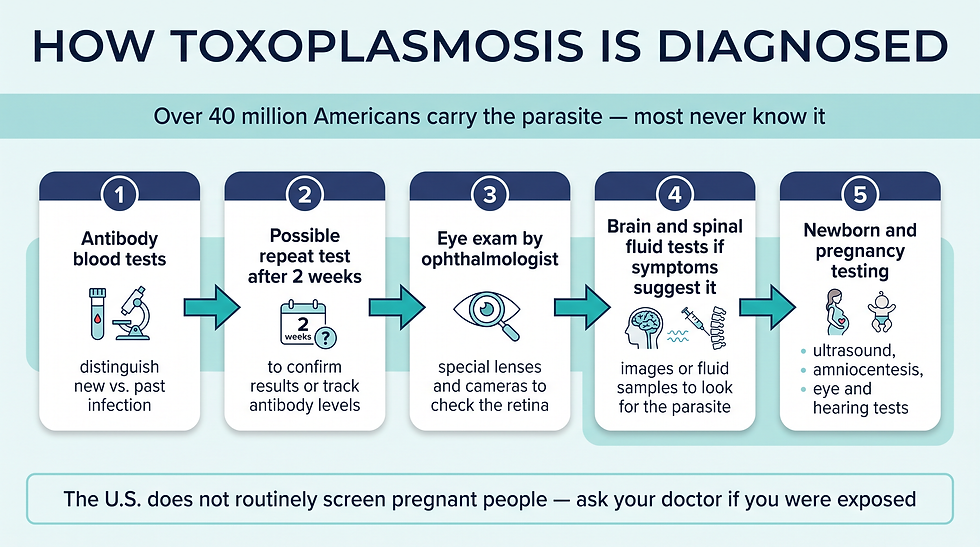
A diagnosis of toxoplasmosis is based on blood tests. Laboratory tests can detect two types of antibodies. One antibody is an immune system agent that is present during a new and active infection with the parasite. The other antibody is present if you had an infection at any time in the past. Depending on the results, your healthcare professional may repeat a test after two weeks [2].
More diagnostic tests are used depending on other symptoms, your health, and other factors [2].
Situation | Diagnostic approach |
|---|---|
Eye symptoms | Exam by an ophthalmologist using special lenses or cameras to see tissues inside the eye |
Brain and nervous system symptoms | Brain imaging (MRI or CT), cerebral spinal fluid (CSF) test, rarely brain tissue sampling |
Pregnancy (suspected active infection) | Diagnostic blood test when symptoms suggest active infection or ultrasound shows irregular features; amniotic fluid test (amniocentesis) to confirm fetal infection |
Newborn (suspected infection) | Blood tests, then brain ultrasound or CT, CSF tests, eye tests, hearing tests, and EEG |
One detail matters for readers in the United States: pregnant people here are not routinely screened for toxoplasmosis. Recommendations for screening vary in other countries. Your healthcare professional may order a diagnostic blood test if your symptoms might be from an active toxoplasma infection, or if ultrasound images of your baby show irregular features linked to toxoplasmosis [2].
How Is Toxoplasmosis Treated?
Medicine is used to treat active infections. How much and how long you take medicine depends on different factors. These include how seriously ill you are, your immune system health, where the infection is located, and your stage of pregnancy [2].
Most infections do not need treatment [1]. Treatment decisions look like this:
Group | Typical approach |
|---|---|
Healthy person, no symptoms | No treatment |
Pregnant person with active infection | Drug treatment to reduce transmission to the baby [1][2] |
Newborn with congenital infection | Drug treatment may last 1 to 2 years, with frequent follow-up [2] |
Person with weakened immunity (HIV/AIDS, transplant, chemotherapy) | Drug treatment, often longer or preventive [2] |
Serious eye disease | Drug treatment plus anti-inflammatory glucocorticosteroids [2] |
Your healthcare professional may give you a combination of prescription drugs [2]:
Drug | What it does | Notable cautions |
|---|---|---|
Pyrimethamine (Daraprim) | Fights infections caused by microscopic organisms; can block the body's use of folic acid | Long-term use may cause bone marrow suppression and liver toxicity |
Leucovorin calcium | Helps correct the effects of pyrimethamine on folic acid activity | Given alongside pyrimethamine |
Sulfadiazine | Antibiotic often prescribed with pyrimethamine | Alternatives include clindamycin (Cleocin) and azithromycin (Zithromax) |
Treatment for infants may last 1 to 2 years. Regular and frequent follow-up appointments are needed to watch for side effects, vision problems, and physical, intellectual, and overall development [2].
In addition to the regular drug treatment, eye disease also may be treated with anti-inflammatory steroids called glucocorticosteroids [2].
How Can You Prevent Toxoplasmosis?
Certain precautions can help prevent toxoplasmosis. The prevention list below comes from current clinical guidance [1].
Prevention step | Detail |
|---|---|
Garden with gloves | Wear gloves when working outdoors; wash your hands with soap and water afterward |
Cook meat thoroughly | Use a meat thermometer; follow the temperature table above |
Avoid raw shellfish | Do not eat raw clams, mussels, or oysters, particularly during pregnancy |
Wash kitchen utensils thoroughly | Soapy water after contact with raw meats or unwashed fruits and vegetables; wash hands before and after food preparation |
Wash all fruits and vegetables | Before eating, peeling, or cooking |
Avoid unpasteurized goat milk | Skip it and products made from the milk |
Avoid untreated water | Particularly during pregnancy |
Cover children's sandboxes | Prevents outdoor cats from using them as litter boxes |
For cat lovers
If you are pregnant or otherwise at risk of toxoplasmosis, take these steps to protect yourself [1]:
Step | Recommendation |
|---|---|
Help your cat stay healthy | Keep your cat indoors; feed it dry or canned cat food, not raw or undercooked meat |
Avoid stray cats or kittens | Avoid stray cats, especially kittens; do not get a new cat when you are pregnant |
Manage the litter box safely | Have someone else clean the box daily if possible; if someone else cannot clean it, wear gloves and a face mask to change the litter, then wash your hands well |
When Should You See a Doctor?
Talk to your healthcare professional about a test if you are worried about exposure to the parasite, or if you are planning a pregnancy or are pregnant [1].
The symptoms of severe toxoplasmosis include blurred vision, confusion, and loss of coordination. These need immediate medical care, particularly if you have a weakened immune system [1].
How Can You Prepare for Your Appointment?
You are likely to start by seeing your healthcare professional. If you are pregnant, you will likely see your obstetrician. You also may see a perinatologist, a specialist in fetal health. In some cases, you will see an infectious disease specialist [2].
Question you will likely be asked | How to prepare |
|---|---|
What are your symptoms? | Note each symptom and its severity |
When did they start? | Note the approximate date |
Have you been diagnosed with toxoplasmosis in the past? | Bring prior lab results if available |
Do you have a cat? Is it indoor or outdoor? Do you change the litter? | Be ready to describe your cat and litter habits |
Have you recently eaten raw or undercooked meat or fish? | Recall recent meals honestly |
Have you had unpasteurized goat's milk products? | Recall recent foods and drinks |
Do you garden or work outdoors? Do you wear gloves? | Describe your exposure habits |
What medicine, vitamins, or supplements do you take? | Bring a written list |
Conclusion: What to Do About Toxoplasmosis
Two anchor truths frame toxoplasmosis. First, most infections never announce themselves — over 40 million Americans carry the parasite, and most stay healthy for life because their immune systems keep it dormant [1][3]. Second, the risk is not evenly distributed — unborn babies, people with weakened immune systems, and the eye bear the serious consequences [1].
Practice food hygiene now. Cook meat to safe internal temperatures, wash produce, and keep raw meat away from other foods. These habits are the single most effective defense [1].
If you are pregnant or planning pregnancy, ask your healthcare professional about testing, and follow the cat-care and food-safety steps above [1][2].
Seek immediate care for blurred vision, confusion, or loss of coordination — especially with a weakened immune system [1].
If diagnosed, follow the treatment and follow-up plan completely; infant treatment can extend one to two years, and the follow-up protects vision and development [2].
Frequently Asked Questions
Can you get toxoplasmosis from your cat? Yes, but only through contact with infected cat feces — touching your mouth after handling a litter box or contaminated soil. Cats that hunt or eat raw meat are more likely to carry the parasite. Indoor cats fed commercial food pose very low risk, especially since litter is cleaned daily before the parasite becomes infectious [1].
Can toxoplasmosis go away on its own? In healthy people, the immune system usually controls the parasite without any treatment, and most infections cause no symptoms at all. The parasite often remains dormant for life, and the immune system clears repeat exposures [1].
Is toxoplasmosis dangerous during pregnancy? It can be. The parasite can pass from the mother to the fetus during pregnancy, and infection during the first trimester often causes more-severe disease and may result in miscarriage. Because the U.S. does not routinely screen pregnant people, ask your doctor about testing if you may have been exposed [1][2].
Do you need antibiotics for toxoplasmosis? Not usually. Most infections need no treatment. Drug treatment — typically pyrimethamine with sulfadiazine, plus leucovorin — is used for pregnant people, newborns, people with serious illness, and people with weakened immune systems [1][2].
Can toxoplasmosis cause blindness? Untreated eye disease (ocular toxoplasmosis) can cause blindness. It can occur even in people with healthy immune systems and may involve eye pain, poor vision, and floaters [1].
How long does treatment last for a baby? Drug treatment for infants may last 1 to 2 years, with regular follow-up appointments to monitor for side effects, vision problems, and physical, intellectual, and overall development [2].
Can toxoplasmosis come back years later? Yes, in people whose immune systems weaken later in life. An infection from earlier in life may become active again, potentially causing serious lung or brain disease [1].
How common is toxoplasmosis? Very common. Over 40 million people in the United States have been infected, about 11 percent of Americans age 6 and older show evidence of past infection, and an estimated 1.1 million new infections occur each year [3][4][5].
References
1. Toxoplasmosis — Symptoms & causes — Mayo Clinic (updated May 6, 2026)
2. Toxoplasmosis — Diagnosis & treatment — Mayo Clinic (updated May 6, 2026)
3. About Toxoplasmosis — U.S. Centers for Disease Control and Prevention (updated March 11, 2025)
4. Toxoplasmosis: Causes and How It Spreads — U.S. Centers for Disease Control and Prevention (updated May 15, 2024)
6. Toxoplasmosis: Background, Etiology, Pathophysiology — Medscape eMedicine (updated December 20, 2022)
Comments