Sexually Transmitted Diseases (STDs) Guide: Symptoms, Causes, Diagnosis, and Treatment

Updated: 2 days ago
Medically reviewed by Dr. Baraa Alnahhal, MD · Last reviewed: September 2026
TL;DR
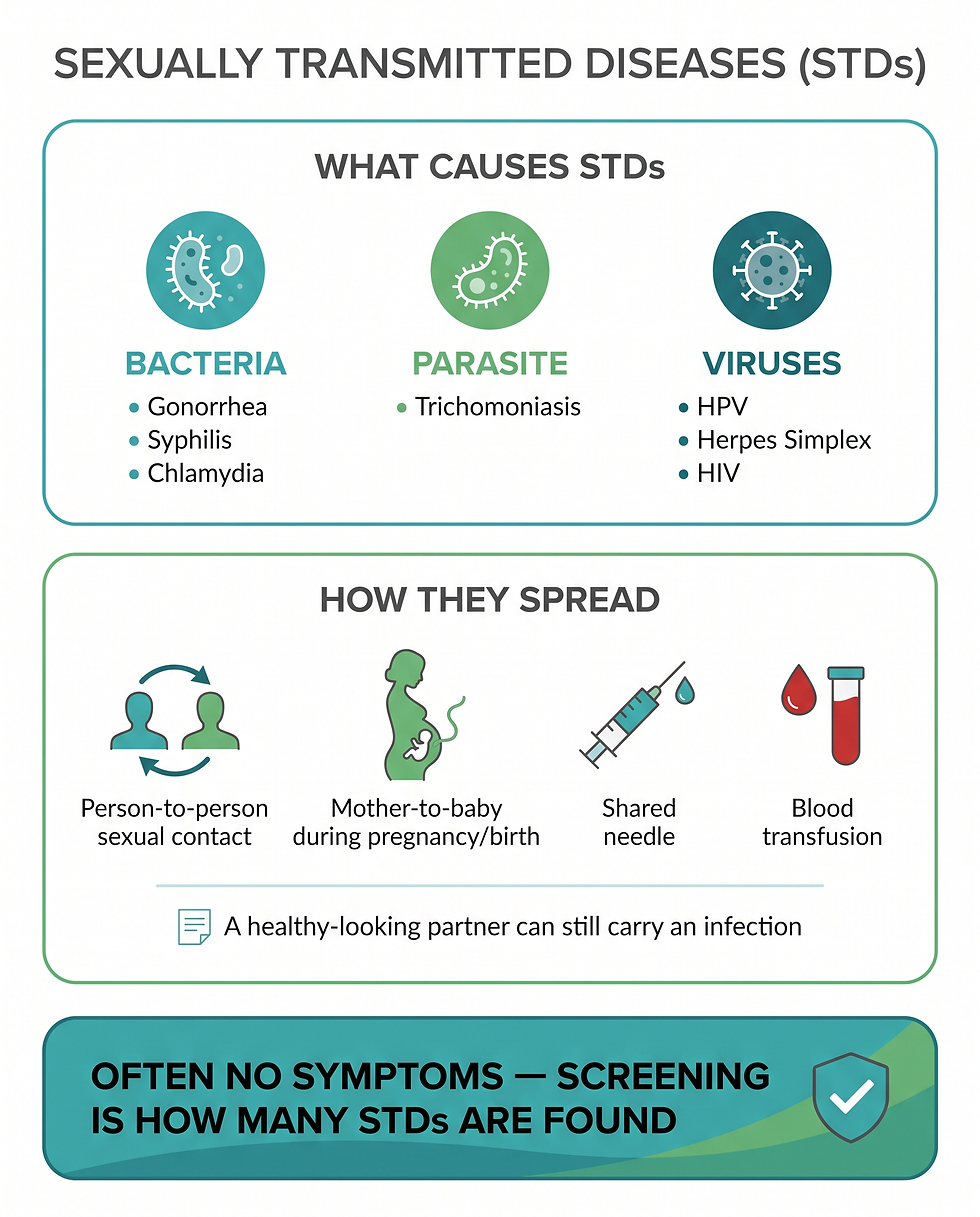
Sexually transmitted diseases (STDs) are caused by infections passed on mainly through sexual contact, by bacteria (gonorrhea, syphilis, chlamydia), a parasite (trichomoniasis), or viruses (HPV, herpes simplex, and HIV) [1]. They travel through blood, semen, and vaginal and other bodily fluids, and can also spread during pregnancy or birth, through blood transfusions, or by sharing needles [1]. Because many STDs cause no symptoms, a person can catch one from someone who seems healthy and has no idea they are infected [1]. The ten warning signs include sores or bumps, painful urination, unusual discharge, and rash, and most bacterial and parasitic STDs can be cured with antibiotics, while viral ones like herpes and HIV are managed but not always cured [2].
Quick Answer
What they are: Diseases caused by infections spread mainly through sexual contact, bacteria, one parasite, and several viruses [1].
The key catch: They often cause no symptoms, so a healthy-looking partner can still transmit one [1].
The ten signs: Sores or bumps, painful or burning urination, penile or unusual vaginal discharge, unusual vaginal bleeding, pain during sex, swollen lymph nodes, lower abdominal pain, fever, and rash [1].
How they're tested: Blood tests (HIV, later-stage syphilis), urine samples (chlamydia, gonorrhea), and fluid swabs from open sores [2].
Treatment in one line: Antibiotics often cure bacterial and parasitic STDs, sometimes in a single dose, while antivirals manage viral infections; avoid sex until treatment is complete and sores heal [2].
What This Guide Is Based On
This guide is built entirely from specialist-reviewed clinical guidance updated in September 2023, supported by the U.S. Preventive Services Task Force HIV screening recommendations, the CDC's PrEP and HIV treatment resources, the American College of Obstetricians and Gynecologists' cervical cancer screening guidance, the Merck Manual professional reference, UpToDate overviews of sexually transmitted infections, Campbell-Walsh-Wein Urology (12th ed., 2021), and the Nelson Textbook of Pediatrics for pregnancy and infant transmission. These peer-reviewed and institution-backed references are cited inline throughout, with the full list at the end of this guide [1] [2].
What Are STDs?
Sexually transmitted diseases are diseases that are caused by sexually transmitted infections (STIs). They're spread mainly by sexual contact [1].
Bacteria, viruses, and parasites cause these infections. They pass from person to person through blood, semen, or vaginal and other bodily fluids [1].
Importantly, STDs can also spread through non-sexual contact. Some pass from mother to infant during pregnancy or childbirth, and a few can be spread through blood transfusions or by sharing needles used to inject drugs [1].
What Are the Symptoms?
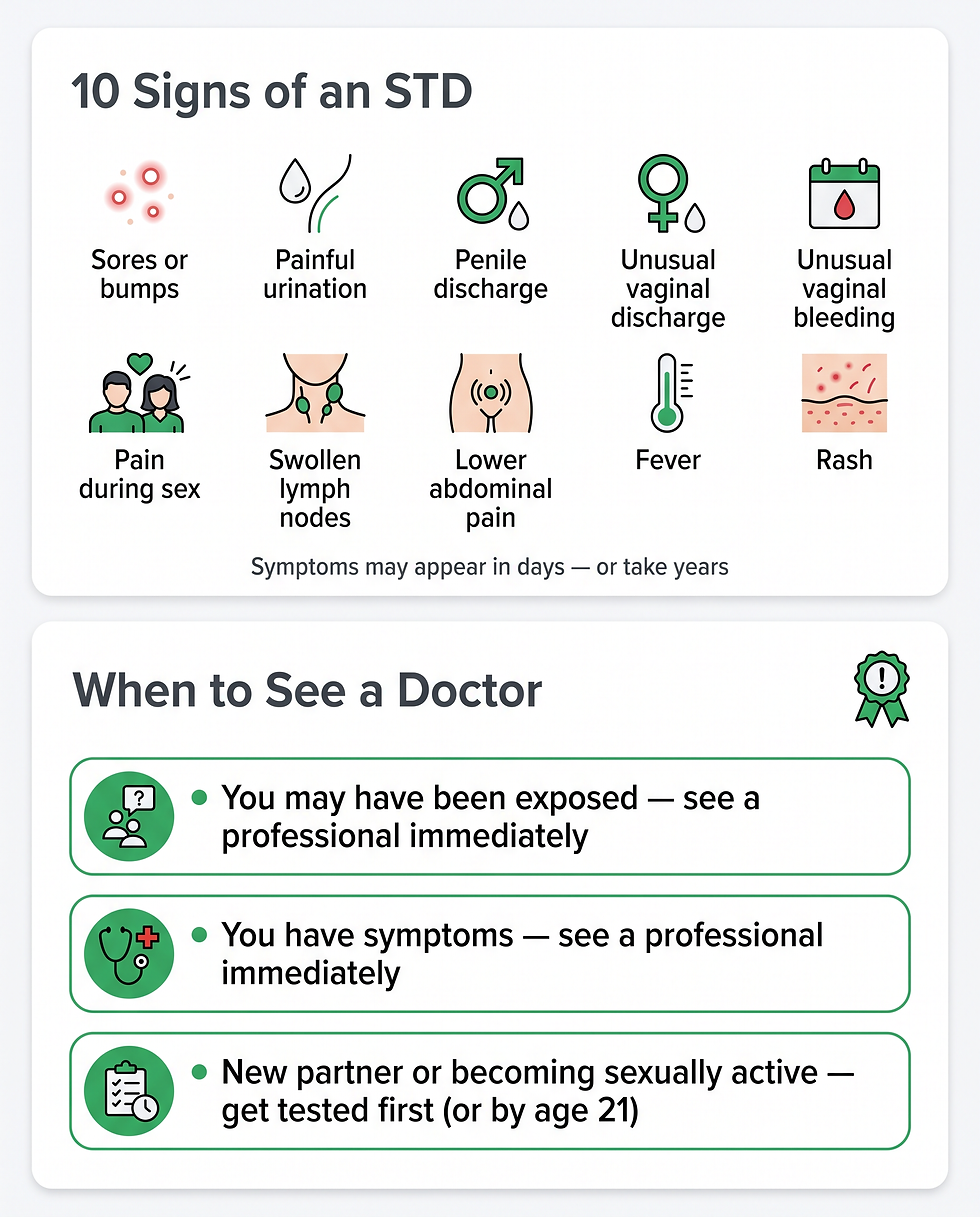
Some people don't have signs or symptoms with a sexually transmitted infection. But if they do occur, symptoms may begin within days of exposure, or it may take years before you notice a problem, depending on the organism [1].
Sign | What it looks like |
Sores or bumps | On the genitals or in the oral or rectal area [1] |
Painful or burning urination | Burning sensation when urinating [1] |
Discharge from the penis | Fluid coming from the penis [1] |
Unusual or odorous vaginal discharge | Different than usual, or smelling unusual [1] |
Unusual vaginal bleeding | Bleeding outside your normal period [1] |
Pain during sex | Pain with intercourse [1] |
Sore, swollen lymph nodes | Particularly in the groin, but sometimes more widespread [1] |
Lower abdominal pain | Pain in the lower belly [1] |
Fever | Elevated body temperature [1] |
Rash | Over the trunk, hands, or feet [1] |
A symptom appearing right after a new sexual partner doesn't automatically mean infection from that person. It can take years for an infection to produce symptoms [1].
When Should You See a Doctor?
See your doctor immediately if you are sexually active and you may have been exposed to an STD. See your doctor immediately if you have symptoms of an STD [1].
It is also wise to make an appointment for STD screening when you are considering becoming sexually active, or at age 21, whichever comes first. And if you are thinking about starting to have sex with a new partner, it is a good idea to have a conversation about being tested first [1].
What Causes STDs?
Three types of organisms cause STDs, and they behave very differently in treatment. Bacteria cause gonorrhea, syphilis, and chlamydia. Parasites cause trichomoniasis. Viruses cause infections such as human papillomavirus (HPV), genital herpes, and human immunodeficiency virus (HIV), the infection that causes AIDS [1].
This division matters because of what happens next: bacterial and parasitic STDs are generally curable, while viral STDs are manageable but not always curable [2].
What Increases Your Risk?
The more frequently you have sexual contact, with the same person or with several people, the greater your risk of an STD. The behaviors that matter most are covered in the table below [1].
Risk factor | Why it matters |
Unprotected sex | Vaginal or anal sex without a correctly used latex or polyurethane condom greatly increases risk; natural-membrane condoms are not recommended because they are not as effective at preventing STDs; improper or inconsistent condom use also raises risk; oral sex is less risky but STDs can spread without a barrier [1] |
Sexual contact with many partners | The more partners you have, the greater your risk [1] |
A history of STDs | Having one STD makes it easier for another to take hold [1] |
Being forced to engage in sexual activity | Seek medical screening, treatment, and emotional support as soon as possible [1] |
Misuse of alcohol or recreational drugs | Substance use interferes with judgment and increases the likelihood of risk-taking behavior [1] |
Injecting drugs | Sharing needles spreads many serious STDs, including HIV and hepatitis B and C [1] |
Being young | Half of all new STDs occur in people ages 15 to 24 [1] |
Mother to infant. Some STDs can pass from mother to child during pregnancy or delivery. These infections can cause serious problems in a newborn, even death. All pregnant women should be screened for these infections and treated as necessary [1].
What Are the Possible Complications?
Untreated or poorly treated STDs can damage the body well beyond the original infection [1].
Complication | What it involves |
Pelvic pain | Ongoing discomfort after infection [1] |
Pregnancy complications | Serious problems for a newborn, even death [1] |
Eye inflammation | Infection-related inflammation of the eyes [1] |
Arthritis | Joint inflammation triggered by certain STDs [1] |
Pelvic inflammatory disease (PID) | Infection of the reproductive organs in women [1] |
Infertility | Difficulty becoming pregnant, often linked to PID [1] |
Heart disease | Long-term cardiovascular effects of some infections [1] |
Certain cancers | HPV strains that cause most cervical cancers and are associated with cancers of the anus, penis, vagina, vulva, and oropharynx [1] |
How Are STDs Diagnosed?
Testing begins with your doctor asking about your sexual history and current symptoms, followed by a physical or pelvic exam to check for signs such as rashes, warts, and unusual discharge [2].
Test | What it finds |
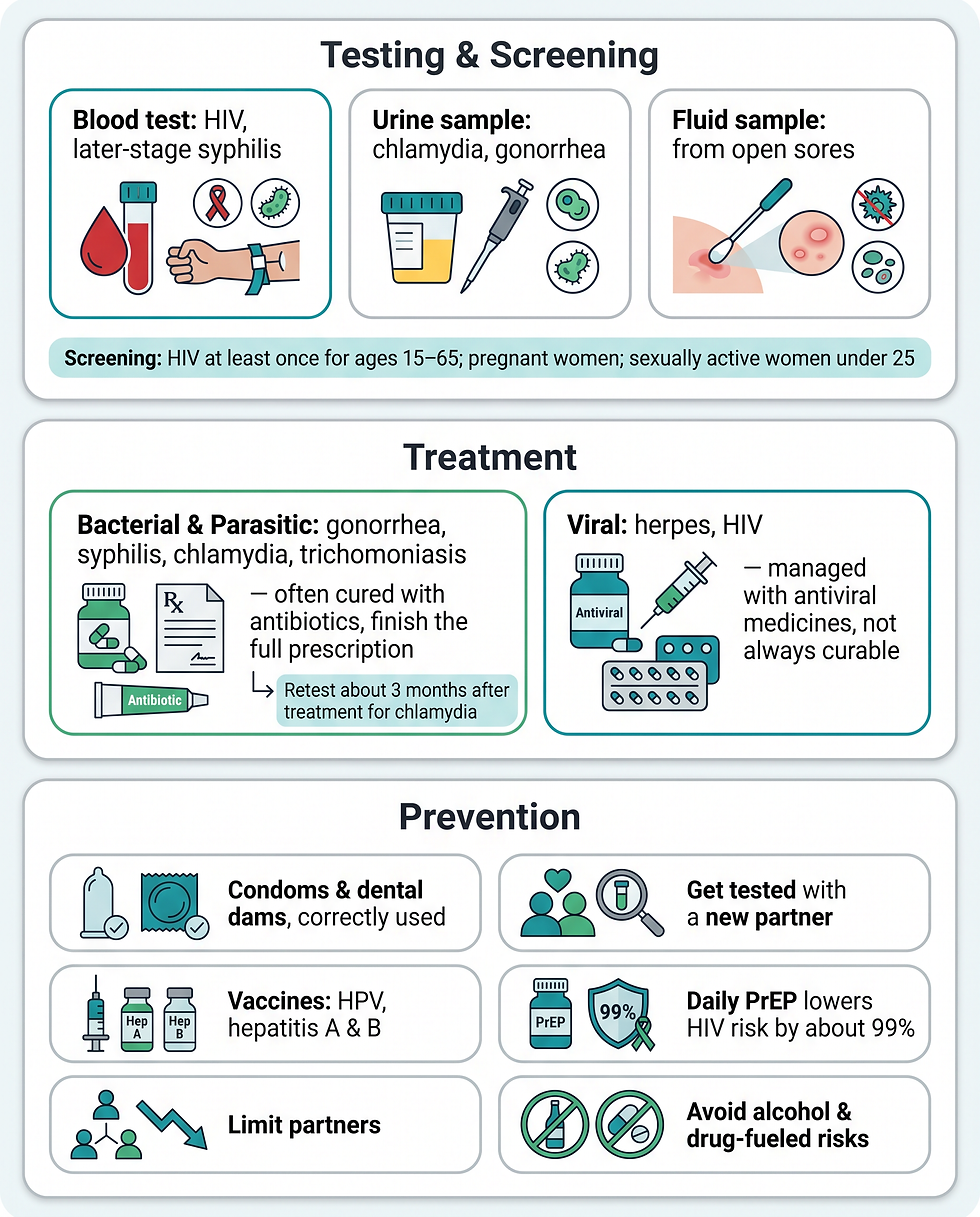
Blood tests | Can confirm HIV or later-stage syphilis [2] |
Urine samples | Can confirm some STDs, including chlamydia and gonorrhea [2] |
Fluid samples | Testing fluid from an open genital sore can type the infection [2] |
One important caveat: it is possible to be infected yet test negative, most commonly when the test is taken soon after infection [2].
Who Should Get Screened, and When?
Screening means testing when you have no symptoms. It is not routine for most people, but health care providers suggest it in certain situations, such as before sex with a new partner, when moving to a higher-risk setting, or with a history of STDs [2].
Group | Recommended screening |
Almost everyone ages 15–65 | HIV test at least once; higher risk means yearly testing; hepatitis B at least once at 18 or older; hepatitis C for all adults [2] |
Pregnant women | HIV, hepatitis B, chlamydia, and syphilis early in pregnancy; gonorrhea and hepatitis C at least once if at high risk [2] |
Women starting at 21 | Pap test every 3 years; after 30, HPV test with Pap every 5 years, or Pap alone every 3, or HPV alone every 3 [2] |
Sexually active women under 25 | Test for chlamydia via urine or self-collected vaginal fluid, plus gonorrhea screening [2] |
Men who have sex with men | Annual or more-frequent screening for HIV, syphilis, chlamydia, and gonorrhea; hepatitis B evaluation [2] |
People with HIV | Test for syphilis, gonorrhea, chlamydia, and herpes right away; hepatitis C screening; women with HIV need earlier and more frequent cervical screening [2] |
Reinfection is common because an untreated or undertreated partner can pass the infection back. Ask your doctor how long after treatment you should be retested, for chlamydia, about three months after treatment, and again if you start sex with a new partner. Note that routine genital herpes testing is not recommended without symptoms [2].
How Are STDs Treated?
Treatment depends on what is causing the infection. Bacterial STDs are generally easier to treat. Viral STDs can be managed and treated but are not always curable [2]. If you are pregnant and have an STD, treatment right away will prevent or lower your risk of passing the infection to your baby [2].
Treatment | What it covers |
Antibiotics | Often effective in a single dose for gonorrhea, syphilis, chlamydia, and trichomoniasis; it is critical to finish the entire prescription [2] |
Antiviral drugs | Daily suppressive therapy for herpes reduces recurrences but transmission remains possible; antivirals keep HIV in check for years, and treatment started sooner is more effective [2] |
Timing rules for antibiotics. Avoid sexual activity until seven days after finishing antibiotics, and until any sores have healed. Because chlamydia is so often passed back and forth between partners, get retested about three months after treatment even if your partner was treated [2].
An encouraging note on HIV. When antiviral medicines are used as directed, they can suppress the virus to levels that tests can't detect, and if the virus can't be found in your body, you won't spread it to sex partners [2].
How Can You Prevent STDs?
There is no sure way to avoid STDs other than avoiding sex. The measures below reduce risk substantially, and most work best in combination [1].
Prevention measure | How it helps |
Stay in one uninfected, monogamous relationship | Limits exposure to a single known-tested partner [1] |
Wait and test with new partners | Get tested for STDs before having vaginal or anal sex with new partners; use a condom or dental dam for oral sex [1] |
Get vaccinated | Vaccines exist for HPV, hepatitis A, and hepatitis B [1] |
Use condoms and dental dams consistently and correctly | Use a new one for each sex act; never pair oil-based lubricants with latex; note they offer less protection for STDs spread by sores, such as HPV and herpes; birth control pills and IUDs do not protect against STDs [1] |
Avoid excessive alcohol and drug use | Judgment slips, and risk-taking rises [1] |
Take daily PrEP if at high HIV risk | Emtricitabine + tenofovir disoproxil fumarate (Truvada) or emtricitabine + tenofovir alafenamide fumarate (Descovy), taken exactly as prescribed; an HIV test is required before starting and every 3 months after; daily Truvada lowers sexual HIV transmission risk by about 99% and injection-drug-use risk by more than 74% [1] |
Talking with your partner about what activities you are both comfortable with is itself a protective step, and discussing male circumcision with a doctor can lower the risk of HIV infection acquired from a female partner by as much as 60% [1].
What Should You Do About Partners?
If you are diagnosed with an STD, it is important to tell your current sexual partner and any partners from the past three months to a year so they can be tested and treated if needed. Telling partners lowers the risk of reinfection, you can catch some STDs more than once [2].
Most states require certain STDs to be reported to the health department, where disease intervention specialists can help notify your partners privately and confidentially and refer them for treatment. This service matters especially for syphilis and HIV [2].
How Can You Cope With an STD Diagnosis?
Finding out you have an STD can be a traumatic experience. You may feel anger, shame, or worry. If you feel betrayed by a partner, hold off placing blame, either one of you may have been infected by a previous partner [2].
Try to be honest with your health care workers. Sexual histories are confidential, and providers are not there to judge. You can also contact your health department for confidential testing, treatment, and partner-notification services, though note that local departments may lack the staff and funds to offer all services [2].
How Should You Prepare for Your Appointment?
Your doctor will need details about your sexual history, which can feel intimidating. If you are nervous, write your experiences down and share them at your appointment, or hand the list over before the discussion starts [2].
Write down your symptoms, a complete list of all your medications, vitamins, and supplements, and your questions. Find out before your visit whether there are any restrictions you should follow in the meantime [2]. While waiting, avoid sexual activity until you have talked with your doctor; if you do have sex, use safe sex practices such as a condom [2].
Questions to ask your doctor | Why it helps |
What is the medical name of the infection? | Names the exact condition [2] |
How is the infection transmitted? | Clarifies how you caught it and how to avoid repeating it [2] |
Will it keep me from having children? | Addresses fertility concerns [2] |
Could I give it to my baby if I get pregnant? | Covers pregnancy planning [2] |
Can I catch this again? | Frames reinfection risk [2] |
Could this come from a one-time encounter? | Corrects the "only long-term partners" myth [2] |
Could I pass it on in a single encounter? | Informs how you protect others [2] |
How long have I had it? | Sets realistic expectations about timing [2] |
How do I manage this with my other conditions? | Coordinates care [2] |
Should I avoid sexual activity while being treated? | Sets the safe-waiting window [2] |
Does my partner have to see a doctor to be treated? | Resolves the partner-treatment question [2] |
Expect your doctor to ask about symptoms and their duration, whether you have sex with men, women, or both, how many partners you have had and for how long, any history of injecting drugs, your protection practices, pregnancy prevention, prior STD diagnoses and treatments, and partners in the past year [2].
Conclusion: The One Conversation That Changes Everything
STDs are among the most common, and most misunderstood, infections in medicine. The single biggest source of confusion is that they often cause no symptoms, which means a person can feel completely healthy and still carry an infection that takes years to surface. That is why screening exists: nearly everyone should have at least one HIV test between ages 15 and 65, sexually active women under 25 should be tested for chlamydia, and anyone with a new partner should test before starting sex. The good news is that most bacterial and parasitic STDs are curable, often with a single antibiotic dose, and viral infections like HIV are now so treatable that effective therapy can stop transmission entirely. Prevention stacks the odds further, consistent condom use, vaccination against HPV and hepatitis, mutual testing, and PrEP for those at high HIV risk. If you notice any of the ten signs, have been exposed, or are starting a new sexual relationship, the best next step is the same: get tested early, finish every treatment completely, and talk to your partner honestly.
If you notice any sign of a possible STD or believe you have been exposed, contact your health care provider right away.
This guide is for general education only and is not a substitute for professional medical advice, diagnosis, or treatment. Always seek the advice of a qualified healthcare provider with any questions about a medical condition.
Frequently Asked Questions
What is an STD, in simple terms?
It is a disease caused by an infection, bacteria, a parasite, or a virus, that spreads mainly through sexual contact, passing through blood, semen, vaginal, and other bodily fluids [1].
Can I tell if my partner has an STD just by looking?
No. Many STDs cause no symptoms, so a person can look completely healthy and still carry and spread an infection without knowing it [1].
What are the main symptoms to watch for?
Ten signs cover most cases: sores or bumps, painful or burning urination, penile discharge, unusual or odorous vaginal discharge, unusual vaginal bleeding, pain during sex, swollen lymph nodes, lower abdominal pain, fever, and a rash on the trunk, hands, or feet [1].
How fast do symptoms appear?
It depends on the organism, symptoms may begin within days of exposure, or it may take years before a problem becomes noticeable [1].
Are STDs curable?
Mostly, yes, bacterial and parasitic STDs such as gonorrhea, syphilis, chlamydia, and trichomoniasis are generally curable, often with a single antibiotic dose. Viral STDs like herpes and HIV are treatable and manageable but not always curable [2].
How are STDs tested for?
Through blood tests (which confirm HIV or later-stage syphilis), urine samples (which confirm chlamydia and gonorrhea), and fluid samples taken from open genital sores, combined with a sexual history and physical or pelvic exam [2].
Can I get tested again and still be infected?
Yes, it is possible to be infected yet test negative, most commonly when testing happens soon after infection, before the body shows markers [2].
Do I need to tell my partners?
Yes. Current partners and anyone from the past three months to a year should be told so they can be tested and treated, which is essential because reinfection is common, health departments can notify them confidentially for you [2].
References
Additional references consulted:
U.S. Preventive Services Task Force: Human immunodeficiency virus (HIV) infection: screening
Centers for Disease Control and Prevention: Pre-Exposure Prophylaxis (PrEP)
Centers for Disease Control and Prevention: HIV treatment
American College of Obstetricians and Gynecologists: Cervical cancer screening
Merck Manual Professional Version: Sexually transmitted diseases
Ghanem KG, et al. Sexually transmitted infections. UpToDate.
Campbell-Walsh-Wein Urology. 12th ed. Elsevier; 2021.
Centers for Disease Control and Prevention: Hepatitis B testing
Centers for Disease Control and Prevention: Vaccines for HPV and hepatitis
Source references:
Sexually transmitted diseases (STDs) — Symptoms & causes (updated Sep 08, 2023)
Sexually transmitted diseases (STDs) — Diagnosis & treatment (updated Sep 08, 2023)
Comments