CD4 Count: Normal Range, What a Low CD4 Count Means and How Often It's Checked

Updated: 2 days ago
Written and medically reviewed by Dr. Baraa Alnahhal, MD · Last reviewed: November 2026 · How we review
Quick Answer
A CD4 count is a blood test that measures CD4 cells, a type of white blood cell that coordinates the immune response. HIV destroys these cells, so the count shows how strong the immune system is. A normal CD4 count is about 500–1,200 cells/mm³. A count of 200 or below defines stage 3 HIV (AIDS).
What the research says
Treating HIV early protects CD4 cells and health: in the START trial of 4,685 adults with HIV and CD4 counts above 500, starting antiretroviral therapy right away cut serious AIDS-related and non-AIDS-related illness or death by 57% compared with waiting until the CD4 count fell to 350 (INSIGHT START Study Group, Lundgren JD et al., New England Journal of Medicine, 2015) [2]
The benefit holds even with higher CD4 counts: in the TEMPRANO trial of 2,056 adults in Ivory Coast, starting HIV treatment immediately lowered the risk of severe illness, including among those whose CD4 count was 500 or higher (TEMPRANO ANRS 12136 Study Group, Danel C et al., New England Journal of Medicine, 2015) [3]
Key takeaways
Measures helper T cells, the immune cells HIV destroys.
Normal: about 500–1,200 cells/mm³; 200 or below means stage 3 HIV (AIDS).
Used with the viral load test to track HIV and treatment.
Checked at diagnosis, every 3–6 months on treatment, then every 6–12 months when stable.
No preparation; results often within a day or two.
What are CD4 cells?
CD4 cells are helper T cells, a type of lymphocyte. They signal other immune cells to attack germs. HIV uses the CD4 protein to enter these cells and destroys them, so without treatment the count gradually falls and the body becomes vulnerable to opportunistic infections. Sources: [1]
Why is it done?
To stage HIV infection at diagnosis.
To see how well antiretroviral therapy (ART) is working, together with the HIV viral load test.
To decide when to start preventive medicines against opportunistic infections.
To monitor anti-rejection medicines after a transplant or treatments for autoimmune diseases.
To help diagnose some lymphomas and DiGeorge syndrome. Sources: [1]
How the test is done
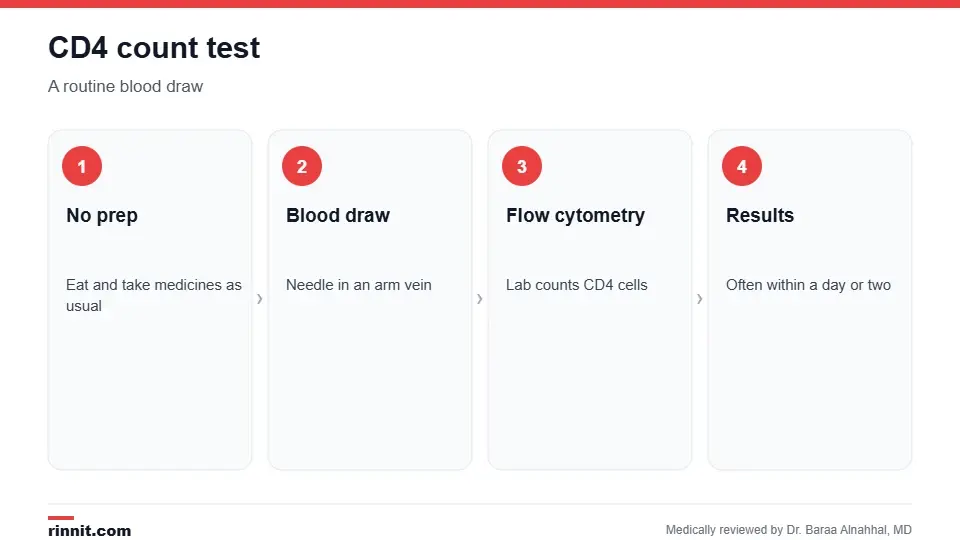
The CD4 count is a routine blood test.
No preparation is needed; eat and take your medicines as usual. A provider draws a small sample of blood from your arm. The lab counts CD4 cells with flow cytometry, often within 24 hours. You may feel a brief sting. Sources: [1]
What do the results mean?
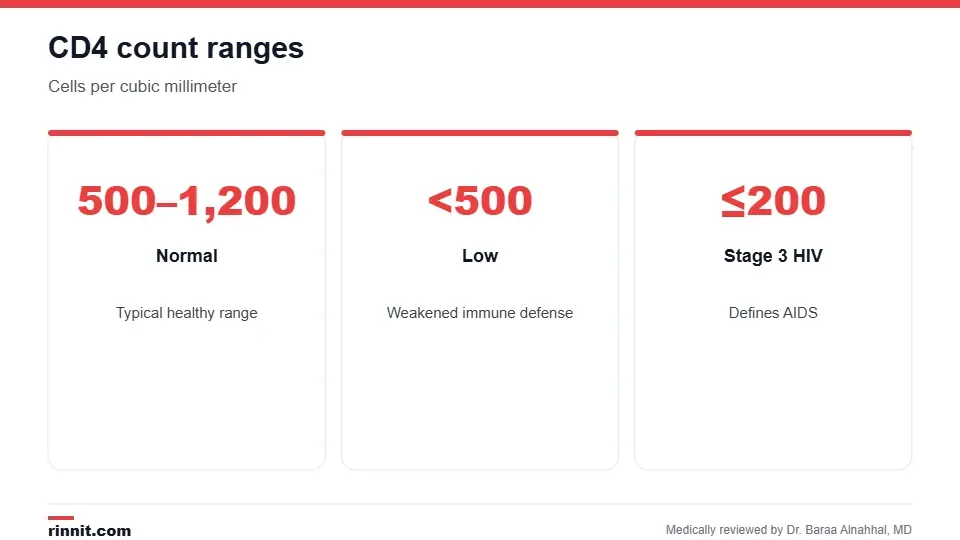
CD4 counts are reported as cells per cubic millimeter.
CD4 count (cells/mm³) | What it generally means |
500–1,200 | Normal range |
Below 500 | Low; weakened immune defenses |
200 or below | Stage 3 HIV (AIDS); high risk of opportunistic infections |
Above 1,200 | High; can occur with infections and some blood cancers |
Sources: [1]
Some labs use slightly different ranges, and results may be written as cells/mm³ or cells/mcL, which are the same. The CD4 percentage, the share of all lymphocytes that are CD4 cells, is used when the absolute count is less reliable, such as in young children. Sources: [1]
What affects CD4 counts?
Time of day the blood is drawn.
A current infection, including a cold.
Age.
Other health conditions.
Medicines, such as chemotherapy and immunosuppressants. Sources: [1]
Because a single result can vary, providers look at the trend over time. A count that is low without HIV can be caused by infections, chemotherapy or immunosuppressant medicines; see lymphopenia. Sources: [1]
How often is CD4 checked?
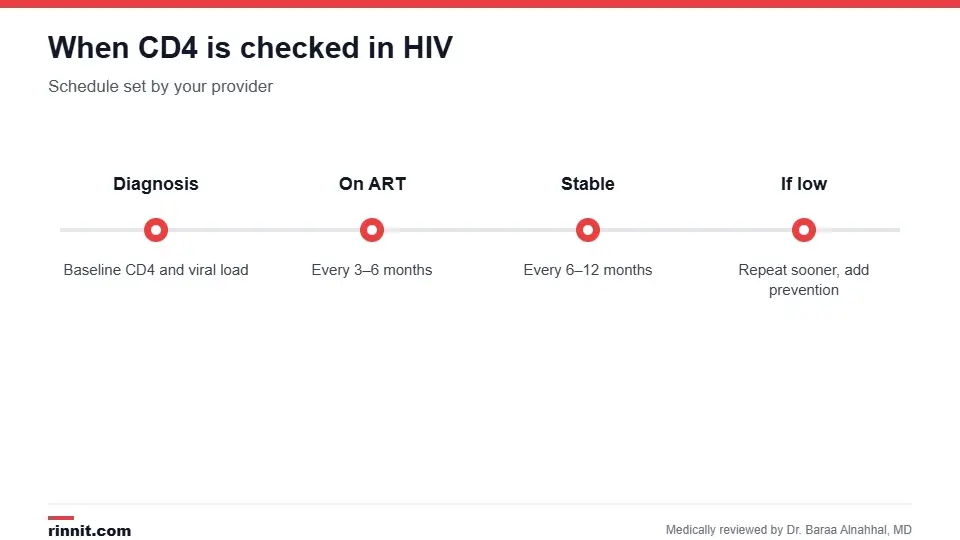
Your provider sets your testing schedule.
CD4 is checked when HIV is first diagnosed. After starting ART, it's usually repeated every 3–6 months, then every 6–12 months once your count is stable. If your count is low, your provider may repeat it sooner, prescribe preventive antibiotics or antifungals or adjust your HIV medicines. Sources: [1, 2, 3]
Risks
Risks are minimal: lightheadedness or fainting, bruising, and rarely infection or bleeding at the needle site. Sources: [1]
Conclusion
The CD4 count is a key measure of immune health, especially for people living with HIV. With effective, early treatment, CD4 counts can recover and stay in the healthy range. Go to the emergency room if you have signs of a serious infection, such as fever, pain, swelling or pus.
Keep learning: read about HIV and AIDS and the HIV viral load test.
Frequently asked questions
What is a CD4 count?
A blood test that counts helper T cells, a key part of your immune system.
What is a normal CD4 count?
About 500–1,200 cells/mm³.
What CD4 count means AIDS?
A count of 200 or below means stage 3 HIV (AIDS).
How often should CD4 be checked?
At diagnosis, every 3–6 months on treatment, then every 6–12 months when stable.
Do I need to fast?
No. Eat and take your medicines as usual.
What is CD4 percentage?
The share of lymphocytes that are CD4 cells, useful in children and some adults.
Can CD4 counts go back up?
Yes. Effective HIV treatment usually lets CD4 counts recover.
Can a CD4 count be low without HIV?
Yes, from infections, chemotherapy or immune-suppressing medicines.
What's the difference between CD4 count and viral load?
CD4 shows immune strength; viral load shows how much HIV is in your blood.
How long do results take?
Often within a day or two.
Related Reading
Antiretroviral Therapy (ART) for HIV: How It Works and Side Effects explains antiretroviral therapy for HIV.
HIV/AIDS: Symptoms, Causes, and How It Is Diagnosed and Treated the infection CD4 counts track.
HIV Viral Load: Test, Normal Range, Results and What They Mean the companion test that measures HIV levels.
HIV Test: Types, Window Periods, How It Works and Results tests used to diagnose HIV.
Understanding Helper T Cells: The Orchestrators of the Immune System the cells a CD4 count measures.
Lymphopenia: Low Lymphocyte Count, Causes, Symptoms and Treatment causes of a low lymphocyte count.
References
Cleveland Clinic. CD4 Cell Count (T-Cell Test): Results & Normal Range. Cleveland Clinic. Last updated April 15, 2025. https://my.clevelandclinic.org/health/diagnostics/cd4-count
INSIGHT START Study Group; Lundgren JD, Babiker AG, Gordin F, et al. Initiation of antiretroviral therapy in early asymptomatic HIV infection. N Engl J Med. 2015;373(9):795-807. PMID 26192873. https://doi.org/10.1056/NEJMoa1506816
TEMPRANO ANRS 12136 Study Group; Danel C, Moh R, Gabillard D, et al. A trial of early antiretrovirals and isoniazid preventive therapy in Africa. N Engl J Med. 2015;373(9):808-822. PMID 26193126. https://doi.org/10.1056/NEJMoa1507198
Medical disclaimer
This article is for general education only and does not replace advice from a qualified healthcare professional. Talk to your doctor about your own diagnosis and treatment, and seek emergency care right away for severe or sudden symptoms.



Comments