Flow Cytometry: What It Is, Why It's Done, How It Works and Results

Updated: 2 days ago
Written and medically reviewed by Dr. Baraa Alnahhal, MD · Last reviewed: November 2026 · How we review
Quick Answer: What is flow cytometry?
Flow cytometry is a laser-based lab test that looks at the physical and chemical features of cells in a sample of blood, bone marrow, tissue or other body fluid. Providers use it to count and sort immune cells and to identify cancer cells, especially in leukemia and lymphoma. Results usually take several days to a week.
What the research says
Clearing leftover leukemia cells after treatment is linked with better survival in ALL. A meta-analysis of 39 publications with 13,637 children and adults with acute lymphoblastic leukemia found that reaching minimal residual disease (MRD) negativity was linked with much better event-free survival in both children (hazard ratio 0.23) and adults (hazard ratio 0.28). (Berry et al., JAMA Oncology, 2017) [2]
MRD status also predicts outcomes in acute myeloid leukemia. Across 81 publications with 11,151 patients, estimated 5-year overall survival was 68% in people without MRD and 34% in people with MRD, and the link held across age groups and detection methods. (Short et al., JAMA Oncology, 2020) [3]
In multiple myeloma, testing negative for MRD after treatment is tied to longer remission. Pooled data from 14 studies (1,273 patients) showed MRD-negative status was linked with better progression-free survival (hazard ratio 0.41), and 12 studies (1,100 patients) showed better overall survival (hazard ratio 0.57). (Munshi et al., JAMA Oncology, 2017) [4]
Key takeaways
Flow cytometry uses a laser and fluorescent antibody tags to count and classify cells in a sample [1].
It helps diagnose and monitor blood and bone marrow cancers, such as leukemia and lymphoma [1].
It can also check immune cell numbers in conditions like HIV and inherited immune deficiencies [1].
You usually do not need to prepare, and the test itself has no known risks [1].
Results often take several days to a week, and a pathologist interprets the cell patterns [1].
Results can help your care team judge how aggressive a disease is, how well treatment may work and whether it has come back [1].
What is flow cytometry?
Flow cytometry is a lab test that measures the features of cells or other tiny particles. It works by spotting differences in how cells look and what proteins they carry [1].
To prepare the sample, the lab suspends cells in fluid and adds fluorescent antibody dyes. These dyes attach to specific proteins on the surface of cells or inside them. This tagging method is known as fluorescence-activated cell sorting, or FACS [1].
The process is fast. A computer can analyze roughly 10,000 cells in less than a minute [1].
What flow cytometry can do

Flow cytometry can count, sort and classify cells from a single sample.
Providers use flow cytometry for several purposes [1]:
Counting cells [1].
Sorting cells into groups [1].
Learning about the features and function of cells [1].
Diagnosing and guiding treatment of blood and bone marrow cancers [1].
Finding biomarkers that may predict how a cancer will behave or respond to treatment [1].
Immunophenotyping, which means identifying and classifying cell types [1].
Why is flow cytometry done?
Your provider may order flow cytometry to check the number and types of immune cells in your body or to find and describe cancer cells [1].
Condition group | Examples | What the test helps show |
Blood cancers | Leukemia, lymphoma | Whether abnormal cells are present and what type they are |
Blood disorders | Paroxysmal nocturnal hemoglobinuria (PNH), antithrombin deficiency | Changes in blood cells linked to the disorder |
Immune problems | HIV, inherited immune deficiencies | The number and types of immune cells |
Sources: [1]
After a complete blood count
Flow cytometry often follows a complete blood count (CBC). This is more likely if your lymphocytes are high, your cell counts are unusual or immature blood cells show up in your blood [1].
In cancer care
If you have cancer, the test can give your care team useful clues. It can help predict how aggressive the disease is, whether it is likely to respond to treatment and whether it has returned [1].
Who performs the test?
Several people are involved in your test. Your ordering provider, such as a primary care doctor or an oncologist, collects the sample and sends it to a pathology lab [1].
In the lab, technicians run the test. A pathologist, a doctor who specializes in studying cells and tissues, then interprets the results [1].
How should you prepare?
Most people do not need to do anything special before flow cytometry [1].
If your provider gives you specific instructions, follow them closely. You can ask your care team if you are unsure [1].
What happens during flow cytometry?
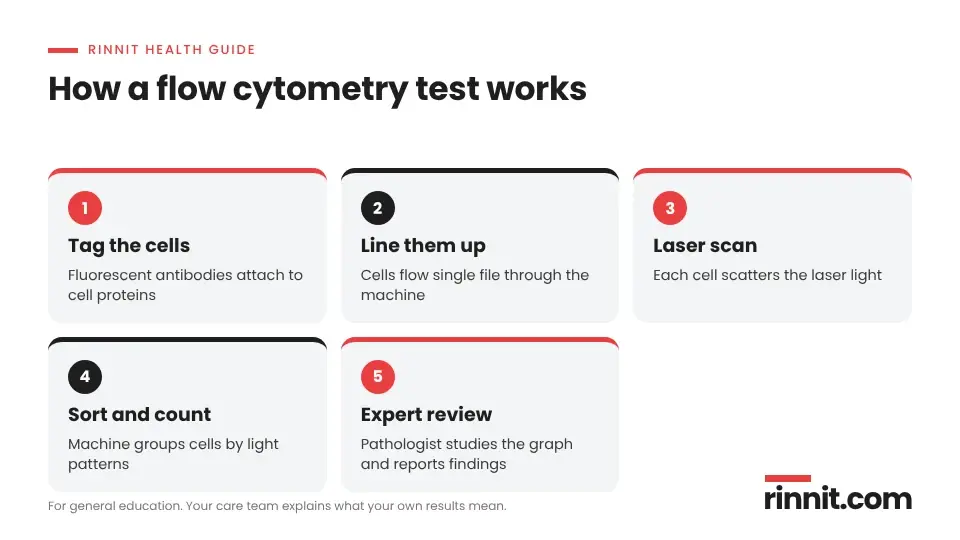
Cells pass one at a time through a laser so the machine can sort and count them.
Your provider collects a sample of blood, tissue or bone marrow, often during an office visit. The sample then goes to a lab for testing [1].
Inside the lab
Here is how the test works once your sample reaches the lab [1]:
A technician places the cells in liquid and tags them with fluorescent antibodies [1].
The flow cytometer lines up the cells single file and passes them through a laser beam, where they scatter light [1].
The machine counts the cells and sorts them into categories based on how they scatter the light [1].
A computer turns the data into a report, usually shown as a dot graph or bar graph [1].
A pathologist reviews the report and writes up the findings [1].
Are there any risks?
Flow cytometry itself has no known risks [1].
The testing happens in a lab, on a sample your provider collects and sends there [1].
How long do results take?
Results usually come back in several days to a week. The exact timing depends on the lab [1].
What do flow cytometry results mean?

Your result is based on the pattern of markers found on your cells.
The pathologist looks at the antigens, or markers, on your cells. Healthy cells show a marker pattern that fits their type and stage of maturity [1].
Abnormal cells show different patterns. These patterns may suggest leukemia, lymphoma or another disease [1].
Conditions an abnormal result may suggest
Abnormal result may point to | Type of condition |
Acute lymphoblastic leukemia | Leukemia |
Acute myeloid leukemia | Leukemia |
Chronic lymphocytic leukemia | Leukemia |
Multiple myeloma | Plasma cell cancer |
B-cell or T-cell non-Hodgkin lymphoma | Lymphoma |
Sources: [1]
How your provider uses the report
Your provider reviews the pathologist's report along with your symptoms, health history and most recent physical exam. They then explain what the results mean for you and what comes next [1].
What happens after the test?
If your results are abnormal, your provider will talk with you about treatment options [1].
Flow cytometry results can show how aggressive a condition is, whether a treatment is likely to work and how likely the disease is to come back. Your care team uses this information to shape your treatment plan [1].
Conclusion
Flow cytometry is a fast, laser-based test that gives your care team a detailed look at the cells in your blood, bone marrow or tissue. It plays a key role in finding and tracking blood cancers and immune problems.
Waiting for results can feel hard, but the information helps your team make an accurate diagnosis and build a plan that fits you. Ask your provider any questions you have about your report.
Keep learning: Read our complete guide to the complete blood count (CBC) or our guide to biopsy and how tissue samples are taken. For more background, see the MedlinePlus Leukemia page.
FAQ
What is flow cytometry?
It is a lab test that uses a laser and fluorescent dyes to count and classify cells in a sample of blood, bone marrow, tissue or other body fluid.
Why would my doctor order flow cytometry?
It is often ordered to look for blood cancers like leukemia or lymphoma, check immune cell counts or follow up on an unusual complete blood count.
How does flow cytometry work?
Cells are tagged with fluorescent antibodies, lined up single file and passed through a laser. The machine sorts and counts them by how they scatter light.
Does flow cytometry hurt?
The test itself is done in a lab, so you feel nothing. You may feel brief discomfort when your blood, bone marrow or tissue sample is collected.
Do I need to prepare for flow cytometry?
Usually not. Follow any specific instructions your provider gives you before your sample is collected.
How long does it take to get flow cytometry results?
Results usually take several days to a week, depending on the lab that processes your sample.
What is a normal flow cytometry result?
A normal result means your cells show marker patterns that match their expected type and maturity, with no abnormal cell groups found.
What does an abnormal flow cytometry result mean?
Abnormal marker patterns may suggest a condition such as leukemia, lymphoma or multiple myeloma. Your provider will explain what your specific result means.
Are there risks with flow cytometry?
The lab test itself has no known risks. Any risks relate to how the sample is collected, which your provider can explain.
What happens after an abnormal result?
Your provider will review the report with your health history and discuss treatment options. Results can also help predict how well treatment may work.
Related Reading
Immunostaining: How Labeled Antibodies Help Diagnose Cancer and Other Diseases explains the antibody staining methods pathologists use to pinpoint a diagnosis.
Immunophenotyping: How It Identifies Blood Cells to Diagnose Leukemia and Lymphoma explains the marker test used to diagnose and classify leukemia and lymphoma.
Lymphoma: Symptoms, Types, Causes, Diagnosis and Treatment explains the lymphoma types that flow cytometry helps identify and classify.
Understanding Leukemia: Types, Symptoms, and Modern Management covers the leukemias, such as ALL, AML and CLL, that this test often helps diagnose.
What Is Multiple Myeloma? A Plain-Language Guide to Symptoms, Causes, and Treatment explains a plasma cell cancer that abnormal flow cytometry results may point to.
What Is Myelodysplastic Syndrome? A Plain-Language Guide to Symptoms, Causes, and Treatment covers a bone marrow disorder where blood and marrow cell testing plays a role.
HIV/AIDS: Symptoms, Causes, and How It Is Diagnosed and Treated explains HIV, a condition where flow cytometry helps count immune cells.
References
Cleveland Clinic. Flow Cytometry: Test, Uses, & Results. Cleveland Clinic. Last updated August 1, 2024. https://my.clevelandclinic.org/health/diagnostics/22086-flow-cytometry
Berry DA, Zhou S, Higley H, et al. Association of Minimal Residual Disease With Clinical Outcome in Pediatric and Adult Acute Lymphoblastic Leukemia: A Meta-analysis. JAMA Oncol. 2017;3(7):e170580. PMID 28494052. https://doi.org/10.1001/jamaoncol.2017.0580
Short NJ, Zhou S, Fu C, et al. Association of Measurable Residual Disease With Survival Outcomes in Patients With Acute Myeloid Leukemia: A Systematic Review and Meta-analysis. JAMA Oncol. 2020;6(12):1890-1899. PMID 33030517. https://doi.org/10.1001/jamaoncol.2020.4600
Munshi NC, Avet-Loiseau H, Rawstron AC, et al. Association of Minimal Residual Disease With Superior Survival Outcomes in Patients With Multiple Myeloma: A Meta-analysis. JAMA Oncol. 2017;3(1):28-35. PMID 27632282. https://doi.org/10.1001/jamaoncol.2016.3160
Medical disclaimer
This article is for general education only and does not replace advice from a qualified healthcare professional. Talk to your doctor about your own diagnosis and treatment, and seek emergency care right away for severe or sudden symptoms.



Comments