Complete Blood Count (CBC): What It Measures, Normal Ranges and Abnormal Results

Updated: 2 days ago
Written and medically reviewed by Dr. Baraa Alnahhal, MD · Last reviewed: November 2026 · How we review
Quick Answer: What is a complete blood count (CBC)?
A complete blood count (CBC) is a blood test that measures the number and size of red blood cells, white blood cells and platelets, plus hemoglobin. Providers use it in routine checkups, to look into symptoms such as tiredness, fever, bruising or bleeding, and to monitor conditions. It can detect anemia, infections and blood cancers. No fasting is needed. [1]
What the research says
Anemia, one of the main findings on a CBC, affects about 1 in 4 people worldwide. The Global Burden of Disease 2021 study estimated a global anemia prevalence of 24.3% in 2021, or 1.92 billion people. Dietary iron deficiency was the leading cause of the disability linked to anemia. (GBD 2021 Anaemia Collaborators, The Lancet Haematology, 2023) [2]
Some often-overlooked CBC numbers carry useful information. A clinical review highlighted three underused CBC values: red cell distribution width (RDW), mean platelet volume (MPV) and the nucleated red blood cell (NRBC) count. Each has its own diagnostic and prognostic uses when read with the rest of the CBC. (May et al., Cleveland Clinic Journal of Medicine, 2019) [3]
Key takeaways
A CBC counts and measures red blood cells, white blood cells and platelets from a single blood sample. [1]
A CBC with differential also counts each type of white blood cell. [1]
It can show anemia, high or low white cell counts and high or low platelet counts. [1]
Normal ranges depend on the lab, age, hormone status and pregnancy, so compare your results with your own report. [1]
An abnormal result may need follow-up tests, treatment or only monitoring. [1]
What is a complete blood count (CBC)?
A CBC is a blood test providers use to monitor or diagnose health conditions. It shows how medicines or illnesses are affecting your body and how healthy your immune system is. A lab measures your red blood cells, hemoglobin (the oxygen-carrying protein in red cells), white blood cells and platelets, and the size of your blood cells. Your provider may also order a peripheral blood smear to see how the cells look under a microscope. [1]
What is a CBC with differential?
A CBC with differential also counts each type of white blood cell and any immature blood cells. This gives your provider more detail about what's happening with your immune system. [1]
Why would you need a CBC?
Your provider may order a CBC: [1]
As part of a routine health exam
To look into unexplained fever, weight loss, night sweats, bruising, bleeding or tiredness
To monitor an ongoing condition, such as cancer or chronic kidney disease
To see how a treatment or medicine is affecting your body, since some can lower white cell counts
To monitor your health during pregnancy
What can a CBC detect?
A CBC can show whether you have anemia (low red cells or hemoglobin), erythrocytosis (high red cells), leukocytosis (high white cells), leukopenia (low white cells), thrombocytosis (high platelets) or thrombocytopenia (low platelets). These can be signs of infections, cancer, blood conditions or medicine side effects, and your provider uses them together with your symptoms to find the cause. [1]
What does a CBC measure?
A machine counts and sizes your red cells (erythrocytes), white cells (leukocytes) and platelets (thrombocytes). If anything is unclear, a pathologist checks your sample under a microscope. [1]
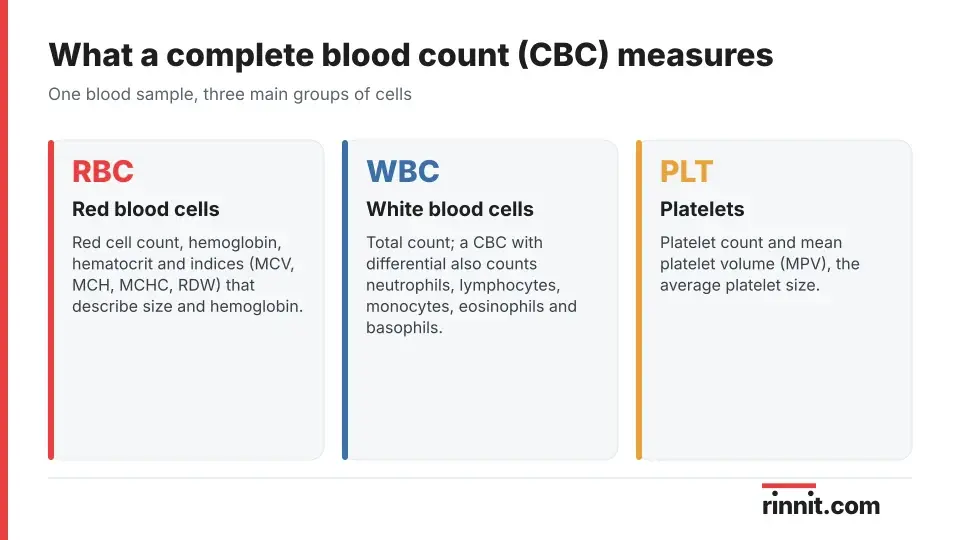
Part of the CBC | Values reported |
Red blood cells | Red blood cell count (RBC), hemoglobin (Hb), hematocrit (Hct) |
Red cell indices | MCV (average size), MCH (hemoglobin per cell), MCHC, RDW (variation in size) |
Platelets | Platelet count and mean platelet volume (MPV) |
White blood cells | Total WBC; with a differential, neutrophils, lymphocytes, monocytes, eosinophils, basophils, immature granulocytes and nucleated red blood cells |
Sources: [1]
What do the white blood cell types do?
Neutrophils: first responders that fight bacterial and fungal infections.
Lymphocytes: fight viral infections and help your immune system remember past infections.
Monocytes: clean up cell debris and alert other white cells to invaders.
Eosinophils: fight parasitic infections and take part in allergic reactions.
Basophils: release histamine during allergic reactions and heparin, which prevents clotting.
Sources: [1]
How do you prepare for a CBC?
You don't need to fast or follow special instructions. You can eat, drink and take your medicines as usual, unless other tests on the same sample need special preparation. [1]
What happens during a CBC?
A provider cleans your arm, inserts a needle and collects your blood in one or more tubes. The needle may sting or pinch a little. In infants, blood is usually taken from the heel. Afterward, your arm may be sore for a few hours and you may get a small bruise. [1]
Are there risks?
A CBC is a safe, common test. There's a small risk of infection at the needle site, especially if your immune system is weak, and some people feel faint or lightheaded for a short time. [1]
What are normal CBC ranges?
Normal ranges vary, but in general they include: [1]
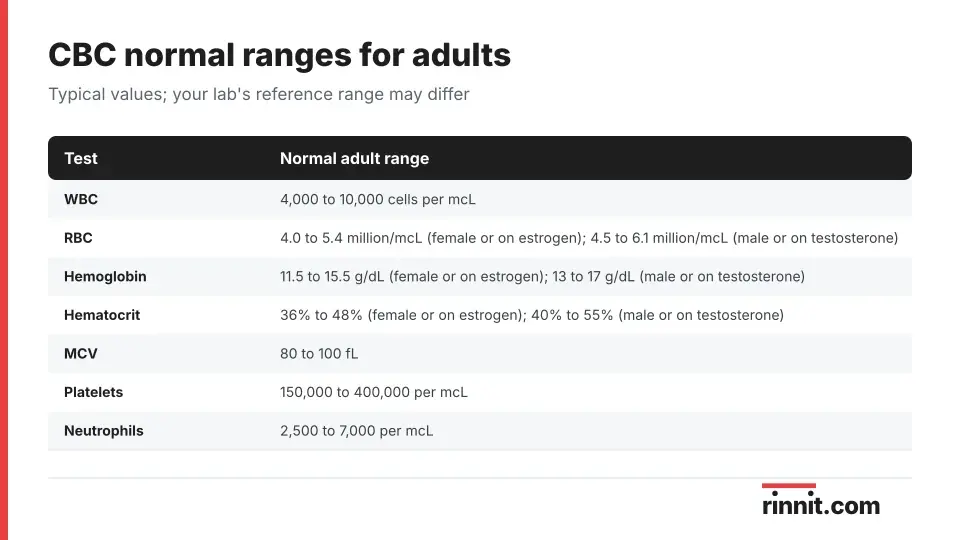
Test | Normal value for adults |
WBC | 4,000 to 10,000 cells per mcL |
RBC | 4.0 to 5.4 million per mcL (female or taking estrogen); 4.5 to 6.1 million per mcL (male or taking testosterone) |
Hemoglobin | 11.5 to 15.5 g/dL (female or taking estrogen); 13 to 17 g/dL (male or taking testosterone) |
Hematocrit | 36% to 48% (female or taking estrogen); 40% to 55% (male or taking testosterone) |
MCV | 80 to 100 fL |
MCH | 27 to 31 pg per cell |
MCHC | 32 to 36 g/dL |
RDW | 12% to 15% |
Platelets | 150,000 to 400,000 per mcL |
MPV | 7.0 to 9.0 fL |
Neutrophils | 2,500 to 7,000 per mcL |
Lymphocytes | 1,000 to 4,800 per mcL |
Monocytes | 200 to 800 per mcL |
Eosinophils | Less than 500 per mcL |
Basophils | Less than 300 per mcL |
Sources: [1]
Ranges can differ by lab, hormone status, age (children have different ranges), pregnancy and other conditions, and by units. A result in cells per microliter looks much larger than one in thousands of cells per microliter (k/mcL). Always compare your numbers with the reference range on your own report. [1]
When will you get CBC results?
Results are usually ready within a few days and sometimes within 24 hours. Your provider will explain them and discuss any next steps. [1]
What do abnormal CBC results mean?
Many conditions can cause high or low counts. Some are serious, while others are common and easy to treat: [1]

Result | Possible causes |
High red blood cells | Heart and lung conditions, polycythemia vera, sleep apnea |
Low red blood cells (anemia) | Iron or vitamin B12 deficiency, bleeding, low kidney function, blood and bone marrow disorders |
High white blood cells | Infections, allergic or autoimmune conditions, lymphoma, leukemia |
Low white blood cells | Autoimmune diseases, medicines, bone marrow disorders, infections |
High platelets | Infections and immune system issues |
Low platelets | Immune thrombocytopenia, certain cancers, hemolytic uremic syndrome |
Sources: [1]
If your results are outside the reference range, your provider may order follow-up tests, start treatment or simply monitor you. [1]
Does a CBC show kidney function?
Not directly. Some values, such as lymphocytes and MCV, together with other tests, can help your provider understand how your kidneys are working. [1]
When should you call your doctor?
Contact your provider if you have questions about the test or your results. [1]
Questions to ask your provider
Why are you ordering a CBC for me?
Do I need a CBC with differential?
Which of my values are outside the range, and what could explain them?
Do I need more tests or a repeat CBC?
Could my medicines be affecting my blood counts?
Conclusion
A complete blood count is one of the most common blood tests, measuring your red cells, white cells and platelets from one sample with no fasting. It helps spot anemia, infections, blood cancers and medicine side effects and shows how conditions and treatments are affecting you. [1]
Ranges vary by lab and by person, so read your numbers against your own report and talk with your provider about any value outside the range. [1] [3]
Keep learning: Read our guides to iron-deficiency anemia, leukocytosis, immune thrombocytopenia and the MCH blood test. For more, see MedlinePlus: CBC blood test.
FAQ
What is a complete blood count (CBC)?
A CBC is a blood test that measures your red blood cells, white blood cells, platelets and hemoglobin to help monitor or diagnose health conditions. [1]
What does a CBC test check for?
A CBC can show anemia, high or low white blood cells and high or low platelets, which may point to infections, blood conditions or cancer. [1]
Do I need to fast for a CBC?
No. You can eat, drink and take your medicines as usual unless other tests need fasting. [1]
What is a CBC with differential?
A CBC with differential also counts each type of white blood cell, such as neutrophils and lymphocytes, and immature cells. [1]
What is a normal white blood cell count?
A normal adult white blood cell count is about 4,000 to 10,000 cells per microliter. [1]
What is a normal platelet count?
A normal adult platelet count is about 150,000 to 400,000 per microliter. [1]
What is a normal hemoglobin level?
Normal hemoglobin is about 11.5 to 15.5 g/dL for females and 13 to 17 g/dL for males. [1]
How long do CBC results take?
CBC results are usually ready within a few days, sometimes within 24 hours. [1]
Can a CBC detect cancer?
A CBC can show changes that suggest blood cancers such as leukemia or lymphoma, but more tests are needed to diagnose cancer. [1]
What happens if my CBC is abnormal?
Your provider may order follow-up tests, start treatment or monitor you, depending on the cause. [1]
Related Reading
Blood Volume Testing: How It Works and What Results Mean explains the nuclear test that measures total blood volume.
Learn more in our guide to Iron Deficiency Anemia: Symptoms, Causes, Treatment & Complete Guide.
Learn more in our guide to High White Blood Cell Count (Leukocytosis): Causes and Management.
Learn more in our guide to Immune Thrombocytopenia: Symptoms, Causes, and Treatment.
Learn more in our guide to Understanding Leukemia: Types, Symptoms, and Modern Management.
Learn more in our guide to Aplastic Anemia: Symptoms, Causes, Treatment & Complete Guide.
Peripheral Blood Smear: Why It's Done, How It Works and What It Shows explains the microscope test that examines the shape and number of red cells, white cells and platelets.
Hematocrit Test: Normal Range and What High or Low Levels Mean explains the blood test that measures the percentage of red blood cells.
G6PD Test: Checking for G6PD Deficiency and Hemolytic Anemia explains the blood test for inherited G6PD enzyme deficiency.
References
Cleveland Clinic. Complete Blood Count (CBC): What It Is & Normal Ranges. Cleveland Clinic. Last updated March 14, 2024. https://my.clevelandclinic.org/health/diagnostics/4053-complete-blood-count
GBD 2021 Anaemia Collaborators. Prevalence, years lived with disability, and trends in anaemia burden by severity and cause, 1990-2021: findings from the Global Burden of Disease Study 2021. Lancet Haematol. 2023;10(9):e713-e734. PMID 37536353. https://doi.org/10.1016/S2352-3026(23)00160-6
May JE, Marques MB, Reddy VVB, et al. Three neglected numbers in the CBC: The RDW, MPV, and NRBC count. Cleve Clin J Med. 2019;86(3):167-172. PMID 30849034. https://doi.org/10.3949/ccjm.86a.18072
Medical disclaimer
This article is for general education only and does not replace advice from a qualified healthcare professional. Talk to your doctor about your own diagnosis and treatment, and seek emergency care right away for severe or sudden symptoms.



Comments