Peripheral Blood Smear: Why It's Done, How It Works and What It Shows

Updated: 2 days ago
Written and medically reviewed by Dr. Baraa Alnahhal, MD · Last reviewed: November 2026 · How we review
Quick Answer: What is a peripheral blood smear?
A peripheral blood smear (PBS) is a blood test in which a lab spreads a drop of blood on a slide, stains it and examines the red blood cells, white blood cells and platelets under a microscope. It shows the size, shape and appearance of each cell type. It's usually ordered when a complete blood count is abnormal.
What the research says
Computers are learning to read smears, but human review still matters. A systematic review and meta-analysis of 190 studies of artificial intelligence models that classify leukemia from peripheral blood smear images reported a mean validation accuracy of about 95%, yet 87% of studies tested the models only on their own data, so external validation is still needed. (Aria et al., Journal of Evidence-Based Medicine, 2025) [2]
Smear review is a major, often unpaid, lab workload. A nationwide survey of laboratories in South Korea found that smear reviews triggered by abnormal blood counts took technologists a median of 4,825 minutes per month in large academic centers, and 79.4% of institutions did not bill for them. (Kim et al., Annals of Laboratory Medicine, 2026) [3]
Key takeaways
A peripheral blood smear is a visual check of your blood cells under a microscope, done by a specialist rather than a machine. [1]
It is usually ordered after an abnormal complete blood count or for symptoms such as fatigue, fever or easy bruising. [1]
It can reveal changes in the size and shape of red cells, white cells and platelets, and even parasites such as malaria. [1]
No fasting or other preparation is needed; it is a simple blood draw. [1]
The smear is not a positive-or-negative test; it adds detail that helps your provider decide on further testing. [1]
What is a peripheral blood smear?
A peripheral blood smear lets providers look directly at the three main parts of your blood. A lab technician treats a thin film of blood with chemicals that highlight the cells, and a hematologist or hematopathologist reviews the slide. The test does not diagnose disease by itself, but it gives your provider detailed information about your blood cells and platelets that automated tests cannot. [1]

What a peripheral blood smear looks at.
Cell type | What it does | What the smear can show |
Red blood cells | Carry oxygen from the lungs to tissues and carbon dioxide back | Changes in size and shape that point to anemia and other disorders |
White blood cells | Fight infection; there are five types | Abnormal numbers or immature cells that can signal leukemia or infection |
Platelets | Help blood clot | Too few or oddly shaped platelets |
Sources: [1]
Why is a peripheral blood smear done?
Your provider may order a smear if: [1]
A routine complete blood count shows abnormal results. [1]
You have symptoms such as fatigue, fever or bruising that could point to a blood cancer, a blood disorder or an infection. [1]
They need more information about your bone marrow and blood cells before a possible stem cell transplant. [1]
They want to check whether a treatment is working. [1]
Conditions a blood smear can help detect
Condition | What the smear may show |
Leukemia | Abnormal or immature white blood cells |
Cells that fail to mature normally | |
Anemia | Too few or misshapen red blood cells |
Cancerous white blood cells | |
Autoimmune diseases | Low white cell or platelet counts |
Malaria | Parasites inside red blood cells |
Heart failure | A higher-than-normal red blood cell count |
Sources: [1]
How do you prepare for a peripheral blood smear?
No fasting or other preparation is needed. [1]
What happens during a peripheral blood smear?
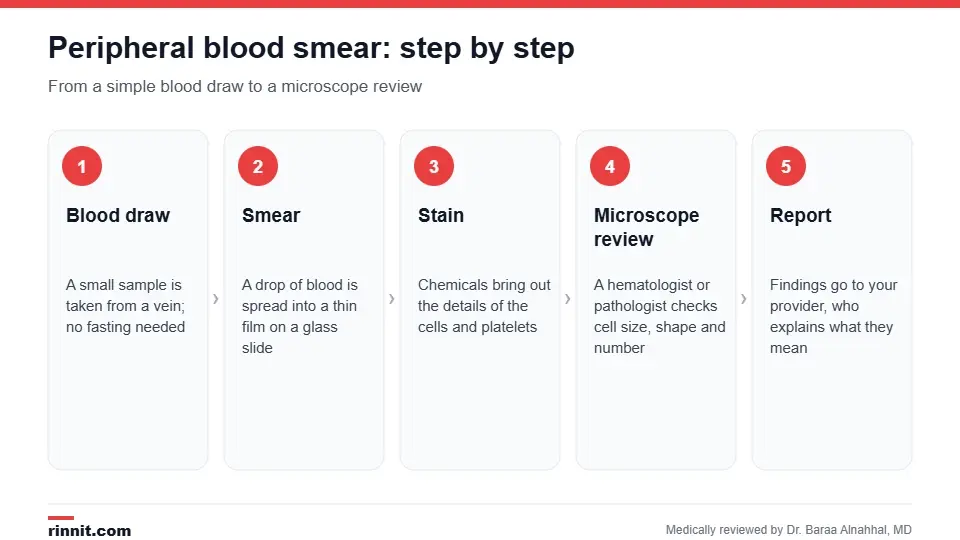
From blood draw to report.
A phlebotomist draws a small blood sample into a tube and sends it to the lab. [1]
A technician spreads a drop of blood onto a glass slide to make a thin film. [1]
The technician treats the film with chemicals that bring out the details of the cells and platelets. [1]
A hematologist or hematopathologist examines the slide under a microscope for abnormalities. [1]
The results go to your provider. [1]
Blood smear vs complete blood count
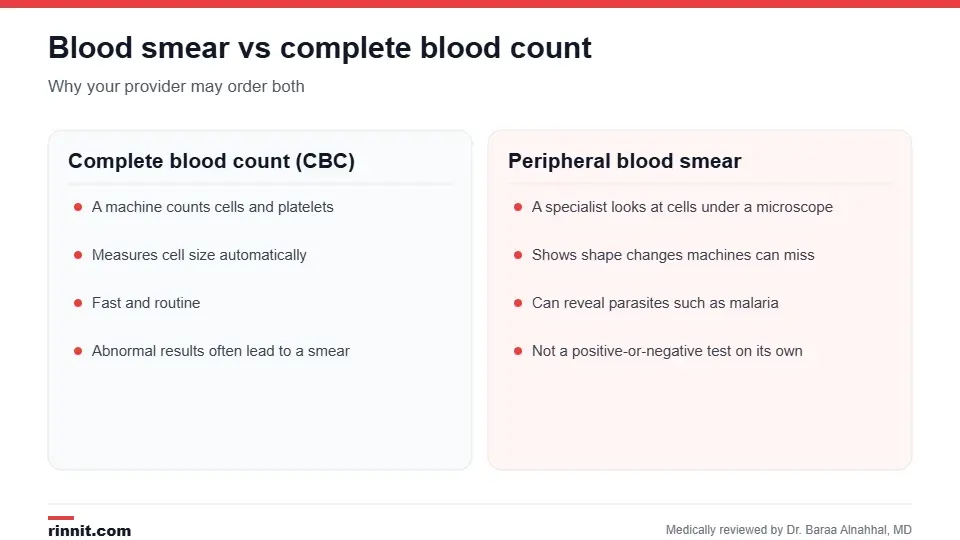
How a smear differs from a CBC.
A complete blood count uses a machine to count your blood cells and platelets and measure their size. A peripheral blood smear uses a microscope to look for changes in the cells and platelets themselves, which is why the two tests are often ordered together. [1] Researchers are now training artificial intelligence to classify smear images with high accuracy, but most models have not yet been tested outside the labs that built them, so expert review remains the standard. [2]
What are the risks of a peripheral blood smear?
The test needs only a routine blood draw. You may have brief discomfort, bruising or tenderness where the needle went in.
What do peripheral blood smear results mean?
Results depend on why the test was ordered; for example, they may explain certain symptoms. The smear is not reported as positive or negative, because it is not designed to find one specific problem. Your provider may order other tests for more detail. [1]
When should you call a doctor?
If you had the test because of symptoms, contact your provider if those symptoms get worse or new ones appear. [1]
Conclusion
A peripheral blood smear gives your care team a direct look at your blood cells that automated counts cannot. It helps explain an abnormal CBC, investigate symptoms such as fatigue or bruising, and track treatment. [1]
Because the smear adds detail rather than a yes-or-no answer, expect your provider to interpret it alongside your other results. Reviewing smears is skilled, time-consuming work that remains central to diagnosing blood disorders. [3]
Keep learning: Read our guide to the complete blood count to understand the test that usually comes first.
Frequently asked questions
What is a peripheral blood smear?
A blood test in which a specialist examines your red cells, white cells and platelets under a microscope.
Why would a doctor order a blood smear?
Usually because a complete blood count was abnormal, or because symptoms suggest a blood disorder, blood cancer or infection.
Do I need to fast for a peripheral blood smear?
No. No fasting or other preparation is needed.
How is a blood smear done?
A small blood sample is spread into a thin film on a slide, stained and examined under a microscope.
What can a blood smear detect?
Changes in cell size, shape and number that point to anemia, leukemia, lymphoma, myelodysplastic syndrome, autoimmune disease or malaria.
What is the difference between a CBC and a blood smear?
A CBC counts cells by machine; a smear examines their appearance under a microscope.
Is a peripheral blood smear positive or negative?
No. It describes what the cells look like rather than giving a yes-or-no result.
Who reviews a blood smear?
A hematologist or hematopathologist.
Does a blood smear diagnose leukemia?
It can show abnormal white cells, but other tests such as a bone marrow biopsy are needed to confirm the diagnosis.
Are there risks with a blood smear?
Only the minor discomfort or bruising of a routine blood draw.
Related Reading
Complete Blood Count (CBC): What It Measures, Normal Ranges and Abnormal Results explains the automated blood count that usually leads to a smear.
What Is Myelodysplastic Syndrome? A Plain-Language Guide to Symptoms, Causes, and Treatment covers a bone marrow disorder the smear can help detect.
Lymphoma: Symptoms, Types, Causes, Diagnosis and Treatment describes a white blood cell cancer that may show on a smear.
Anemia of Chronic Disease: Why Inflammation Traps Your Iron, Who's at Risk, and How Treatment Works explains one type of anemia seen on a blood smear.
Platelet Count (PLT) Blood Test: Normal Range, Low and High Results Explained covers the platelet test that a smear often follows.
References
Cleveland Clinic. Peripheral Blood Smear (PBS). Cleveland Clinic. Last updated July 24, 2026. https://my.clevelandclinic.org/health/diagnostics/22742-peripheral-blood-smear-test
Aria M, Javanmard Z, Pishdad D, et al. Towards Diagnostic Intelligent Systems in Leukemia Detection and Classification: A Systematic Review and Meta-analysis. J Evid Based Med. 2025;18(1):e70005. PMID 40013326. https://doi.org/10.1111/jebm.70005
Kim H, Kwon WK, Park S, et al. Nationwide Survey of Laboratory-Initiated Peripheral Blood Smear Review Practices in Korea: Criteria, Workload, and Reimbursement. Ann Lab Med. 2026. PMID 42989616. https://doi.org/10.3343/alm.2026.0382
Medical disclaimer
This article is for general education only and does not replace advice from a qualified healthcare professional. Talk to your doctor about your own diagnosis and treatment, and seek emergency care right away for severe or sudden symptoms.



Comments