Platelet Count (PLT) Blood Test: Normal Range, Low and High Results Explained

Updated: 2 days ago
Written and medically reviewed by Dr. Baraa Alnahhal, MD · Last reviewed: November 2026 · How we review
Quick Answer: What is a platelet count?
A platelet count is a common blood test that measures how many platelets, the blood cells that help blood clot, are in the blood. A normal count is 150,000 to 400,000 platelets per microliter. Fewer than 150,000 is low (thrombocytopenia), and more than 450,000 is high (thrombocytosis). It's usually part of a complete blood count (CBC). [1]
What the research says
A raised platelet count can be an early clue worth checking. In a large English primary care study of adults aged 40 and over, 11.6% of men and 6.2% of women with a count above 400,000 were diagnosed with cancer within a year, compared with 4.1% and 2.2% of people with normal counts. The risk was higher (18.1% in men and 10.1% in women) when a second raised count followed within 6 months. (Bailey et al., British Journal of General Practice, 2017) [2]
Counts at the high end of normal carry a smaller signal. Among 295,312 people aged 40 and over with normal counts, men aged 60 and older with counts of 326,000 to 400,000 had a 4.2% chance of a cancer diagnosis within a year. For every group of women studied, the risk stayed under 3%. (Mounce et al., British Journal of General Practice, 2020) [3]
Both very low and high counts are linked with health risks. Following 21,252 Danish adults, researchers found higher death rates when counts were below 175,000 or above 300,000. Counts of 301,000 to 450,000 were linked with a 42% higher risk of death compared with counts of 201,000 to 250,000. These studies show links, not proof of cause. (Vinholt et al., Thrombosis Research, 2016) [4]
Key takeaways
A platelet count measures the platelets in your blood, the cells that help form clots. [1]
A normal count is 150,000 to 400,000 platelets per microliter of blood at any age. [1]
Fewer than 150,000 is low (thrombocytopenia); more than 450,000 is high (thrombocytosis). [1]
Below 50,000, the risk of bleeding rises even during everyday activities. [1]
An abnormal result usually needs more tests, and many causes are not serious. [1]
What is a platelet count?
A platelet count is a blood test that measures how many platelets you have. Platelets (also called thrombocytes) are blood cells that help your blood form clots, often working together with clotting proteins. [1]
On lab reports, platelets are often shown as "PLT." The test is usually done as part of a complete blood count (CBC), which also measures your white blood cells and red blood cells. [1]
Having too few platelets can be a sign of cancer, infection or other health problems, while too many can lead to clots you don't need. [1]
Why is a platelet count done?
Your provider may check your platelet count: [1]
As part of a routine physical exam
When they suspect your platelets may be too low (thrombocytopenia)
When they suspect your platelets may be too high (thrombocytosis)
How is a platelet count done?
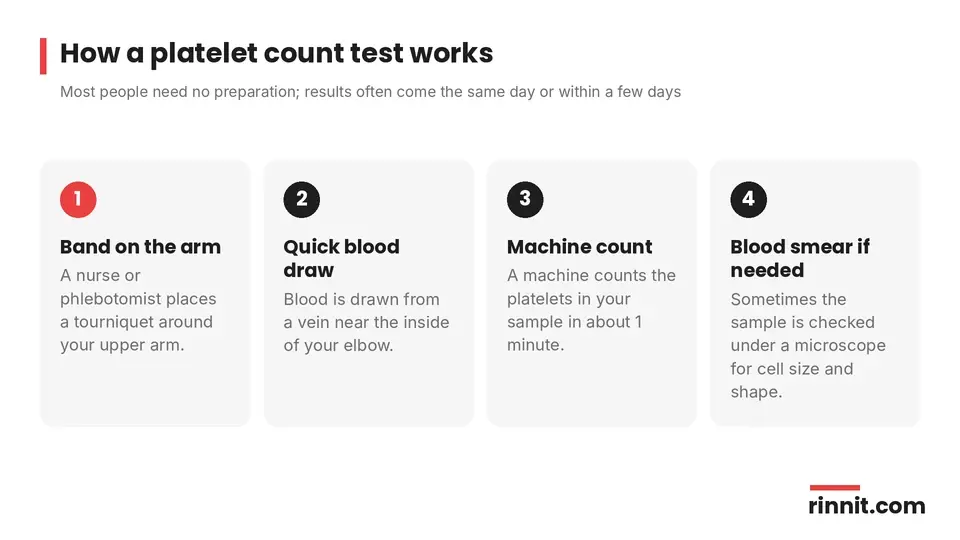
A platelet count uses a simple blood draw. [1]
How do you prepare?
Most people don't need to do anything to prepare. You may be asked to fast if other tests will be run on the same blood sample. Ask your provider whether there are any instructions or medicines to avoid before the test. [1]
What happens during the test?
A nurse or phlebotomist places a tourniquet (band) around your upper arm.
They draw blood from a vein on the inside of your arm, near your elbow.
A machine counts the platelets in your sample in about 1 minute.
Sometimes the lab also does a peripheral blood smear, looking at your blood under a microscope to check the size and shape of your cells.
The blood draw takes a few minutes and can be done at your provider's office, a hospital or a lab. [1]
Are there risks?
A platelet count has no significant risks. You may have light bleeding, light bruising or soreness where the needle went in. These usually go away the same day. [1]
What is a normal platelet count?
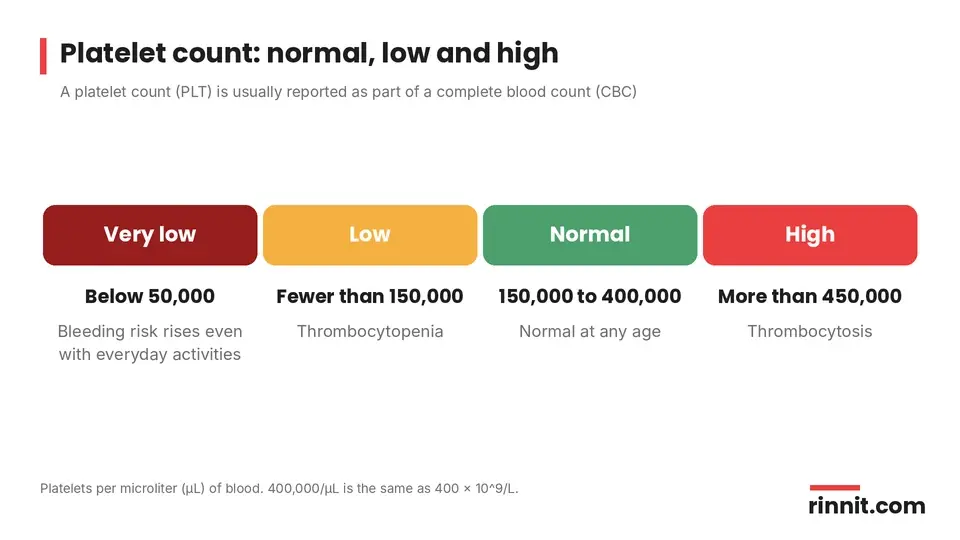
Platelet counts are measured in platelets per microliter of blood. [1]
Platelet count (per microliter) | What it means |
Below 50,000 | Bleeding risk rises even during everyday activities; providers monitor closely |
Fewer than 150,000 | Low platelet count (thrombocytopenia) |
150,000 to 400,000 | Normal |
More than 450,000 | High platelet count (thrombocytosis) |
Sources: [1]
The normal range of 150,000 to 400,000 applies at any age. Counts often fall slightly as you get older, especially after age 60. A drop that stays within the normal range isn't necessarily a problem, but your provider may keep an eye on counts that keep falling. [1]
Some labs and research studies write platelet counts as "x 10^9/L." That unit is the same as thousands per microliter, so 400 x 10^9/L equals 400,000 per microliter.
What does a low platelet count mean?
A low platelet count (thrombocytopenia) means you have fewer than 150,000 platelets per microliter. Some of the most common causes are: [1]
Autoimmune diseases that destroy platelets
Cancers that slow down platelet production
Cancer treatments, such as chemotherapy
Side effects of medications
Mildly low counts may cause no symptoms. With a low count, you may bleed too much after an injury, which can lead to heavy bleeding (hemorrhage) and internal bleeding. [1]
What does a high platelet count mean?
A high platelet count (thrombocytosis) means you have more than 450,000 platelets per microliter. Causes include: [1]
Temporary rises caused by stress on the body, such as after surgery or during an infection
Rare inherited blood disorders that make the body produce too many platelets
When there are too many platelets, they can clump together and cause clotting you don't need. This can lead to a heart attack or stroke. [1]

When will you get your results?
Most people get platelet count results the same day or within a few days, though some wait up to a week. A result outside the normal range usually needs more tests to find the cause, and many causes are not serious. [1]
Don't panic if your report flags your count as "high" or "low." Many conditions and medicines, often harmless ones, can push platelet levels out of range. An abnormal count does not automatically mean you're at immediate risk of bleeding or dangerous clots. [1]
When should you call your doctor?
Contact your provider if you have questions about when to expect your results or what they mean. Get medical care right away for bleeding that won't stop, blood in your urine or stool, or many tiny red or purple spots on your skin. Talk your results over with them, especially if your count is outside the normal range. [1]
Questions to ask your provider
Is my platelet count normal for me?
If it's low or high, what do you think is causing it?
Do I need a repeat test or a blood smear?
Should I avoid any medicines or activities while my count is low?
How often should my platelets be checked?
Conclusion
A platelet count tells you how many clotting cells are in your blood. It's usually part of a CBC, it needs only a quick blood draw, and results often arrive the same day or within a few days.
A normal count is 150,000 to 400,000 per microliter. Low and high counts have many possible causes, many of them not serious, so your provider will usually order more tests before drawing any conclusions.
Keep learning: Read our guides to the complete blood count (CBC), the MPV blood test, immune thrombocytopenia and thrombocytosis. For more on blood counts, see MedlinePlus: Platelet Tests.
FAQ
What is a normal platelet count?
A normal platelet count is 150,000 to 400,000 platelets per microliter of blood at any age. [1]
What is considered a low platelet count?
Fewer than 150,000 platelets per microliter is low and is called thrombocytopenia. [1]
What is considered a high platelet count?
More than 450,000 platelets per microliter is high and is called thrombocytosis. [1]
What platelet level is dangerous?
Below 50,000, bleeding risk rises even during everyday activities, so providers monitor closely. [1]
What causes low platelets?
Common causes include autoimmune diseases, cancers that slow platelet production, chemotherapy and medication side effects. [1]
What causes high platelets?
Temporary rises after surgery or during infection, and rare inherited blood disorders, can raise platelet counts. [1]
Do I need to fast for a platelet count?
Usually not, unless other tests will be run on the same blood sample. [1]
What does PLT mean on a blood test?
PLT is short for platelets and shows your platelet count, usually as part of a complete blood count. [1]
Does platelet count change with age?
Counts often fall slightly with age, especially after 60, though the normal range stays the same. [1]
How long do platelet count results take?
Most people get results the same day or within a few days, and some wait up to a week. [1]
Related Reading
Learn more in our guide to Platelets: Function, Count, Disorders and Tests.
Learn more in our guide to Immune Thrombocytopenia: Symptoms, Causes, and Treatment.
Learn more in our guide to Thrombocytosis: Symptoms, Causes, Diagnosis and Treatment — What You Need to Know.
Learn more in our guide to Heparin-Induced Thrombocytopenia (HIT): Risks and Management.
Learn more in our guide to Bernard-Soulier Syndrome: The Rare Bleeding Disorder That Leaves You With Fewer, Larger Platelets — and Why Most People Still Live Full, Active Lives.
Peripheral Blood Smear: Why It's Done, How It Works and What It Shows explains the microscope test that examines the shape and number of red cells, white cells and platelets.
References
Cleveland Clinic. Platelet Count (PLT): Normal Range, Test Results & Meaning. Cleveland Clinic. Last updated October 21, 2024. https://my.clevelandclinic.org/health/diagnostics/21782-platelet-count
Bailey SE, Ukoumunne OC, Shephard EA, Hamilton W. Clinical relevance of thrombocytosis in primary care: a prospective cohort study of cancer incidence using English electronic medical records and cancer registry data. Br J Gen Pract. 2017;67(659):e405-e413. PMID 28533199. https://doi.org/10.3399/bjgp17X691109
Mounce LT, Hamilton W, Bailey SE. Cancer incidence following a high-normal platelet count: cohort study using electronic healthcare records from English primary care. Br J Gen Pract. 2020;70(698):e622-e628. PMID 32719013. https://doi.org/10.3399/bjgp20X710957
Vinholt PJ, Hvas AM, Frederiksen H, et al. Platelet count is associated with cardiovascular disease, cancer and mortality: A population-based cohort study. Thromb Res. 2016;148:136-142. PMID 27586589. https://doi.org/10.1016/j.thromres.2016.08.012
Medical disclaimer
This article is for general education only and does not replace advice from a qualified healthcare professional. Talk to your doctor about your own diagnosis and treatment, and seek emergency care right away for severe or sudden symptoms.



Comments