MPV Blood Test (Mean Platelet Volume): Normal Range, High and Low Results

Updated: 2 days ago
Written and medically reviewed by Dr. Baraa Alnahhal, MD · Last reviewed: November 2026 · How we review
Quick Answer: What is an MPV blood test?
An MPV (mean platelet volume) blood test measures the average size of platelets, the blood cells that help blood clot. It's part of a complete blood count (CBC). A normal MPV is 7 to 9 femtoliters (fL) in non-pregnant adults. A high or low result isn't a diagnosis on its own; your provider reads it alongside your platelet count. [1]
What the research says
MPV can help tell why platelets are low. A meta-analysis of 14 studies found MPV was on average 2.03 fL higher in immune thrombocytopenia (ITP) than in low platelets caused by poor bone marrow production. MPV separated the two with 76% sensitivity and 79% specificity. (Walle et al., PLOS ONE, 2023) [2]
Larger platelets are linked to heart attacks. Pooling 16 studies (2,809 patients), MPV was 0.92 fL higher in people having a heart attack than in those without one. After a heart attack, a high MPV was tied to higher death rates (11.5% vs 7.1%). Whether this should change treatment is still unknown. (Chu et al., Journal of Thrombosis and Haemostasis, 2010) [3]
Key takeaways
MPV measures average platelet size, a clue to how healthy your platelets and bone marrow are. [1]
It usually comes with a CBC, often at a yearly checkup. [1]
The normal range is generally 7 to 9 fL, but labs use different cutoffs. [1]
High MPV often means many new, larger platelets; low MPV may mean the bone marrow is making too few. [1]
Altitude, pregnancy, periods, hard exercise and some medicines can shift results. [1]
What do platelets do?
Platelets are made in your bone marrow. When you're injured, they clump at the wound to slow and stop bleeding. Because newly made platelets are larger than older ones, their average size gives clues about how your bone marrow is working. [1]
Why is an MPV test done?
An MPV result is usually part of a CBC, which may be ordered at a yearly physical. A CBC also measures red blood cells, white blood cells and platelets, plus other features such as cell size. [1]
Platelet measure | What it shows |
Platelet count | How many platelets you have |
Mean platelet volume (MPV) | The average size of your platelets |
Platelet distribution width (PDW) | How much platelet widths vary |
Sources: [1]
Together, these help evaluate thrombocytopenia (a low platelet count) and thrombocytosis (a high platelet count). Your provider may also order the test separately if you have unexplained bleeding, bruising or other possible clotting problems. [1]
How do you prepare for an MPV test?
Usually no special preparation is needed. Because MPV is often run on the same sample as other tests, such as blood sugar or cholesterol, you may need to fast. Follow your provider's instructions about food, drinks and any medicines to pause. [1]
What happens during an MPV blood test?
A doctor, nurse or phlebotomist takes the sample in an office, lab or hospital, often in under five minutes. A lab technician then runs the test. [1]
A tourniquet is tied around your upper arm.
The skin is cleaned, and a needle is placed in a vein.
Blood collects in a vial.
The needle is removed, and pressure is applied to stop bleeding.
Sources: [1]
There are no serious risks. You may have mild soreness or a small bruise that fades within a few days. [1]
What is a normal MPV range?
In general, a normal MPV is 7 to 9 fL for non-pregnant adults, though cutoffs vary between labs. Always compare your result with the reference range on your report. [1]

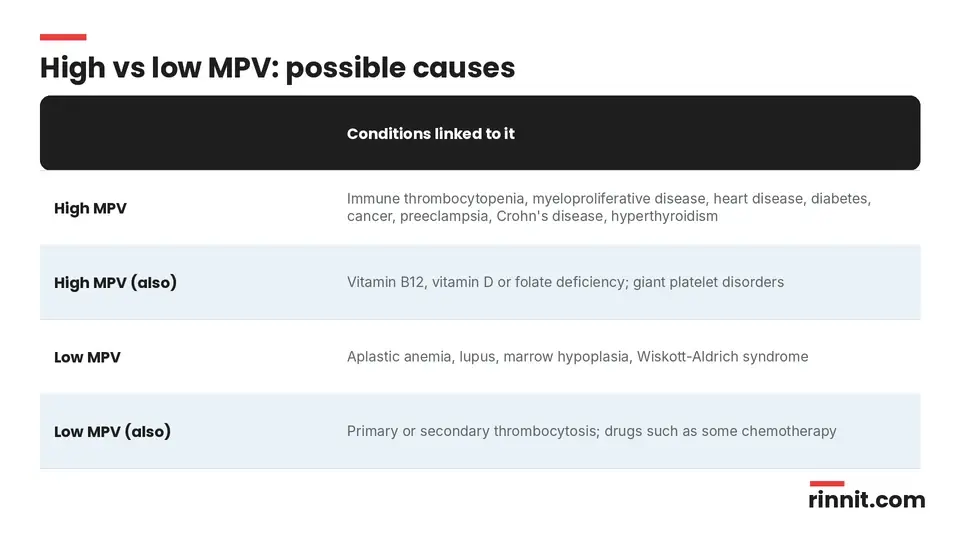
Result | What it may mean | Linked conditions |
High MPV (larger platelets) | Bone marrow is making many new platelets, or older, smaller platelets are being destroyed faster | Immune thrombocytopenia, myeloproliferative disease, cardiovascular disease, diabetes, cancer, preeclampsia, Crohn's disease, hyperthyroidism, vitamin B12, vitamin D or folate deficiency, giant platelet disorders |
Low MPV (smaller platelets) | Bone marrow isn't making enough new platelets, or a drug such as some chemotherapy is limiting production | Aplastic anemia, lupus, marrow hypoplasia, Wiskott-Aldrich syndrome, primary or secondary thrombocytosis |
Sources: [1]
What can affect MPV without a disease?
A high or low result doesn't always mean you have a disease. These factors can change MPV: [1]

Living at high altitude
Pregnancy
Menstruation
Regular strenuous exercise
Certain medicines, such as birth control pills
Physical and mental stress can also affect platelet size. Long-term vigorous exercise can raise MPV, and people with panic disorders may have a higher-than-normal MPV. Ask your provider whether any of these might explain your result. [1]
Is MPV linked to COVID-19?
Some studies have found higher MPV in people with COVID-19, but these findings are early and need more research. [1]
What happens after an abnormal MPV result?
MPV is one clue among many. Your provider looks at it together with your platelet count and other results, and may suggest follow-up tests. Follow their advice on next steps. [1]
Conclusion
An MPV blood test tells you the average size of your platelets, which hints at how actively your bone marrow is making them. It's a quick, low-risk part of a routine CBC.
If your MPV is high or low, don't panic: many everyday factors can shift it. Ask your provider how it fits with your platelet count and whether any follow-up is needed.
Keep learning: Read our guide to platelets and platelet disorders or learn about immune thrombocytopenia. For more background, see the MedlinePlus page on the complete blood count.
FAQ
What does MPV mean in a blood test?
MPV stands for mean platelet volume, the average size of your platelets.
What is a normal MPV level?
Generally 7 to 9 fL in non-pregnant adults, though labs use different cutoffs.
What does a high MPV mean?
Your platelets are larger than usual, often because the bone marrow is making many new ones or older platelets are destroyed faster.
What does a low MPV mean?
Your platelets are smaller than usual, which may mean the bone marrow isn't making enough or a drug is limiting production.
Is a high MPV dangerous?
Not by itself. MPV isn't a diagnosis; your provider interprets it with your platelet count and other tests.
Do I need to fast for an MPV blood test?
Usually not, but you may need to fast if other tests like blood sugar or cholesterol use the same sample.
Is MPV part of a CBC?
Yes. MPV is usually reported as part of a complete blood count.
What can affect MPV results?
Altitude, pregnancy, menstruation, strenuous exercise, stress and some medicines such as birth control pills.
What conditions cause a high MPV?
Examples include immune thrombocytopenia, myeloproliferative disease, diabetes, heart disease and some vitamin deficiencies.
What conditions cause a low MPV?
Examples include aplastic anemia, lupus, marrow hypoplasia and Wiskott-Aldrich syndrome.
Are there risks to an MPV blood test?
No serious risks; you may get mild soreness or a small bruise.
Related Reading
Platelets: Function, Count, Disorders and Tests explains how platelets work and the tests that measure them.
Immune Thrombocytopenia: Symptoms, Causes, and Treatment covers a low-platelet condition often linked to a high MPV.
Thrombocytosis: Symptoms, Causes, Diagnosis and Treatment — What You Need to Know explains high platelet counts, which MPV helps evaluate.
Myeloproliferative Neoplasms: Types, Symptoms, Diagnosis and Treatment covers bone marrow disorders that can raise MPV.
Bernard-Soulier Syndrome: The Rare Bleeding Disorder That Leaves You With Fewer, Larger Platelets — and Why Most People Still Live Full, Active Lives explains a giant platelet disorder with fewer, larger platelets.
Wiskott-Aldrich Syndrome: Understanding This Rare Genetic Immune Disorder covers a rare condition with unusually small platelets and a low MPV.
References
Cleveland Clinic. MPV Blood Test: High MPV, Low MPV & Normal Ranges. Cleveland Clinic. Last updated July 19, 2022. https://my.clevelandclinic.org/health/diagnostics/23572-mpv-blood-test
Walle M, Arkew M, Asmerom H, et al. The diagnostic accuracy of mean platelet volume in differentiating immune thrombocytopenic purpura from hypo-productive thrombocytopenia: A systematic review and meta-analysis. PLoS One. 2023;18(11):e0295011. PMID 38033118. https://doi.org/10.1371/journal.pone.0295011
Chu SG, Becker RC, Berger PB, et al. Mean platelet volume as a predictor of cardiovascular risk: a systematic review and meta-analysis. J Thromb Haemost. 2010;8(1):148-156. PMID 19691485. https://doi.org/10.1111/j.1538-7836.2009.03584.x
Medical disclaimer
This article is for general education only and does not replace advice from a qualified healthcare professional. Talk to your doctor about your own diagnosis and treatment, and seek emergency care right away for severe or sudden symptoms.



Comments