Thrombocytosis: Symptoms, Causes, Diagnosis and Treatment — What You Need to Know

Updated: 3 days ago
Medically reviewed by Dr. Baraa Alnahhal, MD · Last reviewed: October 17, 2026
Editorial note: This article is provided for educational purposes only. It is not medical advice. Always consult a qualified healthcare professional about your individual health situation.
Quick Answer
Thrombocytosis is a condition in which the body produces too many platelets, the blood cells that form clots [1]. Most people have no symptoms [1]. The common reactive form is a temporary response to infection, blood loss or iron deficiency that usually resolves with treatment [2], while the rarer essential thrombocythemia is a bone marrow disease with higher clotting and bleeding risk [1].
What the research says
Essential thrombocythemia carries a real clotting burden, mostly in arteries. Pooling 70 studies of 25,805 patients, arterial thrombosis occurred in 13.4% of people with essential thrombocythemia over follow-up (about 2.0% a year; stroke 5.3%), versus 5.5% for venous thrombosis (0.7% a year). Arterial thrombosis was more frequent in JAK2-positive than JAK2-negative patients (18.4% vs 5.9%) (Wang et al., Clinical and Applied Thrombosis/Hemostasis, 2023) [3].
The type of gene mutation matters. In a meta-analysis of 1,257 patients with essential thrombocythemia (73 MPL-positive, 1,184 JAK2V617F-positive), MPL-positive patients had a higher risk of thrombosis than JAK2V617F-positive patients (RR 1.80, 95% CI 1.08–3.01) (Yang et al., Annals of Hematology, 2021) [4].
In lung cancer, a high platelet count predicts poorer outcomes. Across 37 studies of 14,833 patients, thrombocytosis was linked to worse overall survival (HR 1.033, 95% CI 1.017–1.050) and disease-free survival (HR 1.568, 95% CI 1.276–1.928) (Ma et al., Platelets, 2021) [5].
When should you see a doctor for thrombocytosis?
Most people discover thrombocytosis through a routine blood test, not symptoms [2]. But if you have a high platelet count — or symptoms that suggest blood clots — medical evaluation matters.
Seek prompt medical attention for symptoms that suggest a blood clot, such as confusion or changes in speech, chest pain, or shortness of breath [1]. Less commonly, very high platelet levels can cause bleeding, including nosebleeds, bruising, bleeding from the mouth or gums, or bloody stool [1].
"Don't take aspirin without checking with your healthcare team." [2] — Mayo Clinic, May 22, 2026
What Is Thrombocytosis?
Platelets are parts of the blood that help form blood clots. Thrombocytosis (throm-boe-sie-TOE-sis) is a condition in which your body produces too many platelets [1].
It's called reactive thrombocytosis or secondary thrombocytosis when the cause is an underlying condition, such as an infection [1]. Less commonly, when there is no apparent underlying condition as a cause, the high platelet count is called primary thrombocythemia or essential thrombocythemia. This is a blood and bone marrow disease [1].
A routine blood test known as a complete blood count can detect a high platelet count [1]. It's important to determine whether you have reactive thrombocytosis or essential thrombocythemia to choose the best treatment options [1].

Question | Answer |
What happens? | The body produces too many platelets, the blood parts that form clots |
How is it found? | Usually by a routine complete blood count (CBC) |
What are the two types? | Reactive (secondary) and essential (primary) thrombocythemia |
Which is more common? | Reactive thrombocytosis [1] |
Which carries higher risk? | Essential thrombocythemia — a much higher risk of clotting or bleeding complications [1] |
What should you do first? | Have a clinician determine the type before deciding on treatment |
What Are the Symptoms of Thrombocytosis?
People with high platelet levels often don't have signs or symptoms [1]. When symptoms occur, they're often related to blood clots [1].
Symptom category | Specific signs |
Often no symptoms | Most people with high platelet levels have no signs at all |
Clot-related symptoms | Headache; confusion or changes in speech; chest pain; shortness of breath; nausea; weakness; burning pain in the hands or feet [1] |
Bleeding (less common) | Nosebleeds; bruising; bleeding from the mouth or gums; bloody stool [1] |
Note the important nuance: less commonly, very high platelet levels may cause bleeding rather than clotting [1].
What Causes Thrombocytosis?
Bone marrow is a spongy tissue inside your bones. It contains stem cells that can become red blood cells, white blood cells, or platelets. Platelets stick together, helping blood form a clot that stops bleeding when you damage a blood vessel, such as when you cut yourself [1]. Thrombocytosis occurs when your body produces too many platelets.
Reactive thrombocytosis
This is the more common type of thrombocytosis. It is caused by an underlying medical issue [1]:
Underlying cause | Examples |
Blood loss | From injury or surgery |
Cancer | Any cancer causing an elevated count |
Infections | The classic trigger — hence the name "secondary" |
Iron deficiency | Low iron driving platelet production |
Spleen removal | Affects platelet regulation |
Hemolytic anemia | The body destroys red blood cells faster than it produces them, often due to certain blood diseases or autoimmune conditions |
Inflammatory conditions | Rheumatoid arthritis, sarcoidosis, or inflammatory bowel disease |
Surgery and trauma | Surgery and other types of trauma |
Essential thrombocythemia
The cause of this condition is unclear. It often appears to be connected to changes in certain genes, called mutations [1]. The bone marrow produces too many of the cells that form platelets, and these platelets often do not work properly. This poses a much higher risk of clotting or bleeding complications than does reactive thrombocytosis [1].
Who Is at Risk?
Older adults and women are more likely to develop thrombocytosis [1]. Some medical conditions also may increase the risk. Anemia, cancer, and inflammation or infections are all risk factors for thrombocytosis [1].
Risk factor | Detail |
Age | Older adults are more likely to develop it |
Sex | Women are more likely to develop it |
Anemia | Increases risk |
Cancer | Increases risk |
Inflammation or infections | Increases risk |
What Are the Complications?
Essential thrombocythemia can lead to a variety of potentially life-threatening complications [1].
What about pregnancy?
Most people who have essential thrombocythemia have typical, healthy pregnancies. But uncontrolled thrombocythemia can lead to miscarriage and other complications [1]. You may lessen your risk of pregnancy complications with regular checkups and medicine [1]. Be sure to have your healthcare professional regularly monitor your condition.
How Is Thrombocytosis Diagnosed?
A blood test called a complete blood count (CBC) can show whether your platelet count is too high [2]. You may also need blood tests to check for high or low iron levels, markers of inflammation, undiagnosed cancer, and gene mutations [2].
You also might need a procedure that uses a needle to remove a small sample of your bone marrow for testing — a bone marrow biopsy [2].
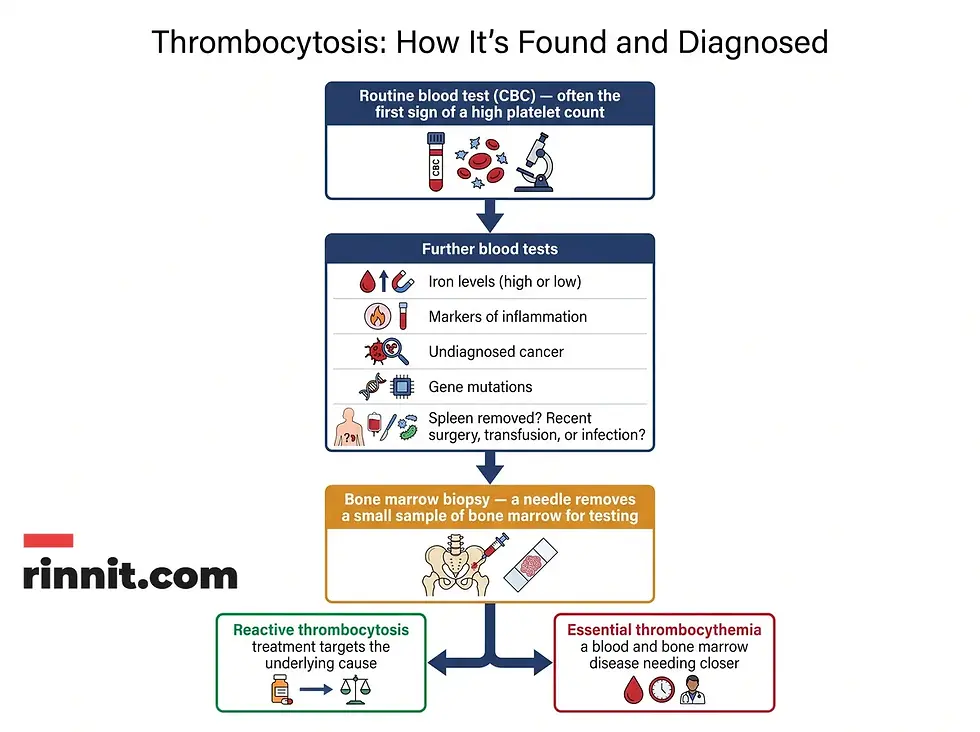
Diagnostic step | Purpose |
Complete blood count (CBC) | Shows whether your platelet count is too high — often the first indication |
Iron tests | Check for high or low iron levels |
Inflammation markers | Look for an underlying inflammatory cause |
Cancer screening | Check for undiagnosed cancer |
Gene mutation tests | Look for mutations connected to essential thrombocythemia |
Bone marrow biopsy | Needle removes a small sample of bone marrow for testing |
How Is Thrombocytosis Treated?
Treatment depends entirely on which type you have — which is why telling them apart is so important.
Reactive thrombocytosis
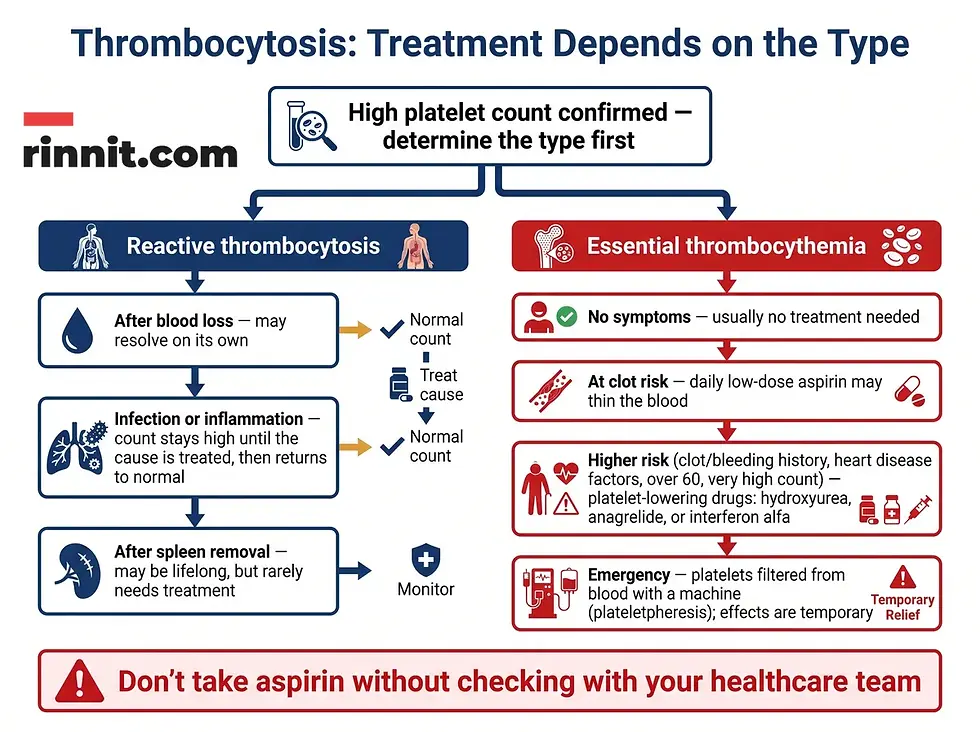
Treatment for this condition depends on the cause [2].
Cause | What happens |
Blood loss | If you've had significant blood loss from a recent surgery or injury, your elevated platelet count might resolve on its own [2] |
Infection or inflammation | Your platelet count likely stays high until the condition is treated; it usually returns to the standard range after the cause is resolved [2] |
Spleen removed | You might have lifelong thrombocytosis, but you are unlikely to need treatment [2] |
Essential thrombocythemia
People with this condition who have no signs or symptoms usually do not need treatment [2]. You might need to take daily, low-dose aspirin to help thin your blood if you are at risk of blood clots — but don't take aspirin without checking with your healthcare team [2].
You might need prescription medicine or procedures to lower your platelet counts if you have a history of blood clots and bleeding, have risk factors for heart disease, are older than 60, or have a very high platelet count [2].
Your healthcare professional might prescribe platelet-lowering drugs such as hydroxyurea (Hydrea), anagrelide (Agrylin), or interferon alfa (Intron A) [2]. In emergencies, platelets can be filtered from your blood with a machine — a procedure called plateletpheresis. The effects are only temporary [2].
How Should You Prepare for an Appointment?
Preparing for a thrombocytosis appointment often starts after a routine blood test shows a high platelet count, and it includes listing symptoms, history and medicines. Besides taking your medical history, examining you physically, and running tests, your healthcare professional might ask about factors that could affect your platelets, such as a recent surgery, a blood transfusion, or an infection. You might be referred to a doctor who specializes in blood diseases, called a hematologist [2].
Be aware of pre-appointment restrictions — when you make the appointment, ask if there's anything you need to do in advance, such as restricting your diet [2]. Take a family member or friend along, if possible, to help you remember the information you're given [2].
Make a list of your symptoms and when they began; your medical history, including recent infections, surgical procedures, bleeding, and anemia; all medicines, vitamins, and other supplements you take, including doses; and questions to ask your healthcare professional [2].
Questions to ask include: what tests do I need; is my condition likely temporary or chronic; what treatment do you recommend; what follow-up care will I need; do I need to restrict my activity; how can I best manage my other health conditions together; should I see a specialist; and do you have brochures or recommended websites.
Your healthcare professional is likely to ask whether your signs and symptoms have worsened over time, whether you drink alcohol or smoke, whether you've had your spleen removed, whether you have a history of bleeding or a lack of iron, and whether there's a family history of high platelet counts [2].
Conclusion
Thrombocytosis has a misleading name for most people who encounter it: the more common form is reactive, a response to an infection, blood loss, iron deficiency, or inflammation that usually fades once the cause is treated. Many people only discover they ever had a high platelet count through a routine blood test.
The form that demands attention is essential thrombocythemia — a blood and bone marrow disease with no obvious underlying cause, where the bone marrow produces too many of the cells that form platelets, and those platelets often don't work properly. It carries a much higher risk of clotting or bleeding complications, including stroke and heart attack. The good news is that many people with it need no treatment at all, and for those who do, options range from low-dose aspirin to platelet-lowering drugs and, in emergencies, plateletpheresis.
The single most important step is getting the diagnosis right. Reactive thrombocytosis and essential thrombocythemia require completely different approaches — so a high platelet count on a blood test is a reason to see your clinician, not a reason to panic.
Your next step: If a routine blood test has shown a high platelet count, talk with your healthcare professional about whether further testing — iron levels, inflammation markers, gene mutations, or a bone marrow biopsy — is needed to find the cause. And remember: never start daily aspirin on your own; check with your healthcare team first.
Related reading: Microcytic Anemia | Anemia of Chronic Disease | Craniosynostosis | Leukemia | Sudden Cardiac Arrest | Subarachnoid Hemorrhage
Sources: Mayo Clinic — Thrombocytosis: Symptoms & Causes | Mayo Clinic — Thrombocytosis: Diagnosis & Treatment
Frequently Asked Questions
1. What is thrombocytosis?
Thrombocytosis is a condition in which your body produces too many platelets — the parts of the blood that help form blood clots.
2. What are the two types?
Reactive (secondary) thrombocytosis, caused by an underlying condition such as an infection, and essential (primary) thrombocythemia, a blood and bone marrow disease with no apparent underlying cause.
3. Which type is more common?
Reactive thrombocytosis.
4. Do most people have symptoms?
No. People with high platelet levels often don't have signs or symptoms.
5. What symptoms can occur?
Often related to blood clots: headache, confusion or changes in speech, chest pain, shortness of breath, nausea, weakness, and burning pain in the hands or feet. Less commonly, very high levels cause bleeding: nosebleeds, bruising, bleeding from the mouth or gums, or bloody stool.
6. What causes reactive thrombocytosis?
Underlying medical issues such as blood loss, cancer, infections, iron deficiency, spleen removal, hemolytic anemia, inflammatory conditions (rheumatoid arthritis, sarcoidosis, inflammatory bowel disease), and surgery or other trauma.
7. What causes essential thrombocythemia?
The cause is unclear, but it often appears connected to gene mutations. The bone marrow produces too many of the cells that form platelets, and these platelets often don't work properly.
8. Why is essential thrombocythemia more serious?
Essential thrombocythemia poses a much higher risk of clotting or bleeding complications than reactive thrombocytosis, and can lead to potentially life-threatening complications.
9. What complications can occur?
Stroke (a clot in the arteries supplying the brain), heart attack (less commonly), and rarely a type of leukemia that progresses quickly.
10. Who is at higher risk?
Older adults and women are more likely to develop thrombocytosis. Anemia, cancer, and inflammation or infections also increase risk.
11. How is it diagnosed?
A routine complete blood count (CBC) detects a high platelet count. Further blood tests check iron levels, inflammation markers, undiagnosed cancer, and gene mutations. A bone marrow biopsy (needle sample of bone marrow) might also be needed.
12. How is reactive thrombocytosis treated?
Treatment depends on the cause. After blood loss it may resolve on its own. With infection or inflammation, the count stays high until the condition is treated, then usually returns to normal. After spleen removal, thrombocytosis may be lifelong but usually needs no treatment.
13. How is essential thrombocythemia treated?
People without symptoms usually need no treatment. Low-dose daily aspirin may thin the blood if you're at clot risk. Prescription platelet-lowering drugs — hydroxyurea, anagrelide, or interferon alfa — may be needed if you have a clotting/bleeding history, heart disease risk factors, are over 60, or have a very high count. In emergencies, platelets can be filtered from the blood (plateletpheresis), with only temporary effects.
14. Should I take aspirin on my own for a high platelet count?
No. Don't take aspirin without checking with your healthcare team.
15. Can it affect pregnancy?
Most people with essential thrombocythemia have typical, healthy pregnancies. But uncontrolled thrombocythemia can lead to miscarriage and other complications; regular checkups and medicine may lessen the risk.
16. What doctor treats thrombocytosis?
You might be referred to a hematologist — a doctor who specializes in blood diseases.
17. Is a high platelet count always permanent?
Not usually. Reactive thrombocytosis typically returns to the standard range after the cause is resolved. Only after spleen removal might it be lifelong — and even then, treatment is usually unnecessary.
18. What questions should I ask my doctor?
What tests do I need; is my condition temporary or chronic; what treatment do you recommend; what follow-up care will I need; do I need to restrict activity; how to manage other conditions together; and whether I should see a specialist.
19. What will my doctor ask me?
Whether symptoms worsened over time, alcohol and smoking habits, whether your spleen was removed, history of bleeding or low iron, and family history of high platelet counts.
20. What should I bring to my appointment?
A list of your symptoms and when they began, your medical history (infections, surgeries, bleeding, anemia), all medicines and supplements with doses, and your questions. Bring a family member or friend if possible.
Related Reading
MPV Blood Test (Mean Platelet Volume): Normal Range, High and Low Results explains the blood test that measures platelet size and helps evaluate this condition.
Learn more in our guide to Platelet Count (PLT) Blood Test: Normal Range, Low and High Results Explained.
References
Mayo Clinic Staff. Thrombocytosis: Symptoms and causes. Mayo Clinic. May 22, 2026. https://www.mayoclinic.org/diseases-conditions/thrombocytosis/symptoms-causes/syc-20378315
Mayo Clinic Staff. Thrombocytosis: Diagnosis and treatment. Mayo Clinic. May 22, 2026. https://www.mayoclinic.org/diseases-conditions/thrombocytosis/diagnosis-treatment/drc-20378319
Wang D, Yu X, Sun Y, et al. Incidence of thrombosis at different sites during the follow-up period in essential thrombocythemia: a systematic review and meta-analysis. Clin Appl Thromb Hemost. 2023;29:10760296231181117. PMID 37350087. https://doi.org/10.1177/10760296231181117
Yang E, Wang M, Wang Z, et al. Comparison of the effects between MPL and JAK2V617F on thrombosis and peripheral blood cell counts in patients with essential thrombocythemia: a meta-analysis. Ann Hematol. 2021;100(11):2699-2706. PMID 34383101. https://doi.org/10.1007/s00277-021-04617-6
Ma Y, Li G, Yu M, et al. Prognostic significance of thrombocytosis in lung cancer: a systematic review and meta-analysis. Platelets. 2021;32(7):919-927. PMID 32892682. https://doi.org/10.1080/09537104.2020.1810653
Medical disclaimer
This article is for education only and is not a substitute for professional medical advice, diagnosis, or treatment. Symptoms suggesting a blood clot — such as confusion or changes in speech, chest pain, or shortness of breath — warrant prompt medical attention. Always consult a qualified healthcare professional about your individual health situation.



Comments