What Is Myelodysplastic Syndrome? A Plain-Language Guide to Symptoms, Causes, and Treatment

Updated: 2 days ago
Medically reviewed by Dr. Baraa Alnahhal, MD · Last reviewed: October 17, 2026
Quick Answer
Myelodysplastic syndrome is a group of disorders in which blood cells are poorly formed or do not work properly because of a bone marrow problem. [1] It can cause fatigue, easy bruising and frequent infections. [1] It is a type of blood cancer and can turn into acute leukemia. Treatment includes transfusions and medications, and transplant offers potential cure. [2]
What the research says
Luspatercept cleared anemia more often than epoetin alfa in lower-risk MDS. In the phase 3 COMMANDS trial (363 patients, median age 74), 60% of patients on luspatercept (110 of 182) reached transfusion independence for at least 12 weeks with a hemoglobin rise of at least 1.5 g/dL, compared with 35% on epoetin alfa (63 of 181); the common risk difference was 25.4% (95% CI 15.8 to 35.0; p<0.0001). (Della Porta et al., Lancet Haematol, 2024 [3])
The benefit lasted over time. At a median follow-up of about 21 months, 44.5% of patients on luspatercept had a stretch of at least one year without needing red cell transfusions, versus 27.6% on epoetin alfa (P=0.0003); for at least 1.5 years the figures were 30.2% versus 13.8%. Progression to high-risk MDS or acute myeloid leukemia was low (under 5%) in both groups. (Garcia-Manero et al., Adv Ther, 2025 [4])
Azacitidine extended survival in higher-risk MDS. In the phase 3 AZA-001 trial (358 patients), median overall survival was 24.5 months with azacitidine versus 15.0 months with conventional care (hazard ratio 0.58; 95% CI 0.43 to 0.77; p=0.0001), and 50.8% of patients on azacitidine were alive at 2 years versus 26.2%. (Fenaux et al., Lancet Oncol, 2009 [5])
What Is Myelodysplastic Syndrome (MDS)?
Myelodysplastic syndromes are a group of disorders caused by blood cells that are poorly formed or don't work properly. They result from something going wrong in the bone marrow, the spongy material inside your bones where blood cells are made. [1]
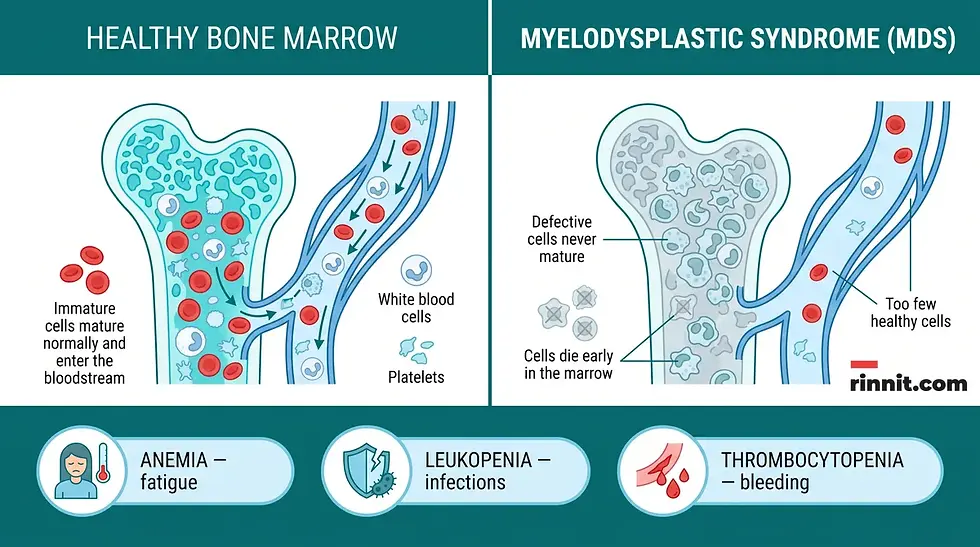
Think of the bone marrow as a factory. In a healthy person, it makes new, immature blood cells that mature over time. In MDS, something disrupts this process so the blood cells don't mature. Instead of developing normally, the blood cells die in the bone marrow or just after entering the bloodstream. [1]
Over time, there are more immature, defective cells than healthy ones. [1] That shortage is what produces the symptoms: fatigue from too few healthy red blood cells (anemia), infections from too few healthy white blood cells (leukopenia), and bleeding from too few blood-clotting platelets (thrombocytopenia).
Management of myelodysplastic syndromes is most often intended to slow the disease, ease symptoms, and prevent complications. [1] Common measures include blood transfusions and medications to boost blood cell production. [1] In certain situations, a bone marrow transplant (also called a stem cell transplant) may be recommended to replace your bone marrow with healthy bone marrow from a donor. [1]
What Does Myelodysplastic Syndrome Feel Like?
People with myelodysplastic syndromes might not experience signs and symptoms at first. [1] The condition can quietly lower blood cell counts before you notice anything. In time, it might cause the symptoms shown below.
Symptom | Why It Happens |
Fatigue | Too few healthy red blood cells (anemia) |
Shortness of breath | Too few red blood cells to carry oxygen |
Unusual paleness (pallor) | Low red blood cell count (anemia) |
Easy or unusual bruising or bleeding | Low blood platelet count (thrombocytopenia) |
Pinpoint-sized red spots beneath the skin (petechiae) | Bleeding under the skin from low platelets |
Frequent infections | Low white blood cell count (leukopenia) |
One detail worth knowing about petechiae, the pinpoint red spots caused by bleeding under the skin that can look like a rash: on white skin, they may be red or purple. On Black or brown skin, they may be brown or hard to see.
When Should I See a Doctor?
Make an appointment with your doctor if you have signs or symptoms that worry you. [1] Because early MDS often causes no symptoms, it is also commonly picked up on routine blood work that shows low blood cell counts.
What Causes Myelodysplastic Syndrome?
In a healthy person, bone marrow makes new, immature blood cells that mature over time. Myelodysplastic syndromes occur when something disrupts this process so that the blood cells don't mature. [1] Instead of developing normally, the blood cells die in the bone marrow or just after entering the bloodstream. Over time, the balance shifts: there are more immature, defective cells than healthy ones. [1]
Most myelodysplastic syndromes have no known cause. Others are caused by exposure to cancer treatments, such as chemotherapy and radiation, or to toxic chemicals, such as benzene.
Who Is at Higher Risk?
What Are the Different Types of MDS?
The World Health Organization divides myelodysplastic syndromes into subtypes based on which type of blood cells (red cells, white cells, and platelets) are involved. [1]
MDS Subtype | What It Means in Plain Language |
Single-lineage dysplasia | One blood cell type (white cells, red cells, or platelets) is low in number and looks abnormal under the microscope |
Multilineage dysplasia | Two or three blood cell types are abnormal [1] |
Ring sideroblasts | One or more blood cell types are low; a hallmark is that red blood cells in the bone marrow contain rings of excess iron [1] |
Isolated del(5q) chromosome abnormality | Low red blood cell numbers with a specific DNA mutation in the cells |
Excess blasts | Any of the three blood cell types might be low and look abnormal; very immature cells (blasts) are found in the blood and bone marrow |
Unclassifiable | One or more mature blood cell types are reduced and might look abnormal; sometimes cells look normal, but analysis finds MDS-associated DNA changes |
What Complications Can Happen?
Complication | What Happens |
Anemia | Reduced red blood cells make you feel tired [1] |
Recurrent infections | Too few white blood cells raise the risk of serious infections [1] |
Bleeding that won't stop | Lacking platelets to stop bleeding can lead to excessive bleeding |
Increased risk of cancer | Some people might eventually develop a cancer of the bone marrow and blood cells (leukemia) [1] |
How Is Myelodysplastic Syndrome Diagnosed?
A physical exam, medical history, and tests might be used if your doctor suspects that you have a myelodysplastic syndrome. [2]

Blood tests. Your doctor might order blood tests to determine the number of red cells, white cells, and platelets and to look for unusual changes in the size, shape, and appearance of various blood cells. [2]
Removing bone marrow for testing. During a bone marrow biopsy and aspiration, a thin needle is used to withdraw (aspirate) a small amount of liquid bone marrow, usually from a spot on the back of your hipbone (the pelvis). Then a small piece of bone with its marrow is removed (biopsy). The two steps are often done at the same time. [2]
Blood and bone marrow samples are sent for laboratory analysis. Specialized tests can determine the specific characteristics of your cells, which helps determine the type of myelodysplastic syndrome you have, your prognosis, and your treatment options. [2]
How Is Myelodysplastic Syndrome Treated?
Management of myelodysplastic syndromes is most often intended to slow the disease, ease symptoms, and prevent complications. There's no cure for myelodysplastic syndromes, but some medications can help slow the progression of the disease. [2]
Watchful waiting. If you have no symptoms, treatment might not be needed right away. Instead, your doctor might recommend regular exams and lab tests to monitor your condition and to see if the disease progresses. [2] Research on myelodysplastic syndromes is ongoing, so it can also be worth asking your doctor about clinical trials for which you might be eligible. [2]
Treatment Option | What It Does |
Blood transfusions | Healthy donor blood cells replace red blood cells and platelets to help control symptoms [2] |
Growth factor medications | Artificial versions of natural bone marrow substances that boost red cell production (cutting the need for transfusions) or white cell production (lowering infection risk) |
Medications that stimulate blood cells to mature | Reduce the need for transfusions in people not helped by growth factors; some may also reduce the risk the disease progresses to leukemia [2] |
Immune-suppressing medications | Used in certain MDS cases to reduce the need for red blood cell transfusions |
Lenalidomide (Revlimid) | For MDS associated with the isolated del(5q) gene mutation [2] |
Treatments to control infections | Given when the condition causes infections |
Bone marrow transplant | The only option offering potential cure; replaces abnormal stem cells with healthy donated cells |

Bone marrow transplant (stem cell transplant). A bone marrow transplant is the only treatment option that offers the potential of a cure for myelodysplastic syndromes. But it carries a high risk of serious complications and is generally reserved for people who are healthy enough to endure it. [2]
During a transplant, high doses of chemotherapy drugs clear out the defective blood cells from your bone marrow. [2] Then the abnormal bone marrow stem cells are replaced with healthy, donated cells (an allogeneic transplant). In some situations, less intense chemotherapy drugs can be used to reduce the risks for older adults and people who might not otherwise be considered for this treatment. [2]
What Can I Do at Home to Lower Infection Risk?
Because people with certain myelodysplastic syndromes have low white blood cell counts, they're subject to recurrent, and often serious, infections. Three habits can help.
Habit | Practical Steps |
Wash your hands | Wash frequently and thoroughly with warm, soapy water, especially before eating or preparing food; carry an alcohol-based hand sanitizer for times when water isn't available [2] |
Take care with food | Thoroughly cook all meat and fish; avoid fruits and vegetables you can't peel, especially lettuce; wash all produce you do use before peeling it; you might want to avoid all raw foods [2] |
Avoid people who are ill | Try to avoid close contact with anyone who is sick, including family members and co-workers [2] |
How Should I Prepare for My Appointment?
You'll likely start by seeing your family doctor or primary care doctor. [2] If your doctor suspects that you have a myelodysplastic syndrome, you might be referred to a doctor who specializes in blood disorders (hematologist).
What you can do. When you make the appointment, ask if there's anything you need to do in advance, such as restricting your diet. Make a list of your symptoms, including those that seem unrelated to the reason for the appointment, and when they began; key personal information, including previous treatment for cancer or exposure to toxic chemicals; and all medications, vitamins, and supplements you take, including doses. Consider taking a family member or friend along to help you remember the information you're given. [2]
Questions to ask. What type of myelodysplastic syndrome do I have? Will I need more tests? What is my prognosis? What is my risk of leukemia? If I need treatment, what are my options and what do you recommend? I have other health conditions, so how can I best manage them together? Are there restrictions I need to follow? Are there brochures or other printed material I can have? What websites do you recommend?
What to expect from your doctor. Your doctor is likely to ask: Have your symptoms been continuous or occasional? How severe are your symptoms? What, if anything, seems to improve your symptoms? What, if anything, appears to worsen your symptoms? [2]
What is the bottom line on myelodysplastic syndrome?
Myelodysplastic syndrome is a group of blood disorders in which the bone marrow's factory line goes wrong and produces cells that never properly mature. The result is a shortage of healthy red cells, white cells, or platelets, and with it, fatigue, infections, and bleeding that might not show up until counts drop. Most people with MDS are over 60, and most cases have no known cause. The condition can be monitored, its symptoms can be eased with transfusions and medications, and for those healthy enough, a bone marrow transplant offers the potential of a cure. If your blood counts come back low or you notice the warning signs above, the best first step is a conversation with your doctor.
Take the Next Step
If blood tests have ever shown low red cells, white cells, or platelets, or if unexplained fatigue, frequent infections, or easy bruising keep showing up, don't dismiss it. Write down your symptoms, bring this guide to your appointment, and ask for a referral to a hematologist if your doctor suspects MDS. Knowing your type, your prognosis, and your risk of leukemia gives you the clearest picture for deciding on a plan.
Frequently Asked Questions
What is myelodysplastic syndrome?
Myelodysplastic syndromes are a group of disorders caused by blood cells that are poorly formed or don't work properly, resulting from a problem in the bone marrow where blood cells are made.
What are the first signs of myelodysplastic syndrome?
Many people notice nothing at first. Over time, signs can include fatigue, shortness of breath, unusual paleness, easy or unusual bruising or bleeding, pinpoint red skin spots called petechiae, and frequent infections.
What causes myelodysplastic syndrome?
Most cases have no known cause. Others are linked to previous chemotherapy or radiation treatment for cancer, or to exposure to toxic chemicals such as benzene.
Is myelodysplastic syndrome a cancer?
Yes. MDS is considered a type of blood cancer, and some people with MDS eventually develop acute leukemia, a faster-growing cancer of the bone marrow and blood cells.
Is there a cure for myelodysplastic syndrome?
There's no cure for myelodysplastic syndromes for most people, but a bone marrow transplant is the only treatment option that offers the potential of a cure. It carries a high risk of serious complications and is reserved for people healthy enough to endure it.
Do all people with MDS need treatment right away?
No. If you have no symptoms, treatment might not be needed right away; your doctor might instead recommend regular exams and lab tests to monitor your condition and watch for progression.
How is myelodysplastic syndrome diagnosed?
Through blood tests that count red cells, white cells, and platelets and examine cell appearance, plus a bone marrow biopsy and aspiration, in which a thin needle removes liquid marrow and a small piece of bone from the back of the hipbone for laboratory analysis.
How can I lower my risk of infection with MDS?
Wash your hands frequently and thoroughly, especially before eating or preparing food; thoroughly cook all meat and fish and avoid foods you can't peel; and avoid close contact with people who are sick.
What is the outlook for someone with MDS?
The outlook varies a lot from person to person. It depends on the type of MDS, blood counts, gene changes in the cells and overall health. Your hematologist can use these details to explain your risk group and what to expect.
When should someone with MDS get urgent care?
Call your care team right away for a fever, chills or other signs of infection, because low white cell counts make infections more serious. Get emergency help for bleeding that will not stop, severe shortness of breath or chest pain.
Related Reading
What Is Multiple Myeloma? A Plain-Language Guide to Symptoms, Causes, and Treatment
What Is Multiple System Atrophy? A Plain-Language Guide to Symptoms, Causes, and Treatment
What Is Myasthenia Gravis? A Plain-Language Guide to Symptoms, Diagnosis, and Treatment
What Is Mantle Cell Lymphoma? A Plain-Language Guide to This Rare Blood Cancer
Learn more in our guide to MCV Blood Test: Normal Range and What Low or High MCV Means.
Learn more in our guide to Bone Marrow Biopsy: Why It's Done, What to Expect, Pain and Recovery.
Flow Cytometry: What It Is, Why It's Done, How It Works and Results explains the lab test that sorts and counts cells by their surface markers to help diagnose and monitor blood cancers and immune conditions.
Learn more in our guide to Reticulocyte Count: Normal Range, Low and High Results Explained.
Peripheral Blood Smear: Why It's Done, How It Works and What It Shows explains the microscope test that examines the shape and number of red cells, white cells and platelets.
References
Mayo Clinic Staff. Myelodysplastic syndromes - Symptoms & causes. Mayo Clinic. October 25, 2024. https://www.mayoclinic.org/diseases-conditions/myelodysplastic-syndrome/symptoms-causes/syc-20366977
Mayo Clinic Staff. Myelodysplastic syndromes - Diagnosis & treatment. Mayo Clinic. October 25, 2024. https://www.mayoclinic.org/diseases-conditions/myelodysplastic-syndrome/diagnosis-treatment/drc-20366980
Della Porta MG, et al. Luspatercept versus epoetin alfa in erythropoiesis-stimulating agent-naive, transfusion-dependent, lower-risk myelodysplastic syndromes (COMMANDS): primary analysis of a phase 3, open-label, randomised, controlled trial. Lancet Haematol. 2024;11(9):e646-e658. PMID 39038479. https://doi.org/10.1016/S2352-3026(24)00203-5
Garcia-Manero G, et al. Long-Term Transfusion Independence with Luspatercept Versus Epoetin Alfa in Erythropoiesis-Stimulating Agent-Naive, Lower-Risk Myelodysplastic Syndromes in the COMMANDS Trial. Adv Ther. 2025;42(7):3576-3589. PMID 40377899. https://doi.org/10.1007/s12325-025-03208-5
Fenaux P, et al. Efficacy of azacitidine compared with that of conventional care regimens in the treatment of higher-risk myelodysplastic syndromes: a randomised, open-label, phase III study. Lancet Oncol. 2009;10(3):223-232. PMID 19230772. https://doi.org/10.1016/S1470-2045(09)70003-8
Medical disclaimer
This article is for general informational purposes only and does not constitute medical advice. Always consult a qualified healthcare professional for diagnosis and treatment decisions.



Comments