What Is Multiple System Atrophy? A Plain-Language Guide to Symptoms, Causes, and Treatment

Updated: 3 days ago
Medically reviewed by Dr. Baraa Alnahhal, MD · Last reviewed: October 2026
Quick Answer
Multiple system atrophy is a rare condition in which the brain slowly shrinks, disrupting movement and involuntary body functions. It most often affects people in their 50s or 60s and has parkinsonian and cerebellar types. Symptoms include stiffness, poor balance, slurred speech and dizziness when standing. There is no cure, but medicines and therapy help control symptoms.
What the research says
What defines MSA: According to PubMed, a 2026 review describes MSA as a rare, rapidly progressive neurodegenerative disorder defined by the combination of parkinsonism, cerebellar ataxia, and autonomic failure, with misfolded α-synuclein building up in oligodendrocytes. Diagnosis follows Movement Disorder Society criteria and MRI findings but can only be confirmed after death, and no disease-modifying therapies are currently available. [6]
Rehabilitation: A 2026 scoping review of 60 studies (20 on MSA) found rehabilitation was consistently safe and feasible, with short-term benefits from gait and balance training, voice and swallowing therapy, and multimodal programs — though high-quality evidence remains limited. [7]
What Is Multiple System Atrophy?
Multiple system atrophy, called MSA for short, is a rare condition that causes people to lose coordination and balance or become slow and stiff. It also causes changes in speech and a loss of control over other bodily functions. [1]
MSA sometimes looks like Parkinson's disease because it can cause slow movement, rigid muscles, and poor balance. That similarity is one reason it can be hard to diagnose.
There is no cure. Treatment includes medicines and lifestyle changes that help manage symptoms, but the condition gets worse over time.
Old names to know: In the past, this condition was called Shy-Drager syndrome, olivopontocerebellar atrophy, or striatonigral degeneration. If you see any of these terms, they all refer to what we now call MSA.
What Happens Inside the Brain?
MSA causes parts of the brain to shrink — this shrinking is called atrophy. The areas that shrink are the cerebellum, the basal ganglia, and the brainstem. These are the brain areas that control movement and internal body functions, which is why MSA affects both. [1]
Under a microscope, the brain tissue of people with MSA shows a buildup of a protein called alpha-synuclein. Some research suggests this buildup leads to the condition.

What Are the Two Types of MSA?
Multiple system atrophy (MSA) is classified into two types, which are identified at diagnosis. The type depends on which symptoms a person has when diagnosed. [1]
Type | How Common | Main Problems | Typical Symptoms |
Parkinsonian | Most common type | Slow, stiff movement like Parkinson's disease | Stiff muscles; trouble bending arms and legs; slow movement (bradykinesia); tremors at rest or when moving; slurred, slow, or soft speech (dysarthria); trouble with posture and balance |
Cerebellar | Less common type | Poor muscle coordination (ataxia) | Loss of balance and unsteady walking; slurred, slow, or soft speech; blurred or double vision and trouble focusing the eyes; trouble chewing or swallowing (dysphagia) |
Bradykinesia is the medical word for slow movement. Dysarthria means slurred, slow, or soft speech. Ataxia means poor muscle coordination. Dysphagia means trouble chewing or swallowing.
What Other Symptoms Can Appear?
MSA affects both types through the autonomic nervous system — the body system that controls involuntary functions such as blood pressure. When this system doesn't work properly, many different symptoms can appear. [1]
What Is Postural Hypotension, and Why Does It Matter?
Postural hypotension (also called orthostatic hypotension) is a form of low blood pressure. People feel dizzy or lightheaded when they stand up after sitting or lying down, and they may even faint. Not everyone with MSA has it.
People with MSA can also develop dangerously high blood pressure while lying down, called supine hypertension. So blood pressure problems in MSA can run both ways — too low when standing, too high when lying down.
What Other Body Systems Can MSA Affect?
MSA symptoms reach far beyond movement. The table below covers what else can happen.
Body System | Possible Symptoms |
Urinary and bowel | Constipation; loss of bladder or bowel control (incontinence) |
Sweat and temperature | Less sweat; heat intolerance because of less sweating; poor body temperature control, often causing cold hands or feet |
Sleep | Agitated sleep from "acting out" dreams, known as REM sleep behavior disorder; breathing that stops and starts during sleep, known as sleep apnea; a high-pitched whistling sound while breathing, called stridor |
Sexual | Trouble getting or keeping an erection (erectile dysfunction); trouble with lubrication and having an orgasm; loss of interest in sex |
Cardiovascular | Color changes in the hands and feet |
Psychiatric | Trouble controlling emotions, such as laughing or crying when not expected |

What Causes Multiple System Atrophy?
Researchers have not yet identified a clear cause for multiple system atrophy (MSA). Some researchers are studying a possible role of genetics or environmental causes such as a toxin, but there is no substantial evidence to support these theories.[1]
Who Is at Higher Risk?
Multiple system atrophy (MSA) is not known to be inherited or passed down through families. However, two things are linked to a higher chance of having it:
Risk Factor | What It Means |
REM sleep behavior disorder | People act out their dreams. Most people who have MSA have a history of this disorder. |
Autonomic nervous system problems | A condition where the involuntary body-control system doesn't work properly. Symptoms such as urinary incontinence could be an early sign of MSA. |
When Should I See a Doctor?
If you develop any of the symptoms of MSA, see your healthcare professional. If you have already been diagnosed with MSA, contact your healthcare professional if your symptoms become worse or if new symptoms occur.
What Complications Can MSA Cause?
Complications vary from person to person, but for everyone with MSA, symptoms get worse over time and make daily activities harder. [1]
Possible Complication | How It Happens |
Worsening breathing problems during sleep | Sleep apnea and other breathing issues can grow more severe. |
Injuries from falls | Poor balance or fainting from low blood pressure can lead to falls. |
Skin breakdown | People who have trouble moving or can't move are at risk. |
Loss of self-care ability | Day-to-day activities become harder to do alone. |
Vocal cord paralysis | Affects both speech and breathing. |
Increased trouble swallowing | Dysphagia can worsen over time. |
Life expectancy: People typically live about 7 to 10 years after MSA symptoms first appear. However, the survival rate varies widely. Death is often due to trouble breathing, infections, or blood clots in the lungs.
How Is Multiple System Atrophy Diagnosed?
Diagnosing MSA can be challenging. Symptoms such as stiffness and trouble walking also happen in other diseases, including Parkinson's disease. Because it is hard to make a diagnosis, some people are never properly diagnosed.[2]
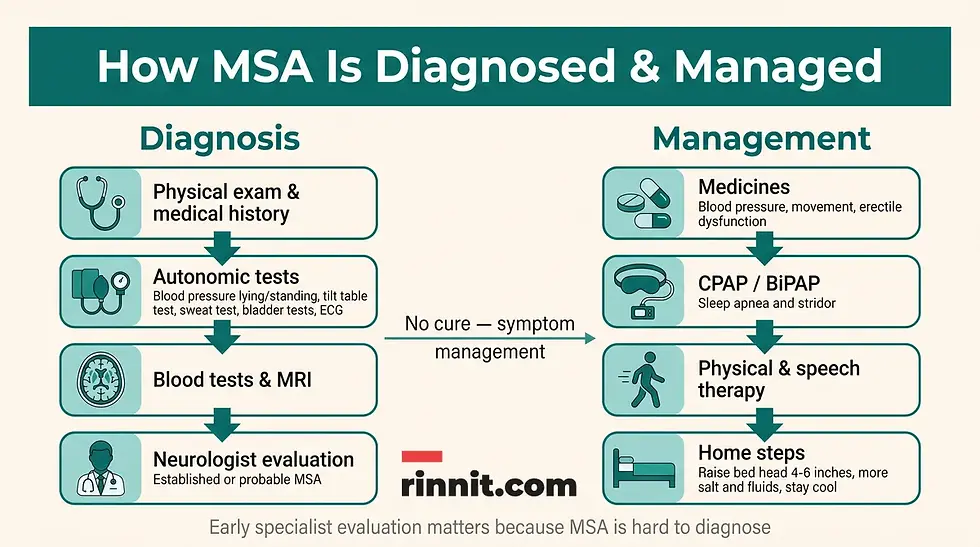
Your healthcare professional gives a physical exam, reviews your medical history, and tests autonomic functions such as blood pressure. You also may need blood tests and imaging tests, such as an MRI. These tests can help diagnose MSA or point to another cause of your symptoms.
If your healthcare professional thinks you have MSA, test results help determine whether the diagnosis is clinically established MSA or clinically probable MSA. You may be referred to a neurologist — a doctor trained in nervous system conditions — for further evaluation.
What Tests Are Used?
Test | What It Checks |
Tilt table test | You are placed on a motorized table, strapped in, and tilted upward to a 70-degree angle. Your blood pressure and heart rate are watched to see if blood pressure responds abnormally to position changes. |
Blood pressure tests (without tilt table) | Blood pressure is measured lying down and standing. |
Sweat test | Evaluates the areas of the body that sweat. |
Bladder and bowel function tests | Checks how well these systems are working. |
Electrocardiogram | Tracks the electrical signals of your heart. |
MRI | Imaging of the brain to help diagnose MSA or find other causes. |
Sleep study | Done if you stop breathing during sleep, snore, or have other sleep symptoms; can diagnose a treatable sleep condition such as sleep apnea. |
How Is Multiple System Atrophy Treated?
Multiple system atrophy has no cure, so treatment manages symptoms with medicines, feeding or breathing support, bladder care, and physical and speech therapy. Treatment involves managing your symptoms — keeping you as comfortable as possible and helping you maintain your body functions. [2]
What Medicines Can Help?
Symptom | Medicines and Key Details |
Low blood pressure when standing (postural hypotension) | Fludrocortisone: a corticosteroid that increases blood pressure by helping your body retain more salt and water. Midodrine (Orvaten): raises blood pressure quickly; must be taken carefully because it can raise blood pressure while lying down — don't lie flat for four hours after taking it. Pyridostigmine (Mestinon, Regonol): raises blood pressure while standing without causing a large increase when lying down. Droxidopa (Northera): common side effects include headaches, dizziness, and nausea. |
Parkinson's-like symptoms (stiffness, slow movement, balance trouble) | Combined levodopa and carbidopa (Sinemet, Duopa, others) can help some people. Important note: many people with MSA do not respond to Parkinson's medicines, and they may become less effective after a few years. |
Erection problems | Sildenafil (Revatio, Viagra) helps manage erectile dysfunction, but it can lower blood pressure. |
How Are Breathing, Swallowing, and Bladder Problems Handled?
Swallowing and breathing: If you have trouble swallowing, try eating softer foods. If swallowing or breathing symptoms become worse, you might need surgery to insert a feeding or breathing tube. A gastrostomy tube delivers food directly into your stomach. If you have sleep apnea, you might be treated with CPAP (continuous positive airway pressure) or BiPAP (bilevel positive airway pressure). Stridor also can be treated with CPAP.
Bladder care: If you have trouble with bladder control, medicines can help in the earlier stages. But as MSA gets worse, you may need a catheter — a soft tube inserted to drain your bladder.
Therapy: A physical therapist can help you maintain as much movement and strength as possible as the disease gets worse. A speech-language pathologist can help you improve or maintain your speech.
What Can I Do at Home?
Several simple lifestyle steps can help minimize MSA symptoms: [2]
Home Step | How It Helps |
Add a little salt to your diet and drink more fluids (especially before exercise) | Salt and fluids increase blood volume and raise blood pressure. |
Drink coffee and other caffeine-containing fluids | Caffeine can increase blood pressure. |
Raise the head of your bed about 4 to 6 inches (10 to 15 centimeters) | Helps control blood pressure when you sleep. Get up slowly after lying down. |
Eat more fiber; try over-the-counter laxatives or stool softeners | Eases constipation. |
Eat small, low-carbohydrate meals | Supports steadier blood pressure and digestion. |
Stay cool on hot days; keep the bathroom from getting too hot when showering | Helps with heat intolerance caused by reduced sweating. |
Wear elastic support stockings up to your waist | Helps keep blood pressure from dropping. |
What Should I Ask at My Appointment?
You first may see your healthcare professional, who may refer you to a neurologist — a doctor trained in nervous system conditions. Preparation helps.
Before the visit, do these five things: Write down any symptoms you're having and for how long, including recent changes in your physical or emotional well-being (for example, moods shifting more quickly). Make a list of your medical information, including other conditions and all medicines you take with doses. Write down key personal information, including any changes in your sex life. Find a family member or friend who can come with you. Write down questions to ask.
Useful questions to ask your doctor:
Questions to Ask | How to Prepare |
What is likely causing my symptoms? | A complete symptom list, including anything that seems unrelated. |
Could it be something else, such as Parkinson's disease? | Notes on when symptoms started and how they've changed. |
How will you make a firm diagnosis, and what tests do I need? | Your full medicine and supplement list with doses. |
What treatment options are available, and what are the side effects? | A family member or friend to accompany you. |
How is my condition likely to change over time, and will treatment slow it or just relieve symptoms? | A prioritized question list, most important first. |
While you wait for your appointment, find out if any blood relatives — a parent, sibling, or grandparent — have been diagnosed with a nervous system condition such as Parkinson's disease or cerebellar ataxia. MSA is not known to be passed down through families, so a family history of a similar-symptom condition may help rule out MSA.
Expect your doctor to ask about: when symptoms began; dizziness or fainting when standing; emotional changes such as laughing then crying; voice changes; loud snoring or interrupted breathing while sleeping; constipation or bladder control problems; sexual symptoms such as lower sex drive or trouble getting an erection; chewing or swallowing trouble; trouble breathing; movement problems such as slowness or poor coordination; family history of Parkinson's disease or another neurological disease; and any other conditions you're being treated for.
Conclusion
Multiple system atrophy is a rare condition where the brain slowly shrinks, affecting both movement and the automatic systems that control blood pressure, bladder, sleep, and more. It usually starts in the 50s or 60s and comes in two types — parkinsonian and cerebellar. There is no cure, and symptoms worsen over time, but medicines, therapy, and simple home steps such as raising the head of your bed, adding a little salt, and staying cool can meaningfully improve daily life. Because MSA shares symptoms with Parkinson's disease and other conditions, an early evaluation by a neurologist is the right first step if you notice unexplained slowness, balance trouble, dizziness when standing, or unusual sleep changes.
Learn more. If you or someone you love has noticed unexplained stiffness, slow movement, balance trouble, dizziness when standing, bladder changes, or disturbed sleep, don't write it off as "just aging." Early evaluation matters: seeing a healthcare professional — and getting a referral to a neurologist — gives you the clearest picture and the best chance to manage symptoms early. If you've already been diagnosed with MSA, contact your healthcare professional if your symptoms become worse or if new symptoms appear. For more plain-language health guides, visit Rinnit.com.
Frequently Asked Questions
What is multiple system atrophy in simple terms?
MSA is a rare condition where parts of the brain slowly shrink, disrupting movement and involuntary body functions like blood pressure, bladder control, and sweating. It usually begins in the 50s or 60s and gets worse over time.
Is MSA the same as Parkinson's disease?
No, but they share symptoms like slow movement, rigid muscles, and poor balance — which is why MSA is hard to diagnose. Many people with MSA do not respond to Parkinson's medicines, and MSA also affects automatic body functions like blood pressure and bladder control, which Parkinson's typically affects differently.
What are the first signs of MSA?
Early signs can include unsteady walking or poor balance, slow or stiff movement, slurred speech, dizziness or fainting when standing up, constipation, bladder control problems, and acting out dreams during sleep (REM sleep behavior disorder). Most people with MSA have a history of acting out their dreams.
Is multiple system atrophy hereditary?
MSA is not known to be passed down through families. Researchers are studying possible genetic or environmental causes such as a toxin, but there is no substantial evidence to support these theories.
Can MSA be cured?
There is no cure for MSA. Treatment focuses on managing symptoms with medicines that raise blood pressure, medicines that may help movement, therapy, CPAP for breathing problems, and lifestyle steps like raising the head of your bed and adding a little salt to your diet.
How long do people live with MSA?
People typically live about 7 to 10 years after MSA symptoms first appear, though survival varies widely from person to person. Death is often due to trouble breathing, infections, or blood clots in the lungs.
What tests confirm MSA?
There is no single test. Diagnosis combines a physical exam, medical history, autonomic function tests (blood pressure lying down and standing, a tilt table test, a sweat test, bladder and bowel function tests, and an electrocardiogram), blood tests, and an MRI. Results determine whether the diagnosis is "clinically established" or "clinically probable" MSA.
What daily habits help with MSA symptoms?
Add a little salt and more fluids (especially before exercise), raise the head of your bed 4 to 6 inches, eat more fiber for constipation, eat small low-carbohydrate meals, stay cool in hot weather, and wear elastic support stockings up to your waist to keep blood pressure from dropping.
Is MSA the same as Shy-Drager syndrome?
Yes. Shy-Drager syndrome, olivopontocerebellar atrophy and striatonigral degeneration are older names for conditions now grouped together as multiple system atrophy.
What kind of doctor treats multiple system atrophy?
A neurologist, a doctor trained in nervous system conditions, usually leads care. Physical therapists and speech-language pathologists often help with movement, speech and swallowing.
Related Reading
What Is Multiple Sclerosis? A Plain-Language Guide to Symptoms, Types, and How It's Treated — another condition that affects the nervous system, with a different cause.
Understanding Mild Cognitive Impairment: A Guide to Symptoms and Care — changes in thinking and memory that can accompany nervous system conditions.
References
Mayo Clinic Staff. Multiple system atrophy - Symptoms and causes. Mayo Clinic. August 2, 2024. https://www.mayoclinic.org/diseases-conditions/multiple-system-atrophy/symptoms-causes/syc-20356153
Mayo Clinic Staff. Multiple system atrophy - Diagnosis and treatment. Mayo Clinic. August 2, 2024. https://www.mayoclinic.org/diseases-conditions/multiple-system-atrophy/diagnosis-treatment/drc-20356157
National Institute of Neurological Disorders and Stroke (NINDS). Multiple System Atrophy. National Institute of Neurological Disorders and Stroke. Last reviewed September 2, 2026. https://www.ninds.nih.gov/health-information/disorders/multiple-system-atrophy
Coon E. Multiple System Atrophy. Merck Manual Professional Edition. Last updated May 2025. https://www.merckmanuals.com/professional/neurologic-disorders/autonomic-nervous-system/multiple-system-atrophy
Genetic and Rare Diseases Information Center (GARD). Multiple system atrophy. Genetic and Rare Diseases Information Center. Accessed October 15, 2026. https://rarediseases.info.nih.gov/diseases/7079/multiple-system-atrophy
Wilkens I, et al. Multiple system atrophy. Fortschr Neurol Psychiatr. 2026;94(9):377-388. PMID 42561997. https://doi.org/10.1055/a-2877-5054
Kamo H, et al. Rehabilitation strategies for atypical parkinsonian syndromes: A scoping review of progressive supranuclear palsy, multiple system atrophy, corticobasal syndrome, and dementia with Lewy bodies. J Parkinsons Dis. 2026:1877718X261440430. PMID 42615574. https://doi.org/10.1177/1877718X261440430
Medical disclaimer
This article is for general informational purposes only and does not constitute medical advice. Always consult a qualified healthcare professional for diagnosis and treatment decisions.



Comments