MCV Blood Test: Normal Range and What Low or High MCV Means

Updated: 2 days ago
Written and medically reviewed by Dr. Baraa Alnahhal, MD · Last reviewed: November 2026 · How we review
Quick Answer: What is an MCV blood test?
MCV, or mean corpuscular volume, is a value on a complete blood count (CBC) that shows the average size of the red blood cells. A normal MCV is 80 to 100 femtoliters (fL). A low MCV can point to iron-deficiency anemia or thalassemia; a high MCV to low vitamin B12 or folate, liver disease or bone marrow problems. [1]
What the research says
Red cell measures help tell the two main causes of small red cells apart, but none is perfect on its own. A meta-analysis of 99 articles on 12 indices used to separate thalassemia from iron deficiency in people with microcytic anemia found the best index had a diagnostic odds ratio of 100.8, while the weakest scored 6.8. No index was accurate enough to make the diagnosis by itself. (Hoffmann et al., Clinical Chemistry and Laboratory Medicine, 2015) [2]
High MCV has two broad groups of causes. A clinical review defines macrocytosis in adults as an MCV above 100 fL. It explains that megaloblastic anemia comes from too little vitamin B12 or folate, while other macrocytic anemias come from conditions such as myelodysplastic syndrome, liver problems, alcohol use, an underactive thyroid and some medicines. (Nagao and Hirokawa, Journal of General and Family Medicine, 2017) [3]
In some groups, a low MCV carries more risk than a high one. In 8,571 people on hemodialysis in Japan, an MCV below 90 fL was linked with higher death rates and more hospital stays for infection, while an MCV above 102 fL was not. This finding applies to dialysis patients, not the general public. (Honda et al., Scientific Reports, 2020) [4]
Key takeaways
MCV is the average size of your red blood cells and is part of every complete blood count. [1]
A normal MCV is 80 to 100 femtoliters (fL). [1]
Low MCV (below 80 fL) may point to iron-deficiency anemia, thalassemia or other hemoglobin disorders. [1]
High MCV (above 100 fL) may point to low vitamin B12 or folate, pernicious anemia, liver disease or bone marrow problems. [1]
No preparation is needed, and results are usually ready the same day. [1]
What is mean corpuscular volume (MCV)?
MCV is a value calculated during a complete blood count (CBC). It tells you the average size of your red blood cells (RBCs), the cells that carry oxygen through your body. [1]
The size of your red blood cells reflects how well they can carry oxygen. When many cells are unusually large or small, it can point to certain health conditions. [1]
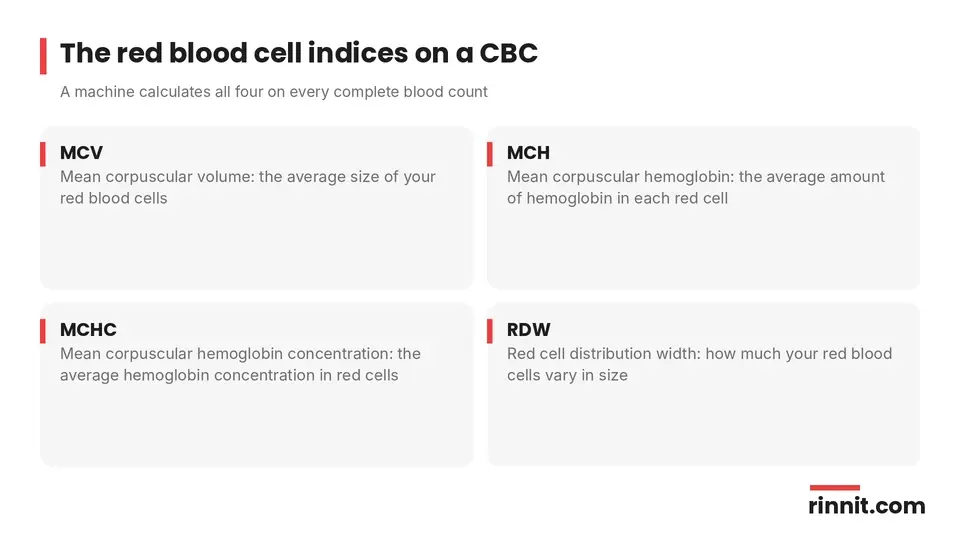
MCV is one of the RBC indices, a group of values a machine calculates on every CBC to describe your red blood cells: [1]
Index | What it measures |
MCV (mean corpuscular volume) | The average size of your red blood cells |
MCH (mean corpuscular hemoglobin) | The average amount of hemoglobin in each red blood cell |
MCHC (mean corpuscular hemoglobin concentration) | The average concentration of hemoglobin in your red blood cells |
RDW (red cell distribution width) | How much your red blood cells vary in size |
Sources: [1]
Because MCV is an average, it can look normal even when you have abnormal cells. This can happen when your red blood cells vary widely in size, with some too large and some too small. [1]
Why is MCV checked?
MCV is checked as part of a routine CBC. Your provider may pay closer attention to it because: [1]
MCV is usually low in iron-deficiency anemia, which may lead to more iron testing
MCV may change if you have liver disease
MCV may change if you're low in vitamin B12 or folate
How is the MCV test done?

MCV comes from a standard blood draw. An automated blood counter then calculates it from the number of red blood cells in a set volume of blood. [1]
How do you prepare?
You don't need to prepare. MCV is part of a routine CBC. [1]
What happens during the test?
You sit down, and the provider cleans the site with an alcohol wipe.
They tie a band above the site so the vein is easier to see.
You feel a quick prick as the needle goes in, and blood flows into a vial.
The needle comes out, and a cotton ball and bandage are placed to stop the bleeding.
The draw takes fewer than 5 minutes. You can usually leave right away. If you feel lightheaded, staff will watch you until it's safe to go. [1]
Are there risks?
The test isn't considered risky. Your arm may feel sore or bruise slightly, and this usually goes away quickly. [1]
What do MCV results mean?

Your report shows a number for the average size of your red blood cells, along with the lab's normal range. MCV is measured in femtoliters (fL). [1]
MCV result | What it's called | Possible causes |
Below 80 fL | Low MCV (microcytosis) | Iron-deficiency anemia, thalassemia, other hemoglobin disorders |
80 to 100 fL | Normal | Red blood cells are an average size |
Above 100 fL | High MCV (macrocytosis) | Pernicious anemia, vitamin B12 deficiency, folate deficiency, liver disease, bone marrow problems such as myelodysplastic syndrome, chemotherapy |
Sources: [1]
What causes low MCV?
A low MCV means your red blood cells are smaller than average. Possible causes include: [1]
Iron-deficiency anemia
Thalassemia
Other disorders that affect hemoglobin
What causes high MCV?
A high MCV means your red blood cells are larger than average. Possible causes include: [1]
Pernicious anemia
Vitamin B12 deficiency
Folate deficiency
Liver disease
Bone marrow problems, such as myelodysplastic syndrome
Chemotherapy
Is an abnormal MCV serious?
Not on its own. A low or high MCV may signal a condition, but it shouldn't be read alone. Your provider also looks at your other test results and your symptoms. [1]
Read together with MCH, MCHC and RDW, MCV helps your provider build a fuller picture of how your red blood cells are working and decide whether you need more tests, such as iron studies. [1]
When will you get your results?
CBC results, including MCV, are usually ready the same day as your blood draw. Ask your provider how and when you'll get them, such as by phone, letter or an online patient portal. [1]
Questions to ask your provider
Is my MCV low, normal or high?
How do my other red blood cell values look?
What do you think is causing an abnormal result?
Do I need iron, vitamin B12 or folate tests?
When should I have my blood tested again?
Conclusion
MCV shows the average size of your red blood cells and appears on every complete blood count. A normal result is 80 to 100 fL, while a low or high value can point to conditions such as iron-deficiency anemia, thalassemia or low vitamin B12 or folate.
An MCV outside the normal range is a clue, not a diagnosis. Your provider reads it with your other blood results and symptoms to decide on next steps.
Keep learning: Read our guides to the complete blood count (CBC), the MCH blood test, the RDW blood test and the hemoglobin test. For more on this value, see MedlinePlus: MCV (Mean Corpuscular Volume).
FAQ
What does MCV mean in a blood test?
MCV (mean corpuscular volume) is the average size of your red blood cells, calculated on a complete blood count. [1]
What is a normal MCV level?
A normal MCV is 80 to 100 femtoliters (fL). [1]
What does a low MCV mean?
A low MCV (below 80 fL) means smaller red cells and may point to iron-deficiency anemia, thalassemia or other hemoglobin disorders. [1]
What does a high MCV mean?
A high MCV (above 100 fL) means larger red cells and may point to low vitamin B12 or folate, pernicious anemia, liver disease or bone marrow problems. [1]
Can chemotherapy raise MCV?
Yes. Chemotherapy is one possible cause of a high MCV. [1]
Do I need to fast for an MCV test?
No. MCV is part of a routine CBC and needs no preparation. [1]
Is an abnormal MCV serious?
Not on its own. Your provider reads MCV with your other test results and symptoms before deciding what it means. [1]
Can MCV be normal if my blood cells are abnormal?
Yes. Because MCV is an average, it can look normal when some red cells are too large and others too small. [1]
What is the difference between MCV and MCH?
MCV is the average size of your red blood cells, while MCH is the average amount of hemoglobin inside each cell. [1]
How long do MCV results take?
CBC results, including MCV, are usually ready the same day as your blood draw. [1]
Related Reading
Learn more in our guide to Understanding Microcytic Anemia: Causes, Symptoms, and Management.
Learn more in our guide to Iron Deficiency Anemia: Symptoms, Causes, Treatment & Complete Guide.
Learn more in our guide to Thalassemia: Symptoms, Causes, Treatment & Complete Guide.
Learn more in our guide to Megaloblastic Anemia: Understanding Vitamin-Deficiency Blood Disorders.
Learn more in our guide to Understanding Vitamin B12 Deficiency: Causes, Symptoms, and Recovery.
Learn more in our guide to Folate Deficiency Anemia: Symptoms, Causes, and Management.
Learn more in our guide to What Is Myelodysplastic Syndrome? A Plain-Language Guide to Symptoms, Causes, and Treatment.
References
Cleveland Clinic. Mean Corpuscular Volume (MCV Blood Test). Cleveland Clinic. Last updated January 19, 2023. https://my.clevelandclinic.org/health/diagnostics/24641-mcv-blood-test
Hoffmann JJML, Urrechaga E, Aguirre U. Discriminant indices for distinguishing thalassemia and iron deficiency in patients with microcytic anemia: a meta-analysis. Clin Chem Lab Med. 2015;53(12):1883-1894. PMID 26536581. https://doi.org/10.1515/cclm-2015-0179
Nagao T, Hirokawa M. Diagnosis and treatment of macrocytic anemias in adults. J Gen Fam Med. 2017;18(5):200-204. PMID 29264027. https://doi.org/10.1002/jgf2.31
Honda H, Kimachi M, Kurita N, et al. Low rather than high mean corpuscular volume is associated with mortality in Japanese patients under hemodialysis. Sci Rep. 2020;10(1):15663. PMID 32973294. https://doi.org/10.1038/s41598-020-72765-2
Medical disclaimer
This article is for general education only and does not replace advice from a qualified healthcare professional. Talk to your doctor about your own diagnosis and treatment, and seek emergency care right away for severe or sudden symptoms.



Comments