Hemoglobin Test: Normal Ranges, Results and What They Mean

Updated: 2 days ago
Written and medically reviewed by Dr. Baraa Alnahhal, MD · Last reviewed: November 2026 · How we review
Quick Answer: What is a hemoglobin test?
A hemoglobin test is a blood test that measures the amount of hemoglobin, the iron-rich protein in red blood cells that carries oxygen. It's part of a complete blood count and is most often used to check for anemia. For adults, a normal level is about 12 to 17.4 g/dL, though ranges vary by lab, age and sex. [1]
What the research says
Low hemoglobin (anemia) affects about 1 in 4 people worldwide. A global analysis of hemoglobin levels across 204 countries and territories estimated that 24.3% of people of all ages, about 1.92 billion, had anemia in 2021, down from 28.2% in 1990. Young children and women were most affected, and dietary iron deficiency was the leading cause. (GBD 2021 Anaemia Collaborators, The Lancet Haematology, 2023) [2]
Quick finger-prick devices are useful for anemia screening in children. A pooled analysis of 16 community studies in children up to age 14 found point-of-care hemoglobin tests correctly identified about 79.5% of children with anemia and correctly ruled it out in about 90.1% of those without it. Average hemoglobin readings were not significantly different from lab analyzers. (Panda et al., European Journal of Pediatrics, 2025) [3]
Rapid bedside readings during surgery are not interchangeable with lab results. Across 34 studies with 2,427 surgical patients and 6,857 paired measurements, every point-of-care device showed wider differences from central lab hemoglobin than the allowable limit, so the authors advise caution when using them to guide transfusion. (Ahn et al., BJS Open, 2024) [4]
Key takeaways
A hemoglobin test measures the oxygen-carrying protein in your red blood cells and gives clues about red blood cell health. [1]
It is usually part of a complete blood count (CBC) and is most commonly used to detect anemia. [1]
No special preparation is needed, and the blood draw takes only a few minutes. [1]
A normal adult range is about 12 to 17.4 g/dL, but ranges vary by age, sex, race and lab. [1]
The test shows whether hemoglobin is low or high, but it cannot tell the cause on its own, so more tests may follow. [1]
What is a hemoglobin test?
A hemoglobin test measures how much hemoglobin is in your blood. Hemoglobin is a protein and the main component of red blood cells. It contains iron, which lets it bind to oxygen and carry it from your lungs to your tissues and organs. [1]
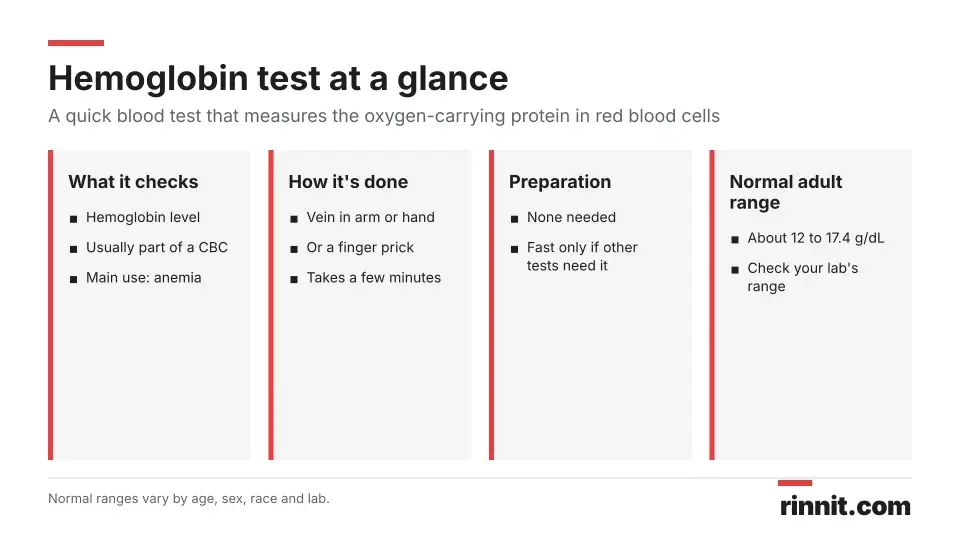
Because hemoglobin is so central to red blood cells, your level gives your provider clues about how healthy your red blood cells are. [1]
Why is a hemoglobin test done?
A hemoglobin test is often part of a routine physical exam. It is usually measured as part of a complete blood count (CBC), which also counts your white blood cells and platelets. Your provider may order it to: [1]
Check for anemia, which means you have too little hemoglobin or too few healthy red blood cells
Help diagnose blood disorders and other conditions
Look into symptoms that suggest your hemoglobin may be too low or too high
See how you are responding to treatment that raises or lowers your red blood cell count
Monitor a blood disorder over time, since people on treatment may need regular testing
Sources: [1]
Symptoms that may lead to a hemoglobin test
Low and high hemoglobin can cause different symptoms. Your provider may suggest the test if you notice any of these: [1]
Low hemoglobin | High hemoglobin |
Fatigue | Headaches |
Pale skin (pallor) | Blurred or double vision |
Weakness | Dizziness |
Dizziness | Itching |
Shortness of breath | Blood clots |
Cold hands and feet | Slower blood flow that can deprive organs of oxygen |
Sources: [1]
How do you prepare for a hemoglobin test?
You do not need any special preparation for a hemoglobin test. If it is done along with other blood tests that require fasting, your provider will tell you how long to avoid food and drink beforehand. [1]
Follow fasting instructions if given. These apply only when other tests are drawn at the same time.
Tell your provider about your medicines. Some medications can change hemoglobin levels.
Mention recent changes. Altitude, diet and exercise or physical activity can also affect your level.
Sources: [1]
What happens during a hemoglobin test?
The test is done in a provider's office, a medical laboratory or another outpatient setting. Blood is usually taken from a vein in your arm or hand. It can also be collected with a finger prick, and newborns and infants may have a heel stick. [1]

A provider cleans the skin with an alcohol swab.
An elastic band is placed around your upper arm, and you make a fist to help blood flow.
A small needle is inserted into a vein. You may feel a brief sting.
Blood flows into a vial, and the sample is sent to a lab for testing.
Sources: [1]
Hemoglobin test at a glance
Item | Typical detail |
Where it is done | Provider's office, medical lab or other outpatient setting |
Sample | Blood from a vein in the arm or hand, a finger prick or, in infants, a heel stick |
Preparation | None, unless fasting is needed for other tests |
How long it takes | A few minutes |
Usually part of | A complete blood count (CBC) |
Main use | Detecting anemia |
Sources: [1]
What happens after a hemoglobin test?
You can usually go back to your normal activities right away. The puncture site may look bruised or feel slightly sore for a few days, and this usually goes away on its own. Your provider will review your results with you, often alongside other blood test results. [1]
What are normal hemoglobin levels?
For adults, the normal range for hemoglobin is about 12 to 17.4 grams per deciliter (g/dL) of blood. Levels can vary with age, race and sex, and each lab may use slightly different reference ranges, so always compare your result with the range printed on your report. [1]
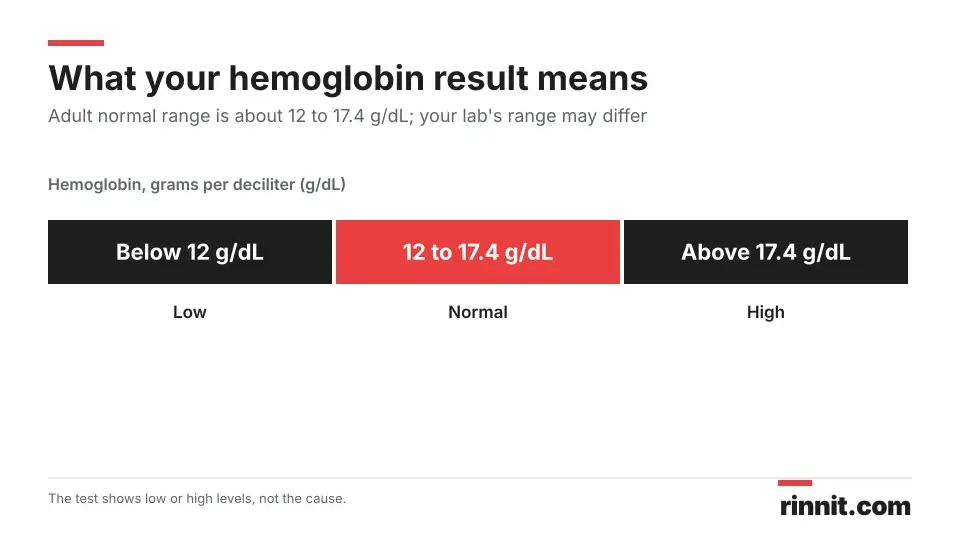
Lifestyle and environmental factors can also shift your level, including: [1]
Living at a high altitude
Diet
Exercise or physical activity
Certain medications
Sources: [1]
What do abnormal hemoglobin results mean?
A hemoglobin test shows whether your level is low or high and can help show how severe a condition may be. It cannot identify the cause on its own, so your provider interprets it alongside other tests. [1]
Possible causes of low and high hemoglobin
Low hemoglobin may be linked to | High hemoglobin may be linked to |
Iron deficiency | Polycythemia vera |
Vitamin B12 or folic acid deficiency | Congenital heart defects |
Blood loss from surgery, injury, menstrual bleeding or the digestive tract | Certain kidney diseases, including kidney cancer |
Kidney disease or liver disease | Lung diseases, such as COPD and pulmonary fibrosis |
Sickle cell disease or thalassemia | Dehydration, which raises red blood cells relative to blood volume |
Blood or bone marrow cancers, or autoimmune diseases | — |
Sources: [1]
Low hemoglobin can also mean red blood cells are being destroyed faster than your body makes them, which is called hemolytic anemia. Chronic blood loss is one of the most common causes of anemia. [1]
Hemoglobin test vs. hemoglobin A1c
Feature | Hemoglobin test | Hemoglobin A1c test |
What it measures | The amount of hemoglobin in your blood | How much glucose (sugar) has attached to hemoglobin over time |
Main use | Detecting anemia | Diagnosing diabetes or monitoring blood sugar |
What higher results suggest | Possible polycythemia, heart, kidney or lung conditions, or dehydration | Higher blood sugar levels |
Sources: [1]
What are the risks of a hemoglobin test?
A hemoglobin test has very few risks. You may feel slight pain when the needle goes in, and the site may look bruised or swollen for a few days. These effects usually go away on their own. [1]
What happens next after abnormal results?
If your hemoglobin is low or high, your provider may order more tests to find the cause. Treatment depends on the underlying condition, and people being treated for a blood disorder may need regular hemoglobin checks to see how well treatment is working. [1]
When should you call your provider?
Contact your provider if you notice symptoms that can point to a hemoglobin problem, or if you have questions about your results: [1]
Ongoing fatigue, weakness, pale skin, dizziness, shortness of breath or cold hands and feet, which can be signs of low hemoglobin
Headaches, blurred or double vision, dizziness or itching, which can be signs of high hemoglobin
Signs of a blood clot
Heavy or ongoing bleeding, such as heavy menstrual periods or bleeding from the digestive tract
Sources: [1]
Questions to ask your provider
Why are you checking my hemoglobin?
Is my result within the normal range for your lab, my age and my sex?
What might be causing my low or high level?
Do I need more tests to find the cause?
How often should my hemoglobin be rechecked?
Conclusion
A hemoglobin test is a quick, low-risk blood test that measures the oxygen-carrying protein in your red blood cells. It is usually part of a complete blood count, needs no special preparation and is most often used to find anemia or track a blood disorder. [1]
A result outside the normal range is a starting point, not a diagnosis. Because hemoglobin can be affected by many conditions as well as altitude, diet, exercise and medicines, your provider will look at it alongside other tests and may order more testing before deciding on treatment. [1] [2]
Keep learning: Read our guides to iron deficiency anemia, thalassemia and polycythemia vera. For more on this test, see the MedlinePlus guide to the hemoglobin test.
FAQ
What is a hemoglobin test?
A hemoglobin test is a blood test that measures how much hemoglobin, the iron-containing protein in red blood cells that carries oxygen, is in your blood.
Why is a hemoglobin test done?
It is most often used to check for anemia. It can also help diagnose other blood disorders and track how well treatment for a blood condition is working.
Is a hemoglobin test part of a CBC?
Yes. Hemoglobin is usually measured as part of a complete blood count (CBC), which also counts white blood cells and platelets.
Do I need to fast before a hemoglobin test?
No special preparation is needed. If other tests that require fasting are done at the same time, follow your provider's fasting instructions.
Does a hemoglobin test hurt?
You may feel a brief sting when the needle goes in. The site may be slightly sore, bruised or swollen for a few days.
How long does a hemoglobin test take?
The blood draw only takes a few minutes. It can be done from a vein in your arm or hand, or with a finger prick.
What is a normal hemoglobin level?
For adults, a normal hemoglobin level is about 12 to 17.4 grams per deciliter (g/dL). Ranges vary by age, sex, race and lab.
What does low hemoglobin mean?
Low hemoglobin usually points to anemia. Causes include iron or vitamin deficiency, blood loss, kidney or liver disease, sickle cell disease and thalassemia.
What does high hemoglobin mean?
High hemoglobin can be linked to polycythemia vera, congenital heart defects, some kidney diseases and lung diseases such as COPD. Dehydration can also raise it.
Is a hemoglobin test the same as an A1c test?
No. A hemoglobin test mainly checks for anemia, while an A1c test measures sugar attached to hemoglobin to diagnose or monitor diabetes.
Related Reading
Learn more in our guide to Iron Deficiency Anemia: Symptoms, Causes, Treatment & Complete Guide.
Learn more in our guide to Vitamin Deficiency Anemia: Symptoms, Causes, Treatment & Complete Guide.
Learn more in our guide to Sickle Cell Anemia: Symptoms, Causes, Treatment & Complete Guide.
Learn more in our guide to Thalassemia: Symptoms, Causes, Treatment & Complete Guide.
Learn more in our guide to Polycythemia Vera: Complete Guide to Symptoms, Causes, Diagnosis, and Treatment.
Learn more in our guide to Hemoglobinopathy: Understanding Inherited Blood Disorders.
Hemoglobin Electrophoresis: What It Shows, Hemoglobin Types and What Results Mean explains the blood test that identifies sickle cell, thalassemia and other hemoglobin types.
Hematocrit Test: Normal Range and What High or Low Levels Mean explains the blood test that measures the percentage of red blood cells.
References
Cleveland Clinic. Hemoglobin Test: What It Is, Procedure & Results. Cleveland Clinic. Last updated July 18, 2022. https://my.clevelandclinic.org/health/diagnostics/17790-hemoglobin-test
GBD 2021 Anaemia Collaborators. Prevalence, years lived with disability, and trends in anaemia burden by severity and cause, 1990-2021: findings from the Global Burden of Disease Study 2021. Lancet Haematol. 2023;10(9):e713-e734. PMID 37536353. https://doi.org/10.1016/S2352-3026(23)00160-6
Panda PK, Sharawat IK, Pradhan P, et al. Diagnostic accuracy of point-of-care devices for detection of anemia in children in community settings: a systematic review and meta-analysis. Eur J Pediatr. 2025;184(1):23. PMID 39556152. https://doi.org/10.1007/s00431-024-05875-y
Ahn HS, Lenet T, Gilbert RWD, et al. Accuracy of point-of-care testing devices for haemoglobin in the operating room: meta-analysis. BJS Open. 2024;8(1):zrad148. PMID 38266123. https://doi.org/10.1093/bjsopen/zrad148
Medical disclaimer
This article is for general education only and does not replace advice from a qualified healthcare professional. Talk to your doctor about your own diagnosis and treatment, and seek emergency care right away for severe or sudden symptoms.



Comments