Hemoglobin Electrophoresis: What It Shows, Hemoglobin Types and What Results Mean

Updated: 2 days ago
Written and medically reviewed by Dr. Baraa Alnahhal, MD · Last reviewed: November 2026 · How we review
Quick Answer
Hemoglobin electrophoresis is a blood test that separates and measures the different types of hemoglobin, the oxygen-carrying protein in red blood cells. It's used to diagnose sickle cell disease, thalassemia and other inherited hemoglobin disorders, as part of newborn screening, and to explain unexplained anemia. No preparation is needed.
What the research says
Blood-count clues can flag who needs the test: in 500 pregnant women with anemia in India, of whom 132 had beta-thalassemia trait confirmed by HPLC (HbA2 3.5–9%), the Shine and Lal index was the most sensitive screening clue (90.9%) and a low MCH the most specific (89.9%); using the two together worked best before confirmatory hemoglobin testing (Singh N et al., Journal of Obstetrics and Gynaecology of India, 2026) [2]
Simple indices help separate thalassemia trait from iron deficiency: in 156 patients, the Patra index (MCV divided by RDW) identified beta-thalassemia trait with 83% sensitivity and 100% specificity against HbA2 measurement, but the authors stress that confirmatory hemoglobin testing remains essential (Patra S et al., Cureus, 2026) [3]
Key takeaways
Separates hemoglobin types (HbA, HbA2, HbF and abnormal variants such as HbS and HbC) using an electric current.
In adults, HbA2 is normally about 2–3%; HbF is high in babies and falls by about age 3.
Used for sickle cell disease and trait, thalassemia, newborn screening and unexplained anemia.
No preparation; arm-vein draw in adults, heel stick in newborns.
Results are interpreted with a complete blood count, iron studies and sometimes genetic testing.
What is hemoglobin electrophoresis?
Hemoglobin is made of protein chains. Inherited gene changes can alter these chains, producing abnormal hemoglobin (such as HbS in sickle cell disease) or reducing the amount made (as in thalassemia). In electrophoresis, a blood sample is placed in a gel or capillary and exposed to an electric current. Each hemoglobin type carries a different charge, so it travels a different distance and forms its own band. The lab identifies the bands and measures each one as a percentage of the total. A related method, isoelectric focusing (IEF), and high-performance liquid chromatography (HPLC) are used the same way. Sources: [1]
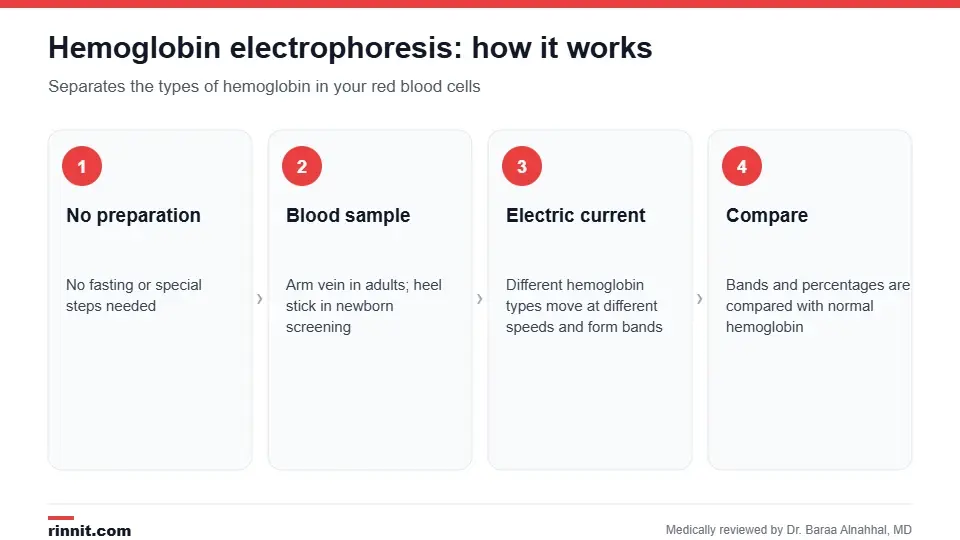
Hemoglobin electrophoresis sorts hemoglobin types by how they move in an electric field.
Why is it done?
Diagnosing sickle cell disease, sickle cell trait and other hemoglobinopathies.
Finding thalassemia, especially when a blood count shows small red cells (microcytic anemia) with normal iron.
Newborn screening, as one of several heel-stick tests.
Investigating symptoms of a blood disorder, such as anemia, jaundice or an enlarged spleen.
Family planning, when relatives or a partner carry a hemoglobin variant. Sources: [1]
Hemoglobin types
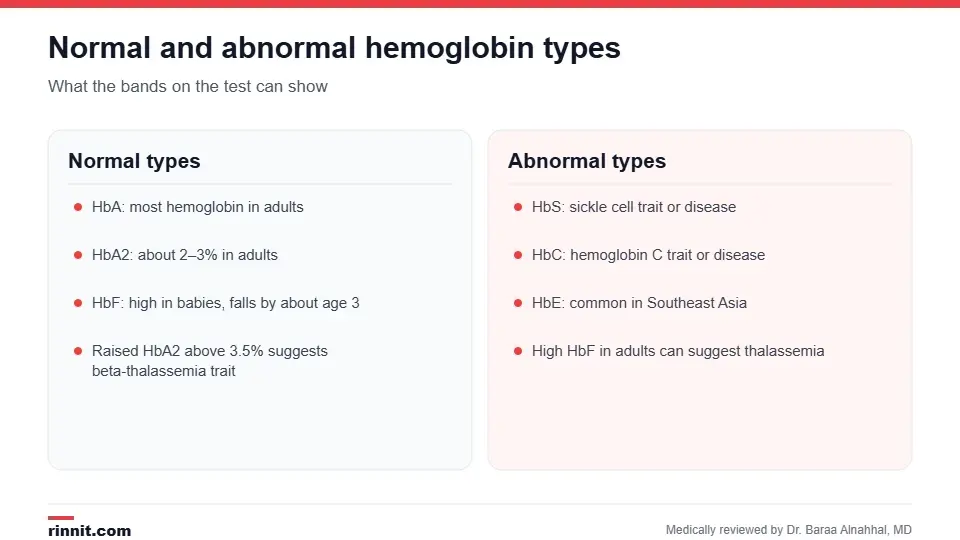
What the bands on hemoglobin electrophoresis can show.
Type | What it is | What the result can mean |
HbA | Main adult hemoglobin | Makes up most hemoglobin in normal adult red cells |
HbA2 | Minor adult hemoglobin, about 2–3% | Raised above about 3.5% suggests beta-thalassemia trait |
HbF | Fetal hemoglobin | Normal in babies; raised levels later can suggest thalassemia or other disorders |
HbS | Sickle hemoglobin | Sickle cell trait (some HbS) or sickle cell disease (mostly HbS) |
HbC | Hemoglobin C | Trait or HbC disease; linked with hemolytic anemia |
HbE | Hemoglobin E | Common in Southeast Asia; can combine with beta-thalassemia |
Sources: [1, 2, 3]
How do I prepare?
No preparation is needed. Tell your provider if you have had a blood transfusion in the past few months, because donated blood can change the result. Sources: [1]
What happens during the test?
In adults and older children, blood is drawn from a vein in the arm.
In newborns, a few drops are collected with a heel stick; a finger stick may also be used.
The sample is sent to the lab for separation and measurement. Sources: [1]
Understanding your results
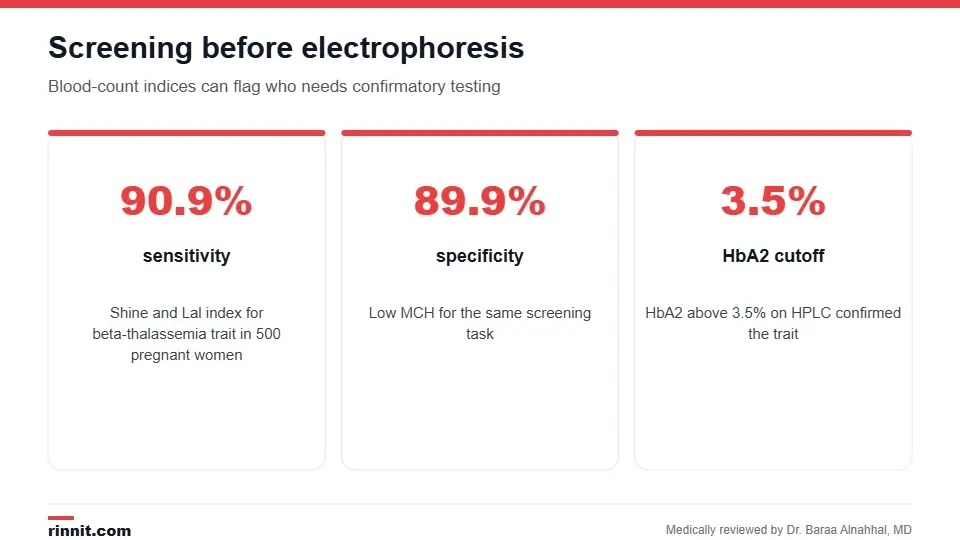
Simple blood-count indices can flag who needs confirmatory hemoglobin testing.
Your provider compares each hemoglobin type with its reference range and interprets the pattern with your blood count and iron studies. Examples: Sources: [1]
Normal: mostly HbA with about 2–3% HbA2 and very little HbF in adults.
Sickle cell trait: HbA plus a smaller amount of HbS; usually no symptoms.
Sickle cell disease: mostly HbS with no HbA (in HbSS).
Beta-thalassemia trait: HbA2 above about 3.5%, often with small red cells.
Raised HbF in adults: can suggest a form of thalassemia or another condition.
Because iron deficiency also causes small red cells and can lower HbA2, iron levels are checked alongside. Blood-count indices such as the Shine and Lal index or the Patra index can suggest thalassemia trait, but studies agree that hemoglobin testing is still needed to confirm it. Sources: [2, 3]
Risks
The risks are those of a routine blood draw or heel stick: brief discomfort and a small bruise. Sources: [1]
Conclusion
Hemoglobin electrophoresis tells you which hemoglobin types your red cells carry and how much of each. It confirms sickle cell disease and thalassemia, identifies carriers before pregnancy, and is part of newborn screening. Ask your provider how your result fits with your blood count and iron levels, and whether family members should be tested.
Keep learning: read about sickle cell disease and microcytic anemia.
Frequently asked questions
What is hemoglobin electrophoresis used for?
To identify sickle cell disease and trait, thalassemia and other inherited hemoglobin disorders, and as part of newborn screening.
Do I need to fast?
No. No preparation is needed.
What is a normal HbA2 level?
About 2–3% of total hemoglobin in adults. Levels above about 3.5% suggest beta-thalassemia trait.
Why is HbF high in babies?
Fetal hemoglobin carries oxygen before birth and is gradually replaced by HbA, normally reaching low adult levels by about age 3.
Can the test tell sickle cell trait from sickle cell disease?
Yes. Trait shows both HbA and HbS; sickle cell disease (HbSS) shows mostly HbS without HbA.
Can iron deficiency affect the result?
Yes. It can lower HbA2 and hide thalassemia trait, so iron studies are checked at the same time.
Does a blood transfusion affect the test?
Yes. Donor blood can mask your own hemoglobin pattern for several months; tell your provider about recent transfusions.
Is the test part of newborn screening?
Yes. A heel-stick sample is tested for sickle cell disease and other hemoglobin variants in many countries.
Should my partner be tested?
If you carry a hemoglobin variant, testing your partner helps estimate the chance that a child inherits a serious disorder.
Are there risks?
Only minor discomfort or bruising from the blood draw or heel stick.
Related Reading
Sickle Cell Anemia: Symptoms, Causes, Treatment & Complete Guide the most common disorder this test diagnoses.
Thalassemia: Symptoms, Causes, Treatment & Complete Guide inherited anemias identified by abnormal HbA2 and HbF.
Hemoglobinopathy: Understanding Inherited Blood Disorders an overview of inherited hemoglobin disorders.
Understanding Microcytic Anemia: Causes, Symptoms, and Management the small-red-cell anemia that often leads to this test.
Hemoglobin Test: Normal Ranges, Results and What They Mean the basic blood test that measures total hemoglobin.
References
Cleveland Clinic. Hemoglobin Electrophoresis: Test, Procedure & Results. Cleveland Clinic. Last updated January 13, 2026. https://my.clevelandclinic.org/health/diagnostics/22420-hemoglobin-electrophoresis
Singh N, Seth T, Kant S, et al. Diagnostic accuracy of an erythrocyte index-based protocol for screening beta thalassemia trait among antenatal women in India. Journal of Obstetrics and Gynaecology of India. 2026;76(4):346-351. PMID 42630504. https://doi.org/10.1007/s13224-025-02195-5
Patra S, Shome A, Patra CC, et al. Diagnostic accuracy of the Patra index and red cell distribution width index in distinguishing beta-thalassemia trait from iron deficiency anemia: a retrospective comparative study. Cureus. 2026;18(2):e104454. PMID 41918657. https://doi.org/10.7759/cureus.104454
Medical disclaimer
This article is for general education only and does not replace advice from a qualified healthcare professional. Talk to your doctor about your own diagnosis and treatment, and seek emergency care right away for severe or sudden symptoms.



Comments