Hematocrit Test: Normal Range and What High or Low Levels Mean

Updated: 2 days ago
Written and medically reviewed by Dr. Baraa Alnahhal, MD · Last reviewed: November 2026 · How we review
Quick Answer
A hematocrit (Hct) test is a blood test that measures the percentage of the blood made up of red blood cells. It's part of a routine complete blood count (CBC). Typical adult ranges are about 41–50% for males and 36–44% for females. A low hematocrit can point to anemia; a high one can come from dehydration.
What the research says
Hematocrit targets matter in polycythemia vera: in a randomized trial of 365 adults with polycythemia vera, keeping hematocrit below 45% led to far fewer cardiovascular deaths and major blood clots (2.7%) than a target of 45–50% (9.8%) (Marchioli R et al., N Engl J Med, 2013) [2]
Quick bedside results aren't always interchangeable: in more than 31,000 emergency patients, hematocrit from a blood gas analyzer correlated strongly with the main lab result, but the agreement wasn't close enough to treat the two as identical (Altunok İ et al., Am J Emerg Med, 2019) [3]
Key takeaways
Measures the percentage of blood made up of red blood cells.
Part of a complete blood count (CBC).
Adult ranges: about 41–50% (males) and 36–44% (females).
Low levels often mean anemia; high levels can mean dehydration or too many red cells.
No fasting or preparation is needed.
What is hematocrit?
Blood is made of red blood cells, white blood cells, platelets and plasma, the liquid part. Hematocrit shows how much of your blood volume is red cells. It's closely related to the hemoglobin test, which measures the oxygen-carrying protein inside red cells. Both are part of a complete blood count. Sources: [1]
Why is it done?
As part of routine blood work during a checkup.
When you have symptoms of anemia such as fatigue, weakness, pale skin or shortness of breath.
To monitor a known blood disorder or its treatment. Sources: [1]
How the test is done
No preparation is needed; you can eat, drink and take your usual medicines. Blood is drawn from a vein, usually inside the elbow, or from the heel in infants. It takes a few minutes, and results usually come back within 24 hours to a few days. Some people feel faint during a blood draw; tell the staff if you do. Sources: [1]
Normal hematocrit ranges
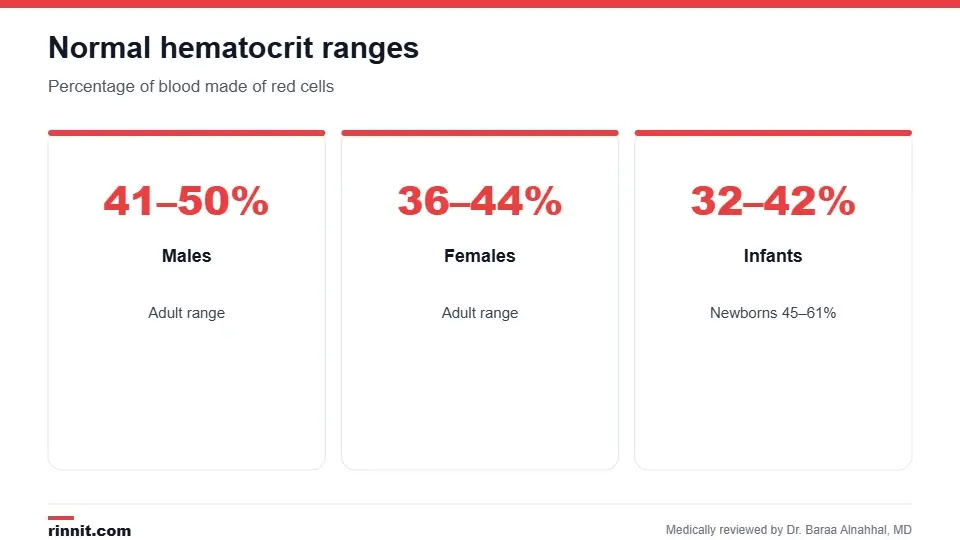
Ranges vary by lab, age and sex.
Group | Typical range |
Males | 41%–50% |
Females | 36%–44% |
Infants | 32%–42% |
Newborns | 45%–61% |
Results outside the range are flagged high (H) or low (L). An abnormal number isn't always a concern; your provider reads it with your symptoms and other results. Sources: [1]
Causes of low hematocrit
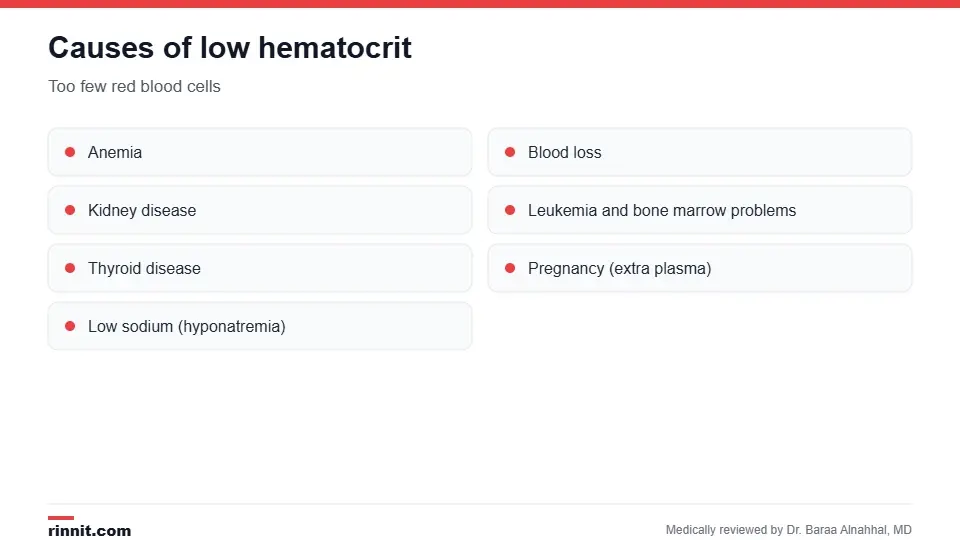
Low hematocrit usually means too few red blood cells.
Anemia, such as iron deficiency anemia.
Blood loss from injury, surgery or bleeding.
Kidney disease.
Leukemia and other bone marrow problems, such as aplastic anemia.
Thyroid disease.
Low sodium (hyponatremia).
Pregnancy, because plasma volume increases. Sources: [1]
Causes of high hematocrit
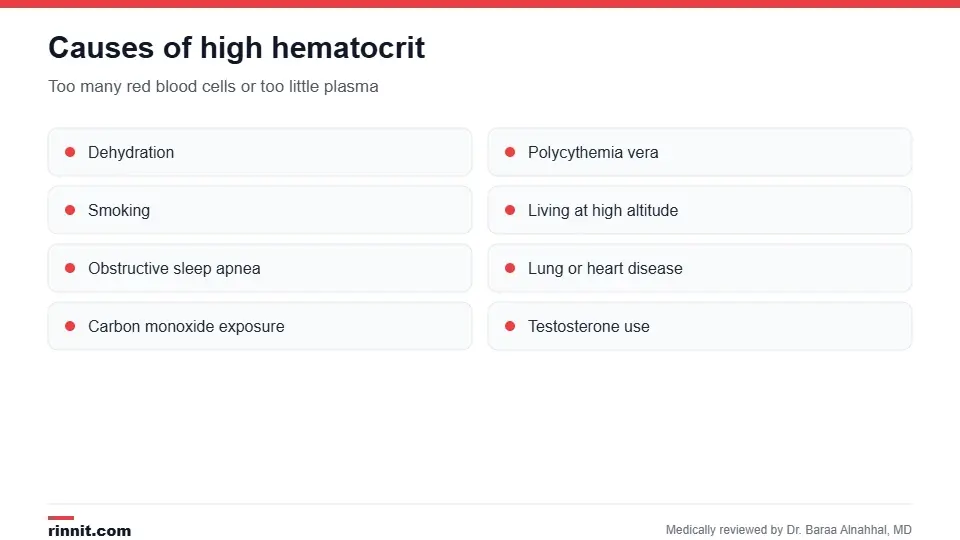
High hematocrit can reflect too many red cells or too little fluid.
Polycythemia vera, a bone marrow disorder.
Smoking and carbon monoxide poisoning.
Obstructive sleep apnea, pulmonary fibrosis or heart disease.
Testosterone use.
Living at high altitude. Sources: [1, 2]
Conclusion
Hematocrit is a simple, widely used number that reflects how many red blood cells you have. It helps detect anemia and conditions that thicken the blood, and it's always interpreted with your hemoglobin, other blood counts and symptoms.
Keep learning: read about the complete blood count and polycythemia vera.
Frequently asked questions
What does hematocrit measure?
The percentage of your blood made up of red blood cells.
What is a normal hematocrit?
About 41–50% for males and 36–44% for females, depending on the lab.
Do I need to fast?
No preparation is needed.
What does low hematocrit mean?
Often anemia, blood loss or a bone marrow or kidney problem.
What does high hematocrit mean?
Possibly dehydration, smoking, sleep apnea or polycythemia vera.
Is hematocrit the same as hemoglobin?
No. Hemoglobin measures the oxygen-carrying protein; hematocrit measures red cell volume.
Is hematocrit part of a CBC?
Yes.
Can pregnancy lower hematocrit?
Yes, because the plasma volume increases.
How long do results take?
Usually 24 hours to a few days.
Does living at high altitude affect it?
Yes. It can raise hematocrit.
Related Reading
Blood Volume Testing: How It Works and What Results Mean explains the nuclear test that measures total blood volume.
Complete Blood Count (CBC): What It Measures, Normal Ranges and Abnormal Results the panel that includes hematocrit.
Hemoglobin Test: Normal Ranges, Results and What They Mean the closely related red cell test.
Polycythemia Vera: Complete Guide to Symptoms, Causes, Diagnosis, and Treatment a cause of high hematocrit.
Iron-Deficiency Anemia: Causes, Symptoms, and Recovery a common cause of low hematocrit.
Aplastic Anemia: Symptoms, Causes, Treatment & Complete Guide bone marrow failure that lowers blood counts.
References
Cleveland Clinic. Hematocrit Test: What It Is, Levels, and High & Low Range. Cleveland Clinic. Last updated May 12, 2025. https://my.clevelandclinic.org/health/diagnostics/17683-hematocrit
Marchioli R, Finazzi G, Specchia G, et al. Cardiovascular events and intensity of treatment in polycythemia vera. N Engl J Med. 2013;368(1):22-33. PMID 23216616. https://doi.org/10.1056/NEJMoa1208500
Altunok İ, Aksel G, Eroğlu SE. Correlation between sodium, potassium, hemoglobin, hematocrit, and glucose values as measured by a laboratory autoanalyzer and a blood gas analyzer. Am J Emerg Med. 2019;37(6):1048-1053. PMID 30131206. https://doi.org/10.1016/j.ajem.2018.08.045
Medical disclaimer
This article is for general education only and does not replace advice from a qualified healthcare professional. Talk to your doctor about your own diagnosis and treatment, and seek emergency care right away for severe or sudden symptoms.



Comments