Blood Volume Testing: How It Works and What Results Mean

Updated: 2 days ago
Written and medically reviewed by Dr. Baraa Alnahhal, MD · Last reviewed: November 2026 · How we review
Quick Answer
Blood volume testing is a nuclear medicine test that measures how much blood is in the body and compares it with what's normal for your height, weight and sex. A small amount of radioactive tracer is injected into a vein, and several blood samples are drawn. It's used mostly in intensive care. The test takes under 90 minutes.
What the research says
It can unmask false anemia: in people with advanced heart failure, 46% of those who looked anemic on routine blood counts actually had extra plasma diluting their blood, not true anemia, and they had worse outcomes (Androne AS et al., Circulation, 2003) [2]
It shows low volume in POTS: in a study of people with postural tachycardia syndrome, blood volume testing found a larger total blood volume deficit than in healthy people (689 vs. 228 mL) (Raj SR et al., Circulation, 2005) [3]
Key takeaways
Blood volume testing measures the total amount of blood in your body.
A radioactive tracer is injected, then several blood samples are drawn.
It helps guide fluid and blood treatment in serious illness.
It can show whether low red blood cell counts are true anemia or extra plasma.
The test usually takes under 90 minutes.
What is blood volume testing?
Your blood is made of plasma (the liquid part) and red blood cells. Standard tests like a complete blood count (CBC) or a hematocrit test show concentrations, not total amounts. If you have extra plasma, your red cells can look low even when you have enough. Blood volume testing measures the actual amounts, helping your provider see whether you have too little blood (hypovolemia), too much (hypervolemia) or a normal amount. Sources: [1]
Why it's done

The test helps guide fluid and blood treatment.
Blood loss or dehydration.
Heart failure, kidney failure or liver failure.
Serious burns or shock.
Unexplained anemia.
Fainting (syncope) or orthostatic hypotension, a drop in blood pressure when you stand.
Screening before surgery. Sources: [1]
How to prepare
Don't eat or drink for a few hours beforehand, as directed.
Avoid caffeinated drinks on the day of the test.
Ask whether to adjust any medicines.
Tell your provider if you're pregnant or breastfeeding; the test isn't done during pregnancy or breastfeeding, and a pregnancy test may be ordered.
You'll take an iodine pill before the test to protect your thyroid. Sources: [1]
What happens during the test

The test usually takes under 90 minutes.
An IV line is placed in your arm while you lie still on an exam table.
A small amount of radioactive tracer is injected.
You wait about 12 minutes while it mixes with your blood.
Several blood samples are drawn about 6 minutes apart.
The lab measures how diluted the tracer has become to calculate your blood volume. Sources: [1]
Risks
The radiation dose is small. Some people have an allergic reaction, especially those allergic to iodine, shellfish or eggs, so tell your provider about any allergies. Radioactive iodine can affect the thyroid, which is why you take an iodine pill first. Afterward, the IV is removed and you can go home; drink extra fluids to help flush the tracer. Sources: [1]
What the results mean
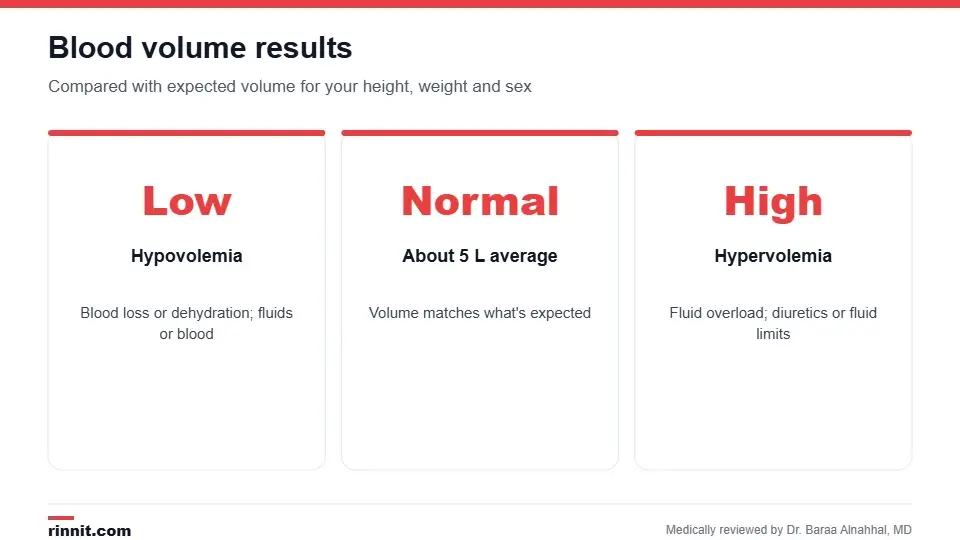
Results guide treatment such as fluids, blood or diuretics.
Result | What it may mean | Possible next steps |
Low | Too little blood, such as from bleeding or dehydration | Fluids or blood transfusion |
Normal | Blood volume matches what's expected | No change |
High | Too much fluid, such as with heart or kidney failure | Diuretics or fluid limits |
Results show whether your plasma volume, red cell volume or both are off. For example, someone with heart failure may have low red cell counts because of extra plasma rather than true anemia, which changes treatment. Sources: [1, 2]
Conclusion
Blood volume testing gives a direct measurement of how much blood you have. It helps your care team decide whether you need fluids, blood, diuretics or other treatment, especially when standard blood counts can be misleading.
Keep learning: read about the complete blood count (CBC) and the tilt table test.
Frequently asked questions
What is blood volume testing?
A nuclear medicine test that measures how much blood is in your body.
What is normal blood volume?
About 5 liters for an average adult, adjusted for height, weight and sex.
How long does it take?
Usually under 90 minutes.
Is it radioactive?
Yes, a small amount of tracer is used.
Why do I take an iodine pill?
To protect your thyroid from the radioactive iodine.
Can I eat before the test?
No food or drink for a few hours beforehand.
Who shouldn't have it?
People who are pregnant or breastfeeding.
What are the risks?
Mainly a possible allergic reaction.
Why not just use a CBC?
A CBC shows concentration, not the total amount of blood.
What happens after the test?
You go home and drink extra fluids.
Related Reading
Complete Blood Count (CBC): What It Measures, Normal Ranges and Abnormal Results the most common blood count test.
Hematocrit Test: Normal Range and What High or Low Levels Mean measures the share of blood made of red cells.
Tilt Table Test: How It Works, What to Expect and What Results Mean a test for fainting and blood pressure drops.
Nuclear Medicine Imaging: How Tracer Scans Work, Safety and Results an overview of tracer-based tests.
Heart Failure: Symptoms, Causes & Treatment Guide a condition that can change blood volume.
References
Cleveland Clinic. Blood Volume: What It Is & How Testing Works. Cleveland Clinic. Last updated July 8, 2022. https://my.clevelandclinic.org/health/diagnostics/16793-blood-volume-testing
Androne AS, Katz SD, Lund L, et al. Hemodilution is common in patients with advanced heart failure. Circulation. 2003;107(2):226-229. PMID 12538419. https://doi.org/10.1161/01.cir.0000052623.16194.80
Raj SR, Biaggioni I, Yamhure PC, et al. Renin-aldosterone paradox and perturbed blood volume regulation underlying postural tachycardia syndrome. Circulation. 2005;111(13):1574-1582. PMID 15781744. https://doi.org/10.1161/01.CIR.0000160356.97313.5D
Medical disclaimer
This article is for general education only and does not replace advice from a qualified healthcare professional. Talk to your doctor about your own diagnosis and treatment, and seek emergency care right away for severe or sudden symptoms.



Comments