Tilt Table Test: How It Works, What to Expect and What Results Mean

Updated: 2 days ago
Written and medically reviewed by Dr. Baraa Alnahhal, MD · Last reviewed: November 2026 · How we review
Quick Answer: What is a tilt table test?
A tilt table test, also called head-up tilt table (HUTT) testing, helps find out why you faint. You lie strapped to a padded table that quickly moves you from flat to nearly upright while monitors track your blood pressure, heart rate and heart rhythm. It can help diagnose vasovagal syncope, postural orthostatic tachycardia syndrome (POTS) and orthostatic hypotension. [1]
What the research says
Tilt testing separates people with unexplained fainting from people who don't faint fairly well. In a meta-analysis of 55 studies comparing 4,361 patients with 1,791 controls, the test had an area under the curve of 0.84, and adding nitroglycerin raised sensitivity while keeping similar specificity. (Forleo et al., International Journal of Cardiology, 2013) [2]
A standard medicine-assisted protocol exists. The "Italian Protocol" uses 5 minutes lying down, 20 minutes tilted at 60 degrees, then 15 more minutes after a 400-microgram sublingual nitroglycerin spray if needed. (Bartoletti et al., Europace, 2000) [3]
Key takeaways
A tilt table test shows how your blood pressure and heart rate respond when you go from lying down to upright. [1]
It helps diagnose vasovagal syncope, POTS and orthostatic hypotension after heart-related causes are ruled out. [1]
You rest flat for at least 10 minutes, then stay tilted at about 70 degrees for up to 45 minutes. [1]
Fainting during the test is possible, but staff lower the table right away so you recover quickly. [1]
Arrange a ride home, since driving yourself afterward is generally considered unsafe. [1]
What is a tilt table test?
A tilt table test is a procedure providers use to understand why you have fainting (syncope) episodes. You're securely fastened to a padded table that moves from a flat to a vertical position, which mimics standing up. Devices monitor your blood pressure, heart rate and heart rhythm to see how your body reacts. It's among the most detailed ways to study the cause of fainting. [1]
How does it work?
Moving from flat to upright forces your autonomic nervous system, the network of nerves that controls automatic processes, to maintain your blood pressure. Normally it does this without trouble. Conditions like vasovagal syncope and POTS disrupt that process, which is why you might faint or nearly faint when you stand up. [1]
Why is a tilt table test done?

The test looks for three common, nervous-system-related causes of fainting.
Your provider may suggest the test if you've fainted several times without a clear reason. Before it, they rule out heart-related causes such as arrhythmias or structural heart problems. The test can help diagnose or manage: [1]
Orthostatic hypotension: your blood pressure drops more than it should when you stand, causing dizziness or fainting.
Postural orthostatic tachycardia syndrome (POTS): your heart beats faster than it should when you stand, which can lead to fainting and other symptoms.
Vasovagal syncope: you faint when your nervous system overreacts to triggers like medical instruments, stress or fatigue.
Who may not be able to have it?
Tilt table testing may not be safe if you're pregnant or have blockages in the arteries that supply your heart or brain. Your provider will review your medical history first. [1]
How do you prepare for a tilt table test?
The provider who orders the test will tell you how to prepare. You may be asked to: [1]
Avoid caffeine and alcohol for 12 hours before the test
Fast (no food or drinks except water) for at least 2 hours beforehand
Arrange for someone to drive you to and from your appointment
What happens during a tilt table test?
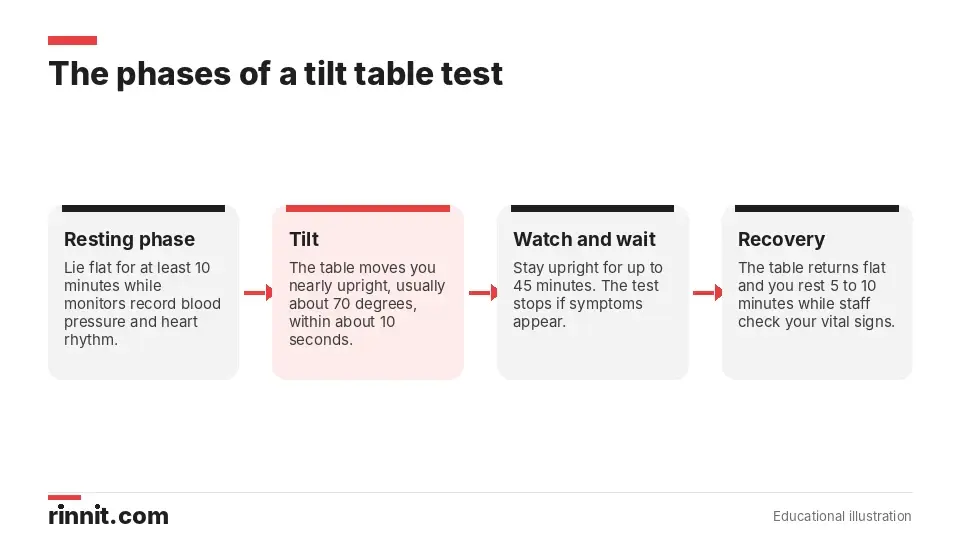
Most of the test is quiet monitoring while you rest and then stay upright.
The test happens in a safe, controlled setting. Your provider will: [1]
Help you onto the table. It's padded, with straps for your chest and legs and a footrest, so you don't use your leg muscles to stand.
Connect you to monitors. You'll have a blood pressure cuff on your arm and another on your finger, plus an EKG to record your heart's rate and rhythm.
Start the resting phase. You lie flat without moving for at least 10 minutes while monitors collect data.
Tilt the table. It moves you nearly upright, usually to about 70 degrees, within about 10 seconds.
Watch and wait. You stay upright for up to 45 minutes and tell staff about symptoms like dizziness or nausea.
Your provider stops the test if you develop symptoms. If you faint, they move the table back down right away. You may also feel tired or queasy, and some people release urine when they faint. [1]
Is medicine used during the test?
In the past, providers often gave medicine to make the heart beat faster if tilting alone didn't trigger symptoms. Today, many centers instead give a nitroglycerin spray under the tongue, which makes the test more likely to bring on symptoms in people with vasovagal syncope. [1] [3]
What happens after the test?
The table is lowered and you lie flat for 5 to 10 minutes while staff check your blood pressure, heart rate and rhythm. It's rare for severe symptoms to continue, but if they do, you may need care in the emergency department. Most people go home afterward and can eat normally, unless other tests require fasting. [1]
What do tilt table test results mean?

Your provider reads the monitor data together with your symptoms and history.
Result | What happened | What monitors may show |
Positive | You had symptoms such as dizziness or fainting | A large drop in blood pressure (vasovagal syncope or orthostatic hypotension) or a large rise in heart rate (POTS) |
Negative | No symptoms and no fainting | A mild drop in blood pressure and a mild rise in heart rate |
Sources: [1]
If your result is positive, your provider combines the monitor data with your symptoms and medical history to reach a diagnosis. They may repeat the test if they think the results aren't right. You may need more tests, and your provider may change the types or doses of your medicines based on the results. [1]
When should you call your provider?
Call with any questions about the test or how to prepare, and tell your provider about new or changing symptoms at any point. [1]
Conclusion
A tilt table test recreates the moment of standing up under close watch, so your care team can see exactly how your blood pressure and heart rate behave when you faint or nearly faint. That helps confirm or rule out vasovagal syncope, POTS and orthostatic hypotension. [1] [2]
Fainting can make you afraid to be alone or go out. Once your provider knows the cause, they can build a treatment plan that helps you feel safer day to day. [1]
Keep learning: Read our vasovagal syncope guide or our orthostatic hypotension guide.
FAQ
What is a tilt table test?
A test that moves you from lying flat to nearly upright on a padded table while monitors track your blood pressure, heart rate and rhythm, to find the cause of fainting. [1]
What does a tilt table test diagnose?
It helps diagnose vasovagal syncope, POTS and orthostatic hypotension. [1]
Can a tilt table test diagnose POTS?
Yes. A large rise in heart rate when you're tilted upright can point to POTS. [1]
How long does a tilt table test take?
At least 10 minutes lying flat, up to 45 minutes tilted upright and 5 to 10 minutes of recovery. [1]
How should I prepare for a tilt table test?
You may need to avoid caffeine and alcohol for 12 hours, fast for at least 2 hours and arrange a ride home. [1]
Will I faint during a tilt table test?
You might. If you do, staff lower the table right away so you recover quickly. [1]
Is a tilt table test safe?
It happens in a safe, controlled setting, but it may not be safe during pregnancy or with blocked arteries to the heart or brain. [1]
What does a positive tilt table test mean?
You had symptoms such as dizziness or fainting, often with a large drop in blood pressure or a large rise in heart rate. [1]
What does a negative tilt table test mean?
Your body responded normally, with only a mild drop in blood pressure and a mild rise in heart rate. [1]
Can I drive after a tilt table test?
Driving yourself home is generally considered unsafe, so arrange for someone to drive you. [1]
Related Reading
Blood Volume Testing: How It Works and What Results Mean explains the nuclear test that measures total blood volume.
QSART Test: How Sweat Testing Checks Your Autonomic Nerves explains the sweat test that checks the small nerves of the autonomic system.
Vasovagal Syncope: Why You Faint and What to Do About It explains the most common type of fainting this test helps confirm.
Orthostatic Hypotension: Symptoms, Causes, and Treatment — When Standing Makes You Dizzy covers the blood pressure drop on standing that tilt testing can show.
Orthostatic Intolerance: Symptoms, Types, and Management explains the group of standing-related disorders that includes POTS.
Hemodynamic Test: Checking Heart Output and Circulation for Fainting explains the heart output and circulation test used to find causes of fainting.
References
Cleveland Clinic. Tilt Table Test: Procedure Details and Results. Cleveland Clinic. Last updated April 13, 2026. https://my.clevelandclinic.org/health/diagnostics/17043-tilt-table-test
Forleo C, Guida P, Iacoviello M, et al. Head-up tilt testing for diagnosing vasovagal syncope: a meta-analysis. Int J Cardiol. 2013;168(1):27-35. PMID 23041006. https://doi.org/10.1016/j.ijcard.2012.09.023
Bartoletti A, Alboni P, Ammirati F, et al. 'The Italian Protocol': a simplified head-up tilt testing potentiated with oral nitroglycerin to assess patients with unexplained syncope. Europace. 2000;2(4):339-342. PMID 11194602. https://doi.org/10.1053/eupc.2000.0125
Medical disclaimer
This article is for general education only and does not replace advice from a qualified healthcare professional. Talk to your doctor about your own diagnosis and treatment, and seek emergency care right away for severe or sudden symptoms.



Comments