QSART Test: How Sweat Testing Checks Your Autonomic Nerves

Updated: 3 days ago
Written and medically reviewed by Dr. Baraa Alnahhal, MD · Last reviewed: November 2026 · How we review
Quick Answer
The quantitative sudomotor axon reflex test (QSART) checks the small nerves that control sweating. Electrodes on the leg, foot and wrist deliver a gentle electrical current, and a machine measures how much and how fast you sweat. It helps evaluate autonomic neuropathy, small fiber neuropathy and POTS. It takes about 45 minutes to an hour and isn't painful.
What the research says
Sweat nerve problems are common in POTS: in a Mayo Clinic review of 152 people with postural orthostatic tachycardia syndrome who had full autonomic testing, about half had sweating abnormalities on QSART and thermoregulatory sweat testing, pointing to a nerve-related cause in at least half of cases (Thieben MJ et al., Mayo Clinic Proceedings, 2007) [2]
Results depend on the equipment used: in 94 healthy volunteers tested with two systems under identical conditions, a commercial device (Q-Sweat) measured lower sweat volumes than the Mayo QSART setup at all four standard sites, so each system's own normal values should be used (Sletten DM et al., Muscle & Nerve, 2010) [3]
Key takeaways
QSART measures sweat to test the nerves that control sweating.
Electrodes are placed on the leg, foot and wrist.
It helps evaluate autonomic and small fiber neuropathy.
It takes about 45 minutes to an hour and isn't painful.
Avoid caffeine, alcohol, tobacco and lotions beforehand.
What is QSART?
Your autonomic nervous system controls functions you don't think about, such as body temperature, heart rate, blood pressure and digestion. Tiny nerve fibers that control sweat glands are among the first to be damaged in some neuropathies. QSART stimulates these nerves and measures the sweat they trigger. Sources: [1]
Why it's done
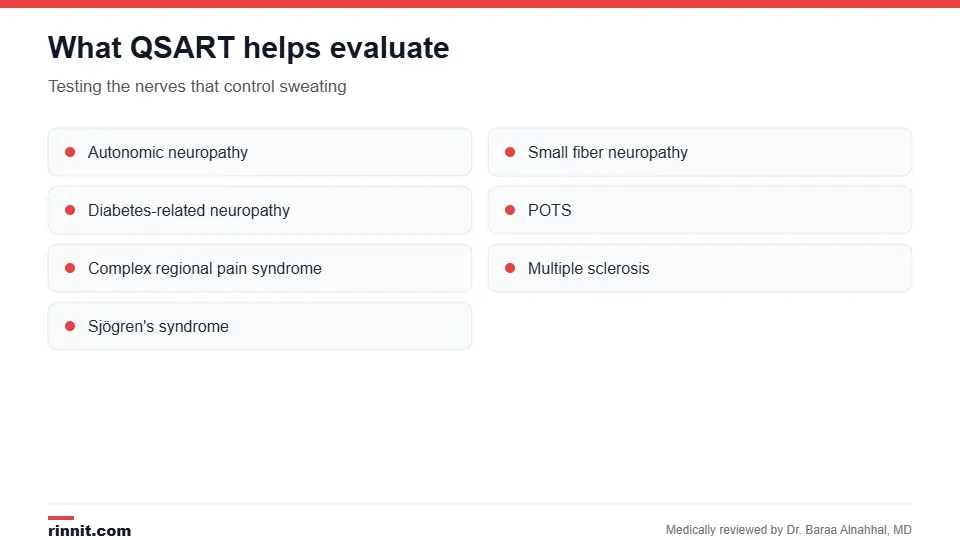
QSART is one of several autonomic tests.
Autonomic neuropathy and small fiber neuropathy.
Diabetes-related peripheral neuropathy.
Postural orthostatic tachycardia syndrome (POTS).
Complex regional pain syndrome (CRPS).
Multiple sclerosis and Sjögren's syndrome. Sources: [1, 2]
QSART is often done with other autonomic tests, such as the tilt table test. Sources: [1]
How to prepare

Careful preparation gives accurate results.
Avoid | How long before the test |
Caffeine | 8 hours |
Alcohol | 12 hours |
Tobacco | Up to 4 hours |
Food | Eat a light meal at least 3 hours before |
Drinks | 3 hours (drink plenty of water the day before) |
Lotions, creams and compression stockings | The day of the test |
Keep taking your medicines unless told otherwise. Some, including pain relievers, antidepressants, antihistamines, aspirin, blood pressure medicines, diuretics and decongestants, may need to be stopped up to 48 hours before. Wear loose, comfortable clothes. Sources: [1]
What happens during the test

The test takes about 45 minutes to an hour.
You remove your shoes and socks and lie on your back.
The skin on your foot, leg and wrist is cleaned and dried.
Four electrodes are placed, usually three on the leg and one on the wrist, with acetylcholine on the skin.
A small electrical current pushes the acetylcholine into your skin to stimulate sweat glands.
The machine measures the sweat produced; electrodes may be moved and the steps repeated. Sources: [1]
You may feel tickling, prickling or mild burning under the electrodes. Tell the team if it hurts. Redness at the electrode sites usually fades within a few hours. Sources: [1]
Understanding results
The test measures how long sweating takes to start, when it peaks and the total volume. Normally, sweating starts within 1 to 2 minutes, increases for up to 5 minutes, then decreases. Normal values depend on your age, sex and the equipment used. An abnormal result, such as delayed onset or reduced or increased sweat, suggests a problem with autonomic nerves but isn't a diagnosis on its own. Results usually take a few days. Sources: [1, 3]
Conclusion
QSART is a safe, noninvasive way to test the small nerves that control sweating. It helps your provider find nerve damage that other tests can miss and plan the next steps.
Keep learning: read about autonomic neuropathy and the tilt table test.
Frequently asked questions
What does QSART stand for?
Quantitative sudomotor axon reflex test.
What does QSART measure?
How well the nerves that control sweating work.
Does QSART hurt?
No, though you may feel tingling or mild burning.
How long does it take?
About 45 minutes to an hour.
Where are the electrodes placed?
Usually on the foot, leg and wrist.
Can I drink coffee before the test?
No. Avoid caffeine for 8 hours.
Should I stop my medicines?
Only if your provider tells you; some may be stopped up to 48 hours before.
What does an abnormal result mean?
It suggests an autonomic nerve problem that needs more evaluation.
When will I get results?
Usually within a few days.
Is QSART the same as a sweat test for cystic fibrosis?
No. That test measures sweat salt, not nerve function.
Related Reading
Autonomic Neuropathy: Symptoms, Causes, Tests & Treatment — Complete Guide the nerve condition QSART often looks for.
Tilt Table Test: How It Works, What to Expect and What Results Mean another key autonomic test.
Peripheral Neuropathy: Symptoms, Causes, and Treatment Options Explained nerve damage that can affect sweating.
What Is Complex Regional Pain Syndrome (CRPS)? Symptoms, Causes, Diagnosis, Treatment & Outlook a pain condition QSART can help assess.
The Autonomic Nervous System: Understanding Your Body's Automatic Controls how your body's automatic controls work.
References
Cleveland Clinic. QSART: What It Is, Purpose, Procedure & Results. Cleveland Clinic. Last updated March 7, 2024. https://my.clevelandclinic.org/health/diagnostics/16398-quantitative-sudomotor-axon-reflex-test-qsart
Thieben MJ, Sandroni P, Sletten DM, et al. Postural orthostatic tachycardia syndrome: the Mayo Clinic experience. Mayo Clinic Proceedings. 2007;82(3):308-313. PMID 17352367. https://doi.org/10.4065/82.3.308
Sletten DM, Weigand SD, Low PA. Relationship of Q-sweat to quantitative sudomotor axon reflex test (QSART) volumes. Muscle & Nerve. 2010;41(2):240-246. PMID 19768767. https://doi.org/10.1002/mus.21464
Medical disclaimer
This article is for general education only and does not replace advice from a qualified healthcare professional. Talk to your doctor about your own diagnosis and treatment, and seek emergency care right away for severe or sudden symptoms.



Comments