MCH Blood Test: Normal Range, Low and High MCH Explained

Updated: 2 days ago
Written and medically reviewed by Dr. Baraa Alnahhal, MD · Last reviewed: November 2026 · How we review
Quick Answer: What is MCH in a blood test?
MCH, or mean corpuscular hemoglobin, is a value on a complete blood count (CBC) that measures the average amount of hemoglobin in each red blood cell. The normal adult range is 27 to 33 picograms per cell, though labs vary. Low MCH often points to iron deficiency or thalassemia, while high MCH points to low vitamin B12 or folate. [1]
What the research says
Red cell values like MCH help separate the two most common causes of small red cells. In 100 people with microcytic anemia, MCV, MCH and MCHC were all significantly lower in iron-deficiency anemia than in beta-thalassemia trait. A newer index built from CBC values reached 90% accuracy, and the widely used Mentzer index reached 81%. (Hans et al., Cureus, 2024) [2]
Simple CBC formulas can sort many cases before more testing. In 166 Thai adults (102 with beta-thalassemia trait and 64 with iron deficiency), a formula dividing RDW by the red cell count was the most reliable, with 100% specificity and 91% sensitivity. (Plengsuree et al., Hemoglobin, 2015) [3]
Key takeaways
MCH is the average amount of hemoglobin per red blood cell, reported in picograms per cell. [1]
The typical adult range is 27 to 33 pg per cell for all sexes, but always check your lab's range. [1]
Low MCH may mean hypochromic or microcytic anemia, often from iron deficiency, thalassemia or chronic inflammation. [1]
High MCH may mean macrocytic anemia, often from low vitamin B12 or folate. [1]
MCH is never read alone: providers look at it with MCV, MCHC and RDW. [1] [2]
What is mean corpuscular hemoglobin (MCH)?
MCH is a value on a routine blood test called a complete blood count (CBC). It measures the average ("mean") amount of hemoglobin in each red blood cell. Hemoglobin lets red blood cells do their main job: carrying oxygen to the cells that keep your body working. [1]
MCH is one of the red blood cell (RBC) indices, the part of the CBC that describes your red cells. The other indices are: [1]
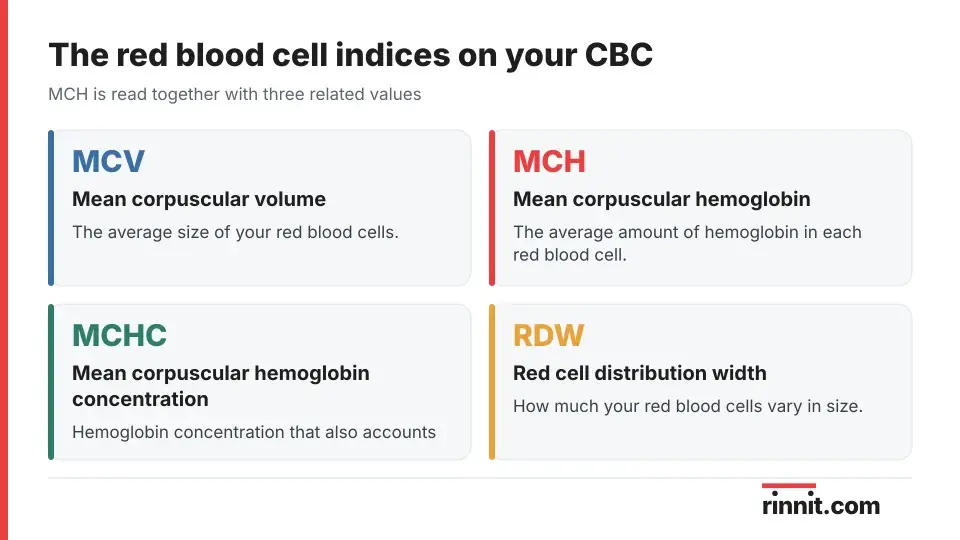
Index | What it measures |
MCV (mean corpuscular volume) | The average size of your red blood cells |
MCH (mean corpuscular hemoglobin) | The average amount of hemoglobin per red blood cell |
MCHC (mean corpuscular hemoglobin concentration) | Hemoglobin concentration that also accounts for cell size |
RDW (red cell distribution width) | How much your red blood cells vary in size |
Sources: [1]
Why is MCH checked?
MCH is a standard part of every CBC, which checks your red blood cells, white blood cells and platelets and can catch signs of a condition early. MCH is especially useful if you have symptoms of anemia, such as tiredness or frequent headaches. Read alongside the other indices, an abnormal MCH helps show whether you have anemia and what is likely causing it. [1]
How is the MCH test done?
MCH comes from a simple blood draw. A nurse or phlebotomist collects a blood sample, and an automated blood counter analyzes it and calculates MCH from your red blood cell results. [1]
How do you prepare?
You don't need to do anything special to have your MCH checked. If other tests are being run on the same sample, you may be asked to fast, so follow your provider's instructions. [1]
What happens during the test?
You sit with your arm extended while a provider: [1]
Cleans the site with an alcohol wipe.
Ties a band above the site so blood collects there.
Gently inserts a needle and fills a collection tube.
Removes the needle and presses a cotton ball on the site.
The draw usually takes five minutes or less. You may feel a quick sting, and you can usually leave right away unless you feel lightheaded. [1]
Are there risks?
A CBC is not risky. You may have a small bruise or a sore arm where the needle went in, which usually goes away the same day. [1]
What do MCH results mean?
MCH is reported in picograms (one-trillionth of a gram) of hemoglobin per red blood cell. Although labs vary, the normal adult range is 27 to 33 pg per cell, regardless of sex. A result outside this range isn't automatically a concern; your provider reads it with your other RBC indices. [1]

MCH result | What it may suggest |
Below 27 pg per cell | Low MCH: hypochromic (pale) or microcytic (small) red cells |
27 to 33 pg per cell | Normal adult range |
Above 33 pg per cell | High MCH: macrocytic (large) red cells |
Sources: [1]
What causes low MCH?
A low MCH may mean hypochromic anemia, where red cells are paler than normal, or microcytic anemia, where red cells are abnormally small. In both, red cells lack enough hemoglobin. Common causes include: [1]
Iron deficiency: too little iron stops your body from making enough hemoglobin. The most common cause is blood loss, such as heavy periods, internal bleeding or heavy bleeding after surgery.
Hemoglobinopathies: inherited blood disorders that affect how hemoglobin is made, such as thalassemia and sickle cell anemia.
Chronic inflammation: long-term infections, kidney disease, liver disease and cancer.
Because iron deficiency and thalassemia trait can both cause low MCH, providers often compare several CBC values, and sometimes iron studies or hemoglobin tests, to tell them apart. [2] [3]
What causes high MCH?
A high MCH may mean macrocytic anemia, where the body makes abnormally large red blood cells. This often happens when you don't get enough folate or vitamin B12, or a condition stops you absorbing them. Other causes include: [1]
Long-term alcohol use disorder
Thyroid problems
Side effects of medicines or treatments, such as chemotherapy

What happens if your MCH is abnormal?
Next steps depend on the likely cause. For example, if your provider suspects iron deficiency, you may need tests of your iron stores. Other results may call for different tests. Some causes, such as inherited blood disorders, need careful monitoring and treatment, while others are short-term and not a real concern. [1]
When should you call your doctor?
Ask your provider to explain your MCH in light of your other CBC values if you're worried about the result, and contact them if you have anemia symptoms such as ongoing tiredness or frequent headaches. [1]
Questions to ask your provider
Is my MCH high or low, and how do my other red cell values look?
What do you think is causing the change?
Do I need iron, vitamin B12 or folate tests?
Could I have a thalassemia trait?
When should my CBC be repeated?
Conclusion
MCH tells you the average amount of hemoglobin in each red blood cell and is reported on every CBC. A normal adult range is about 27 to 33 pg per cell; low values often point to iron deficiency or thalassemia, and high values to low vitamin B12 or folate. [1]
On its own, MCH is just one clue. Read with MCV, MCHC and RDW, it helps your provider find the cause of anemia and choose the right next test. [1] [2]
Keep learning: Read our guides to microcytic anemia, iron-deficiency anemia and thalassemia. For more on red cell values, see MedlinePlus: Red Blood Cell Indices.
FAQ
What is MCH in a blood test?
MCH (mean corpuscular hemoglobin) is the average amount of hemoglobin in each red blood cell, measured on a complete blood count. [1]
What is a normal MCH level?
The normal adult MCH range is about 27 to 33 picograms per cell, regardless of sex, though labs vary. [1]
What does low MCH mean?
Low MCH may mean hypochromic or microcytic anemia, most often from iron deficiency, thalassemia or chronic inflammation. [1]
What does high MCH mean?
High MCH may mean macrocytic anemia, often caused by low vitamin B12 or folate. [1]
Is a low or high MCH serious?
Not always. Your provider reads MCH with your other red cell values to decide whether there is a problem. [1]
What is the difference between MCH and MCHC?
MCH is the average hemoglobin per red cell, while MCHC is the hemoglobin concentration that also accounts for cell size. [1]
Do I need to fast for an MCH test?
No, unless other tests run on the same sample require fasting. [1]
How is MCH measured?
MCH comes from a standard blood draw; an automated blood counter calculates it from your red blood cell results. [1]
Can alcohol cause high MCH?
Yes. Long-term alcohol use disorder is one cause of high MCH. [1]
What happens after an abnormal MCH result?
Your provider may order tests such as iron studies based on the likely cause, then plan monitoring or treatment. [1]
Related Reading
Learn more in our guide to Understanding Microcytic Anemia: Causes, Symptoms, and Management.
Learn more in our guide to Iron Deficiency Anemia: Symptoms, Causes, Treatment & Complete Guide.
Learn more in our guide to Thalassemia: Symptoms, Causes, Treatment & Complete Guide.
Learn more in our guide to Megaloblastic Anemia: Understanding Vitamin-Deficiency Blood Disorders.
Learn more in our guide to Complete Blood Count (CBC): What It Measures, Normal Ranges and Abnormal Results.
References
Cleveland Clinic. MCH in a Blood Test (Mean Corpuscular Hemoglobin). Cleveland Clinic. Last updated August 21, 2024. https://my.clevelandclinic.org/health/diagnostics/mch-blood-test
Hans A, Atreja CB, Batra N. Distinguishing Iron Deficiency Anemia From Beta-Thalassemia Trait: Comparative Analysis of CRUISE Index and Other Traditional Diagnostic Indices. Cureus. 2024;16(7):e64048. PMID 39114184. https://doi.org/10.7759/cureus.64048
Plengsuree S, Punyamung M, Yanola J, et al. Red Cell Indices and Formulas Used in Differentiation of β-Thalassemia Trait from Iron Deficiency in Thai Adults. Hemoglobin. 2015;39(4):235-9. PMID 26076394. https://doi.org/10.3109/03630269.2015.1048352
Medical disclaimer
This article is for general education only and does not replace advice from a qualified healthcare professional. Talk to your doctor about your own diagnosis and treatment, and seek emergency care right away for severe or sudden symptoms.



Comments