RDW Blood Test: What It Measures, Normal Range and High RDW Results

Updated: 5 days ago
Written and medically reviewed by Dr. Baraa Alnahhal, MD · Last reviewed: November 2026 · How we review
Quick Answer: What is an RDW blood test?
An RDW (red cell distribution width) blood test measures how much your red blood cells vary in size and volume. It's reported as part of a complete blood count (CBC). A typical result falls around 12% to 15%, though ranges vary by lab, and a high RDW may point to anemia or a related condition. [1]
What the research says
RDW helps tell two common causes of small red cells apart. In 100 adults with small, pale red blood cells (microcytic hypochromic anemia), RDW was significantly higher in the 61 people with iron deficiency anemia than in the 39 with beta thalassemia trait (an inherited blood condition). (Hans et al., Cureus, 2024) [3]
A high RDW before surgery was linked to higher one-year mortality. Among 97,443 adults having surgery, an RDW above 15.7% was tied to more than double the risk of dying within a year (adjusted hazard ratio 2.34), after accounting for other risk factors. (Sim et al., PLoS One, 2017) [4]
In heart patients, a higher RDW signaled a worse outlook. A review of 24 studies with about 83,000 people having a heart artery stent procedure found that elevated RDW beforehand was linked to a 46% higher risk of death from any cause (hazard ratio 1.46). (Peng et al., Frontiers in Cardiovascular Medicine, 2026) [2]
Key takeaways
RDW shows how much your red blood cells differ in size; it's part of a routine CBC. [1]
A normal RDW is about 12% to 15%, and ranges vary by lab. [1]
A high RDW (15% or more) may be a sign of anemia, but it isn't a diagnosis on its own. [1]
A low RDW (under 12%) isn't a sign of an underlying condition or anemia. [1]
Your provider often reads RDW alongside MCV (average red cell size) to narrow down the cause. [1]
Studies link a high RDW with worse outcomes in some groups, such as people having surgery or heart procedures. [2] [4]
What is an RDW blood test?
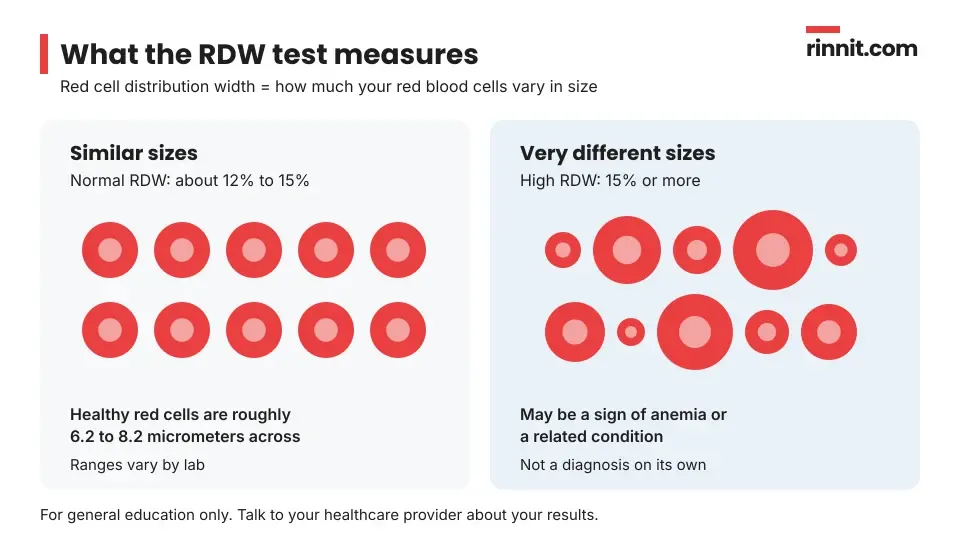
Red cell distribution width (RDW) is a measurement of how much your red blood cells vary in size and volume. Red blood cells carry oxygen from your lungs to the rest of your body. [1]
Healthy red blood cells tend to be close to the same size, roughly 6.2 to 8.2 micrometers across. When cells come in very different sizes, that spread can be a sign of anemia (too few healthy red blood cells). [1]
RDW isn't usually ordered alone. It's one of the results reported in a complete blood count (CBC), a common blood test. [1]
Why is an RDW test done?
Providers use RDW to help diagnose anemia and the conditions that can cause it. It's one of several measurements that describe your red blood cells, and it works best as part of the bigger picture. [1]
Conditions linked to anemia that your provider may consider include: [1]
Low levels of iron, folate or vitamin B12
Thalassemia (an inherited condition that affects hemoglobin)
Kidney disease or liver disease
Cardiovascular disease
Cancer
Long-term illnesses such as Crohn's disease or HIV
Because many different conditions can raise RDW, your provider may need other tests, such as imaging or a biopsy, to find the cause. [1]
What other red blood cell tests are part of a CBC?
RDW sits alongside a few other red blood cell indices (measurements). Together, they describe the size and hemoglobin content of your red blood cells. [1]
Test | What it measures |
RDW (red cell distribution width) | How much your red blood cells vary in size and volume |
MCV (mean corpuscular volume) | The average size of your red blood cells |
MCH (mean corpuscular hemoglobin) | The average amount of hemoglobin in each red blood cell |
MCHC (mean corpuscular hemoglobin concentration) | The average concentration of hemoglobin inside your red blood cells |
Sources: [1]
How do you prepare for an RDW test?
There are no special preparation steps listed for an RDW test. [1]
RDW is often drawn with other blood tests, so ask your provider whether anything else being checked at the same visit needs you to fast or adjust your medicines.
What happens during an RDW blood test?
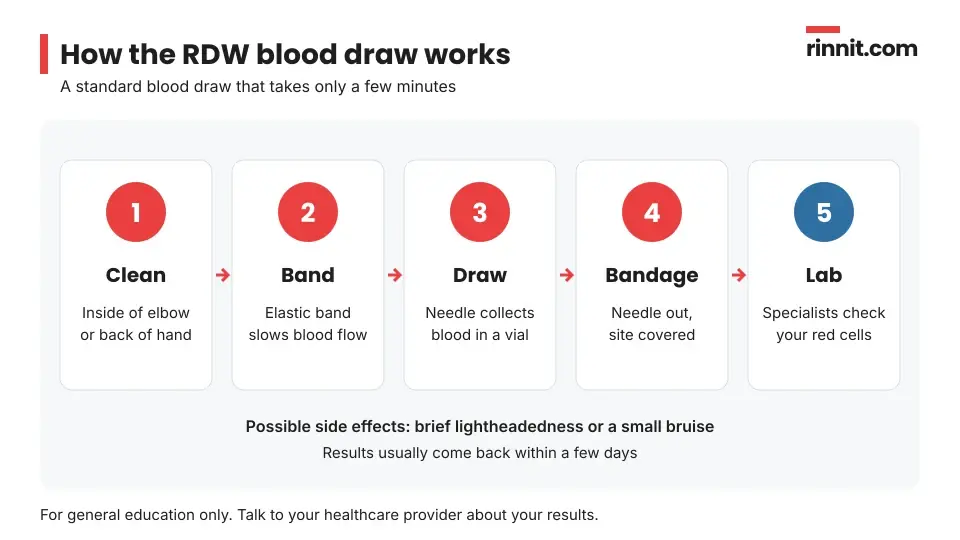
An RDW test is a standard blood draw that takes only a few minutes. [1]
Your provider cleans the skin, usually on the inside of your elbow or the back of your hand. [1]
They wrap an elastic band around your upper arm to slow blood flow and make the vein easier to find. [1]
They insert a small needle into the vein and collect blood in a vial. [1]
They remove the needle and band and cover the spot with a bandage. [1]
Your sample goes to a lab, where specialists examine your red blood cells. [1]
What do RDW test results mean?
RDW is reported as a percentage. Here's how results are generally grouped, keeping in mind that ranges vary by lab. [1]
RDW result | Range | What it may mean |
Low | Below 12% | Not a sign of an underlying condition or anemia |
Normal | About 12% to 15% | Red cells are fairly uniform in size; this doesn't rule out every condition, including some anemias RDW can't detect |
High | 15% or more | Red cells vary widely in size; may be a sign of anemia or a related condition, and usually needs more testing |
Sources: [1]
Results usually come back within a few days. Your provider may set up a visit to go over them with you. [1]

Can you have anemia with a normal RDW?
Yes. A normal RDW means your red cells are fairly even in size, but it doesn't rule out every problem. Some types of anemia don't change RDW, so they won't show up on this measurement alone. [1]
That's why your provider looks at your whole blood count, your symptoms and your health history, not just one number. If something doesn't add up, they may order other tests. [1]
How do RDW and MCV work together?
A high RDW tells your provider that your red cells vary in size, but not why. To narrow down the cause, providers often compare RDW with MCV, which measures the average size of your red cells. [1]
In a large surgical study, abnormal MCV and high RDW each carried their own information about risk. [4] The table below shows only the patterns these sources describe; it isn't a full diagnostic guide.
Pattern | What it may suggest |
High RDW, any MCV | May be a sign of anemia or a related condition; your provider will usually order more tests |
Small red cells (low MCV) with a higher RDW | In one study of small-cell anemia, RDW ran higher in iron deficiency anemia than in beta thalassemia trait |
Small red cells (low MCV) with a lower RDW | In the same study, beta thalassemia trait tended to have a lower RDW than iron deficiency anemia |
Large red cells (high MCV), or a high RDW, before surgery | Each was linked on its own with a higher one-year mortality risk in a large surgical study |
In the small-cell study, RDW alone wasn't the best tool. Combined indices worked better, and blood iron (ferritin) levels and hemoglobin testing confirmed the diagnosis. [3]
Are there any risks or side effects?
Blood tests are safe and carry little risk. [1]
What happens if your RDW is high?
A high RDW is a clue, not a diagnosis. Your provider will explain what your result means and discuss any next tests, such as comparing your RDW with your MCV. [1]
Large studies also link a high RDW with poorer outcomes in some groups. [2] [4] These are associations, so a high RDW doesn't predict what will happen to you as an individual.
Surgery: In a study of 97,443 adults having surgery, 27.8% had anemia before their operation, and most of those had normal-sized red cells. A high RDW, larger-than-normal red cells (adjusted hazard ratio 1.47) and anemia were each linked to higher one-year mortality. [4]
Heart procedures: In people having a stent placed in a heart artery, an elevated RDW was linked to higher overall mortality and higher death from heart causes (hazard ratio 1.66). The link with other major heart events was less certain. [2]
If your RDW is high and you have a heart condition or an upcoming surgery, it's reasonable to ask your provider whether the result changes your care plan.
When should you call your provider?
Contact your provider if symptoms of anemia get worse, such as: [1]
Feeling very tired or weak
Pale skin
Shortness of breath
An irregular heartbeat
Questions to ask your provider
What was my RDW, and what range does your lab use?
What were my MCV, MCH and MCHC results, and how do they fit with my RDW?
Do my results suggest anemia? If so, what might be causing it?
Do I need more tests, such as iron, vitamin B12 or folate levels?
Should I repeat my blood count, and when?
Which symptoms should prompt me to call you sooner?
Conclusion
An RDW blood test shows how much your red blood cells vary in size. It comes as part of a routine CBC and takes only a few minutes to draw. A normal RDW is about 12% to 15%, while a high RDW may point to anemia or a related condition. [1]
RDW is most useful when read alongside your other blood count results, especially MCV. If your RDW is high, your provider can help work out the cause and decide whether you need more testing. [1]
Keep learning: Read our guides to iron deficiency anemia, thalassemia and megaloblastic anemia. For more, see MedlinePlus's page on the RDW test.
FAQ
What is an RDW blood test?
It measures how much your red blood cells vary in size and volume. It's part of a complete blood count (CBC). [1]
Why would a doctor check RDW?
RDW helps providers diagnose anemia and the conditions that cause it, usually alongside other red blood cell tests. [1]
What is a normal RDW range?
A normal RDW is about 12% to 15%. Ranges vary by lab, so check the range on your report. [1]
What does a high RDW mean?
A high RDW (15% or more) means your red cells vary widely in size. It may be a sign of anemia or a related condition and usually needs more testing. [1]
Is a low RDW bad?
No. An RDW below 12% isn't a sign of an underlying condition or anemia. [1]
Do I need to fast for an RDW test?
No special preparation is listed for an RDW test. Ask your provider if other tests drawn at the same time need fasting. [1]
Does an RDW blood test hurt?
You may feel a quick pinch from the needle. Afterward, you might feel briefly lightheaded or get a small bruise. [1]
How long do RDW results take?
The blood draw takes a few minutes, and results usually come back within a few days. [1]
How do RDW and MCV work together?
MCV shows the average size of your red cells, while RDW shows how much they vary. Comparing the two helps your provider narrow down the cause of anemia. [1]
When should I call my doctor?
Call your provider if anemia symptoms get worse, such as tiredness, pale skin, shortness of breath or an irregular heartbeat. [1]
Related Reading
Learn more in our guide to Iron Deficiency Anemia: Symptoms, Causes, Treatment & Complete Guide.
Learn more in our guide to Megaloblastic Anemia: Understanding Vitamin-Deficiency Blood Disorders.
Learn more in our guide to Folate Deficiency: Symptoms, Causes, Diagnosis, Treatment and Outlook.
Learn more in our guide to Thalassemia: Symptoms, Causes, Treatment & Complete Guide.
Learn more in our guide to Sickle Cell Anemia: Symptoms, Causes, Treatment & Complete Guide.
Learn more in our guide to Anemia of Chronic Disease: Why Inflammation Traps Your Iron, Who's at Risk, and How Treatment Works.
References
Cleveland Clinic. RDW Blood Test: What It Is, Procedure & Results. Cleveland Clinic. Last updated April 7, 2026. https://my.clevelandclinic.org/health/diagnostics/22980-rdw-blood-test
Peng W, Deng B, Wang J, et al. Prognostic value of red cell distribution width in patients undergoing percutaneous coronary intervention: a systematic review and meta-analysis. Front Cardiovasc Med. 2026;13:1787857. PMID 42558361. https://doi.org/10.3389/fcvm.2026.1787857
Hans A, Atreja CB, Batra N. Distinguishing Iron Deficiency Anemia From Beta-Thalassemia Trait: Comparative Analysis of CRUISE Index and Other Traditional Diagnostic Indices. Cureus. 2024;16(7):e64048. PMID 39114184. https://doi.org/10.7759/cureus.64048
Sim YE, Wee HE, Ang AL, et al. Prevalence of preoperative anemia, abnormal mean corpuscular volume and red cell distribution width among surgical patients in Singapore, and their influence on one year mortality. PLoS One. 2017;12(8):e0182543. PMID 28777814. https://doi.org/10.1371/journal.pone.0182543
Medical disclaimer
This article is for general education only and does not replace advice from a qualified healthcare professional. Talk to your doctor about your own diagnosis and treatment, and seek emergency care right away for severe or sudden symptoms.



Comments