Reticulocyte Count: Normal Range, Low and High Results Explained

Updated: 2 days ago
Written and medically reviewed by Dr. Baraa Alnahhal, MD · Last reviewed: November 2026 · How we review
Quick Answer: What is a reticulocyte count?
A reticulocyte count measures how many immature red blood cells (reticulocytes) are in the blood, showing whether the bone marrow is making enough new ones. A normal result is 0.5% to 2.5% in adults and 2% to 6% in infants. A low count may point to a marrow problem; a high count to blood loss or hemolytic anemia. [1]
What the research says
A high reticulocyte count tracks red cell breakdown better than other common markers. In 11 people with sickle cell anemia, researchers measured red cell survival directly (average 31.9 days). The absolute reticulocyte count was strongly linked to red cell survival (r = -0.84), while LDH, AST, bilirubin and free hemoglobin were not. Still, the count reflected only about 70% of the variation in red cell survival. (Quinn et al., American Journal of Hematology, 2016) [2]
The youngest reticulocytes can signal bone marrow recovery early. In 44 people after stem cell transplant, an immature reticulocyte fraction above 12% came before neutrophil recovery in 86% of patients (38 of 44), suggesting it can be an early sign that the marrow is working again. (Morkis et al., International Journal of Laboratory Hematology, 2015) [3]
Key takeaways
Reticulocytes are young red blood cells made in your bone marrow.
The test shows whether your marrow is making enough new red blood cells.
Normal is 0.5% to 2.5% in adults and 2% to 6% in infants.
A low count can mean the marrow isn't keeping up; a high count can mean it is working harder to replace lost cells.
It is a simple blood draw from your arm.
What are reticulocytes?
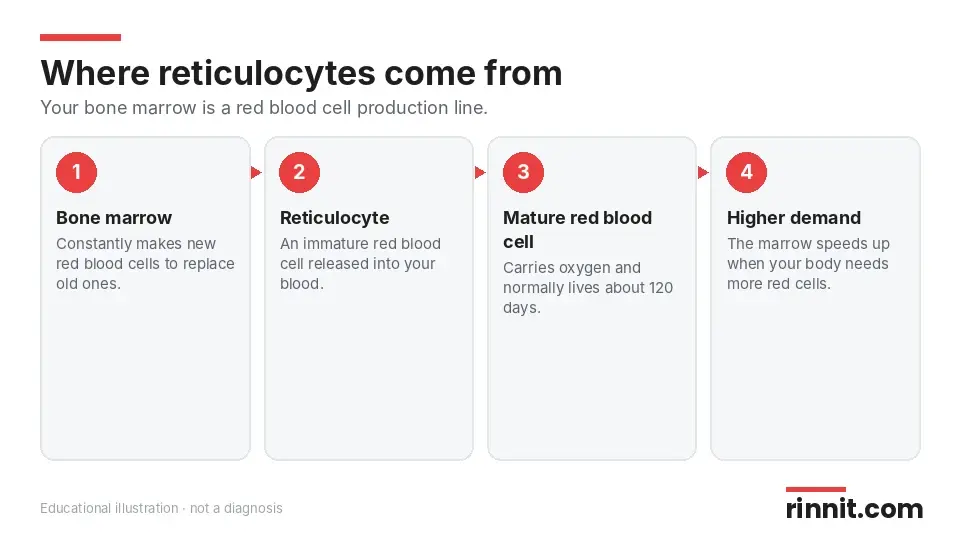
Reticulocytes are immature red blood cells. Your bone marrow works like a production line, constantly making new red blood cells to replace old and dying ones. When your body needs more red blood cells than usual, that production line speeds up. [1]
Measuring reticulocytes is one of many ways providers diagnose and monitor conditions that affect your red blood cells. [1]
Why would you need a reticulocyte count?
Your provider may order this test: [1]
To help find the cause of anemia
To see if your bone marrow is making enough new red blood cells
To check bone marrow function after chemotherapy for a blood disorder or after a bone marrow transplant
How is a reticulocyte count done?
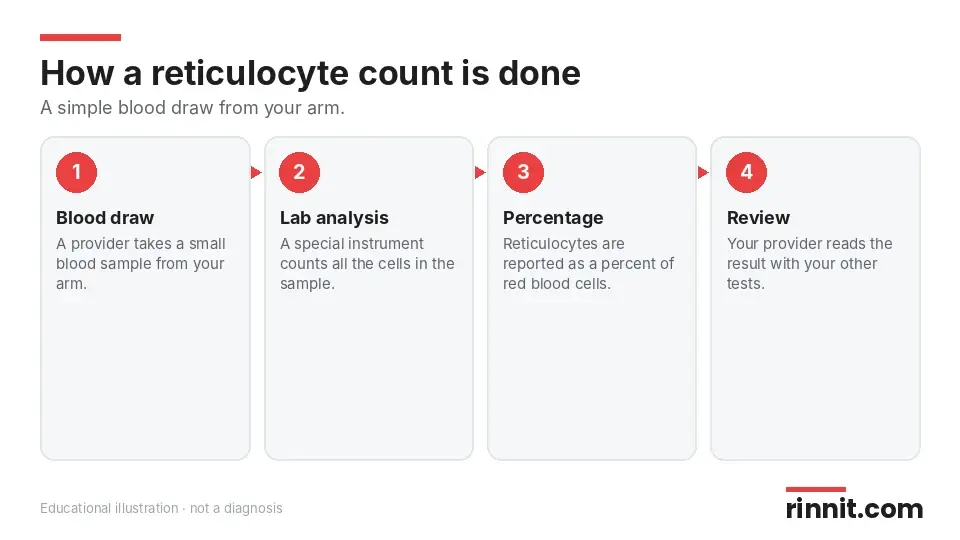
A provider takes a small sample of blood from your arm and sends it to a lab. There, a special instrument measures all the cells in the sample, including the number of reticulocytes and other cell features. [1]
What is a normal reticulocyte count?
Your result is reported as a percentage of all the red blood cells in your sample. [1]
Group | Normal reticulocyte count |
Adults | 0.5% to 2.5% |
Infants | 2% to 6% |
Sources: [1]
A count that is higher or lower than normal may be a sign of a blood disorder, but it doesn't mean you have a specific illness. It is one test among many, so ask your provider to explain your results. [1]
What does a low reticulocyte count mean?
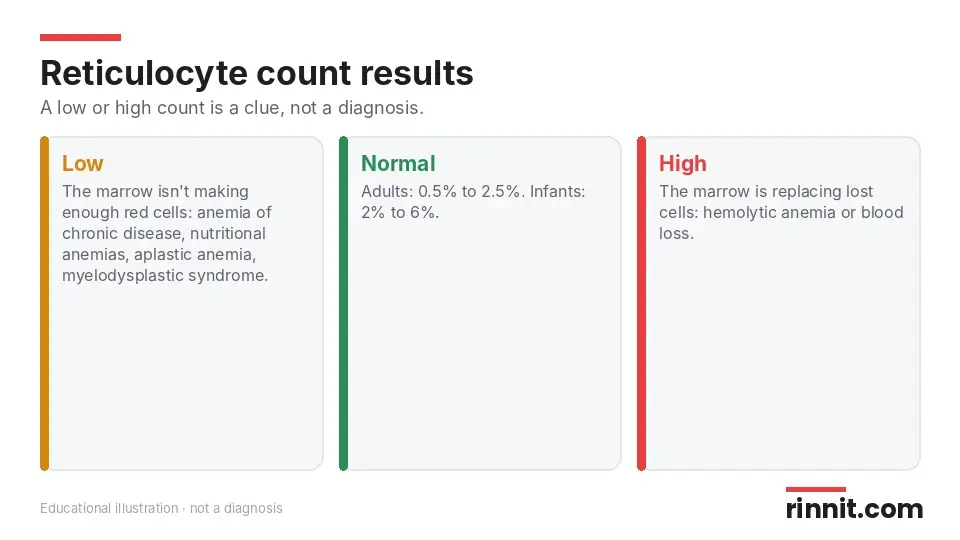
A low count may be a sign of a hypoproliferative anemia, which happens when your bone marrow can't make enough new red blood cells. Examples include: [1]
Condition | What happens |
Anemia of chronic disease | One of the most common anemias, linked to illnesses such as diabetes, heart disease, lung disease, rheumatoid arthritis, chronic infections and cancer |
Nutritional anemias | The marrow lacks building blocks, as in iron-deficiency anemia, pernicious anemia (vitamin B12) or folate deficiency anemia |
Aplastic anemia | A rare disorder where the marrow doesn't have enough stem cells to make blood cells |
Myelodysplastic syndrome | Cancers that keep stem cells from maturing into healthy red blood cells |
Megaloblastic anemia | Linked to low vitamin B12 or folic acid, some medicines and bone marrow diseases; the marrow can't make normal red cells |
Sources: [1]
What does a high reticulocyte count mean?
A higher-than-normal count usually means your bone marrow is making extra red blood cells to make up for a loss. Possible causes include: [1]
Hemolytic anemia. Red blood cells normally live about 120 days. In hemolytic anemia they break down sooner, so the marrow makes more reticulocytes to replace them.
Blood loss. If you lose a lot of blood or have ongoing blood loss, your marrow may speed up reticulocyte production.
What happens after an abnormal result?
An abnormal count is a clue that helps your provider narrow down what is going on. They will look at it together with your symptoms and other tests, and may order more blood work. [1]
It's normal to feel worried when a result is outside the normal range. Asking your provider to explain what your number means for you can help put it in perspective. [1]
Questions to ask your provider
Why do I need this test?
When will I have my results?
Will I need more blood tests?
Is my count low, normal or high, and what could explain it?
Conclusion
A reticulocyte count shows how well your bone marrow is keeping up with your body's need for new red blood cells. A low result may mean the marrow is struggling, while a high result may mean it is working overtime to replace lost or destroyed cells.
Because the result is only one piece of the puzzle, your provider reads it alongside your full blood count, symptoms and history before deciding on next steps.
Keep learning: Read our guides to the complete blood count (CBC), the hemoglobin test, iron blood tests and the bone marrow biopsy. For more on this test, see MedlinePlus: Reticulocyte Count.
FAQ
What is a reticulocyte count?
It measures how many immature red blood cells are in your blood to show whether your bone marrow is making enough new red cells. [1]
What is a normal reticulocyte count?
It is 0.5% to 2.5% in adults and 2% to 6% in infants. [1]
What does a low reticulocyte count mean?
It may mean your bone marrow isn't making enough red cells, as in anemia of chronic disease, nutritional anemias or aplastic anemia. [1]
What does a high reticulocyte count mean?
It may mean your marrow is replacing lost red cells, as in hemolytic anemia or blood loss. [1]
Why would a doctor order a reticulocyte count?
To find the cause of anemia, check bone marrow output, or monitor marrow function after chemotherapy or a bone marrow transplant. [1]
How is the test done?
A small blood sample is taken from your arm and measured by a lab instrument. [1]
How long do red blood cells normally live?
Red blood cells normally live about 120 days. [1]
Can a reticulocyte count diagnose a disease?
No. An abnormal count is a clue that your provider uses with other tests to find the cause. [1]
What does bone marrow have to do with reticulocytes?
Your bone marrow constantly makes new red blood cells to replace old ones, and it speeds up when your body needs more. [1]
What questions should I ask about my results?
Ask why you need the test, when results will be ready and whether you need more blood tests. [1]
Related Reading
Learn more in our guide to Hemolytic Anemia: Understanding Rapid Red Blood Cell Loss.
Learn more in our guide to Aplastic Anemia: Symptoms, Causes, Treatment & Complete Guide.
Learn more in our guide to Anemia of Chronic Disease: Why Inflammation Traps Your Iron, Who's at Risk, and How Treatment Works.
Learn more in our guide to Megaloblastic Anemia: Understanding Vitamin-Deficiency Blood Disorders.
Learn more in our guide to What Is Myelodysplastic Syndrome? A Plain-Language Guide to Symptoms, Causes, and Treatment.
Learn more in our guide to Iron Deficiency Anemia: Symptoms, Causes, Treatment & Complete Guide.
Learn more in our guide to Folate Deficiency Anemia: Symptoms, Causes, and Management.
References
Cleveland Clinic. Reticulocyte Count: Testing, Purpose & Results. Cleveland Clinic. Last updated April 18, 2022. https://my.clevelandclinic.org/health/diagnostics/22787-reticulocyte-count
Quinn CT, Smith EP, Arbabi S, et al. Biochemical surrogate markers of hemolysis do not correlate with directly measured erythrocyte survival in sickle cell anemia. Am J Hematol. 2016;91(12):1195-1201. PMID 27648808. https://doi.org/10.1002/ajh.24562
Morkis IV, Farias MG, Rigoni LD, et al. Assessment of immature platelet fraction and immature reticulocyte fraction as predictors of engraftment after hematopoietic stem cell transplantation. Int J Lab Hematol. 2015;37(2):259-264. PMID 25066534. https://doi.org/10.1111/ijlh.12278
Medical disclaimer
This article is for general education only and does not replace advice from a qualified healthcare professional. Talk to your doctor about your own diagnosis and treatment, and seek emergency care right away for severe or sudden symptoms.



Comments