Hemolytic Anemia: Understanding Rapid Red Blood Cell Loss

Updated: 3 days ago
Medically reviewed by Dr. Baraa Alnahhal, MD · Last reviewed: October 2026
Quick Answer
Hemolytic anemia is a condition in which red blood cells die prematurely, faster than the body can replace them [1]. Causes include genetic disorders like sickle cell anemia, infections like malaria and reactions to medications [1]. Symptoms include jaundice, extreme fatigue and shortness of breath [1] [5], and severe untreated cases can strain the heart [1]. Many forms are curable once the cause is addressed [1].
What the research says
G6PD deficiency is the most common red cell enzyme problem. A systematic review of 280 prevalence estimates from 88 countries put the number of people affected at about 400 million worldwide, noting that most are symptom-free but that oxidative stressors such as certain drugs or infections can trigger acute hemolysis (Nkhoma et al., Blood Cells Mol Dis, 2009) [6].
A few simple blood tests confirm hemolysis. A clinical review lists a high reticulocyte count, raised lactate dehydrogenase, raised unconjugated bilirubin and low haptoglobin as the lab results that confirm hemolysis, with the direct antiglobulin (Coombs) test separating immune from non-immune causes (Phillips & Henderson, Am Fam Physician, 2018) [5].
A low reticulocyte count is a warning sign in autoimmune forms. Reticulocytopenia occurs in 20–40% of autoimmune hemolytic anemia cases and is a poor prognostic factor (Barcellini & Fattizzo, Dis Markers, 2015) [7].
What is hemolytic anemia?
Hemolytic anemia is a condition where the lifespan of red blood cells is significantly shortened [2]. Under normal circumstances, these cells circulate in the bloodstream for roughly 120 days before being replaced [1] [2] [4]. In individuals with hemolytic anemia, these cells break down or die much sooner. This creates a deficit because the bone marrow, which is responsible for producing new blood cells, cannot keep up with the accelerated rate of loss [1] [2].
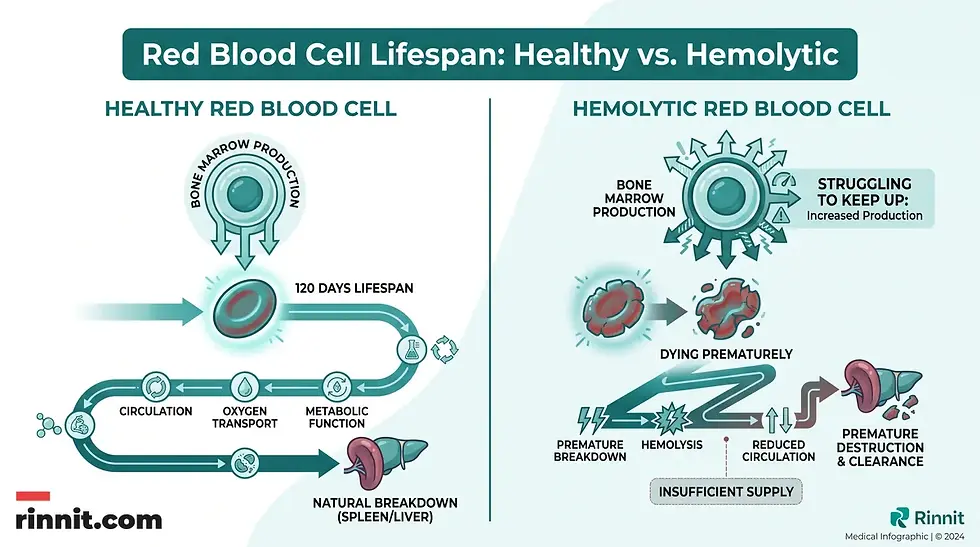
While anemia can also be caused by excessive bleeding or slow production of cells, hemolytic anemia is distinct because it involves the active destruction of existing cells [1] [4]. This destruction can happen suddenly (acute) or develop gradually over time (chronic) [1] [5]. Understanding the specific type and cause is essential for effective treatment.
Feature | Hemolytic Anemia | Standard Anemia (Blood Loss) |
Primary Issue | Accelerated cell destruction | Draining of existing blood supply |
Cell Lifespan | Significantly less than 120 days | Normal, but count is low |
Bone Marrow | Overworked, trying to keep up | Normal, but supply is depleted |
Common Causes | Genetics, infections, medications | Injury, surgery, internal bleeding |
What causes and triggers hemolytic anemia?
The causes of hemolytic anemia are broadly categorized into inherited conditions and acquired factors. In inherited cases, a person is born with a genetic variation that makes their red blood cells fragile or abnormal [2]. In acquired cases, something external—like a virus or a drug—triggers the destruction of otherwise healthy cells [2].

Inherited Genetic Conditions
Several well-known blood disorders are actually forms of hemolytic anemia. Sickle cell anemia causes cells to take on an abnormal shape that gets trapped in small vessels [1], while thalassemia results in the production of abnormal cells that the body quickly destroys [1]. Another common cause is G6PD deficiency, where the lack of a specific protective enzyme makes blood cells vulnerable to breaking apart when exposed to certain triggers [1] [6].
Acquired Triggers: Infections and Medications
Certain infections, such as malaria, Rocky Mountain spotted fever, and HIV, are known to lead to hemolytic anemia [1]. Additionally, some individuals may have a reaction to specific medications. Common drugs that can trigger this response in some people include penicillin, quinine (used for malaria), and methyldopa (used for high blood pressure) [1].
What are the symptoms and emergency signs of hemolytic anemia?
The symptoms of hemolytic anemia can range from mild to life-threatening [1] [5]. Because red blood cells are responsible for carrying oxygen, a shortage often leads to signs of oxygen depletion throughout the body.

Common Symptoms
Jaundice: A yellowing of the skin and the whites of the eyes caused by high levels of bilirubin, a byproduct of broken-down blood cells [1].
Fatigue and Weakness: A persistent feeling of tiredness that interferes with daily activities.
Cardiovascular Signs: A fast heartbeat (tachycardia) and low blood pressure (hypotension) [1] [5].
Physical Changes: Shortness of breath, blood in the urine (hematuria), and an enlarged spleen or liver [1].
When to Seek Emergency Care
Acute anemia can be a medical emergency if red blood cells are being destroyed very rapidly. You should seek immediate help if you experience extreme weakness, a heart that is beating exceptionally hard and fast, or severe difficulty catching your breath [1] [3].
How is hemolytic anemia diagnosed?
Healthcare providers use a combination of physical exams and specialized blood tests to diagnose hemolytic anemia. They will often look for physical signs like jaundice or an enlarged spleen while reviewing your family history and current medications [1].
Essential Diagnostic Tests
Complete Blood Count (CBC): Measures the number, size, and health of your red blood cells and hemoglobin levels [1].
Coombs Test: Specifically used to check for autoimmune hemolytic anemia, where the immune system mistakenly attacks its own cells [1] [5].
Reticulocyte Count: Measures immature red blood cells to see if the bone marrow is responding to the cell loss [1] [7].
Bilirubin and LDH Tests: High levels of these substances in the blood are strong indicators of rapid red blood cell destruction [1] [5].
How is hemolytic anemia treated and managed long term?
The treatment for hemolytic anemia is highly personalized and depends entirely on the underlying cause [1] [2]. If the anemia is severe, a healthcare provider may first order blood transfusions to stabilize the patient [1] before moving on to long-term management.
Addressing the Root Cause
If the condition is triggered by an infection, treating that infection is the priority [1]. If a medication is the culprit, switching to a different drug can often cure the anemia [1]. For autoimmune forms, treatments that dampen the immune system's response may be necessary [2] [4].
Self-Care and Prevention
While you cannot control genetic factors, you can manage your health to reduce the risk of flare-ups. A diet rich in vitamins B12, C, and B9 (folic acid) helps keep red blood cells strong [1]. Staying well-hydrated, getting regular exercise, and practicing good hygiene to avoid infections are also critical steps in long-term management [1].
Conclusion
Hemolytic anemia is a complex condition, but with modern diagnostics and targeted treatments, the outlook is generally positive. By working closely with a hematologist to identify the specific cause—whether it be genetic, infectious, or medicinal—most individuals can successfully manage their symptoms and prevent serious complications like heart failure [1].
For more information on managing blood disorders and maintaining optimal health, visit Rinnit.com.
Frequently Asked Questions
Q: Is hemolytic anemia the same as regular anemia?
A: No. While both result in a low red blood cell count, hemolytic anemia is specifically caused by the rapid destruction of cells rather than blood loss or slow production.
Q: Can I catch hemolytic anemia from someone else?
A: No. It is not contagious. It is caused by genetics, infections, or reactions to medications.
Q: Why does my skin turn yellow with this condition?
A: This is called jaundice. It happens when red blood cells break down quickly, releasing a yellow substance called bilirubin into your bloodstream.
Q: Can hemolytic anemia be cured?
A: In many cases, yes. If it is caused by an infection or medication, treating the infection or stopping the medication can cure the condition.
Q: Is it a lifelong condition?
A: It depends on the cause. Inherited types like sickle cell anemia are lifelong, while acquired types may be temporary.
Q: How does it affect the heart?
A: If untreated, the heart has to work much harder to pump oxygen-poor blood, which can lead to arrhythmias or heart failure.
Q: What is a Coombs test?
A: It is a blood test used to see if your immune system is producing antibodies that are destroying your own red blood cells.
Q: Can children have hemolytic anemia?
A: Yes, especially if they inherit a genetic condition like thalassemia or G6PD deficiency.
Q: Are there specific foods I should eat?
A: A diet rich in B12, Vitamin C, and folic acid (B9) is recommended to support red blood cell health.
Q: What is G6PD deficiency?
A: It is a genetic condition where you lack an enzyme that protects red blood cells from breaking apart.
Q: Can stress trigger hemolytic anemia?
A: While stress itself isn't a direct cause, it can sometimes worsen symptoms or trigger flare-ups in certain inherited types.
Q: Is exercise safe?
A: Generally yes, but you should consult your doctor to determine what level of activity is safe for your specific blood count.
Q: What is a reticulocyte count?
A: It is a test that counts immature red blood cells, showing how hard your bone marrow is working to replace lost cells.
Q: Can blood transfusions cure it?
A: Transfusions are a temporary treatment to stabilize a patient; they do not cure the underlying cause.
Q: What should I do if I suspect I have anemia?
A: See a healthcare provider for a blood test, especially if you notice jaundice, extreme fatigue, or shortness of breath.
Related Reading
Coombs Test: Direct vs Indirect, Why It's Done and What Results Mean explains the blood test that finds antibodies attacking red blood cells.
Learn more in our guide to Reticulocyte Count: Normal Range, Low and High Results Explained.
Bilirubin Test: Normal Levels, High Bilirubin Causes and Newborn Jaundice explains the blood test that measures bilirubin and what high levels mean.
LDH (Lactate Dehydrogenase) Test: Normal Range and What High LDH Means explains the enzyme blood test that signals tissue damage.
G6PD Test: Checking for G6PD Deficiency and Hemolytic Anemia explains the blood test for inherited G6PD enzyme deficiency.
Sources
Cleveland Clinic. Hemolytic Anemia. Cleveland Clinic. Last updated March 3, 2022. https://my.clevelandclinic.org/health/diseases/22479-hemolytic-anemia
Gerber GF. Overview of Hemolytic Anemia. Merck Manual Professional Version. Last updated April 2026. https://www.merckmanuals.com/professional/hematology-and-oncology/anemias-caused-by-hemolysis/overview-of-hemolytic-anemia
Killeen RB, et al. Acute Anemia. In: StatPearls [Internet]. Treasure Island (FL): StatPearls Publishing; 2026 Jan-. PMID 30725917. https://www.ncbi.nlm.nih.gov/books/NBK537232/
Gerber GF. Overview of Anemia. Merck Manual Consumer Version. Last updated April 2026. https://www.merckmanuals.com/home/blood-disorders/anemia/overview-of-anemia
Phillips J, et al. Hemolytic Anemia: Evaluation and Differential Diagnosis. Am Fam Physician. 2018;98(6):354-361. PMID 30215915. https://pubmed.ncbi.nlm.nih.gov/30215915/
Nkhoma ET, et al. The global prevalence of glucose-6-phosphate dehydrogenase deficiency: a systematic review and meta-analysis. Blood Cells Mol Dis. 2009;42(3):267-278. PMID 19233695. https://doi.org/10.1016/j.bcmd.2008.12.005
Barcellini W, et al. Clinical Applications of Hemolytic Markers in the Differential Diagnosis and Management of Hemolytic Anemia. Dis Markers. 2015;2015:635670. PMID 26819490. https://doi.org/10.1155/2015/635670
Medical disclaimer
The information provided in this guide is for educational purposes only and should not be considered medical advice. Always seek the advice of a physician or other qualified health provider with any questions you may have regarding a medical condition. If you think you may have a medical emergency, call your doctor or 911 immediately.



Comments