Bilirubin Test: Normal Levels, High Bilirubin Causes and Newborn Jaundice

Updated: 2 days ago
Written and medically reviewed by Dr. Baraa Alnahhal, MD · Last reviewed: November 2026 · How we review
Quick Answer
A bilirubin test is a blood test that measures bilirubin, a yellow pigment made when red blood cells break down. High levels cause jaundice and can point to liver disease, a blocked bile duct or faster breakdown of red blood cells. A normal total bilirubin is about 0.2–1.3 mg/dL. Very high levels in newborns need treatment, usually phototherapy.
What the research says
Treatment thresholds for newborn jaundice have been updated: the evidence review behind the 2022 American Academy of Pediatrics guideline found that brain damage from bilirubin doesn't occur until levels are well above older exchange-transfusion thresholds, which justified slightly raising the levels at which phototherapy is started (Slaughter JL et al., Pediatrics, 2022) [2]
Slightly higher normal bilirubin may protect the lungs: in more than 500,000 UK adults with normal liver function, each 0.1 mg/dL higher bilirubin was linked to about an 8–11% lower risk of lung cancer, a lower risk of COPD and slightly lower overall mortality, consistent with bilirubin's antioxidant role (Horsfall LJ et al., JAMA, 2011) [3]
Key takeaways
Measures a yellow pigment from the breakdown of red blood cells.
Normal total bilirubin: about 0.2–1.3 mg/dL in adults and children.
Direct and indirect bilirubin help pinpoint whether the problem is in the blood, liver or bile ducts.
High levels cause jaundice, dark urine and pale stools.
Newborn jaundice is common; very high levels are treated with phototherapy.
What is bilirubin?
When red blood cells reach the end of their roughly 120-day life, they break down and release hemoglobin, which is converted into unconjugated (indirect) bilirubin. This travels to the liver bound to albumin, where it's changed into conjugated (direct) bilirubin, which enters bile and is passed in stool, giving it its brown color. Sources: [1]
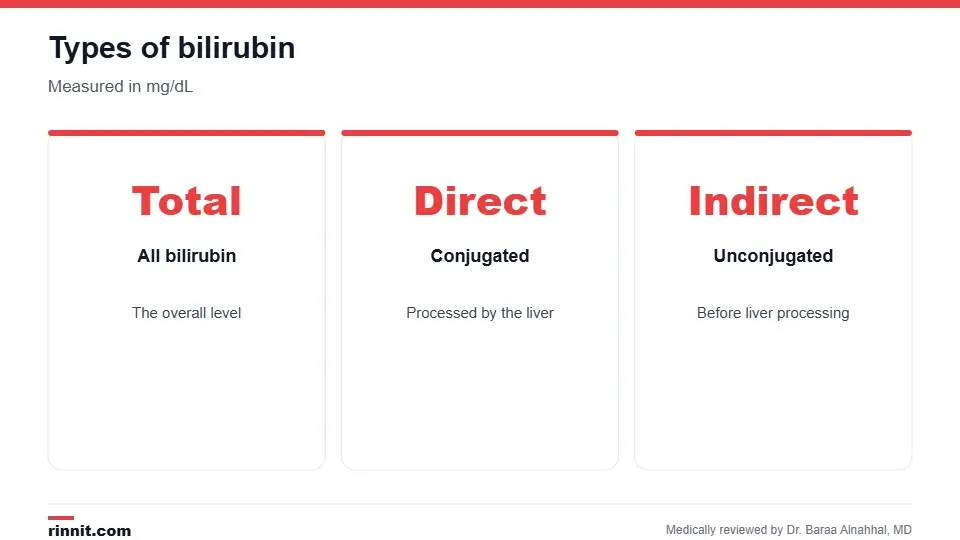
Total bilirubin is the sum of direct and indirect bilirubin.
Why is it done?
To look for the cause of jaundice, dark urine or pale stools.
As part of liver function tests to check for liver disease such as hepatitis or cirrhosis.
To check for a blocked bile duct, such as from gallstones.
To look for hemolytic anemia.
To monitor newborn jaundice and decide on treatment. Sources: [1]
How is the test done?
For adults and children, a small blood sample is drawn from a vein; it takes a few minutes. You may be asked not to eat or drink for a few hours beforehand. For newborns, a few drops are taken from a heel prick, and a skin light meter may be used for screening. Bilirubin can also be checked in urine as part of a urinalysis. Sources: [1]
What do the results mean?
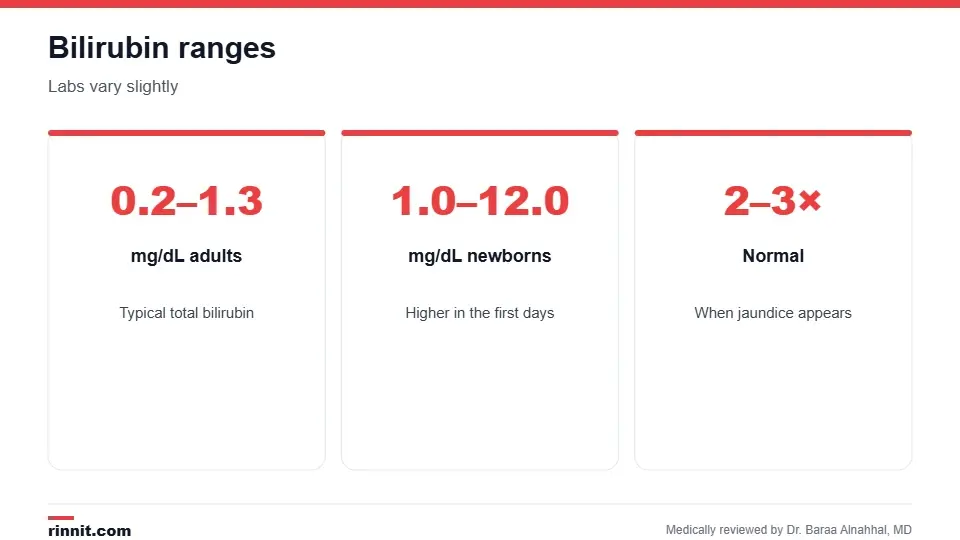
Normal ranges vary slightly between labs.
Group | Typical total bilirubin |
Adults and children | 0.2–1.3 mg/dL |
Newborns | 1.0–12.0 mg/dL |
Visible jaundice | Usually about 2–3 times the normal range |
Sources: [1]
The pattern of direct and indirect bilirubin helps narrow down the cause. High indirect bilirubin suggests too many red blood cells breaking down or a processing problem such as Gilbert syndrome. High direct bilirubin suggests liver damage or a blocked bile duct. Sources: [1]
Causes of high bilirubin

Causes range from harmless to serious.
Red blood cell breakdown: hemolytic anemia, sickle cell disease, transfusion reactions.
Liver problems: viral, alcohol- or drug-related hepatitis, mononucleosis, cirrhosis, liver failure.
Inherited conditions: Gilbert syndrome, Wilson disease, Crigler-Najjar syndrome.
Bile flow problems: gallstones, inflammation of the gallbladder or bile ducts.
Newborns: prematurity, blood type differences with the mother, breast milk jaundice. Sources: [1]
Low bilirubin is generally not a concern and can occur with some medicines. Sources: [1]
Newborn jaundice
Most newborns have some jaundice in the first week because their livers are still maturing. Treatment depends on the baby's age in hours and risk factors; for example, treatment is generally recommended at levels above about 15 mg/dL in the first 48 hours or 20 mg/dL after 72 hours. Phototherapy uses blue light to help the body break down bilirubin. Untreated, very high levels can cause brain damage called kernicterus. Sources: [1, 2]
Risks
A blood draw is safe; you may have slight bruising. A heel prick may cause brief discomfort for a baby. Sources: [1]
Conclusion
A bilirubin test is a simple blood test that helps explain jaundice and check liver, bile duct and blood health. Many causes, such as Gilbert syndrome or normal newborn jaundice, are harmless, but high levels need follow-up to find and treat the cause.
Keep learning: read about liver function tests and infant jaundice.
Frequently asked questions
What is bilirubin?
A yellow pigment made when red blood cells break down.
What is a normal bilirubin level?
About 0.2–1.3 mg/dL for adults and children.
What does high bilirubin mean?
It may point to liver disease, a blocked bile duct, red blood cell breakdown or Gilbert syndrome.
What's the difference between direct and indirect bilirubin?
Indirect is before the liver processes it; direct is after.
Do I need to fast?
You may be asked not to eat for a few hours.
Is newborn jaundice normal?
Mild jaundice is common in the first week.
How is high bilirubin treated in newborns?
Usually with phototherapy (special blue light).
What is Gilbert syndrome?
A harmless inherited condition that causes mildly high bilirubin.
Can low bilirubin be a problem?
Generally not.
What symptoms does high bilirubin cause?
Yellow skin and eyes, dark urine, pale stools and itching.
Related Reading
AST Blood Test (Aspartate Transferase): Normal Range and Results explains the AST liver enzyme blood test.
Antimitochondrial Antibody (AMA) Test for Primary Biliary Cholangitis explains the blood test that helps diagnose primary biliary cholangitis.
Liver Function Tests (LFTs): What They Measure, Normal Ranges and Results the panel that includes bilirubin.
What Is Infant Jaundice? What New Parents Should Know jaundice in newborns.
Gilbert Syndrome: What It Is, and Why It Usually Needs No Treatment at All a harmless cause of high bilirubin.
Hemolytic Anemia: Understanding Rapid Red Blood Cell Loss fast red blood cell breakdown that raises bilirubin.
Kernicterus: Understanding the Risks of Severe Newborn Jaundice brain damage from very high newborn bilirubin.
G6PD Test: Checking for G6PD Deficiency and Hemolytic Anemia explains the blood test for inherited G6PD enzyme deficiency.
References
Cleveland Clinic. Bilirubin Test: Understanding High vs. Low Levels & Causes. Cleveland Clinic. Last updated January 9, 2023. https://my.clevelandclinic.org/health/diagnostics/17845-bilirubin
Slaughter JL, Kemper AR, Newman TB. Technical report: diagnosis and management of hyperbilirubinemia in the newborn infant 35 or more weeks of gestation. Pediatrics. 2022;150(3):e2022058865. PMID 35927519. https://doi.org/10.1542/peds.2022-058865
Horsfall LJ, Rait G, Walters K, et al. Serum bilirubin and risk of respiratory disease and death. JAMA. 2011;305(7):691-697. PMID 21325185. https://doi.org/10.1001/jama.2011.124
Medical disclaimer
This article is for general education only and does not replace advice from a qualified healthcare professional. Talk to your doctor about your own diagnosis and treatment, and seek emergency care right away for severe or sudden symptoms.



Comments