Kernicterus: Understanding the Risks of Severe Newborn Jaundice

Updated: 2 days ago
Medically reviewed by Dr. Baraa Alnahhal, MD · Last reviewed: October 2026
Quick Answer: Key Facts About Kernicterus
Kernicterus, also called bilirubin encephalopathy, is brain damage from very high bilirubin in the blood, a risk that rises sharply when total serum bilirubin reaches 25 mg/dL or more. Risk factors include newborn jaundice and birth before 37 weeks. Early signs include poor feeding and extreme sleepiness. Phototherapy and exchange transfusion treat it; complications include hearing loss and cerebral palsy.
Feature | Details |
Common name | Kernicterus, also called bilirubin encephalopathy. [1] |
Primary cause | Very high bilirubin in the blood (hyperbilirubinemia). A total serum bilirubin of 25 mg/dL or more is dangerously high and greatly raises the risk of kernicterus. [1] |
Risk factors | Newborn jaundice, birth before 37 weeks, poor feeding, darker skin tone (harder to spot yellowing) and a family history of newborn jaundice. [1] |
Early signs | Difficulty feeding and sucking, extreme sleepiness, low muscle tone and no startle response to loud sounds. [1] |
Main treatment | Phototherapy (light therapy), exchange blood transfusion and, for Rh disease, IVIG. [1] |
Complications | Hearing loss, cerebral palsy, problems with cognitive development, permanent brain damage and coma. [1] |
Prevention | Watching for jaundice, attending newborn follow-up visits and treating jaundice under a provider's guidance. [1] |
What the research says
Many newborns have high bilirubin, and a minority need phototherapy. A systematic review and meta-analysis notes that neonatal hyperbilirubinemia is seen in most newborns and that 5% to 15% of neonates need phototherapy. In six trials with 880 neonates, adding ursodeoxycholic acid to phototherapy lowered bilirubin by an extra 2.06 mg/dL in the first 24 hours and shortened phototherapy by about 19.7 hours, but the evidence was low quality and more studies are needed before this is used routinely. (Kuitunen et al., World J Pediatr, 2022) [2]
Home phototherapy may be an option for some low-risk babies. A systematic review of 31 studies covering 5,059 neonates found hospital (re)admission after home phototherapy of 3.5% and no difference in treatment duration or daily bilirubin decline compared with hospital treatment. The certainty of evidence was low, and the authors suggest it may suit near-term, low-risk babies. (Spaan et al., Pediatr Res, 2025) [3]
Zinc sulfate is being studied as an add-on to phototherapy. A meta-analysis of 11 randomized trials (1,349 neonates) found that adding zinc sulfate lowered bilirubin by 0.76 mg/dL at 24 hours, 0.88 mg/dL at 48 hours and 1.19 mg/dL at 72 hours. Term babies of normal birth weight benefited most, while preterm and low-birth-weight babies showed no significant difference. Phototherapy remains the standard treatment. (de Oliveira et al., Eur J Pediatr, 2024) [4]
What Is Kernicterus?
Kernicterus is a rare condition that affects a baby's brain when there is too much bilirubin in their blood (hyperbilirubinemia). Bilirubin is a yellow waste product that the body makes. Sometimes the liver cannot remove enough of it, which causes jaundice: the skin, the whites of the eyes and the gums or the area under the tongue look yellow. Healthcare providers may call kernicterus "bilirubin encephalopathy." [1]
About 60% of infants have yellowing of their skin and eyes during the first few weeks of life. Healthcare providers monitor newborn jaundice to lower the risk of kernicterus, which is why the condition is rare. When the liver cannot get rid of bilirubin through stool, it collects in the blood and can move into brain tissue, where it can cause severe complications. [1]

What are the three stages of kernicterus?
Symptoms of kernicterus progress in stages, on top of the yellow skin of jaundice. Healthcare providers may diagnose the condition one to three weeks after birth. Other signs can include a lack of energy, fever, vomiting and involuntary muscle movements. [1]
Stage | Common symptoms |
Early stage | Difficulty feeding and sucking, very sleepy, low muscle tone and no response to loud sounds (startle reflex). [1] |
Middle stage | Irritability, a loud or high-pitched cry and tense muscles. [1] |
Late stage | Not feeding, stiff muscles (arched back with the neck bent backward) and seizures. [1] |
Late-stage kernicterus is very serious and life-threatening. If your baby has jaundice along with any other symptoms, contact their healthcare provider immediately. If your baby has jaundice and a seizure, call emergency services or go to an emergency room right away. [1]

What causes kernicterus and who is at risk?
Very high bilirubin levels cause kernicterus. This happens when a newborn's liver cannot get rid of enough bilirubin. Causes of hyperbilirubinemia include: [1]
Polycythemia: too many red blood cells in the body.
Hemolysis: the body destroys red blood cells, which is a natural part of their lifecycle, but sometimes too soon or more than usual.
Birth injury: blood collecting under the scalp (cephalohematoma), bleeding between the skin and skull (subgaleal hemorrhage) or bruising.
Underlying conditions: a condition that affects the baby's blood cells, such as Rh hemolytic disease, or one that affects the liver, such as Crigler-Najjar syndrome.
A newborn is more at risk of kernicterus if they have newborn jaundice, a darker skin tone (yellowing is harder to detect), were born before 37 weeks of pregnancy, are not eating well and therefore not pooping enough to get rid of bilirubin, or have a biological family history of newborn jaundice. [1]
How is kernicterus diagnosed, and how is bilirubin monitored?
A healthcare provider diagnoses kernicterus after a physical exam and testing. A light meter test shines a medical-grade light on the baby's skin and estimates bilirubin from how the light reflects. To confirm, a provider takes a small blood sample from the baby's heel for a bilirubin blood test. Imaging such as a head ultrasound, CT scan or MRI is not necessary but may help rule out conditions with similar symptoms. [1]
Providers measure the total serum bilirubin (TSB) level. A TSB of 25 mg/dL or more is dangerously high and needs urgent treatment, but kernicterus itself is diagnosed from the baby's symptoms and exam. If you are unsure about test results, contact your healthcare provider. [1]
How is kernicterus treated with phototherapy and transfusions?
Treatment for kernicterus can include: [1]
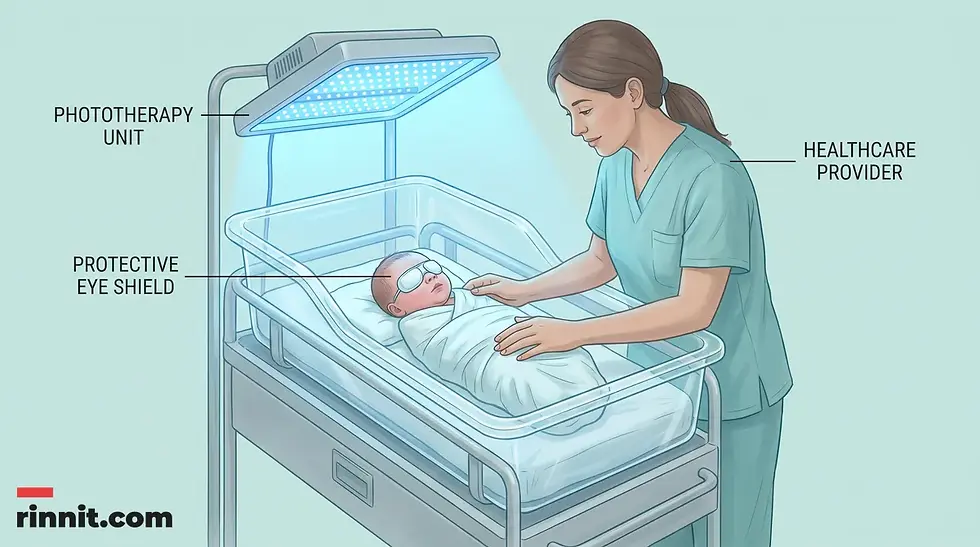
Phototherapy (light therapy): bright, medical-grade lights shine on the newborn's skin and will not harm the baby. The baby rests in a bed with a light directed toward the body and wears protective eye coverings during the session.
Exchange blood transfusions: donor blood and/or plasma replaces the newborn's blood. A provider places a small tube into a vein in the arm or a catheter into the umbilical stump to remove and replenish the blood supply.
Intravenous immunoglobulins (IVIG): if the newborn has Rh disease, a provider may prescribe this antibody therapy, given through an infusion into a vein.
It could take up to two weeks before your child feels better. You can help by making sure your baby gets enough to eat, because passing stool helps move bilirubin out of the body. A provider can explain how to help your child get the nutrients they need if they are not feeding well. [1]
What is the long-term outlook for kernicterus, and what complications can occur?
If a child is treated while kernicterus is in the early or middle stage, they may make a full recovery. Babies with late-stage kernicterus may have complications that can be life-threatening, and once brain tissue is affected the complications are irreversible. Complications can include hearing loss, cerebral palsy, problems with cognitive development, permanent brain damage and coma. Treatment and lifelong support are available to help a child adapt. [1]
In most cases, a provider diagnoses and treats newborn jaundice before it can worsen into kernicterus. You can lower your child's risk by watching for jaundice after birth, attending newborn follow-up appointments (especially if your baby was born early) and treating jaundice under a provider's guidance. [1]
Conclusion
Newborn jaundice is common and usually harmless, but kernicterus is a reminder of why careful newborn care matters. Knowing the warning signs and keeping follow-up appointments helps parents and providers protect a baby's developing brain. If something does not seem right, contact your child's healthcare provider and be their advocate. [1]
Learn more. For more evidence-based health guides, visit Rinnit.com.
Frequently Asked Questions
Is all jaundice dangerous for a baby?
No. Jaundice is common in newborns, and severe complications are rare. It becomes dangerous when bilirubin rises high enough to cause kernicterus, which is why providers monitor it.
Can kernicterus happen in adults?
It mainly affects newborns, but rare cases may affect adults.
How can I tell if my baby has jaundice if they have dark skin?
Yellowing can be harder to see on a darker skin tone. Check the whites of the eyes, the gums and the area under the tongue, and tell your provider about behavior changes such as unusual sleepiness.
Does breastfeeding cause kernicterus?
No. But a baby who is not feeding well may not poop enough to clear bilirubin, which raises the risk. If you are worried about feeding, talk to your provider.
Is phototherapy painful for the baby?
No. The lights are medical-grade and will not harm your child. The baby rests in a bed under the light and wears protective eye coverings.
How long does it take for a baby to feel better after treatment?
It could take up to two weeks. Making sure your baby gets enough to eat helps them pass stool and clear bilirubin.
Can kernicterus be cured?
A baby treated in the early or middle stage may make a full recovery. If late-stage kernicterus has affected brain tissue, the complications are irreversible, although treatment and support can help a child adapt.
Is kernicterus hereditary?
Kernicterus itself is not inherited, but some underlying causes, such as Crigler-Najjar syndrome, and a family history of newborn jaundice can raise the risk.
What is the startle reflex, and why does it matter?
It is a newborn's natural reaction to loud sounds. No response to loud sounds is listed as an early sign of kernicterus.
Can I use a tanning bed or sunlight instead of phototherapy?
No. Phototherapy uses specific medical-grade light and must be given under professional supervision.
What bilirubin level leads to a kernicterus diagnosis?
No single level makes the diagnosis. A total serum bilirubin of 25 mg/dL or more is dangerously high and needs urgent treatment, and kernicterus is diagnosed from the baby's symptoms and exam. Treatment decisions depend on your baby, so follow your provider's guidance.
Why does bilirubin affect the brain?
When bilirubin that the liver cannot clear moves from the blood into brain tissue, it can cause severe complications such as hearing loss and permanent brain damage.
What follow-up do babies need after severe jaundice?
Ask your child's provider what follow-up they recommend, including checks on hearing and development, because complications such as hearing loss can occur.
Can Rh incompatibility be prevented?
Rh-negative mothers are usually given an anti-D injection (such as RhoGAM) during pregnancy to help prevent Rh disease. Ask your obstetrician about your own situation.
What should I do if my baby is too sleepy to eat?
Contact your pediatrician right away. Extreme sleepiness and poor feeding together with jaundice are early signs of kernicterus.
Related Reading
Bilirubin Test: Normal Levels, High Bilirubin Causes and Newborn Jaundice explains the blood test that measures bilirubin and what high levels mean.
References
Cleveland Clinic. Kernicterus: What It Is, Causes, Symptoms & Treatment. Cleveland Clinic. Last updated May 30, 2023. https://my.clevelandclinic.org/health/diseases/25014-kernicterus
Kuitunen I, et al. Ursodeoxycholic acid as adjuvant treatment to phototherapy for neonatal hyperbilirubinemia: a systematic review and meta-analysis. World J Pediatr. 2022;18(9):589-597. PMID 35689782. https://doi.org/10.1007/s12519-022-00563-z
Spaan J, et al. Home phototherapy for neonatal hyperbilirubinemia: a mixed methods systematic review and meta-analysis. Pediatr Res. 2025;99(6):2155-2168. PMID 40715357. https://doi.org/10.1038/s41390-025-04313-5
de Oliveira HM, et al. Zinc sulfate on neonatal hyperbilirubinemia: an updated systematic review and meta-analysis. Eur J Pediatr. 2024;184(1):79. PMID 39671002. https://doi.org/10.1007/s00431-024-05917-5
Medical disclaimer
This article is for general educational purposes only and is not a substitute for professional medical advice. Always seek the advice of your child's pediatrician or other qualified health provider with any questions about jaundice or a medical condition. If your baby has jaundice and seems very sleepy, is feeding poorly or has a seizure, seek care right away.



Comments