Antimitochondrial Antibody (AMA) Test for Primary Biliary Cholangitis

Updated: 3 days ago
Written and medically reviewed by Dr. Baraa Alnahhal, MD · Last reviewed: November 2026 · How we review
Quick Answer
The antimitochondrial antibody (AMA) test is a blood test that looks for antibodies that attack the mitochondria inside liver cells. It's mainly used to help diagnose primary biliary cholangitis (PBC), an autoimmune liver disease that damages the tiny bile ducts. A positive AMA is strongly linked to PBC but isn't enough to diagnose it alone.
What the research says
A positive AMA often comes before PBC: in 29 people with a positive AMA but normal liver tests followed for about 18 years, 76% developed symptoms of primary biliary cholangitis and 83% developed ongoing liver test changes (Metcalf JV et al., Lancet, 1996) [2]
Monitoring matters: in a large study of people with a positive AMA but no established PBC, 16% of those with normal liver tests developed PBC within 5 years, and their 5-year survival was lower than in matched controls (Dahlqvist G et al., Hepatology, 2017) [3]
Key takeaways
The AMA test helps diagnose primary biliary cholangitis (PBC).
A positive result is strongly linked to PBC but isn't a diagnosis by itself.
It's interpreted with liver tests such as ALP and bilirubin.
No preparation is needed.
The blood draw takes less than 5 minutes.
What is the AMA test?
Mitochondria are tiny structures that make energy inside cells. In some autoimmune conditions, the immune system makes antibodies against them. These antimitochondrial antibodies are a hallmark of primary biliary cholangitis, formerly called primary biliary cirrhosis, in which inflammation damages small bile ducts. Bile then builds up and can scar the liver over time. Sources: [1]
Why it's done
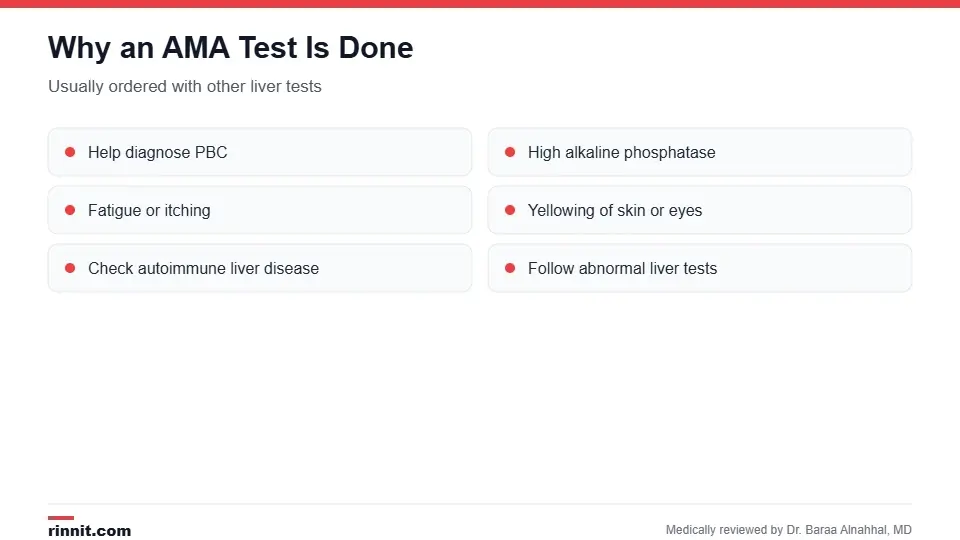
AMA is usually ordered with other liver tests.
Help diagnose primary biliary cholangitis.
Explain abnormal liver test results, especially a high ALP.
Look into symptoms such as fatigue, itching or yellowing of the skin.
Check liver involvement in people with other autoimmune conditions. Sources: [1]
AMA can also be positive in autoimmune hepatitis, Sjögren's syndrome and lupus. Sources: [1]
How the test is done
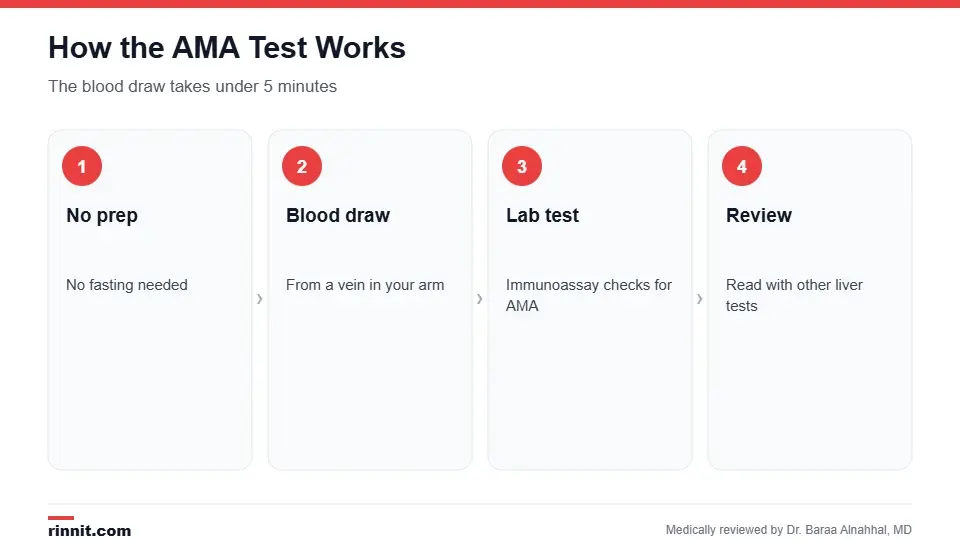
The blood draw takes less than 5 minutes.
No preparation is needed.
A small blood sample is drawn from a vein in your arm.
The sample is tested in a lab with an immunoassay.
Your provider reviews the results with your other test results. Sources: [1]
Risks
Risks are the same as for any blood test: slight bleeding, bruising or, rarely, infection where the needle went in. Some people feel dizzy or faint. Sources: [1]
What the results mean
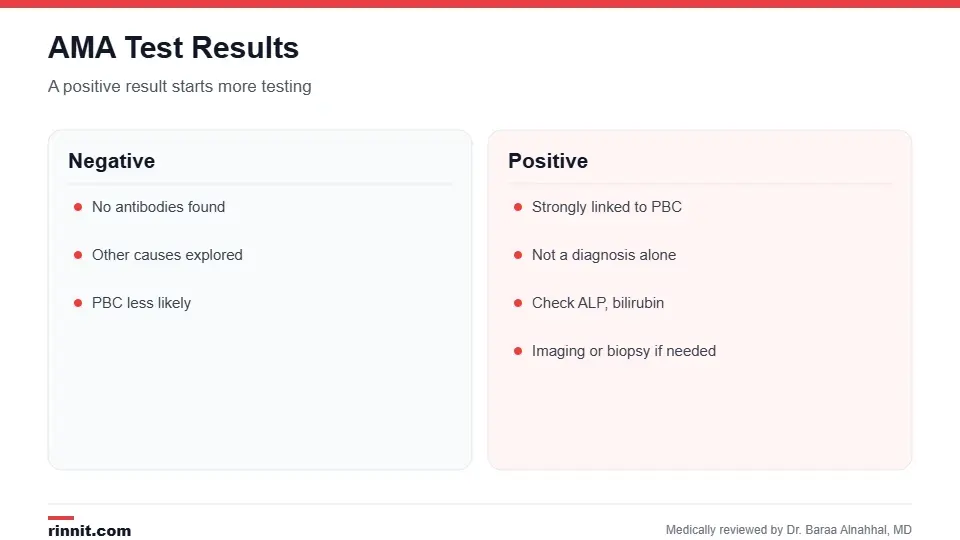
A positive AMA starts further testing.
Result | What it means | Possible next steps |
Negative | No antimitochondrial antibodies found | Other causes of liver problems may be explored |
Positive | Strongly linked to PBC, but not a diagnosis alone | Liver enzymes, ALP, bilirubin, ANA test, liver imaging or biopsy |
Some people with a positive AMA and normal liver tests develop PBC over time, so your provider may recommend regular follow-up. Sources: [1, 2, 3]
Conclusion
The AMA test is a simple blood test that offers a key clue to primary biliary cholangitis. A positive result leads to further testing and, when PBC is confirmed, to early treatment and monitoring that help protect your liver.
Keep learning: read about liver function tests and the ANA test.
Frequently asked questions
What does the AMA test check for?
Antibodies that attack mitochondria, a sign of primary biliary cholangitis.
What is primary biliary cholangitis?
An autoimmune disease that damages small bile ducts in the liver.
Does a positive AMA mean I have PBC?
Not by itself; other tests are needed to confirm it.
Do I need to fast?
No. No preparation is needed.
How long does the test take?
The blood draw takes less than 5 minutes.
What other tests are done with AMA?
Liver enzymes, alkaline phosphatase and bilirubin.
Can AMA be positive in other conditions?
Yes, including autoimmune hepatitis, Sjögren's syndrome and lupus.
What if my AMA is positive but liver tests are normal?
Your provider may recommend regular follow-up.
Are there risks?
Only minor bruising or bleeding from the blood draw.
Who interprets the results?
Your provider, often a liver specialist.
Related Reading
Liver Function Tests (LFTs): What They Measure, Normal Ranges and Results blood tests that check liver health.
ANA Test (Antinuclear Antibody Test): Purpose, Results and What a Positive Means another autoimmune antibody test.
Bilirubin Test: Normal Levels, High Bilirubin Causes and Newborn Jaundice a liver test often checked with AMA.
Liver Ultrasound: Why It's Done, How to Prepare, Types and What Results Mean imaging of the liver.
ENA Panel: Which Antibodies It Tests and What Results Mean antibody tests for autoimmune diseases.
References
Cleveland Clinic. Antimitochondrial Antibody (AMA). Cleveland Clinic. Last updated August 5, 2026. https://my.clevelandclinic.org/health/diagnostics/antimitochondrial-antibody
Metcalf JV, Mitchison HC, Palmer JM, et al. Natural history of early primary biliary cirrhosis. Lancet. 1996;348(9039):1399-1402. PMID 8937278. https://doi.org/10.1016/S0140-6736(96)04410-8
Dahlqvist G, Gaouar F, Carrat F, et al. Large-scale characterization study of patients with antimitochondrial antibodies but nonestablished primary biliary cholangitis. Hepatology. 2017;65(1):152-163. PMID 27688145. https://doi.org/10.1002/hep.28859
Medical disclaimer
This article is for general education only and does not replace advice from a qualified healthcare professional. Talk to your doctor about your own diagnosis and treatment, and seek emergency care right away for severe or sudden symptoms.



Comments