ANA Test (Antinuclear Antibody Test): Purpose, Results and What a Positive Means

Updated: 2 days ago
Written and medically reviewed by Dr. Baraa Alnahhal, MD · Last reviewed: November 2026 · How we review
Quick Answer: What is an ANA test?
An antinuclear antibody (ANA) test is a blood test that looks for antibodies that target the nucleus of your own cells. It helps providers check for autoimmune diseases such as lupus, Sjögren's syndrome and scleroderma. A positive result does not mean you have an autoimmune disease: up to 3 in 10 people without one test positive. [1]
What the research says
About 1 in 7 people in the US carry antinuclear antibodies. In a national sample of 4,754 people aged 12 and older, 13.8% were ANA positive, rising with age and more common in females (17.8%) than males (9.6%). (Satoh et al., Arthritis & Rheumatism, 2012) [2]
A negative ANA makes lupus very unlikely, but a positive one is far from proof. Across 64 studies of 13,080 people with lupus, ANA at a titer of 1:80 picked up 97.8% of cases, but it was only 74.7% specific; at 1:160, sensitivity was 95.8% and specificity 86.2%. (Leuchten et al., Arthritis Care & Research, 2018) [3]
Key takeaways
An ANA test checks your blood for antinuclear antibodies, which can mean your immune system is attacking your own cells. [1]
It helps providers look for autoimmune diseases like lupus, Sjögren's syndrome, scleroderma and autoimmune hepatitis. [1]
Results have three parts: whether ANAs were found, the titer (how concentrated they are) and the fluorescent pattern. [1]
A positive ANA is common in healthy people and can follow viral infections or some medicines. [1] [2]
If your test is positive, your provider will usually order more tests before making any diagnosis. [1]
What is an ANA test?
An antinuclear antibody test, or ANA test, checks your blood for possible signs of an autoimmune disease. Autoimmune diseases happen when your immune system attacks your own cells, and antinuclear antibodies are one way it can do that. [1]
What are antinuclear antibodies?
Antibodies normally circulate in your blood so your immune system can recognize and react quickly to germs like viruses and bacteria. Antinuclear antibodies are autoantibodies: instead of germs, they label your own cells for attack. They get their name from targeting the nucleus of a cell. The higher your ANA level, the more likely an autoimmune disease is. [1]
What is an ANA test used for?

An ANA test is one of the first blood tests providers use when they suspect an autoimmune disease.
Your provider may order an ANA test if they suspect an autoimmune disease, such as: [1]
Systemic lupus erythematosus (SLE), also called lupus
Sjögren's syndrome
Scleroderma
Mixed connective tissue disease (MCTD)
Polymyositis or dermatomyositis
Autoimmune hepatitis
Juvenile idiopathic arthritis (JIA)
Psoriatic arthritis
Some cancers and related paraneoplastic syndromes can also cause a positive ANA test. [1]
How does an ANA test work?
An ANA test starts with a routine blood draw: [1]
A healthcare provider, such as a phlebotomist, inserts a needle into a vein, usually in your arm.
They collect some of your blood into one or more sample tubes.
They remove the needle and put a bandage over the needle site. Your part of the test is then over.
In the lab, a pathologist usually prepares the sample with a method called indirect immunofluorescence (IIF). It makes antinuclear antibodies glow under a fluorescent microscope, so the pathologist can look for glowing cells and the pattern of the glow. [1]
How long do ANA results take?
It can take a few days to get your results. Your provider will tell you how long it usually takes and when to expect them. [1]
What do ANA test results mean?

Your ANA report combines whether antibodies were found, how many there are and how they glow.
ANA results have three main parts. [1]
Part of the result | What it tells you |
Interpretation | Whether the test found ANAs. If it did, the result is positive. |
Titer | How concentrated the antibodies are. The more antibodies you have, the more likely an autoimmune disease is. |
Fluorescent pattern | Where ANAs latch onto the nucleus: the whole surface may glow, or just speckles or dots. Certain patterns may suggest a specific autoimmune disease. |
Sources: [1]
Your provider can explain the specifics of your results and what they mean for you. [1]
What does a positive ANA result mean?
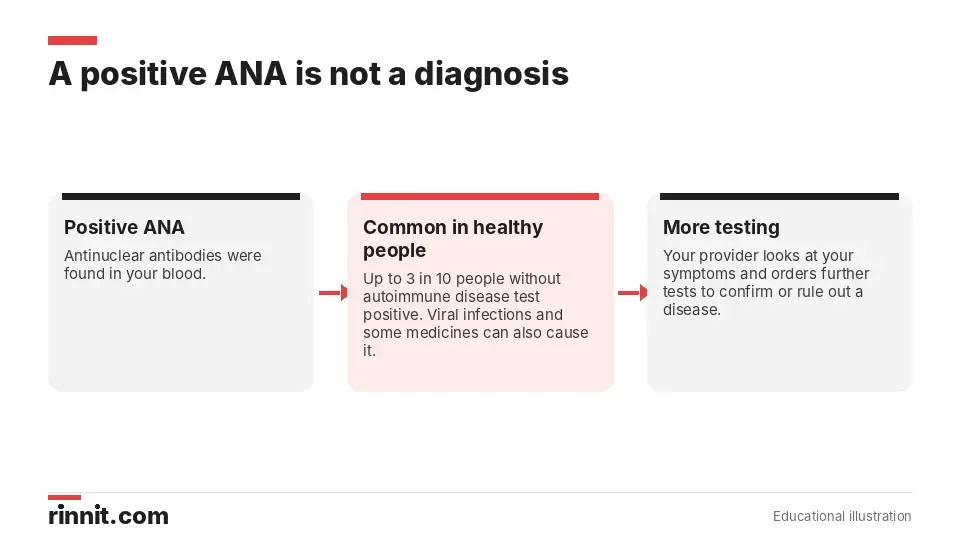
A positive ANA starts a conversation; it does not end one.
A positive ANA result means the test found antinuclear antibodies in your blood. It does not automatically mean you have an autoimmune disease. [1]
If your test is positive, your provider will likely recommend more tests. These can confirm or rule out an autoimmune disease and, if you have one, narrow down which one. [1]
What does a negative ANA result mean?
A negative result means the test didn't detect ANAs. Because ANA testing picks up almost all cases of lupus at standard titers, a negative result makes lupus much less likely. Your provider will still consider your symptoms. [3]
Conclusion
An ANA test is a simple blood test and a useful first step when a provider suspects an autoimmune disease. Its value lies in context: a positive result is common in healthy people, so the titer, the pattern, your symptoms and follow-up tests together decide what it means. [1] [2]
If you're waiting on results or just got a positive ANA, try not to read too much into the number alone. Ask your provider what your titer and pattern suggest and which tests come next. [1]
Keep learning: Read our lupus guide or our overview of autoimmune diseases. For a patient handout from rheumatologists, see the American College of Rheumatology page on ANA.
FAQ
What is an ANA test?
A blood test that looks for antinuclear antibodies, which can be a sign that your immune system is attacking your own cells. [1]
What is an ANA test used to diagnose?
It helps providers look for autoimmune diseases such as lupus, Sjögren's syndrome, scleroderma, mixed connective tissue disease and autoimmune hepatitis. [1]
Does a positive ANA mean I have lupus?
No. Up to 3 in 10 healthy people test positive, so your provider will order more tests before making any diagnosis. [1]
What can cause a positive ANA besides autoimmune disease?
Viral infections, certain medicines and some cancers or paraneoplastic syndromes can cause a positive ANA. [1]
What does ANA titer mean?
The titer shows how concentrated the antibodies are. Higher titers make an autoimmune disease more likely. [1]
What does the ANA pattern mean?
The pattern shows where antibodies attach to the cell nucleus, such as the whole surface or speckles. Some patterns suggest specific diseases. [1]
How is an ANA test done?
A provider draws a small sample of blood from a vein, usually in your arm, and sends it to a lab. [1]
How long do ANA test results take?
Usually a few days. Your provider will tell you when to expect them. [1]
What happens after a positive ANA test?
Your provider will likely order more tests to confirm or rule out an autoimmune disease and identify which one. [1]
Can a negative ANA rule out lupus?
It makes lupus much less likely, because ANA testing detects nearly all lupus cases at standard titers. [3]
Related Reading
Antimitochondrial Antibody (AMA) Test for Primary Biliary Cholangitis explains the blood test that helps diagnose primary biliary cholangitis.
ENA Panel: Which Antibodies It Tests and What Results Mean explains the follow-up antibody test that narrows down a positive ANA.
Lupus: Symptoms, Causes & Treatment Guide explains the autoimmune disease an ANA test is most often used to look for.
Understanding Sjögren's Syndrome: Managing Chronic Dryness covers a condition where ANAs are often found.
Scleroderma Guide: Symptoms, Causes, Diagnosis, and Treatment explains another autoimmune disease an ANA test can help detect.
What Is Mixed Connective Tissue Disease (MCTD)? Symptoms, Causes & Treatment of This Rare Disorder covers an overlap condition that providers check for with ANA testing.
Polymyositis Guide: Symptoms, Causes, Diagnosis, and Treatment explains an inflammatory muscle disease on the ANA testing list.
Autoimmune Hepatitis: What Happens When Your Immune System Attacks Your Liver covers liver inflammation that can come with a positive ANA.
Psoriatic Arthritis: Symptoms, Causes, Diagnosis, Treatment & Complete Guide explains a joint condition included in ANA testing.
Autoimmune Diseases: Why Your Immune System Turns on Your Body and How It's Managed gives the big picture of the disease group ANA tests look for.
References
Cleveland Clinic. Antinuclear Antibody (ANA) Test. Cleveland Clinic. Last updated August 1, 2025. https://my.clevelandclinic.org/health/diagnostics/ana-antinuclear-antibody-test
Satoh M, Chan EK, Ho LA, et al. Prevalence and sociodemographic correlates of antinuclear antibodies in the United States. Arthritis Rheum. 2012;64(7):2319-2327. PMID 22237992. https://doi.org/10.1002/art.34380
Leuchten N, Hoyer A, Brinks R, et al. Performance of Antinuclear Antibodies for Classifying Systemic Lupus Erythematosus: A Systematic Literature Review and Meta-Regression of Diagnostic Data. Arthritis Care Res (Hoboken). 2018;70(3):428-438. PMID 28544593. https://doi.org/10.1002/acr.23292
Medical disclaimer
This article is for general education only and does not replace advice from a qualified healthcare professional. Talk to your doctor about your own diagnosis and treatment, and seek emergency care right away for severe or sudden symptoms.



Comments