Autoimmune Hepatitis: What Happens When Your Immune System Attacks Your Liver

Updated: 3 days ago
Medically reviewed by Dr. Baraa Alnahhal, MD · Last reviewed: October 2026
Quick Answer
Autoimmune hepatitis is a condition in which the immune system attacks the liver instead of viruses and bacteria. Symptoms may include fatigue, belly discomfort, jaundice and joint pain. [1] Blood antibody tests and a liver biopsy confirm it. [2] Treatment uses immune-suppressing medicines such as prednisone, often lifelong, and a liver transplant may be needed if medicines fail or cirrhosis develops. [2]
What the research says
Budesonide plus azathioprine was linked to fewer side effects than prednisone plus azathioprine, but the remission evidence was mixed. A meta-analysis of 6 studies (929 patients; 4 randomized trials and 2 cohort studies) found complete biochemical remission favored budesonide in the trials (RR 1.45, 95% CI 1.24–1.68) but not in the cohort studies (RR 0.86, 95% CI 0.57–1.28). Adverse events were lower with budesonide (trials: RR 0.49, 95% CI 0.35–0.69; cohorts: RR 0.61, 95% CI 0.43–0.88). The authors rated the certainty of evidence as low to very low and suggested the benefit may be greatest in people with less severe liver damage (PubMed: Tong et al., Clin Res Hepatol Gastroenterol, 2025 [5]).
A network meta-analysis of six trials ranked budesonide plus azathioprine highest for remission in adults. Across eight regimens, budesonide plus azathioprine ranked first (cumulative ranking score 89.4), ahead of prednisone (69.1), prednisone plus azathioprine (63.2), and placebo (7.8). Compared with azathioprine alone, budesonide plus azathioprine increased remission (OR 10.30, 95% CI 1.50–70.70). The authors suggested it may suit patients without cirrhosis and called for larger studies with longer follow-up (PubMed: Lu et al., Exp Ther Med, 2018 [6]).
When standard treatment falls short, mycophenolate mofetil is the most studied second-line option, but the evidence is thin. A systematic review of 15 studies of second-line immunosuppressants in adults found that, with prednisone, mycophenolate mofetil gave a mean histological remission rate of 88.6%, with liver transplantation indicated in 11.4% and a mortality rate of 7.2%. A mean reduction in aminotransferases was seen in 94.3% with tacrolimus plus prednisone. The authors noted the lack of randomized trials, small patient numbers, and differing remission criteria (PubMed: De Lemos-Bonotto et al., Eur J Gastroenterol Hepatol, 2018 [7]).
What Is Autoimmune Hepatitis?
Autoimmune hepatitis is a liver disease that happens when the body's immune system attacks the liver. This attack can cause swelling, irritation, and damage to the liver. [1]
The exact cause is unclear. Researchers think genetic and environmental factors appear to interact over time to trigger the disease. [1]
Left untreated, autoimmune hepatitis can lead to scarring of the liver, called cirrhosis. It can also eventually lead to liver failure. [1] The important point: when diagnosed and treated early, autoimmune hepatitis often can be controlled with medicines that suppress the immune system. [1]
What are the symptoms of autoimmune hepatitis?
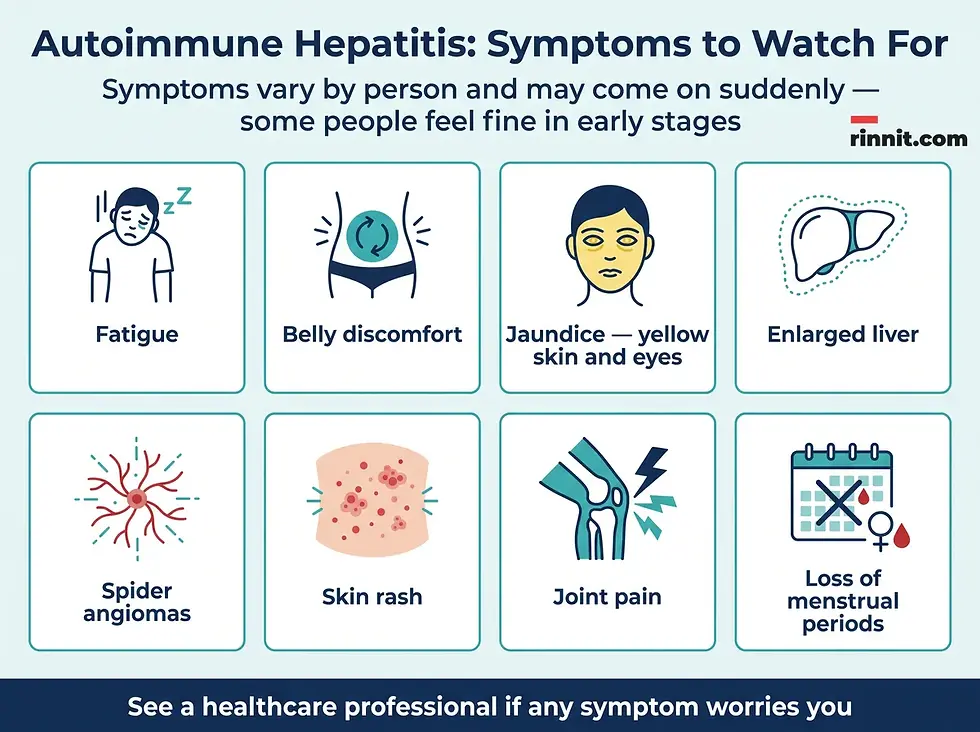
Symptoms of autoimmune hepatitis vary from person to person and may come on suddenly. Some people have few, if any, recognized problems in the early stages of the disease. [1]
Others experience symptoms that may include the following.
Symptom | What you may notice |
Fatigue | Ongoing tiredness |
Belly discomfort | Discomfort in the abdomen |
Jaundice | Yellowing of the skin and whites of the eyes; depending on skin color, this change may be harder or easier to see |
Enlarged liver | The liver becomes enlarged |
Spider angiomas | Irregular blood vessels on the skin |
Skin rash | A rash on the skin |
Joint pain | Pain in the joints |
Loss of menstrual periods | Menstrual periods stop |
When to see a doctor
Make an appointment with a healthcare professional if you have any symptoms that worry you.
Causes: Why Does the Immune System Attack the Liver?
Autoimmune hepatitis occurs when the body's immune system, which usually attacks viruses, bacteria, and other causes of disease, instead targets the liver. [4] This attack on the liver can lead to long-lasting inflammation and serious damage to liver cells.
Just why the body turns against itself is unclear. Researchers think autoimmune hepatitis could be caused by the interaction of genes controlling immune system function and exposure to viruses or medicines. [1]

Types of autoimmune hepatitis
Experts have identified two main forms of autoimmune hepatitis.
Type | Who it affects | Key facts |
Type 1 autoimmune hepatitis | The most common type; can occur at any age [1] | About half the people with type 1 have other autoimmune disorders, such as celiac disease, rheumatoid arthritis, or ulcerative colitis [1] |
Type 2 autoimmune hepatitis | Can develop in adults, but most common in children and young people [1] | Other autoimmune diseases may accompany this type |
What are the risk factors for autoimmune hepatitis?
Factors that may increase your risk of autoimmune hepatitis include the following.
Risk factor | Detail |
Being female | Although both males and females can develop autoimmune hepatitis, the disease is most common in females [1] |
Genetics | Evidence suggests that a predisposition to autoimmune hepatitis may run in families [1] |
Having an autoimmune disease | People who already have an autoimmune disease, such as celiac disease, rheumatoid arthritis, or hyperthyroidism (Graves' disease or Hashimoto thyroiditis), may be more likely to develop autoimmune hepatitis |
What are the complications of untreated autoimmune hepatitis?
Autoimmune hepatitis that goes untreated can cause permanent scarring of the liver tissue, known as cirrhosis. [1] Complications of cirrhosis can be serious.
Complication | What happens |
Esophageal varices | Enlarged veins in the esophagus caused by reduced blood flow through the portal vein, which carries blood from the intestine, pancreas, and spleen to the liver. When circulation through the portal vein is blocked, blood backs up into vessels, mainly in the stomach and esophagus. These thin-walled vessels are likely to bleed, and massive bleeding in the esophagus or stomach is a life-threatening emergency needing immediate medical care [1] |
Ascites | Fluid builds up in the abdomen; it can be uncomfortable and may interfere with breathing; usually a sign of advanced cirrhosis [1] |
Liver failure | Extensive damage to liver cells makes it not possible for the liver to function well; at this point, a liver transplant is needed [1] |
Liver cancer | People with cirrhosis have an increased risk of liver cancer [1] |
How is autoimmune hepatitis diagnosed?
Tests and procedures used to diagnose autoimmune hepatitis include blood tests and a liver biopsy. [2]
Test or procedure | What it does |
Blood tests | Testing a sample of blood for antibodies can distinguish autoimmune hepatitis from viral hepatitis and other conditions with similar symptoms; antibody tests also help pinpoint the type of autoimmune hepatitis you have [2] |
Liver biopsy | A small sample of liver tissue is taken to confirm the diagnosis and to determine the degree and type of liver damage; during the procedure, a thin needle is passed into the liver through a small cut in the skin, and the sample is sent to a laboratory for testing [2] |

How is autoimmune hepatitis treated?
The goal of treatment for autoimmune hepatitis is to slow or stop the immune system attack on the liver. This may help increase the time before the disease gets worse. To meet this goal, you'll likely need medicines that lower immune system activity. [2]
The first treatment is usually prednisone. A second medicine, azathioprine (Azasan, Imuran), may be recommended in addition to prednisone. [2]
Prednisone dosing and side effects
Healthcare professionals typically prescribe prednisone at a high dose for about the first month of treatment. Then, to reduce the risk of side effects, they gradually reduce the dose over the next several months until reaching the lowest possible dose that controls the disease. [2] Adding azathioprine also helps you avoid prednisone side effects. [2]
Prednisone, especially when taken long term, can cause a wide range of serious side effects. [2]
Side effect | Detail |
Diabetes | Prednisone can raise blood sugar |
Weakened or broken bones | Bone strength decreases |
High blood pressure | Blood pressure can rise |
Cataracts | Eye clouding |
Glaucoma | Increased eye pressure |
Weight gain | Body weight increases |
How long is treatment?
Although you may experience remission a few years after starting treatment, the disease often returns if the drug is discontinued. [2] Depending on your situation, you may need lifelong treatment.
When medicines aren't enough: liver transplant
When medicines don't stop the disease from getting worse, or you get scarring that can't be reversed — called cirrhosis — or liver failure, the remaining option is a liver transplant. [2]
During a liver transplant, your diseased liver is removed and replaced with a healthy liver from a donor. [2]
How should you prepare for an autoimmune hepatitis appointment?
If you have any symptoms that worry you, start by making an appointment with someone on your primary healthcare team. If your care team suspects autoimmune hepatitis, you may be referred to a specialist in liver diseases, called a hepatologist. [2]
Because appointments can be brief and there's often a lot to discuss, it's a good idea to be prepared.
Step | What to do |
Pre-appointment restrictions | At the time you make the appointment, ask if there's anything you need to do in advance, such as restricting your diet |
Symptoms | Write down any symptoms you're experiencing, including any that may seem unrelated |
Key personal information | Write down any major stresses or recent life changes |
Medications | Make a list of all medications, vitamins, or supplements you're taking |
Support person | Take a family member or friend along to help remember everything discussed |
Questions | Write down questions to ask your care team |
Questions worth asking
Questions to ask your care team may include the following.
What's the most likely cause of my symptoms?
Are there any other possible causes?
What tests do I need to confirm that I have autoimmune hepatitis?
How severe is the damage to my liver?
Is my condition likely temporary or chronic?
What are my treatment options?
Can treatment cure my autoimmune hepatitis?
What are the potential side effects of each treatment option?
How might treatment affect the management of my other medical conditions?
Could any of my medicines or habits cause or worsen my liver problems?
Are there any dietary restrictions that I need to follow?
Should I see a specialist?
Is there a generic alternative to the medicine you're prescribing me?
Are there brochures or other printed material I can take with me, and what websites do you recommend?
How often will I need follow-up visits?
What your doctor will ask
Be ready to answer questions about when you first began experiencing symptoms, whether your symptoms have been continuous or occasional, how severe they are, and whether anything seems to improve or worsen them. Your doctor will also ask whether you're taking any medicines or treatments for your symptoms, and whether you have a family history of liver disease. [2]
Conclusion: Early Treatment Can Control Autoimmune Hepatitis
Autoimmune hepatitis is serious but treatable. The immune system attacks the liver instead of germs, and without treatment the damage can progress to cirrhosis and liver failure. The good news is that when diagnosed and treated early, the disease often can be controlled with immune-suppressing medicines, though treatment is often lifelong.
If you have symptoms that worry you — fatigue, belly discomfort, or yellowing skin — don't wait. Talk with a healthcare professional about whether testing is right for you. Knowing what questions to ask — and preparing your medication list in advance — can make your appointment far more productive.
Frequently Asked Questions
1. What is autoimmune hepatitis?
Autoimmune hepatitis is a liver disease in which the body's immune system attacks the liver instead of germs, causing swelling, irritation, and damage. Untreated, it can lead to cirrhosis and liver failure, but early treatment with immune-suppressing medicines often controls the disease.
2. What causes autoimmune hepatitis?
The exact cause is unclear, but researchers think autoimmune hepatitis results from the interaction of genes controlling immune system function and exposure to environmental factors such as viruses or medicines, which trigger the immune system to attack the liver.
3. What are the symptoms of autoimmune hepatitis?
Symptoms vary and can appear suddenly. They may include fatigue, belly discomfort, jaundice (yellowing of the skin and eyes), an enlarged liver, spider angiomas on the skin, skin rash, joint pain, and loss of menstrual periods. Some people have few or no symptoms early on.
4. What are the two types of autoimmune hepatitis?
Type 1 is the most common form and can occur at any age; about half of people with type 1 have other autoimmune disorders. Type 2 can develop in adults but is most common in children and young people.
5. Who is at risk for autoimmune hepatitis?
Risk factors include being female, since the disease is most common in females, having a family predisposition, and already having an autoimmune disease such as celiac disease, rheumatoid arthritis, or hyperthyroidism.
6. How is autoimmune hepatitis diagnosed?
Diagnosis uses blood tests and a liver biopsy. Antibody blood tests distinguish autoimmune hepatitis from viral hepatitis and pinpoint the type, while a biopsy confirms the diagnosis and measures the degree and type of liver damage.
7. How is autoimmune hepatitis treated?
Treatment aims to slow or stop the immune attack using medicines that lower immune system activity. The first treatment is usually prednisone, often with azathioprine added. The prednisone dose is typically high for about the first month, then gradually reduced to the lowest dose that controls the disease.
8. How long do I need treatment for autoimmune hepatitis?
The disease often returns if medication is discontinued, even after remission a few years after starting treatment. Depending on your situation, you may need lifelong treatment.
9. What are the side effects of prednisone?
Taken long term, prednisone can cause diabetes, weakened or broken bones, high blood pressure, cataracts, glaucoma, and weight gain. Adding azathioprine helps you avoid prednisone side effects.
10. What happens if medicines don't work?
When medicines don't stop the disease from worsening, or cirrhosis or liver failure develops, the remaining option is a liver transplant, most often using a liver from a deceased donor or part of a liver from a living donor.
Related Reading
Learn more in our guide to ALT Blood Test: What It Measures, Normal Range and What High Levels Mean.
ANA Test (Antinuclear Antibody Test): Purpose, Results and What a Positive Means explains how this blood test looks for autoimmune disease and what a positive result means.
References
Mayo Clinic Staff. Autoimmune hepatitis - Symptoms and causes. Mayo Clinic. May 8, 2024. https://www.mayoclinic.org/diseases-conditions/autoimmune-hepatitis/symptoms-causes/syc-20352153
Mayo Clinic Staff. Autoimmune hepatitis - Diagnosis and treatment. Mayo Clinic. May 8, 2024. https://www.mayoclinic.org/diseases-conditions/autoimmune-hepatitis/diagnosis-treatment/drc-20352158
National Institute of Diabetes and Digestive and Kidney Diseases. Autoimmune Hepatitis. NIDDK. Mar. 2023. https://www.niddk.nih.gov/health-information/liver-disease/autoimmune-hepatitis
American Liver Foundation. Autoimmune Hepatitis (AIH). American Liver Foundation. Sep. 22, 2026. https://liverfoundation.org/liver-diseases/autoimmune-liver-diseases/autoimmune-hepatitis-aih/
Tong T, Hui X, Shi R, et al. The efficacy and safety of budesonide combined with azathioprine versus predniso(lo)ne combined with azathioprine for autoimmune hepatitis: A systematic review and meta-analysis. Clin Res Hepatol Gastroenterol. 2025;49(9):102708. PMID 41067493. https://doi.org/10.1016/j.clinre.2025.102708
Lu FB, Hu ED, Xu LM, et al. Comparative efficacy and tolerability of treatments for adult autoimmune hepatitis: A systematic review and network meta-analysis. Exp Ther Med. 2018;15(6):4838-4850. PMID 29904396. https://doi.org/10.3892/etm.2018.6063
De Lemos-Bonotto M, Valle-Tovo C, Costabeber AM, et al. A systematic review and meta-analysis of second-line immunosuppressants for autoimmune hepatitis treatment. Eur J Gastroenterol Hepatol. 2018;30(2):212-216. PMID 29227329. https://doi.org/10.1097/MEG.0000000000001019
Medical Disclaimer
This article is for informational purposes only and does not constitute medical advice. Always seek the advice of your physician or other qualified health provider with any questions you may have regarding a medical condition. Never disregard professional medical advice or delay in seeking it because of something you have read here.



Comments