ALT Blood Test: What It Measures, Normal Range and What High Levels Mean

Updated: 2 days ago
Written and medically reviewed by Dr. Baraa Alnahhal, MD · Last reviewed: November 2026 · How we review
Quick Answer: What is an ALT blood test?
An ALT blood test measures alanine transaminase, an enzyme found mostly in the liver. When liver cells are injured, ALT can leak into the bloodstream, so a high result can be an early sign of liver damage. One common normal range is 7 to 56 U/L, but ranges vary by lab, and one result alone is not a diagnosis. [1]
What the research says
A normal ALT does not rule out fatty liver disease. Pooling 11 studies with 4,084 patients, researchers found that about 25% of people with nonalcoholic fatty liver disease, and 19% of those with its inflammatory form (NASH), had ALT values in the normal range. (Ma et al., BMC Gastroenterology, 2020) [2]
Regular exercise training lowers ALT. Across 38 randomized studies with 1,880 adults, exercise training lowered ALT by about 3.7 U/L more than no exercise, and also reduced liver fat and fasting blood sugar. (Khalafi et al., Obesity Reviews, 2026) [3]
ALT and long-term health risk differ by region. In 19 cohort studies covering more than 9.24 million people, the highest third of ALT levels was linked to an 18% lower risk of death in North American groups but a 43% higher risk in Asian groups, a gap the authors say needs more study. (Kunutsor et al., International Journal of Epidemiology, 2014) [4]
Key takeaways
ALT is an enzyme found mainly in the liver; high blood levels may point to liver cell injury. [1]
Providers use the test to screen for, monitor and help diagnose liver conditions, but never rely on ALT alone. [1]
You may need to fast for 10 to 12 hours if ALT is part of a comprehensive metabolic panel (CMP). [1]
One common normal range is 7 to 56 U/L; check the range printed on your own lab report. [1]
About 1 in 20 healthy people have a result outside the normal range, so a single abnormal value is not a diagnosis. [1]
A normal ALT does not always mean a healthy liver: about a quarter of people with fatty liver disease have normal values. [2]
What is an ALT blood test?
Alanine transaminase (ALT) is an enzyme (a protein that speeds up chemical reactions) that lives mainly inside your liver cells. Smaller amounts are found in other parts of the body. [1]
Normally, only a low level of ALT circulates in your blood. When liver cells are damaged, they release more ALT, and the level in your blood rises. [1]
You may see this test listed under other names on your lab order or report, including alanine aminotransferase, SGPT (serum glutamic-pyruvic transaminase) or GPT. [1]
How ALT differs from AST
ALT is often measured alongside aspartate aminotransferase (AST), another enzyme. AST is also found in the heart, skeletal muscle and pancreas, so ALT is considered a more specific marker of liver health. [1]

Why is an ALT test done?
Your provider may order an ALT test for three main reasons: to screen for liver disease, to keep track of a known liver condition or to help work out the cause of symptoms. [1] ALT is also part of many routine blood panels, so you may have it checked even if you have no risk factors. [1]
Reason | What it means for you |
Screening | Checks for liver injury if you have risk factors such as heavy alcohol use, diabetes, obesity, a family history of liver disease or injecting drugs with shared needles. |
Monitoring | Shows whether a known liver condition is improving, getting worse or staying stable, or checks your liver while you take a medicine that can affect it. |
Diagnosing | Helps investigate symptoms that may come from the liver, together with other tests and your history. |
Sources: [1]
Symptoms that may lead to an ALT test
Your provider may check your ALT if you have signs that could come from a liver problem, such as: [1]
Nausea or vomiting
Belly (abdominal) pain
Itchy skin
Jaundice (yellowing of your skin or the whites of your eyes)
Fatigue (ongoing tiredness)
Loss of appetite
How do you prepare for an ALT blood test?
Preparation depends on whether ALT is tested alone or as part of a larger panel. [1]
Fasting: If ALT is part of a comprehensive metabolic panel (CMP), you will likely need to fast for 10 to 12 hours, which means only water during that time. If ALT is ordered on its own, fasting usually is not needed. [1]
Medicines and supplements: Tell your provider about everything you take, because many medicines and supplements can change ALT levels. Do not stop any medicine unless your provider tells you to. [1]
Exercise: Let your provider know if you often do intense workouts, since hard exercise can affect your ALT. [1]
What happens during an ALT blood test?
An ALT test is a standard blood draw, usually from a vein on the inside of your arm. A phlebotomist (a person trained to draw blood) or another provider does it in a few simple steps: [1]
They clean the skin over a vein on your arm.
They insert a small needle, which may feel like a quick pinch.
Blood flows into a test tube attached to the needle.
They remove the needle, press cotton or gauze on the spot and put on a bandage.
The whole draw usually takes less than five minutes. Your sample then goes to a lab, where a medical laboratory scientist runs it on a machine called an analyzer. [1]

Does an ALT blood test hurt, and are there risks?
Most people feel only a brief pinch when the needle goes in. The risks of a blood draw are very low. [1]
You may have some mild tenderness or a small bruise where the needle went in. This usually clears up quickly. [1]
What is the normal range for ALT?
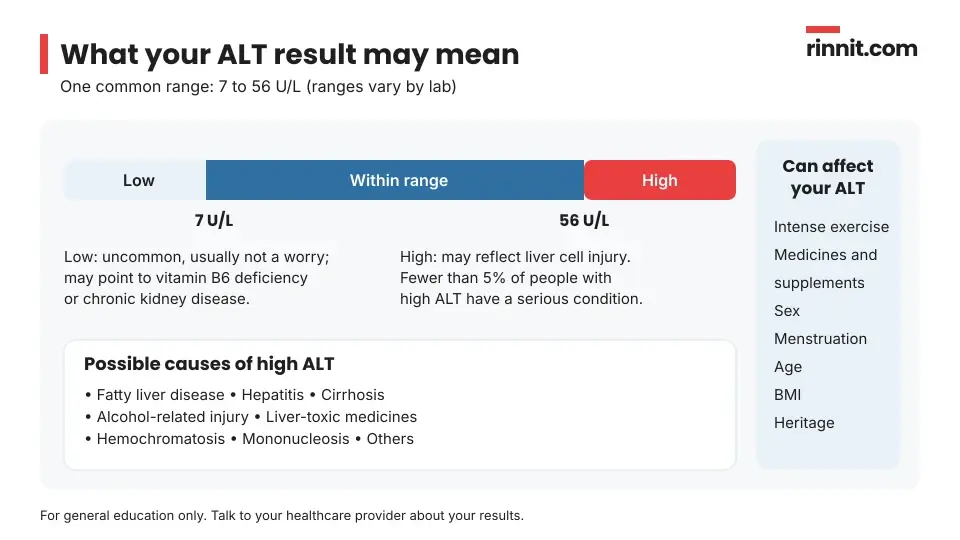
One common reference range for ALT is 7 to 56 units per liter (U/L). Ranges vary by lab, so always compare your result with the range printed on your own report. [1] ALT levels also tend to be higher in males than in females. [1]
Results usually come back within one to two business days, though sometimes it takes longer. [1]
Result | What it may mean | Common next step |
Below the range (low) | Uncommon and usually not a worry; it may point to vitamin B6 deficiency or chronic kidney disease. | Your provider may repeat the test or look into it further. |
Within the range | No sign of liver cell injury on this test. | Usually no action, unless you have symptoms or risk factors. |
Above the range (high) | May reflect liver cell injury; less often, injury to cells elsewhere in the body. | Repeat ALT, other blood tests, imaging or, in some cases, a liver biopsy. |
Sources: [1]
What does a high ALT level mean?
A high ALT level can be a sign that your liver cells are damaged or injured. Less often, it reflects injury to cells in other parts of your body. [1] Possible causes include: [1]
Alcohol-related liver injury
Fatty liver disease
Hepatitis (inflammation of the liver)
Cirrhosis (scarring of the liver)
Medicines that are toxic to the liver
Liver ischemia (too little blood flow to the liver)
Hemochromatosis (iron overload)
Mononucleosis
A liver tumor or liver cancer
Certain genetic conditions
A high result does not automatically mean you have a medical condition. Fewer than 5% of people with a raised ALT have a serious liver condition. [1]
Why a normal ALT is not the whole story
ALT can miss some liver disease. In a pooled analysis of 11 studies, about 1 in 4 people with fatty liver disease had a normal ALT. [2] That is one reason your provider looks at your full picture, not one number.
What can affect your ALT results?
Several everyday factors can push ALT up or down without serious liver disease. [1]
Factor | How it can affect ALT |
Intense exercise | Hard workouts can raise ALT levels. |
Medicines and supplements | Many can change ALT, including acetaminophen. |
Sex | Levels are typically higher in males. |
Menstruation | Can affect ALT levels. |
Age | ALT tends to fall as you get older. |
Body mass index (BMI) | Can be linked with ALT levels. |
Heritage | People of Mexican-American heritage are more likely to have raised levels. |
Sources: [1]
Over the long term, lifestyle matters too. Across 38 randomized studies, regular exercise training lowered ALT by about 3.7 U/L compared with no exercise. [3]
What happens after an abnormal ALT result?
If your ALT is outside the range, your next steps will be tailored to you. You may have a repeat ALT test, other blood tests, imaging tests or, less often, a biopsy (a small sample of liver tissue). [1]
To decide, your provider considers your medical history, how far your result is from the normal range, earlier results, other test results and any symptoms. [1] If your ALT is very high or you have symptoms, further testing may happen right away. [1]
When should you call your provider?
Contact your provider if you notice signs of possible liver damage, such as jaundice or belly pain. [1] If you already have a liver condition, reach out about any new or worrying symptoms. [1]
How often should you get an ALT test?
There is no single schedule for everyone. Your provider may check ALT as part of routine blood work, more often if you have risk factors for liver disease, or regularly if you have a liver condition or take a medicine that can affect your liver. [1]
Questions to ask your provider
Is my ALT being tested alone or as part of a panel, and do I need to fast?
Which of my medicines or supplements could affect my result?
What reference range does this lab use?
How far is my result from the normal range, and how does it compare with my earlier results?
Do I need repeat testing, other blood tests or imaging?
Could my exercise routine or other everyday factors explain my result?
What symptoms should prompt me to call you before my next test?
Conclusion
The ALT blood test is a quick, low-risk way to check for liver cell injury. It helps your provider screen for liver disease, track a known condition or look into symptoms, but it is always read alongside your history and other tests. [1]
If your result is outside the range, try not to panic: many people with an abnormal value do not have serious liver disease. [1] Talk with your provider about what your number means for you and what, if anything, should happen next.
Keep learning: Read our guides to fatty liver disease (MASLD), hepatitis and hemochromatosis. For more, see MedlinePlus's page on the ALT blood test.
FAQ
What is an ALT blood test?
It measures alanine transaminase, an enzyme found mainly in your liver. High levels can signal liver cell injury. [1]
Why would a doctor order an ALT test?
To screen for liver disease, monitor a known liver condition or medicine, or help investigate symptoms such as jaundice or belly pain. [1]
Do I need to fast before an ALT test?
If ALT is part of a comprehensive metabolic panel, you will likely fast for 10 to 12 hours (water only). On its own, fasting usually is not needed. [1]
Does an ALT blood test hurt?
You may feel a quick pinch when the needle goes in, and possibly mild tenderness or a small bruise afterward. [1]
How long does an ALT test take?
The blood draw usually takes less than five minutes. Results often arrive in one to two business days. [1]
What is a normal ALT level?
One common range is 7 to 56 U/L. Ranges vary by lab, and levels are typically higher in males. [1]
What does a high ALT level mean?
It may mean liver cell injury from causes such as fatty liver, hepatitis, alcohol or certain medicines. Fewer than 5% of people with high ALT have a serious liver condition. [1]
Can exercise affect ALT results?
Yes. Intense workouts can raise ALT, so tell your provider if you exercise hard often. [1] Over months, regular exercise training tends to lower ALT. [3]
What does a low ALT level mean?
Low ALT is uncommon and usually not concerning. It may point to vitamin B6 deficiency or chronic kidney disease. [1]
When should I call my doctor about my liver?
Call if you have signs of liver damage, such as jaundice or belly pain, or new symptoms if you already have a liver condition. [1]
Related Reading
Enzyme Markers: Blood Tests for Heart, Liver and Muscle Damage explains blood tests that detect heart, liver and muscle damage.
AST Blood Test (Aspartate Transferase): Normal Range and Results explains the AST liver enzyme blood test.
Acetaminophen Level Test: Checking for Tylenol Overdose explains the blood test used to diagnose and treat acetaminophen overdose.
Learn more in our guide to Fatty Liver Disease (MASLD): The Silent Liver Condition Linked to Weight, Diabetes, and Metabolic Health — Causes, Testing, and Treatment.
Learn more in our guide to Cirrhosis of the Liver: What It Is, How Permanent Scarring Damages Your Liver, and What Treatment Involves.
Learn more in our guide to Hepatitis: Causes, Symptoms, and Modern Treatment Options.
Learn more in our guide to Hepatitis B: Symptoms, Causes, Prevention, Diagnosis and Treatment.
Learn more in our guide to Autoimmune Hepatitis: What Happens When Your Immune System Attacks Your Liver.
Learn more in our guide to Hemochromatosis: The Iron Overload Disease That Hides for Decades.
References
Cleveland Clinic. Alanine Transaminase (ALT) Blood Test: What It Is, Procedure & Results. Cleveland Clinic. Last updated November 4, 2021. https://my.clevelandclinic.org/health/diagnostics/22028-alanine-transaminase-alt
Ma X, Liu S, Zhang J, et al. Proportion of NAFLD patients with normal ALT value in overall NAFLD patients: a systematic review and meta-analysis. BMC Gastroenterol. 2020;20(1):10. PMID 31937252. https://doi.org/10.1186/s12876-020-1165-z
Khalafi M, Fatolahi S, Symonds ME, et al. Comparative Efficacy of Different Exercise Interventions on Intrahepatic Lipid Content, Glucose Homeostasis, and Liver Function in Adults With and Without Nonalcoholic Fatty Liver Disease: A Systematic Review With Pairwise and Network Meta-Analyses. Obes Rev. 2026;27(4):e70052. PMID 41397888. https://doi.org/10.1111/obr.70052
Kunutsor SK, Apekey TA, Seddoh D, et al. Liver enzymes and risk of all-cause mortality in general populations: a systematic review and meta-analysis. Int J Epidemiol. 2014;43(1):187-201. PMID 24585856. https://doi.org/10.1093/ije/dyt192
Medical disclaimer
This article is for general education only and does not replace advice from a qualified healthcare professional. Talk to your doctor about your own diagnosis and treatment, and seek emergency care right away for severe or sudden symptoms.



Comments