Hemochromatosis: The Iron Overload Disease That Hides for Decades

Updated: 3 days ago
Medically reviewed by Dr. Baraa Alnahhal, MD · Last reviewed: October 2026
Hemochromatosis is the most common iron overload disease. It is usually inherited and causes the intestines to absorb too much iron from food, which is then stored in the liver, heart, and pancreas [1]. Most people have no symptoms until midlife, when excess iron can lead to cirrhosis, diabetes, heart failure, and skin color changes [1]. Treatment centers on regular blood removal (therapeutic phlebotomy), which safely lowers iron levels and can help prevent serious complications [2].
Quick Answer: What is hemochromatosis and why does it matter?
Hemochromatosis is a genetic iron overload disease that makes the intestines absorb too much iron from food. The excess iron is stored in organs such as the liver, heart and pancreas, where it can cause liver disease, heart conditions and diabetes. There is no cure, but regular blood removal safely lowers iron levels and can help prevent organ damage. [1] [2]
What the research says
Hemochromatosis has become milder over three decades. In 2,050 adults with two copies of the HFE C282Y mutation (1,460 probands and 542 relatives) diagnosed over 30 years, the frequency of diabetes and liver fibrosis steadily decreased, as did transferrin saturation, serum ferritin, and the amount of iron removed. Tobacco smoking was associated with higher transferrin saturation (Deugnier et al., Journal of Hepatology, 2018 [3]).
Evidence comparing treatment options is still limited. A Cochrane review of 3 trials with 146 participants compared removing red blood cells only (erythrocytapheresis) with standard phlebotomy. Adverse events were similar (10 of 49 people, 20.4%, vs 11 of 51, 21.6%), but the evidence was of very low quality. The authors concluded that phlebotomy remains the treatment of choice for people who need blood removal (Buzzetti et al., Cochrane Database of Systematic Reviews, 2017 [4]).
It is not rare in primary care. A systematic review for the American College of Physicians found hemochromatosis in about 1 in 169 to 1 in 556 patients across 3 studies, and a serum ferritin below 1,000 µg/L was predictive of the absence of cirrhosis (Schmitt et al., Annals of Internal Medicine, 2005 [5]).
What Is Hemochromatosis?
Hemochromatosis is a type of iron overload disease that is caused by a gene change passed down in families. Iron overload disease is any condition that causes the body to hold onto too much iron [1].
The most common form, also called primary or hereditary hemochromatosis, is a genetic condition that triggers the intestines to absorb too much iron from food. The excess iron is stored in the organs, especially the liver, heart, and pancreas. Too much iron can damage these organs and lead to life-threatening conditions such as liver disease, heart conditions, and diabetes [1].
Families of Northern European descent have a higher genetic risk of hereditary hemochromatosis when both parents carry the gene change, also called a gene mutation. Only a few people who have the gene mutation ever develop serious complications [1].
A second category, secondary iron overload, is not passed on in families. It can be caused by another condition that causes the intestines to absorb too much iron, such as liver disease or too much alcohol. Or it can happen when you get too much iron, such as from too many blood transfusions. Over time, secondary iron overload can damage organs too [1].
Hemochromatosis is different from hemosiderosis, which means iron has started to collect in body tissues but has not yet caused organ damage. These conditions are also different from simply having "high iron" on a blood test, which does not necessarily mean iron has built up in the organs [1].

How hemochromatosis works: untreated iron overload can lead to cirrhosis, diabetes, and heart failure.
Treatment for hemochromatosis usually includes removing blood from the body on a regular basis. This lowers iron levels because much of the body's iron is contained in red blood cells [1].
The Symptoms of Hemochromatosis
Some people with hemochromatosis never have symptoms. They may be diagnosed based on a routine blood test, sometimes done because of a family history of the condition [1].
Early signs and symptoms
Early signs and symptoms of iron overload, including hereditary hemochromatosis, often overlap with those of other common conditions. They may include [1]:
Weakness: reduced strength in daily activities.
Tiredness: persistent fatigue.
Joint pain: aching or stiffness in the joints.
Belly pain: discomfort in the abdomen.
There are also some differences in symptoms based on sex assigned at birth. In males, symptoms can include a loss of sex drive and not being able to get and keep an erection firm enough for sexual activity (impotence). In females, symptoms can include missing menstrual periods. Symptoms usually appear later in life in females, possibly because iron is lost through menstruation and pregnancy, so less iron is stored in the body. After menopause or a hysterectomy, this changes [1].
Other signs and symptoms
As iron builds up over the years, symptoms of iron overload can also include [1]:
Diabetes: high blood sugar caused by damage to the pancreas.
Heart problems: heart rhythm changes and heart failure.
Liver failure: the liver loses its ability to function.
Skin color changes: bronze or gray skin. The term "bronze diabetes" is sometimes used when a person has both type 2 diabetes and a bronze skin color.
Eye changes: changes that affect vision.
When symptoms typically appear
The most common type of hemochromatosis is present at birth, but most people do not have symptoms until later in life. For men, symptoms usually start after age 40. Women are more likely to have symptoms after menopause or after age 60 [1].
See a healthcare professional if you have any of the symptoms of hemochromatosis. If you have a parent, sibling, or child who has hemochromatosis, ask your healthcare team about genetic testing, which can check whether you have the gene that increases your risk [1].
Causes: The Genes That Make the Body Absorb Too Much Iron
Hemochromatosis, also called hereditary hemochromatosis, is a type of genetic iron overload disease caused by a gene change that is passed down in families. This is by far the most common type of iron overload disease. Other types of iron overload are not genetic; they may be called secondary or acquired iron overload [1].
Genetic causes of hemochromatosis
Hereditary hemochromatosis can be caused by mutations to different genes that control the amount of iron the body absorbs from food [1]:
The HFE gene: most often the cause of hereditary hemochromatosis. This type mostly affects adults in midlife. The gene has two common mutations, C282Y and H63D.
The HJV, HAMP, or TFR2 genes: a mutation in any of these causes juvenile hemochromatosis, which affects young people. Iron buildup begins earlier, so symptoms usually appear between ages 15 and 30.
If you inherit one gene mutation from each parent, you may develop hemochromatosis, and you can pass the altered gene on to your children. But not everyone who inherits two mutated genes develops symptoms linked to iron overload [1].
If you inherit a gene mutation from one parent, you are not likely to develop hemochromatosis. But you are considered a carrier and can pass the altered gene on to your children. Your children will not develop the disease unless they also inherit another altered gene from the other parent [1].
Causes of secondary or acquired iron overload
Some iron overload is not caused by a gene change passed on in families. Examples include [1]:
Neonatal hemochromatosis: a serious disease where iron builds up quickly in the liver of a baby while in the womb. It is thought to be an autoimmune disease, in which the body attacks itself.
Liver disease: another condition that causes the intestines to absorb too much iron.
Too much alcohol: can also cause the intestines to absorb too much iron.
Too many blood transfusions: used to treat anemia or other conditions, they can deliver too much iron.
Iron supplements: less often, taking too much of an iron supplement.
Diet alone usually does not cause iron overload. But, rarely, some people of African and African American descent may be at increased risk from a diet too high in iron, likely due to a gene change passed down in families [1].
How iron overload affects the organs
Iron plays an important role in several body functions, including helping to produce blood. But too much iron is toxic. A hormone secreted by the liver, called hepcidin, controls how iron is used and absorbed in the body, and how excess iron is stored in various organs. In hemochromatosis, the role of hepcidin is affected, causing the body to absorb more iron than it needs [1].
In other iron overload disease, the body does not absorb too much iron from food. Instead, it usually happens from too many blood transfusions. In either case, excess iron is stored in major organs, especially the liver. Over a period of years, the stored iron can cause severe damage that may lead to organ failure, and to long-lasting diseases such as cirrhosis, diabetes, and heart failure. Many people have gene changes that cause hemochromatosis, but not everyone develops iron overload to a degree that causes tissue and organ damage [1].
What Increases Your Risk
Factors that increase the risk of hemochromatosis include [1]:
Having two copies of an altered HFE gene: the greatest risk factor for hereditary hemochromatosis.
Family history: having a parent or sibling with hemochromatosis increases the likelihood of developing the disease.
Ethnicity: people of Northern European descent are more prone to hereditary hemochromatosis than people of other ethnic backgrounds.
Sex assigned at birth: males are more likely than females to have symptoms at an earlier age. Because females lose iron through menstruation and pregnancy, they tend to store less of the mineral. After menopause or a hysterectomy, the risk goes up for females.
Complications of Untreated Iron Overload
Untreated, hemochromatosis and iron overload can lead to several complications. These especially affect the joints and organs where excess iron tends to be stored, such as the liver, pancreas, and heart [1]:
Liver issues: cirrhosis is permanent scarring of the liver, which increases the risk of liver cancer and other life-threatening complications.
Diabetes: damage to the pancreas can lead to diabetes.
Heart conditions: excess iron in the heart affects its ability to circulate enough blood for the body's needs (congestive heart failure) and can cause irregular heart rhythms called arrhythmias.
Reproductive problems: erectile dysfunction and loss of sex drive in males; absence of the menstrual cycle in females.
Skin color changes: deposits of iron in skin cells can make the skin appear bronze or gray.
How Hemochromatosis Is Diagnosed
Hemochromatosis and iron overload can be difficult to diagnose. Early symptoms such as stiff joints and fatigue are commonly caused by other conditions, and many people with the disease have no symptoms other than high levels of iron in their blood. Hemochromatosis may be identified because of irregular blood test results after testing is done for other reasons [2].
Diagnosis criteria for what is considered iron overload can differ depending on where testing is done. But when blood test results are higher than expected, a genetic test may be done to check for the gene mutation that causes hereditary hemochromatosis. An MRI or liver biopsy may be done to check iron levels in the liver and look for organ damage, if suspected [2].
Blood tests
There is no single hemochromatosis blood test, but a number of blood tests may be done to screen for iron overload. Two key tests are [2]:
Serum transferrin saturation: measures the amount of iron bound to transferrin, the protein that carries iron in the blood. A value of 45% or more is often considered too high. If it is high, a serum ferritin test may be done.
Serum ferritin: measures the amount of iron stored in the liver. A value of more than 200 or 300 micrograms per liter is often considered high for people assigned male at birth, and more than 150 or 200 micrograms per liter for people assigned female at birth.
Different laboratories use different cut-offs. These blood tests may be done after fasting, and elevations in one or all of them can be found in other conditions, so you may need to have the tests repeated for the most accurate results.
Additional testing
A healthcare professional may suggest other tests to confirm the diagnosis and look for other problems [2]:
Liver function tests: can help identify liver damage.
MRI and ultrasound: an MRI is a fast, noninvasive way to measure the degree of iron overload in the liver. A related MRI test called magnetic resonance elastography uses gentle vibrations to measure how stiff liver tissue is from scarring.
Genetic test: testing DNA for changes in the HFE gene is recommended if there are high levels of iron in the blood. Discuss the reasons for and against testing with a healthcare professional or genetic counselor.
Liver biopsy: if liver damage is suspected, a thin needle removes a tissue sample, which the lab checks for iron and for damage, especially scarring or cirrhosis. Risks include bruising, bleeding, and infection.
Screening healthy people for hemochromatosis
Genetic testing is recommended for all parents, siblings, and children of anyone diagnosed with hemochromatosis. If a gene change is found in only one parent, then children do not need to be tested [2].
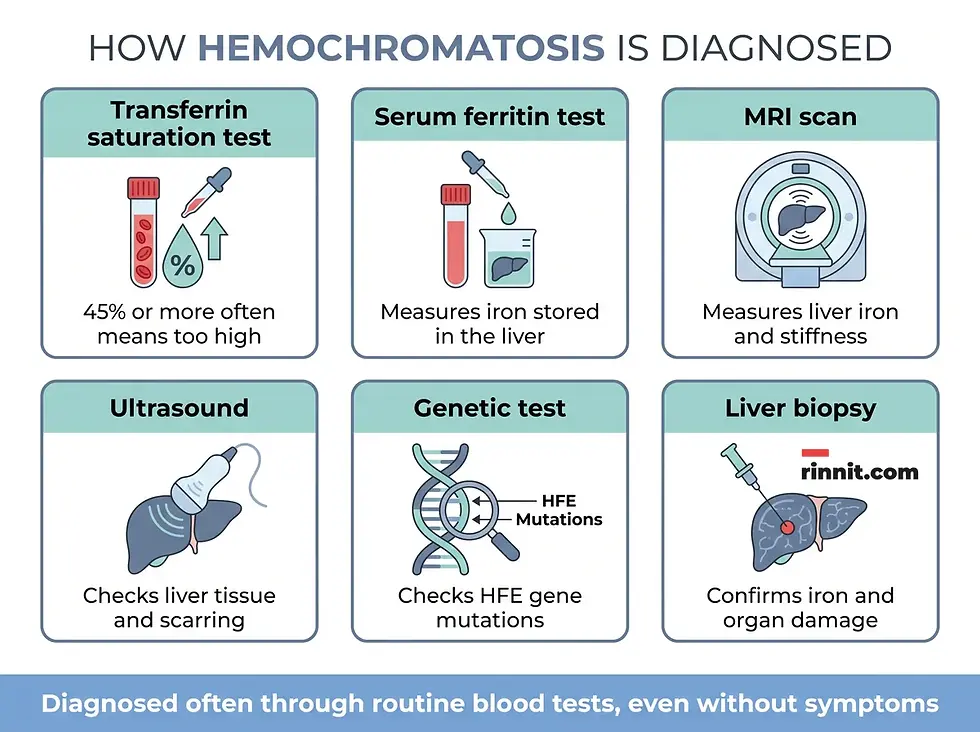
How hemochromatosis is diagnosed — often through routine blood tests, even without symptoms.
Treatment: Lowering Iron Safely
There is no cure for hemochromatosis. But treatments, which are the same as other iron overload treatments, can help manage the condition and stop it from causing more harm [2]:
Blood removal (therapeutic phlebotomy): removing blood on a regular basis lowers iron levels because much of the body's iron is contained in red blood cells.
Chelation medicine: removes extra iron from the body, but only if phlebotomy is not an option.
Dietary changes: reduce the risk of complications but do not replace phlebotomy.
Blood removal: therapeutic phlebotomy
Medical professionals can treat hemochromatosis safely and effectively by removing blood from the body on a regular basis. The process, called therapeutic phlebotomy, is similar to blood donation. The goal is to lower iron levels, and the amount of blood removed and how often depend on age, overall health, and the severity of iron overload [2].
Initial treatment: around a pint (about 470 milliliters) of blood may be taken once or twice a week, usually in a hospital or medical professional's office. You lean back in a chair while a needle is placed into a vein in the arm, and the blood flows into a blood bag.
Maintenance treatment: once iron levels go down, blood can be removed less often, typically every 2 to 4 months. Some people may need it more or less often, depending on how quickly iron builds up; some may maintain typical iron levels without having any blood taken.
Side effects are usually mild. They mainly include symptoms that last a short time after phlebotomy, such as feeling dizzy or like you might faint, nausea, vomiting, sweating, rapid breathing, or low blood pressure. You may also have bruising where the needle is placed in your arm [2].
Donating blood is not a replacement for therapeutic phlebotomy, because your healthcare professional needs to test your iron levels and adjust phlebotomy treatments as needed [2].
Treating hemochromatosis can help relieve symptoms of tiredness, heart changes, and skin darkening, and can help prevent serious complications such as liver disease, heart disease, and diabetes. If you already have one of these conditions, phlebotomy may slow the progression of the disease. Phlebotomy cannot reverse joint pain, but it can slow the progression. For someone with cirrhosis, a healthcare professional may recommend occasional screening for liver cancer, usually with an abdominal ultrasound and CT scan [2].
Chelation for those who cannot undergo blood removal
Phlebotomy may not be an option for someone who has certain conditions, such as some anemias or heart complications. Instead, a healthcare professional may suggest a medicine such as deferoxamine (Desferal) or deferasirox (Exjade, Jadenu) to remove excess iron. The medicine binds excess iron, allowing the body to get rid of it through urine or stool in a process called chelation. Chelation medicines can be injected or taken as a pill. Chelation is not commonly used in hemochromatosis [2].
Dietary changes
In addition to therapeutic blood removal, lifestyle changes may further reduce the risk of complications from hemochromatosis [2]:
Do not take iron supplements or multivitamins containing iron. These can increase iron levels even more.
Do not take vitamin C supplements. Vitamin C increases absorption of iron. There is usually no need to restrict vitamin C in your diet.
Do not drink alcohol. Alcohol increases the risk of liver damage. If you have liver disease, do not drink any alcohol.
Do not eat raw fish and shellfish. People with hemochromatosis are at risk of infections, particularly from certain bacteria in raw fish and shellfish.
Other foods with iron usually are OK, and additional diet changes generally are not needed for people receiving blood removal treatment. Dietary changes cannot replace phlebotomy — phlebotomy is critical to remove the excess iron from the blood [2].
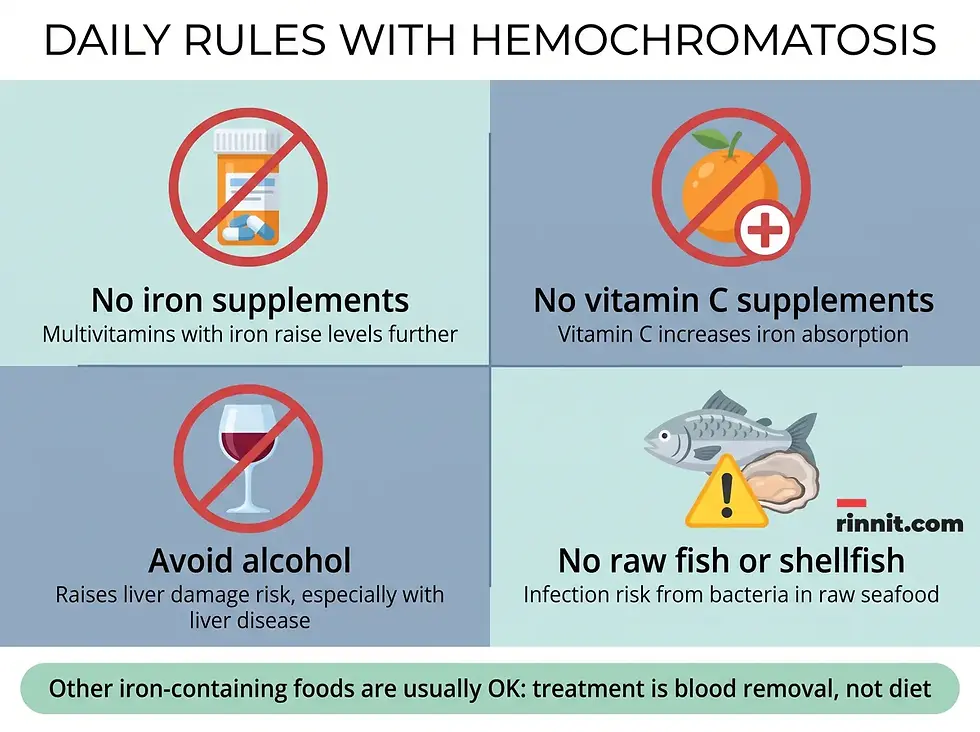
Daily rules with hemochromatosis. Other iron-containing foods are usually OK: treatment is blood removal, not diet.
Preparing for Your Appointment
Make an appointment with someone on your primary healthcare team if you have any symptoms that worry you. You may be referred to a specialist in digestive diseases (a gastroenterologist) or to another specialist, depending on your symptoms [2].
What you can do
Be aware of any pre-appointment restrictions. Ask if there is anything you need to do in advance, such as restrict your diet.
Write down any symptoms you are experiencing, including any that may seem unrelated to the reason you scheduled the appointment.
Write down key personal information, including any major stresses or recent life changes. Ask family members whether there is liver disease in your family.
Make a list of all medicines, vitamins, and supplements you are taking.
Take a family member or friend along to help you remember what is discussed.
Write down questions to ask during the appointment.
Questions to ask your healthcare team
What is the most likely cause of my symptoms?
What kinds of tests do I need?
Is my condition temporary, or will I always have it?
What treatments are available, and what do you suggest for me?
I have other health conditions. How can I best manage these together?
Are there any restrictions I need to follow?
Are there any brochures or other printed material I can take with me, and what websites do you recommend?
What your doctor may ask you
When did your symptoms start?
Have your symptoms been continuous, or do they come and go?
How severe are your symptoms?
Does anything seem to improve your symptoms? What appears to make them worse?
Does anyone in your family have hemochromatosis?
How many alcoholic beverages do you drink in a week?
Are you taking iron supplements or vitamin C?
Do you have a history of viral hepatitis, such as hepatitis C?
Have you had blood transfusions before?
Bottom Line
Hemochromatosis is one of the most common iron overload diseases, yet it often hides for decades because early symptoms like tiredness and joint pain are so common. The condition is inherited, starts at birth, and usually does not cause symptoms until after age 40 in men or after menopause in women. Left untreated, stored iron can damage the liver, pancreas, and heart and lead to cirrhosis, diabetes, and heart failure.
The practical takeaway is simple: if you have unexplained fatigue, joint pain, belly pain, or a family history of hemochromatosis, ask your healthcare team about iron blood tests and genetic testing. Treatment is straightforward — regular blood removal safely lowers iron levels, can relieve symptoms, and can help prevent serious organ damage before it starts.
Your next step: schedule an appointment with your primary healthcare team if you have symptoms that worry you or a close relative with hemochromatosis, and bring the questions from this guide.
Frequently Asked Questions
What is hemochromatosis?
Hemochromatosis is a genetic iron overload disease that causes the intestines to absorb too much iron from food. The excess iron is stored in the liver, heart, and pancreas, where it can damage organs and lead to liver disease, heart conditions, and diabetes.
What causes hemochromatosis?
Most often, a mutation in the HFE gene (commonly C282Y or H63D) passed down from both parents. Mutations in the HJV, HAMP, or TFR2 genes can cause juvenile hemochromatosis. Non-genetic iron overload can result from liver disease, alcohol, or too many blood transfusions.
Who is most at risk of hemochromatosis?
People with two copies of an altered HFE gene, a parent or sibling with hemochromatosis, or Northern European descent. Males develop symptoms earlier than females, who lose iron through menstruation and pregnancy until menopause.
When do hemochromatosis symptoms usually appear?
Most people have no symptoms until later in life, even though the condition is present at birth. For men, symptoms usually start after age 40. Women typically develop symptoms after menopause or after age 60.
What are the first symptoms of hemochromatosis?
Early signs often overlap with common conditions: weakness, tiredness, joint pain, and belly pain. Males may notice loss of sex drive or erectile dysfunction; females may notice missing menstrual periods.
What is "bronze diabetes"?
A term sometimes used when a person has both type 2 diabetes and a bronze skin color. In hemochromatosis, excess iron damages the pancreas (which can lead to diabetes) and deposits in skin cells (causing bronze or gray skin).
How is hemochromatosis diagnosed?
Through blood tests: serum transferrin saturation (45% or more often is considered too high) and serum ferritin (often considered high above 200–300 mcg/L in males and 150–200 mcg/L in females). MRI, ultrasound, genetic testing, and sometimes liver biopsy confirm the diagnosis and check for organ damage.
Is hemochromatosis curable?
There is no cure, but regular therapeutic phlebotomy (blood removal) safely lowers iron levels, can relieve symptoms, and can help prevent liver disease, heart disease, and diabetes. Phlebotomy can slow but not reverse joint pain.
What foods should I avoid with hemochromatosis?
Do not take iron supplements or multivitamins with iron, or vitamin C supplements, and do not drink alcohol (especially with liver disease). Do not eat raw fish and shellfish because of infection risk. Other iron-containing foods are usually OK.
Should my family be tested if I have hemochromatosis?
Yes. Genetic testing is recommended for all parents, siblings, and children of anyone diagnosed. If a gene change is found in only one parent, the children do not need testing.
Related Reading
TIBC Test (Total Iron-Binding Capacity): Normal Range and What Results Mean explains the blood test that shows how much iron your blood can carry.
Learn more in our guide to ALT Blood Test: What It Measures, Normal Range and What High Levels Mean.
Iron Blood Tests: Types, What Results Mean and How to Prepare explains the blood tests used to measure iron levels and stores.
Liver Function Tests (LFTs): What They Measure, Normal Ranges and Results explains the blood tests used to check liver health in this condition.
Transferrin Saturation (TSAT) Test: Normal Range and What Results Mean explains the iron test that helps detect iron deficiency and iron overload.
Ferritin Test: Normal Ferritin Levels and What Low or High Results Mean explains the blood test that measures your stored iron, normal ferritin levels and what low or high results mean.
References
Mayo Clinic Staff. Hemochromatosis - Symptoms and causes. Mayo Clinic. February 9, 2026. https://www.mayoclinic.org/diseases-conditions/hemochromatosis/symptoms-causes/syc-20351443
Mayo Clinic Staff. Hemochromatosis - Diagnosis and treatment. Mayo Clinic. February 9, 2026. https://www.mayoclinic.org/diseases-conditions/hemochromatosis/diagnosis-treatment/drc-20351448
Deugnier Y, Morcet J, Lainé F, et al. Reduced phenotypic expression in genetic hemochromatosis with time: role of exposure to non-genetic modifiers. Journal of Hepatology. 2018;70(1):118-125. PMID 30244162. https://doi.org/10.1016/j.jhep.2018.09.009
Buzzetti E, Kalafateli M, Thorburn D, et al. Interventions for hereditary haemochromatosis: an attempted network meta-analysis. Cochrane Database of Systematic Reviews. 2017;3(3):CD011647. PMID 28273330. https://doi.org/10.1002/14651858.CD011647.pub2
Schmitt B, Golub RM, Green R. Screening primary care patients for hereditary hemochromatosis with transferrin saturation and serum ferritin level: systematic review for the American College of Physicians. Annals of Internal Medicine. 2005;143(7):522-536. PMID 16204165. https://doi.org/10.7326/0003-4819-143-7-200510040-00011
Medical disclaimer
This article is for informational purposes only and is not a substitute for professional medical advice, diagnosis, or treatment. The clinical information in this guide reflects source material last reviewed in February 2026.



Comments