TIBC Test (Total Iron-Binding Capacity): Normal Range and What Results Mean

Updated: 3 days ago
Written and medically reviewed by Dr. Baraa Alnahhal, MD · Last reviewed: November 2026 · How we review
Quick Answer
A TIBC (total iron-binding capacity) test is a blood test that shows how well the blood can carry iron. A typical normal range is 240 to 450 mcg/dL. It's usually ordered with serum iron and ferritin to check for iron-deficiency anemia or iron overload. You'll usually need to fast and skip iron supplements for 12 hours beforehand.
What the research says
Ferritin is the strongest single test for iron deficiency: an overview of 55 studies that compared blood tests with bone marrow findings found serum ferritin was by far the most powerful test for iron-deficiency anemia (area under the curve 0.95), better than other iron measures; results differed in people with inflammatory, liver or cancer-related disease (Guyatt GH et al., J Gen Intern Med, 1992) [2]
Iron tests flag inherited iron overload: in the HEIRS screening study of a racially diverse population, most people with two copies of the C282Y hemochromatosis gene had raised ferritin and transferrin saturation, a measure calculated from serum iron and TIBC (Adams PC et al., N Engl J Med, 2005) [3]
Key takeaways
TIBC shows how much iron your blood could carry.
It mostly reflects transferrin, the main iron-transport protein.
A typical normal range is 240 to 450 mcg/dL.
High TIBC with low ferritin suggests iron-deficiency anemia.
Low TIBC with high iron suggests iron overload such as hemochromatosis.
What is a TIBC test?
Iron travels through your blood attached to transferrin. TIBC measures how much iron all that transferrin could hold if it were full. When your body is short on iron, it makes more transferrin, so TIBC goes up. When you have too much iron or certain chronic illnesses, TIBC tends to go down. TIBC is part of iron blood tests and is used to calculate transferrin saturation. Sources: [1]
Normal ranges

Ranges can differ slightly between labs.
Test | What it measures | Typical normal range |
TIBC | How much iron transferrin can carry | 240–450 mcg/dL |
Serum iron | Iron in your blood right now | Varies by lab, age and sex |
Your body's iron stores | Varies by lab and sex | |
Transferrin saturation | How full transferrin is | Varies by lab |
About 1 in 20 healthy people have results just outside the reference range. Sources: [1]
How to prepare
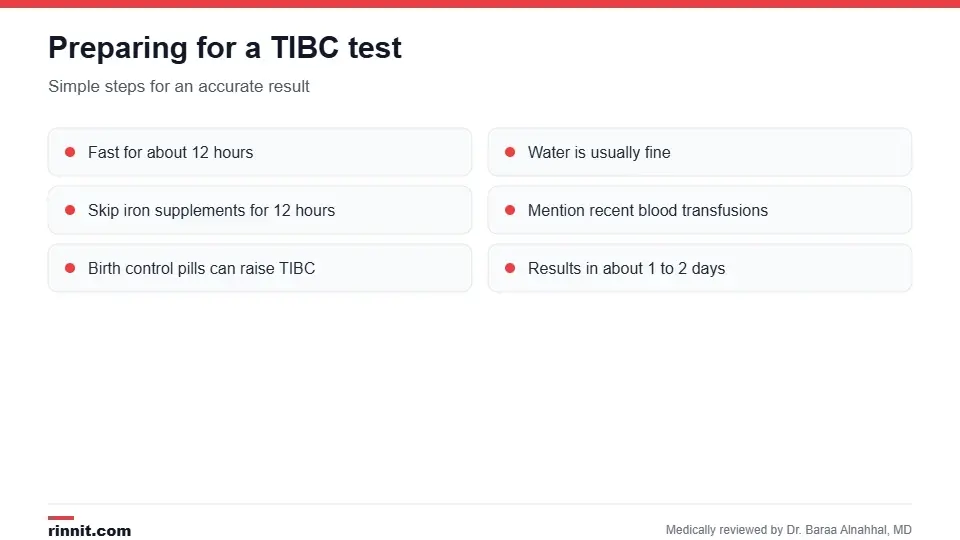
Fasting and skipping iron help give an accurate result.
Don't eat or drink anything except water for about 12 hours before the test.
Don't take iron supplements for 12 hours.
Tell your provider about recent blood transfusions and medicines, including birth control pills, which can raise TIBC, and chloramphenicol or fluoride, which can lower it.
The blood draw from a vein takes only a few minutes. Sources: [1]
Understanding results
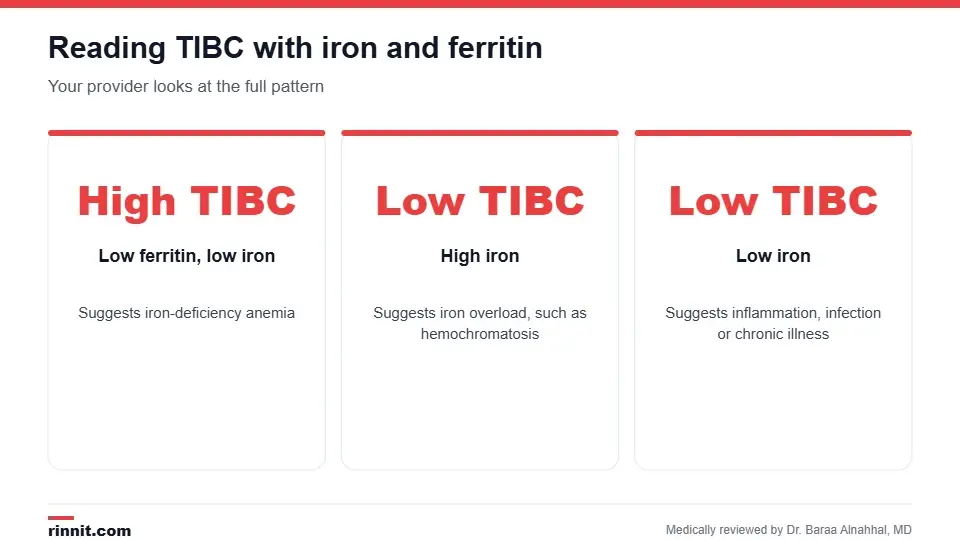
TIBC is interpreted together with iron and ferritin.
Pattern | What it may suggest |
High TIBC, low ferritin, low iron | Iron-deficiency anemia |
Low TIBC, high iron | Iron overload, such as hemochromatosis |
Low TIBC, low iron | Anemia of inflammation, infection, cirrhosis, malnutrition or nephrotic syndrome |
A low TIBC with low iron often points to anemia of chronic disease, where inflammation traps iron in storage. Your provider looks at the full pattern rather than one number. Sources: [1, 2, 3]
Conclusion
TIBC is a simple blood test that helps explain your iron status. Paired with serum iron and ferritin, it helps your provider tell iron deficiency from iron overload or inflammation-related anemia.
Keep learning: read about the ferritin test and hemochromatosis.
Frequently asked questions
What does TIBC stand for?
Total iron-binding capacity.
What is a normal TIBC level?
Usually 240 to 450 mcg/dL.
What does high TIBC mean?
Often iron deficiency, especially with low ferritin.
What does low TIBC mean?
Iron overload, inflammation, liver disease, malnutrition or protein loss.
Do I need to fast for a TIBC test?
Yes, usually for about 12 hours.
Should I stop iron pills before the test?
Yes, for about 12 hours or as instructed.
Is TIBC the same as transferrin?
Not exactly, but TIBC mainly reflects transferrin levels.
Which tests are ordered with TIBC?
Usually serum iron, ferritin and transferrin saturation.
Can birth control pills affect TIBC?
Yes, they can raise it.
How long do results take?
About 1 to 2 days.
Related Reading
Iron Blood Tests: Types, What Results Mean and How to Prepare the full set of tests used to check iron status.
Ferritin Test: Normal Ferritin Levels and What Low or High Results Mean the best single test for iron stores.
Transferrin Saturation (TSAT) Test: Normal Range and What Results Mean a value calculated from iron and TIBC.
Iron-Deficiency Anemia: Causes, Symptoms, and Recovery the most common reason for a high TIBC.
Hemochromatosis: The Iron Overload Disease That Hides for Decades an inherited cause of iron overload.
References
Cleveland Clinic. TIBC (Total Iron-Binding Capacity) Test: What It Is & Results. Cleveland Clinic. Last updated May 11, 2023. https://my.clevelandclinic.org/health/diagnostics/24979-total-iron-binding-capacity-tibc
Guyatt GH, Oxman AD, Ali M, et al. Laboratory diagnosis of iron-deficiency anemia: an overview. J Gen Intern Med. 1992;7(2):145-153. PMID 1487761. https://doi.org/10.1007/BF02598003
Adams PC, Reboussin DM, Barton JC, et al. Hemochromatosis and iron-overload screening in a racially diverse population. N Engl J Med. 2005;352(17):1769-1778. PMID 15858186. https://doi.org/10.1056/NEJMoa041534
Medical disclaimer
This article is for general education only and does not replace advice from a qualified healthcare professional. Talk to your doctor about your own diagnosis and treatment, and seek emergency care right away for severe or sudden symptoms.



Comments