Transferrin Saturation (TSAT) Test: Normal Range and What Results Mean

Updated: 2 days ago
Written and medically reviewed by Dr. Baraa Alnahhal, MD · Last reviewed: November 2026 · How we review
Quick Answer: What is a transferrin saturation test?
A transferrin saturation (TSAT) test is a blood test that shows what percentage of transferrin, the protein that carries iron in the blood, is holding iron. It's calculated from serum iron and total iron-binding capacity (TIBC). A normal result is 20% to 50%. A low TSAT may point to iron deficiency, and a high TSAT to iron overload. [1]
What the research says
TSAT helps find people with inherited iron overload. In screening of 99,711 primary care patients, 299 had two copies of the main hemochromatosis gene variant (C282Y), and most of them had raised serum ferritin and transferrin saturation. (Adams et al., The New England Journal of Medicine, 2005) [2]
Low TSAT with low iron stores predicted worse heart failure outcomes. Among 2,356 people with worsening heart failure, 61.6% were iron deficient (TSAT below 20%), and those with low iron stores had a 47% higher risk of death or heart failure hospitalization. (Grote Beverborg et al., JAMA Cardiology, 2019) [3]
Key takeaways
TSAT shows how much of your transferrin is carrying iron, as a percentage. [1]
It is calculated as serum iron divided by TIBC, multiplied by 100. [1]
A normal TSAT is generally 20% to 50%, though labs vary slightly. [1]
Low results may mean iron deficiency; high results may mean iron overload or a liver condition. [1]
Providers always read TSAT alongside other iron tests, such as ferritin. [1]
What is transferrin saturation?
Iron from food enters your blood and attaches to transferrin, a protein that carries it to places such as your bone marrow and muscles, where cells use it. Transferrin saturation tells you what percentage of that transferrin is loaded with iron. [1]
Providers often order TSAT with other iron blood tests to diagnose iron-deficiency anemia or too much iron in the body, and it can also help evaluate liver problems. Other names include transferrin iron saturation and percent transferrin saturation. [1]
How is transferrin saturation calculated?

TSAT is calculated from two other iron tests.
TSAT is calculated from two other iron tests: [1]
TSAT (%) = serum iron ÷ total iron-binding capacity (TIBC) × 100
TIBC reflects how much iron your blood can carry. Because TSAT depends on these results, serum iron, TIBC and often ferritin are usually ordered at the same time. [1]
Iron test | What it measures |
Serum iron | The amount of iron in your blood |
TIBC | How much iron your blood can carry |
Ferritin | Your body's stored iron |
Transferrin saturation | The percentage of transferrin carrying iron |
Sources: [1]
How do you prepare for a TSAT test?
Usually no preparation is needed, but some providers ask you not to eat or drink on the morning of the test. Follow the instructions you are given. [1]
What happens during the test?
A provider draws blood from a vein in your arm and sends it to a lab. The visit takes a few minutes, and you can go home right away. [1]
Are there risks?
The only risks are those of any blood draw: soreness or pain at the needle site, bruising, and feeling dizzy or lightheaded. These are usually mild and short-lived. [1]
What is a normal transferrin saturation?
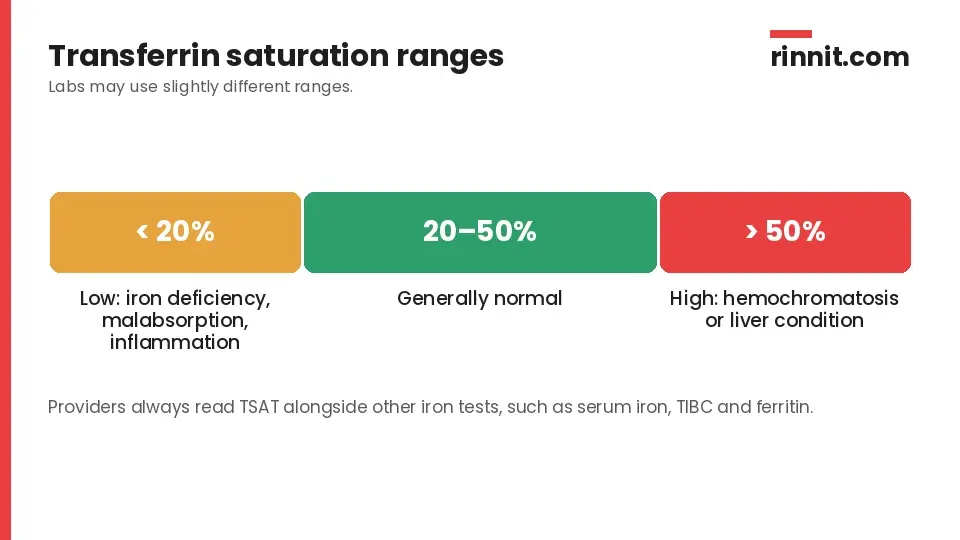
A normal TSAT is generally 20% to 50%.
Results usually take a few days and are reported as a percentage with a reference range. A normal TSAT is generally 20% to 50%, although some labs use slightly different ranges. [1]
TSAT result | What it may suggest |
Below 20% (low) | Iron-deficiency anemia, poor iron absorption (malabsorption) or chronic inflammation |
20% to 50% | Generally normal |
Above 50% (high) | Hemochromatosis (iron overload) or a liver condition |
Sources: [1]
What happens if your TSAT is abnormal?

Most iron problems can be managed or treated.
If it is low, your provider may order tests to confirm iron deficiency, look for other causes of low iron, recommend an iron supplement and recheck your iron levels. [1]
If it is high, your provider will look for the cause, such as certain genetic diseases, taking in too much iron or liver problems. Treatment may follow, with iron levels rechecked after several months. [1]
One result outside the normal range does not necessarily mean you have a health problem, because iron levels vary for many reasons. Most conditions involving too little or too much iron can be managed or treated. [1]
Conclusion
A transferrin saturation test is a simple blood test that shows how well your blood is carrying iron. Read together with serum iron, TIBC and ferritin, it helps your provider tell iron deficiency from iron overload.
If your result is outside the normal range, ask your provider which follow-up tests or treatments fit your situation.
Keep learning: Read our guide to iron blood tests or learn how hepcidin regulates iron. For more background, see the MedlinePlus page on iron tests.
FAQ
What is a transferrin saturation test?
A blood test showing what percentage of transferrin, your blood's iron-carrying protein, is holding iron. [1]
What is a normal transferrin saturation?
Generally 20% to 50%, though labs may vary slightly. [1]
How is transferrin saturation calculated?
Serum iron divided by total iron-binding capacity (TIBC), multiplied by 100. [1]
What does low transferrin saturation mean?
It may point to iron-deficiency anemia, malabsorption or chronic inflammation. [1]
What does high transferrin saturation mean?
It may point to iron overload such as hemochromatosis, or a liver condition. [1]
Do I need to fast for a TSAT test?
Usually not, but some providers ask you not to eat or drink on the morning of the test. [1]
What tests are done with TSAT?
Usually serum iron, TIBC and ferritin. [1]
How long do TSAT results take?
Usually a few days. [1]
Is one abnormal TSAT result a problem?
Not necessarily; iron levels vary for many reasons, and providers read TSAT with other iron tests. [1]
Are there risks to the test?
Only minor blood-draw risks, such as soreness, bruising or brief dizziness. [1]
Related Reading
TIBC Test (Total Iron-Binding Capacity): Normal Range and What Results Mean explains the blood test that shows how much iron your blood can carry.
Hemochromatosis: The Iron Overload Disease That Hides for Decades explains the iron overload condition a high TSAT can signal.
Iron Deficiency Anemia: Symptoms, Causes, Treatment & Complete Guide covers the most common cause of a low TSAT.
Anemia of Chronic Disease: Why Inflammation Traps Your Iron, Who's at Risk, and How Treatment Works describes how inflammation lowers TSAT.
Cirrhosis of the Liver: What It Is, How Permanent Scarring Damages Your Liver, and What Treatment Involves covers a liver condition linked to abnormal iron results.
References
Cleveland Clinic. Transferrin Saturation: What It Is and Normal Range. Cleveland Clinic. Last updated August 25, 2026. https://my.clevelandclinic.org/health/diagnostics/transferrin-saturation
Adams PC, Reboussin DM, Barton JC, et al. Hemochromatosis and iron-overload screening in a racially diverse population. N Engl J Med. 2005;352(17):1769-1778. PMID 15858186. https://doi.org/10.1056/NEJMoa041534
Grote Beverborg N, van der Wal HH, Klip IT, et al. Differences in Clinical Profile and Outcomes of Low Iron Storage vs Defective Iron Utilization in Patients With Heart Failure: Results From the DEFINE-HF and BIOSTAT-CHF Studies. JAMA Cardiol. 2019;4(7):696-701. PMID 31188392. https://doi.org/10.1001/jamacardio.2019.1739
Medical disclaimer
This article is for general education only and does not replace advice from a qualified healthcare professional. Talk to your doctor about your own diagnosis and treatment, and seek emergency care right away for severe or sudden symptoms.



Comments