Iron Blood Tests: Types, What Results Mean and How to Prepare

Updated: 5 days ago
Written and medically reviewed by Dr. Baraa Alnahhal, MD · Last reviewed: November 2026 · How we review
Quick Answer: What is an iron blood test?
An iron blood test measures the iron in your blood. Depending on the test, it shows how much iron is circulating right now, how much is stored, how iron moves through your body and how much your blood can carry. Low results can point to iron deficiency, and high results can point to iron overload. [1]
What the research says
Ferritin is a strong test for low iron stores. A Cochrane review found that, in adults seeking medical care, a ferritin cutoff of 30 µg/L had 79% sensitivity and 98% specificity for iron deficiency (9 studies, 512 people). (Garcia-Casal et al., Cochrane Database of Systematic Reviews, 2021) [2]
Serum iron alone can mislead. In 14,187 children tested in general practice, children with low ferritin were less likely to be diagnosed if serum iron was normal, while children with normal stores had higher odds of being diagnosed if serum iron was low (adjusted odds ratio 2.59). (Sezgin et al., BMJ Open, 2021) [3]
Key takeaways
Iron helps your body make hemoglobin, which carries oxygen to your cells and organs. [1]
There are five main iron tests: serum iron, transferrin, TIBC, transferrin saturation and ferritin. [1]
Some providers ask you to fast for 12 hours before the test; others don't. [1]
The blood draw takes about five minutes, and risks are minor bruising or soreness. [1]
High results may suggest iron overload; low results may suggest iron deficiency. [1]
Why does iron matter?
Iron is an essential mineral that your body uses to make hemoglobin, the protein in red blood cells that carries oxygen to your cells and organs. You get iron from food and supplements. Iron blood tests show not just how much iron is in your blood, but also how much is stored and how well your body is moving it around. [1]
Types of iron blood tests
Your provider may order one test or several together as an iron panel. [1]
Test | What it measures |
Serum iron | The amount of iron in your blood right now |
Transferrin | Transferrin, the protein that moves iron through your body |
Total iron-binding capacity (TIBC) | How much iron your blood can carry |
Transferrin saturation | The percentage of transferrin that is carrying iron |
Ferritin | Your iron stores, or reserves |
Sources: [1]

An iron test is not part of a standard complete blood count (CBC). A CBC can still offer clues, because low iron lowers hemoglobin, which is on the CBC. [1]
What do iron blood tests help diagnose?
Your provider may recommend an iron test if you have symptoms of too much or too little iron. The tests can help diagnose: [1]
Iron deficiency anemia
Iron overload (hemochromatosis)
Anemia of chronic disease
Liver disease
Thalassemias
They are also used to check whether treatment for low or high iron is working. [1]
How do you prepare for an iron blood test?
Some providers ask you not to eat or drink for 12 hours before an iron test, and others don't require fasting. Check a few days ahead so you can plan. If you take daily medicines, ask whether to take them on the day of the test. [1]
What happens during the test?
An iron blood test is like any other blood draw. A phlebotomist finds a vein in your inner elbow, cleans the skin, inserts a small needle and collects blood into a tube. After the needle comes out, a bandage goes on. The whole process takes about five minutes, and you can return to normal activities right away. [1]
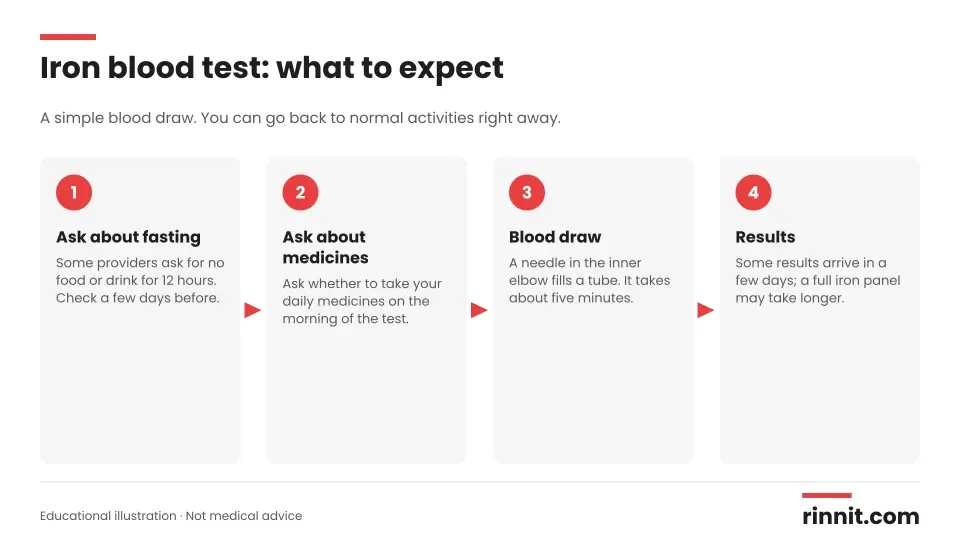
The risks are the same as any blood draw, such as mild bruising or soreness where the needle went in. [1]
What do iron blood test results mean?
Results depend on which test you had. A reference range usually appears next to your numbers. A result above the range is often flagged "H" for high, and a result below it "L" for low. Normal results are not flagged. [1]
In general, high iron results may suggest iron overload, and low results may suggest iron deficiency. If your results are outside the range, your provider will look for the cause and recommend treatment to bring your levels back to a typical range. [1]
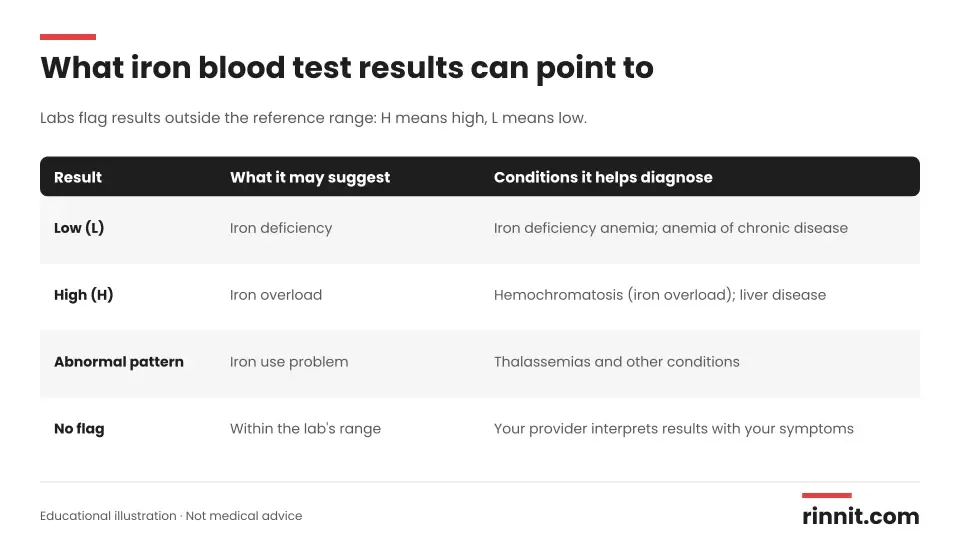
Labs can report results differently, so let your provider interpret them. Some results come back within a few days, while a full iron panel may take a little longer. [1]
Conclusion
Iron blood tests are a simple way to see how your body uses and stores iron. One test rarely tells the whole story, which is why providers often order a panel and read the numbers together with your symptoms. [1]
If you are tired, short of breath or pale, or if iron overload runs in your family, ask your provider whether iron testing makes sense, and check ahead whether you need to fast.
Keep learning: Read our guide to iron deficiency anemia or learn about hemochromatosis. For more background, see this StatPearls chapter on iron-binding capacity.
FAQ
What is an iron blood test?
It is a blood test that measures the iron in your blood, how much is stored and how iron moves through your body. [1]
What are the types of iron blood tests?
The main types are serum iron, transferrin, total iron-binding capacity (TIBC), transferrin saturation and ferritin. [1]
What does a ferritin test show?
Ferritin shows how much iron your body has stored in reserve. [1]
Do I need to fast for an iron blood test?
Some providers ask you to fast for 12 hours and others don't, so check a few days before your test. [1]
Is iron included in a complete blood count (CBC)?
No. A CBC doesn't measure iron, but low hemoglobin on a CBC can hint at low iron. [1]
What does a low iron result mean?
Low iron levels may mean iron deficiency, and your provider will look for the cause. [1]
What does a high iron result mean?
High iron levels may suggest iron overload, such as hemochromatosis. [1]
How long does an iron blood test take?
The blood draw takes about five minutes, and you can go back to your normal activities right away. [1]
How long do iron test results take?
Some results are ready in a few days, while a full iron panel may take a little longer. [1]
Are there risks to an iron blood test?
Risks are the same as any blood draw, such as mild bruising or soreness at the needle site. [1]
Related Reading
TIBC Test (Total Iron-Binding Capacity): Normal Range and What Results Mean explains the blood test that shows how much iron your blood can carry.
Iron Deficiency Anemia: Symptoms, Causes, Treatment & Complete Guide explains the most common condition iron blood tests help diagnose.
Hemochromatosis: The Iron Overload Disease That Hides for Decades covers iron overload, which shows up as high iron results.
Anemia of Chronic Disease: Why Inflammation Traps Your Iron, Who's at Risk, and How Treatment Works explains how inflammation changes iron results.
Thalassemia: Symptoms, Causes, Treatment & Complete Guide covers an inherited blood condition that iron tests help tell apart from iron deficiency.
References
Cleveland Clinic. Iron Blood Test: What It Is & Results. Cleveland Clinic. Last updated October 9, 2025. https://my.clevelandclinic.org/health/diagnostics/iron-blood-tests
Garcia-Casal MN, Pasricha SR, Martinez RX, et al. Serum or plasma ferritin concentration as an index of iron deficiency and overload. Cochrane Database Syst Rev. 2021;5:CD011817. PMID 34028001. https://doi.org/10.1002/14651858.CD011817.pub2
Sezgin G, Li L, Westbrook J, et al. Influence of serum iron test results on the diagnosis of iron deficiency in children: a retrospective observational study. BMJ Open. 2021;11(7):e046865. PMID 34226221. https://doi.org/10.1136/bmjopen-2020-046865
Medical disclaimer
This article is for general education only and does not replace advice from a qualified healthcare professional. Talk to your doctor about your own diagnosis and treatment, and seek emergency care right away for severe or sudden symptoms.



Comments