Ferritin Test: Normal Ferritin Levels and What Low or High Results Mean

Updated: 2 days ago
Written and medically reviewed by Dr. Baraa Alnahhal, MD · Last reviewed: November 2026 · How we review
Quick Answer: What is a ferritin test?
A ferritin test is a blood test that measures ferritin, the protein that stores iron. Low ferritin means iron stores are low, which can lead to iron-deficiency anemia; high ferritin can mean too much stored iron or inflammation. Typical ranges are 15 to 205 ng/mL for females and 30 to 566 ng/mL for males, but labs vary. [1]
What the research says
Ferritin is a strong test for iron deficiency. A Cochrane review found that in adults seeking medical care, a ferritin cutoff of 30 µg/L (the same as 30 ng/mL) correctly identified about 79% of people with iron deficiency and correctly ruled it out in 98% of those without it, though the evidence was low certainty. Ferritin rises with inflammation, which can hide low iron. (Garcia-Casal et al., Cochrane Database of Systematic Reviews, 2021) [2]
Iron shortage may start at higher ferritin levels than once thought. Using US national survey data on 2,569 young children and 7,498 non-pregnant women, researchers found signs of iron-starved red blood cell production began at ferritin levels of about 20 µg/L in children and 25 µg/L in women, higher than the older cutoffs of 12 and 15 µg/L. (Mei et al., The Lancet Haematology, 2021) [3]
Key takeaways
Ferritin is your body's iron storage protein; its level reflects how much iron you have saved up. [1]
Providers often order it when a complete blood count shows low hemoglobin or hematocrit. [1]
Low ferritin with low blood counts is called iron-deficiency anemia. [1]
High ferritin can come from hemochromatosis, inflammation, infection, chronic illness, some cancers or liver damage. [1]
You may be asked not to eat or drink before the test. [1]
What is ferritin?

Ferritin is a protein that stores iron. Think of it as your body's iron storage closet: it holds iron when you don't need it and releases it when you do. So ferritin levels reflect how much iron your body has in storage. Low levels mean you don't have much iron saved up, and high levels can mean you have too much iron or that there is inflammation. [1]
Why is a ferritin test done?
Providers usually order a ferritin test if a complete blood count (CBC) shows low hemoglobin or hematocrit. They may also order it if you're at risk of iron deficiency because of pregnancy, heavy menstrual bleeding or certain health conditions, or if you have symptoms of too little or too much iron. [1]
Signs of low ferritin and iron | Signs of high ferritin and iron |
Paler-than-usual skin | Fatigue or loss of energy |
Fatigue | Joint pain |
Weakness | Unexplained weight loss |
Dizziness | Stomach pain |
Shortness of breath | Low sex drive |
Fast heartbeat |
Sources: [1]
How does a ferritin test work?
A phlebotomist takes a sample of your blood and sends it to a lab, where a machine called an analyzer measures how much ferritin is in it. Your provider may ask you not to eat or drink before the test, so ask how to prepare. [1]
The blood draw usually takes less than five minutes: [1]
You sit in a chair while the provider finds a vein, usually on the inside of your arm at the elbow.
They clean and disinfect the area.
They insert a small needle into your vein, which may pinch a little.
A small amount of blood collects in a test tube.
They remove the needle and press a cotton ball or gauze on the spot.
They put a bandage on top, and you're done.
There's very little risk. You may have tenderness or a bruise where the needle went in, which usually gets better within a day or two. [1]
What are normal ferritin levels?
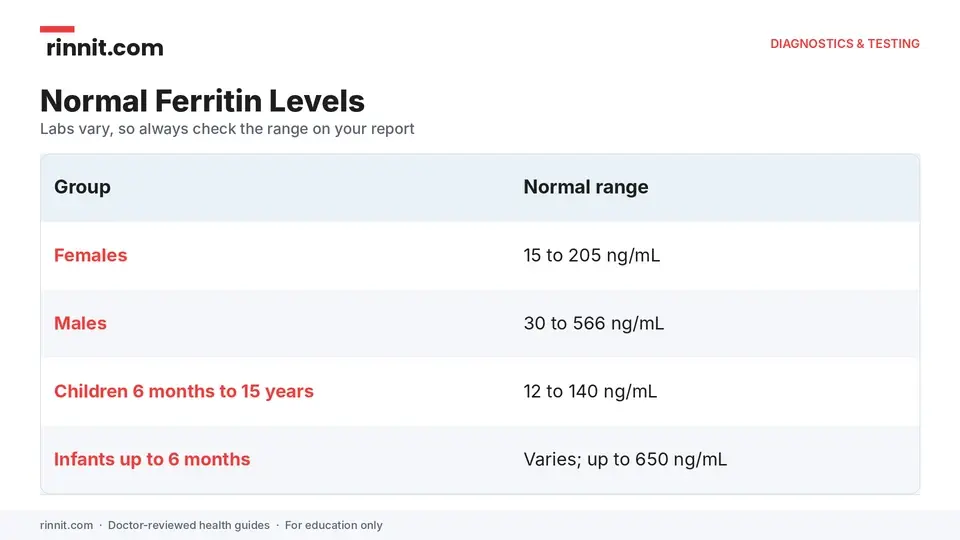
Labs may use different reference ranges, so check the normal range printed on your report. Typical ranges are: [1]
Group | Normal ferritin range |
Females | 15 to 205 ng/mL |
Males | 30 to 566 ng/mL |
Children 6 months to 15 years | 12 to 140 ng/mL |
Infants up to 6 months | Varies with exact age; can be up to 650 ng/mL |
Sources: [1]
You should get results within one or two days, though it can take a little longer. Your report usually lists the test name, your result, the lab's normal range and a flag if your result is high or low. [1]
What does low ferritin mean?
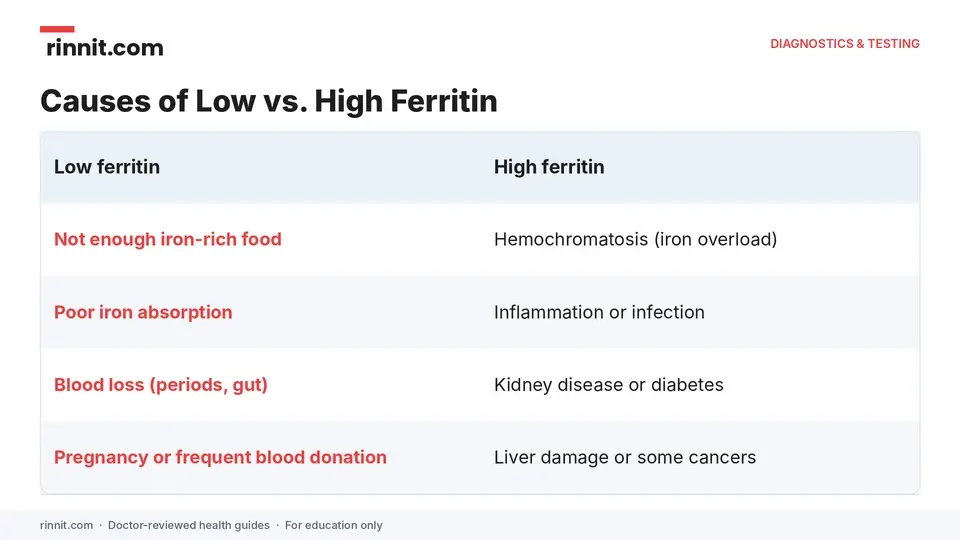
A low ferritin level together with low blood counts is called iron-deficiency anemia. Common causes include: [1]
Not eating enough iron-rich foods
Your body not absorbing enough iron from food
Losing too much blood, such as from your period or your digestive tract
Pregnancy
Giving blood too often
If your ferritin is low, your provider will likely order more iron blood tests, such as serum iron, total iron-binding capacity (TIBC) and transferrin saturation. [1]
What does high ferritin mean?
High ferritin can be caused by hemochromatosis, a condition that makes your body store too much iron. It can also come from inflammation, including autoimmune diseases or infections. Other causes include: [1]
Chronic illnesses such as kidney disease and diabetes
Cancer, especially of the blood or liver
Liver damage from alcohol use disorder, fatty liver disease or other causes
Should you worry about an abnormal ferritin level?
Not necessarily. Temporary medical conditions or a testing error can affect your result. If your level isn't normal, your provider will go over it with you and may order more blood tests to find out why. Most conditions that cause too little or too much iron can be treated with medicine and diet changes. [1]
Contact your provider as soon as possible if you have symptoms of low or high iron, or if you have questions about your results. [1]
Conclusion
A ferritin test is a simple blood test that shows how much iron your body has in storage. Low ferritin points to low iron reserves and possible iron-deficiency anemia, while high ferritin can mean iron overload or inflammation somewhere in the body.
An abnormal result is a starting point, not a diagnosis. Your provider will explain your number in context and order any follow-up tests you need.
Keep learning: Read our guide to iron-deficiency anemia or our explainer on iron blood tests. For more trusted, doctor-reviewed health guides, visit Rinnit.com.
FAQ
What is a ferritin test?
A blood test that measures ferritin, the protein that stores iron in your body.
What is a normal ferritin level?
Typically 15 to 205 ng/mL for females and 30 to 566 ng/mL for males, though labs vary.
What does low ferritin mean?
Your iron stores are low; with low blood counts it's called iron-deficiency anemia.
What causes low ferritin?
Low iron intake, poor absorption, blood loss, pregnancy or giving blood too often.
What does high ferritin mean?
It can mean iron overload, such as hemochromatosis, or inflammation, infection or other illness.
What are symptoms of low ferritin?
Pale skin, fatigue, weakness, dizziness, shortness of breath and a fast heartbeat.
What are symptoms of high ferritin?
Fatigue, joint pain, unexplained weight loss, stomach pain and low sex drive.
Do I need to fast for a ferritin test?
Your provider may ask you not to eat or drink beforehand, so check with them.
How long do ferritin results take?
Usually one to two days.
What tests are done after a low ferritin result?
Often serum iron, total iron-binding capacity and transferrin saturation.
Related Reading
TIBC Test (Total Iron-Binding Capacity): Normal Range and What Results Mean explains the blood test that shows how much iron your blood can carry.
Iron Deficiency Anemia: Symptoms, Causes, Treatment & Complete Guide explains the anemia that low ferritin and low blood counts point to.
Iron-Deficiency Anemia: Causes, Symptoms, and Recovery covers the causes of low iron and how iron levels are restored.
Hemochromatosis: The Iron Overload Disease That Hides for Decades explains the inherited iron overload disease that can raise ferritin.
Anemia of Chronic Disease: Why Inflammation Traps Your Iron, Who's at Risk, and How Treatment Works describes how inflammation affects iron and can push ferritin up.
Anemia During Pregnancy: What It Is, Why It Happens, and How Iron, Vitamins, and Treatment Protect You and Your Baby covers low iron in pregnancy, a common reason to check ferritin.
Fatty Liver Disease (MASLD): The Silent Liver Condition Linked to Weight, Diabetes, and Metabolic Health — Causes, Testing, and Treatment explains a liver condition that can raise ferritin levels.
References
Cleveland Clinic. Ferritin Test: Levels & Test Results. Cleveland Clinic. Last updated August 11, 2025. https://my.clevelandclinic.org/health/diagnostics/17820-ferritin-test
Garcia-Casal MN, Pasricha SR, Martinez RX, et al. Serum or plasma ferritin concentration as an index of iron deficiency and overload. Cochrane Database Syst Rev. 2021;5(5):CD011817. PMID 34028001. https://doi.org/10.1002/14651858.CD011817.pub2
Mei Z, Addo OY, Jefferds ME, et al. Physiologically based serum ferritin thresholds for iron deficiency in children and non-pregnant women: a US National Health and Nutrition Examination Surveys (NHANES) serial cross-sectional study. Lancet Haematol. 2021;8(8):e572-e582. PMID 34329578. https://doi.org/10.1016/S2352-3026(21)00168-X
Medical disclaimer
This article is for general education only and does not replace advice from a qualified healthcare professional. Talk to your doctor about your own diagnosis and treatment, and seek emergency care right away for severe or sudden symptoms.



Comments