Acetaminophen Level Test: Checking for Tylenol Overdose

Updated: 2 days ago
Written and medically reviewed by Dr. Baraa Alnahhal, MD · Last reviewed: November 2026 · How we review
Quick Answer
An acetaminophen level test is a blood test that measures how much acetaminophen (Tylenol) is in the blood. It's used to diagnose a suspected acetaminophen overdose and guide treatment. Too much acetaminophen can cause serious liver damage, sometimes before symptoms appear. The test is usually done about 4 hours after the dose, and treatment works best when started early.
What the research says
Early treatment protects the liver: in 2,540 people with acetaminophen overdose, liver injury occurred in 6.1% of those given acetylcysteine within 10 hours vs. 26.4% when it started 10 to 24 hours later (Smilkstein MJ et al., N Engl J Med, 1988) [2]
Timing is critical: in 662 overdose cases measured against the treatment nomogram, liver enzyme rises occurred in 7% treated within 10 hours, 29% at 10 to 16 hours and 62% at 16 to 24 hours (Rumack BH et al., Arch Intern Med, 1981) [3]
Key takeaways
The test measures the amount of acetaminophen in your blood.
It's used to diagnose and manage acetaminophen overdose.
It's usually done about 4 hours after the dose and repeated.
Levels are compared with the time since the dose to judge liver risk.
Early treatment with acetylcysteine prevents most liver damage.
Why it's done

Overdose symptoms may not appear for up to 24 hours.
Acetaminophen is in many over-the-counter and prescription products, so it's easy to take too much by accident. Symptoms of overdose may start about 2 hours after the dose or not for up to 24 hours, and early symptoms can be mild even when the liver is at risk. Sources: [1]
Belly pain.
Vomiting.
Excessive sweating.
Confusion or blurry vision.
Dark urine.
Yellow skin or eyes (jaundice). Sources: [1]
If you think someone has taken too much acetaminophen, get emergency care or contact Poison Control right away, even if they feel fine. Sources: [1]
How to prepare
No preparation is needed. Tell the care team when and how much acetaminophen was taken, if known, and whether it was taken all at once or over time. Sources: [1]
What happens during the test

Results usually come back within a few hours.
Your arm is cleaned, and a needle is placed in a vein.
Blood is collected in a tube; you may feel a pinch or sting.
The lab measures the acetaminophen level.
The test is often repeated about 4 to 6 hours later to see whether levels are rising or falling. Sources: [1]
Risks
The test is a common and safe blood draw. Some people feel faint or dizzy, and the site may be sore or bruised for a short time. Sources: [1]
What the results mean
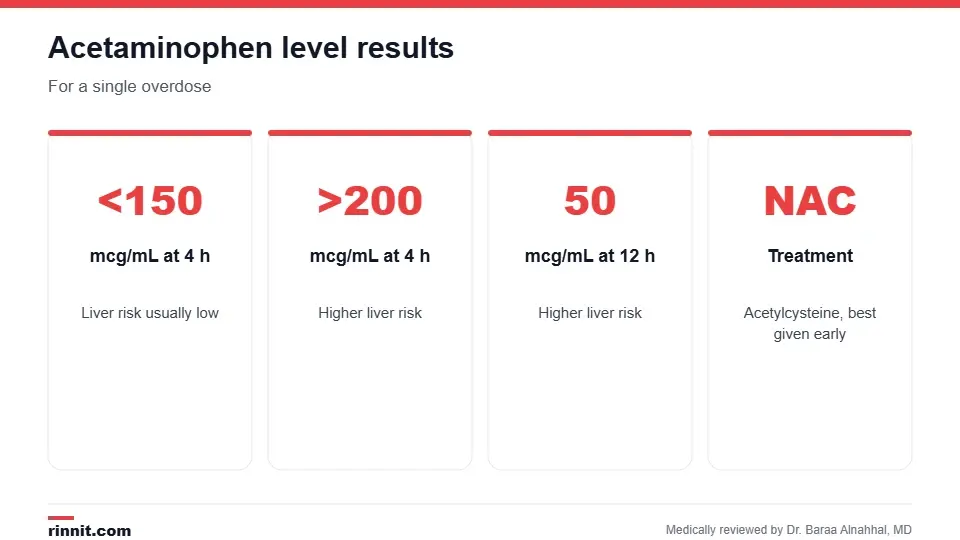
Values apply to a single overdose.
Level and timing | Liver damage risk |
Under 150 mcg/mL at 4 hours | Usually low |
Over 200 mcg/mL at 4 hours | Higher |
50 mcg/mL at 12 hours | Higher |
These values apply to a single overdose. After repeated doses over time, levels can be harder to interpret. High levels may need treatment with acetylcysteine, and liver function tests are often ordered too. Large studies show acetylcysteine prevents most liver injury when started within 10 hours of an overdose. In the U.S., acetylcysteine is usually started when the 4-hour level is 150 mcg/mL or higher, so a level between 150 and 200 mcg/mL still needs treatment. Sources: [1, 2, 3]
Conclusion
The acetaminophen level test is a key tool in treating a possible overdose. Comparing the level with the time since the dose helps doctors decide quickly who needs acetylcysteine to protect the liver.
Keep learning: read about acetaminophen overdose and liver function tests.
Frequently asked questions
What is an acetaminophen level test?
A blood test that measures the amount of acetaminophen in your blood.
Is acetaminophen the same as paracetamol?
Yes.
When is the test done?
Usually about 4 hours after the dose, then repeated.
What level is dangerous?
Over 200 mcg/mL at 4 hours suggests higher liver risk.
Can someone feel fine after an overdose?
Yes. Symptoms may not appear for up to 24 hours.
What is the treatment?
Acetylcysteine, which works best when started early.
Do I need to prepare?
No.
How fast are results?
Usually within a few hours.
Why are liver tests also done?
To check for liver damage.
What should I do if I suspect an overdose?
Get emergency care or call Poison Control right away.
Related Reading
Acetaminophen Overdose: Symptoms, Causes, Diagnosis, and Treatment (2026 Guide) the condition this test helps manage.
Liver Function Tests (LFTs): What They Measure, Normal Ranges and Results blood tests of liver health.
ALT Blood Test: What It Measures, Normal Range and What High Levels Mean a liver enzyme test.
Drug Test: Types, What It Detects, How It's Done and What Results Mean tests that screen for drugs.
Comprehensive Metabolic Panel (CMP): What It Tests, How to Prepare and What Results Mean a broad blood chemistry panel.
References
Cleveland Clinic. Acetaminophen Level Test: Purpose, Risks & Results. Cleveland Clinic. Last updated November 24, 2021. https://my.clevelandclinic.org/health/diagnostics/22157-acetaminophen-level-test
Smilkstein MJ, Knapp GL, Kulig KW, et al. Efficacy of oral N-acetylcysteine in the treatment of acetaminophen overdose: analysis of the national multicenter study (1976 to 1985). N Engl J Med. 1988;319(24):1557-1562. PMID 3059186. https://doi.org/10.1056/NEJM198812153192401
Rumack BH, Peterson RC, Koch GG, et al. Acetaminophen overdose: 662 cases with evaluation of oral acetylcysteine treatment. Arch Intern Med. 1981;141(3):380-385. PMID 7469629. https://doi.org/10.1001/archinte.141.3.380
Medical disclaimer
This article is for general education only and does not replace advice from a qualified healthcare professional. Talk to your doctor about your own diagnosis and treatment, and seek emergency care right away for severe or sudden symptoms.



Comments