Drug Test: Types, What It Detects, How It's Done and What Results Mean

Updated: 6 days ago
Written and medically reviewed by Dr. Baraa Alnahhal, MD · Last reviewed: November 2026 · How we review
Quick Answer: What is a drug test?
A drug test checks a sample of your urine, blood, hair, breath, saliva or sweat for legal or illegal drugs or their breakdown products (metabolites). Urine is the most common sample, and pre-employment screening is the most common reason. A first positive result is usually confirmed with a second, different test, because foods and medicines can cause false positives. [1]
What the research says
Quick on-site urine tests agree closely with lab confirmation, but not near the cutoff. Compared with gas chromatography-mass spectrometry, two point-of-care devices were 97.1% and 96.5% accurate on clinical samples, but only 82.1% and 90.1% accurate on samples spiked near the cutoff level. (Moody et al., Journal of Analytical Toxicology, 2006) [2]
Screening tests can miss some drugs entirely. In 498 patients prescribed benzodiazepines, a point-of-care urine immunoassay gave a false-negative result nearly 20% of the time, often missing lorazepam and clonazepam that mass spectrometry confirmed. (Mikel et al., Clinica Chimica Acta, 2012) [3]
Key takeaways
A drug test detects whether a drug or its metabolites are present in a sample. [1]
Urine testing is the most common; hair covers months, and sweat covers hours to weeks. [1]
A standard panel looks for amphetamines, cocaine, marijuana, opioids and PCP. [1]
A positive screen usually needs a confirmatory test. [1]
A single test cannot show how often or how heavily someone uses a substance. [1]
What is a drug test?
A drug test uses a biological sample to detect the presence or absence of a legal or illegal drug. "Drugs" include alcohol, tobacco, over-the-counter and prescription medicines and illegal substances. [1]
Your body breaks down each drug at its own rate, so the time window for detecting a drug varies widely from substance to substance. A single test cannot show how often or how intensely someone uses a substance, so it cannot tell casual use from a substance use disorder. [1]
Why would you need a drug test?
The most common use is in the workplace. Employers may test: [1]
Before hiring
Randomly or periodically during employment
When signs of drug use are seen at work
After an accident or incident at work
Drug tests are also used to diagnose, treat and monitor alcohol and substance use disorders, including in court-ordered or probation programs, where they help track treatment, abstinence and early relapse. [1]
Other uses include: [1]
Medical testing: to find the cause of symptoms or in emergencies when overdose or poisoning is suspected
Legal testing: for evidence of a crime, child abuse or endangerment cases, or driving under the influence
Prescription monitoring: to check levels of medicines with misuse potential, such as opioids for pain
Athletic testing: to screen athletes for performance-enhancing substances
What are the types of drug tests?
Drug tests differ by the sample they use. [1]
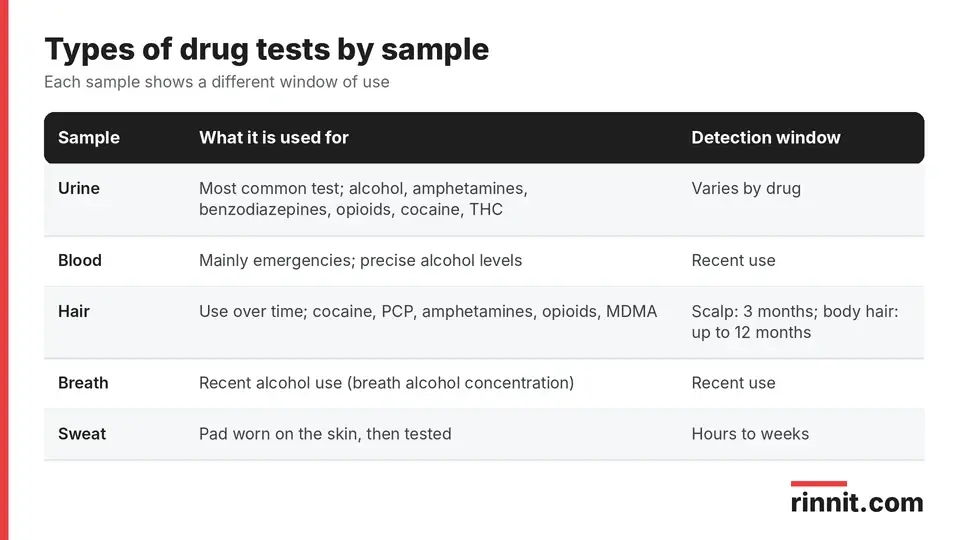
Each sample shows a different window of drug use.
Sample | Main use | Detection window |
Urine | The most common test; detects alcohol, amphetamines, benzodiazepines, opioids, cocaine and THC | Varies by drug |
Blood | Mainly emergencies; gives a precise alcohol level | Recent use |
Hair | Use over time; detects cocaine, PCP, amphetamines, opioids and MDMA | Scalp: 3 months; body hair: up to 12 months |
Breath | Recent alcohol use (breath alcohol concentration) | Recent use |
Sweat | An absorbent pad worn on the skin, then tested | Hours to weeks |
Sources: [1]
Breath alcohol readings are often used to estimate blood alcohol content, but they can overestimate or underestimate it. [1]
What does a drug test detect?
After a drug is absorbed, the liver and other organs break it down into metabolites, which leave the body mainly in urine. For amphetamines, the parent drug itself is detected in urine; for most other drugs, metabolites can be detected longer than the drug. [1]
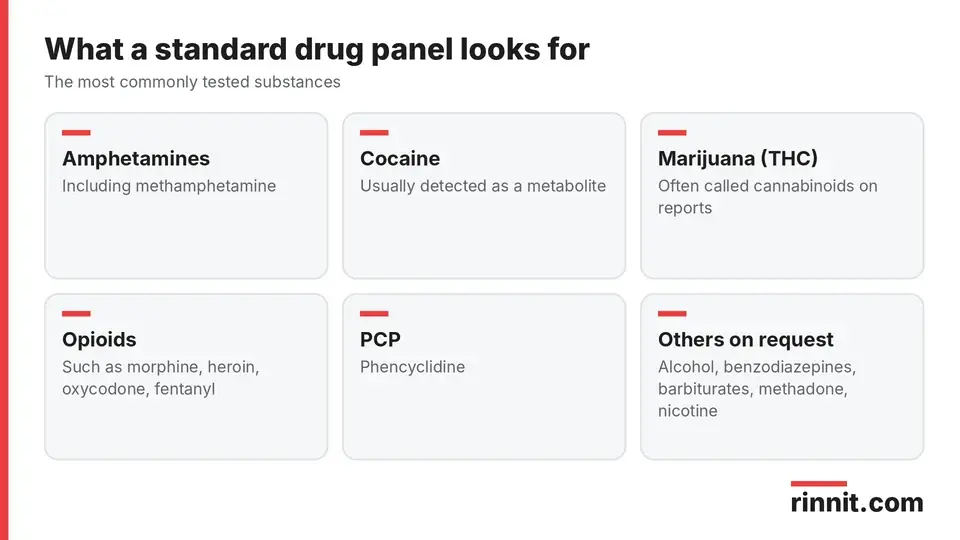
Most panels test several drugs from one sample.
A drug test may look for one drug, but most test for several from one sample. The most commonly tested drugs are amphetamines, cocaine, marijuana, opioids and PCP. Other commonly tested substances include: [1]
Alcohol (ethanol)
Antidepressants, barbiturates and benzodiazepines
Fentanyl, heroin, hydrocodone, methadone, morphine and oxycodone
Methamphetamine
Nicotine and cotinine
Are at-home drug tests reliable?
Home kits can test urine, breath, saliva or hair, but their accuracy varies and they are generally less sensitive than lab tests, so a home test can be negative when a lab test on the same sample is positive. The American Academy of Pediatrics cautions parents against testing their children at home, because it has not been shown to reduce drug use and results can be misread. [1]
What happens during a drug test?
There is nothing you need to do to prepare. Tests can be scheduled, random or done in an emergency, and you may be asked to list your medicines and supplements. [1]
The sample then goes to a laboratory for analysis. Urine and blood tests usually return results faster than hair tests. Ask the organization that ordered the test when to expect results. [1]
What do drug test results mean?
Results are usually reported as positive or negative. Positive means a drug was detected at or above the test's reference cutoff; negative means it was not detected or was below the cutoff. [1]
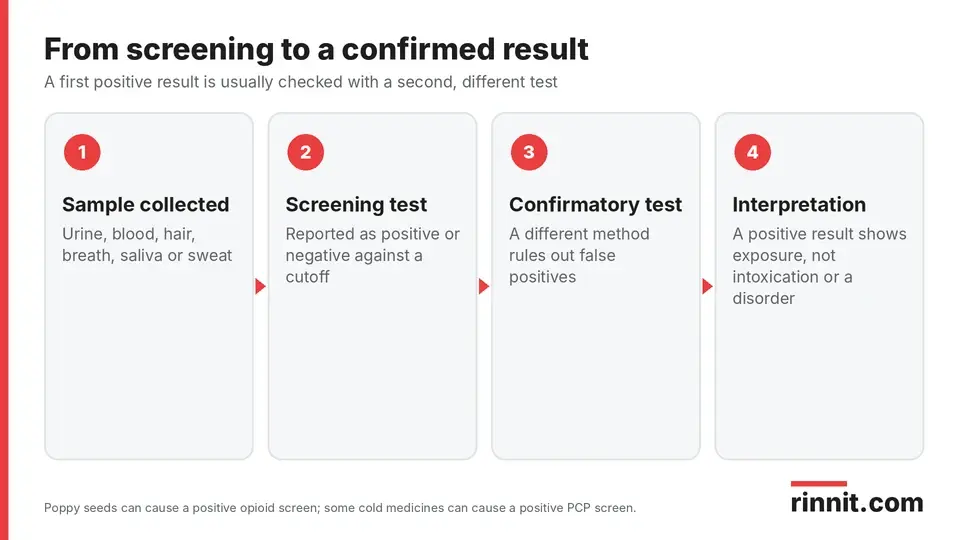
A positive screen is usually confirmed with a different method.
Positive result
A positive result means a detectable amount of a substance was present during a certain window of time. It does not mean the person is intoxicated now or has a substance use disorder. [1]
Positive screens usually need confirmation with a different type of test to reduce false positives. Medicines and foods can cause false positives; for example, poppy seeds can cause a positive opioid result and over-the-counter cold medicine can cause a positive PCP result. [1]
Negative result
A negative result means the substance was not detected, either because its level was too low or because use happened outside the detection window. It does not rule out recent use or a substance use disorder. [1]
False negatives can happen because of: [1]
Improper sample collection or testing
An attempt to falsify the test, such as using someone else's urine
A drug that the test does not look for
Conclusion
A drug test shows whether a substance was present during a specific window of time, which depends on the drug and the sample. Urine testing is the most common, and a positive screening result is usually confirmed with a more precise test before anyone draws conclusions.
If you are asked to take a drug test, list all your medicines and supplements, and ask who will review the results and when.
Keep learning: Read our substance use disorder guide or our guide to opioid use disorder. For more background, see the StatPearls chapter on drug testing.
FAQ
What is a drug test?
It is a test of a sample such as urine, blood, hair, breath or sweat that shows whether a legal or illegal drug is present.
What is the most common type of drug test?
Urine drug testing is the most common.
What does a standard drug panel test for?
The most commonly tested drugs are amphetamines, cocaine, marijuana, opioids and PCP.
How far back can a hair drug test detect use?
Scalp hair covers about three months and slower-growing body hair up to 12 months.
Do I need to prepare for a drug test?
No. You may be asked to list medicines or supplements you take.
Can foods or medicines cause a false positive?
Yes. Poppy seeds can cause a positive opioid result, and some cold medicines can cause a positive PCP result.
What happens after a positive screening test?
A confirmatory test using a different method is usually done to rule out a false positive.
Does a positive drug test mean someone is intoxicated?
No. It only shows a detectable amount during a window of time, not intoxication or a substance use disorder.
Are at-home drug tests accurate?
Accuracy varies, and they are generally less sensitive than laboratory tests.
Why might a drug test be falsely negative?
Improper collection or testing, a tampered sample or a drug the test does not look for.
Related Reading
Acetaminophen Level Test: Checking for Tylenol Overdose explains the blood test used to diagnose and treat acetaminophen overdose.
Drug Addiction (Substance Use Disorder): Symptoms, Causes & Treatment — Complete Guide explains the condition drug tests help monitor during treatment.
What Is Opioid Use Disorder (OUD)? Symptoms, Causes, and Recovery covers how testing supports recovery from opioid use.
Alcohol Use Disorder: The Complete Guide to Recognizing, Understanding, and Recovering explains alcohol testing in diagnosis and recovery.
Oral Drug Test (Mouth Swab): Detection Windows, Accuracy and How It Compares With Urine explains the saliva swab drug test and how long drugs show up.
References
Cleveland Clinic. Drug Test: What It Is, Purpose, Procedure & Types. Cleveland Clinic. Last updated August 5, 2022. https://my.clevelandclinic.org/health/diagnostics/10285-drug-testing
Moody DE, Fang WB, Andrenyak DM, et al. A comparative evaluation of the instant-view 5-panel test card with OnTrak TesTcup Pro 5: comparison with gas chromatography-mass spectrometry. J Anal Toxicol. 2006;30(1):50-56. PMID 16620532. https://doi.org/10.1093/jat/30.1.50
Mikel C, Pesce AJ, Rosenthal M, West C. Therapeutic monitoring of benzodiazepines in the management of pain: current limitations of point of care immunoassays suggest testing by mass spectrometry to assure accuracy and improve patient safety. Clin Chim Acta. 2012;413(15-16):1199-1202. PMID 22484396. https://doi.org/10.1016/j.cca.2012.03.017
Medical disclaimer
This article is for general education only and does not replace advice from a qualified healthcare professional. Talk to your doctor about your own diagnosis and treatment, and seek emergency care right away for severe or sudden symptoms.



Comments