Oral Drug Test (Mouth Swab): Detection Windows, Accuracy and How It Compares With Urine

Updated: 2 days ago
Written and medically reviewed by Dr. Baraa Alnahhal, MD · Last reviewed: November 2026 · How we review
Quick Answer
An oral drug test (mouth swab or saliva drug test) checks a sample of saliva for alcohol, drugs or medicines. It detects recent use, usually within a few hours to about two days, depending on the drug. You can't eat or drink for at least 10 minutes beforehand. A positive screen is usually confirmed by a lab.
What the research says
Saliva THC tracks blood THC only moderately: a meta-analysis of more than 18,000 paired oral fluid and blood samples found THC in saliva detected THC in blood with 71.2% sensitivity and 97.7% specificity, but saliva results matched legal blood limits poorly, leading the authors to advise against random roadside THC screening (Robertson MB et al., Accident Analysis & Prevention, 2022) [2]
Roadside saliva devices still fall short for cannabis: a systematic review of nine oral fluid devices for detecting recent cannabis use found none met the recommended minimum of 80% sensitivity, specificity and accuracy, although devices with lower detection cutoffs performed better (Dobri SCD et al., Public Health, 2019) [3]
Key takeaways
A saliva swab from inside the cheeks and gums checks for alcohol and drugs.
No food or drink for at least 10 minutes before the test.
Detects recent use: about 24 hours for alcohol and THC, up to 36 hours for cocaine and opiates, and up to 48 hours for amphetamines, benzodiazepines and opioids.
On-site results take minutes; lab confirmation takes 24 to 48 hours.
False positives can happen; you can ask for lab confirmation or a second sample.
What is an oral drug test?
When you use a drug, small amounts pass from your blood into your saliva. An oral fluid test detects these substances. It shows whether a drug is present, not how much you took or whether you're impaired. It's used for workplace testing, monitoring people in substance use treatment programs, and roadside checks of drivers suspected of impairment. Sources: [1]

A saliva drug test takes only a few minutes to collect.
What drugs does it detect?
Oral fluid tests can detect alcohol, amphetamines and methamphetamine, benzodiazepines, cocaine, ecstasy, marijuana (THC), opiates such as morphine and heroin, opioids such as oxycodone and fentanyl, and roofies (Rohypnol). The panel depends on the test ordered. Sources: [1]
How long do drugs show up in saliva?
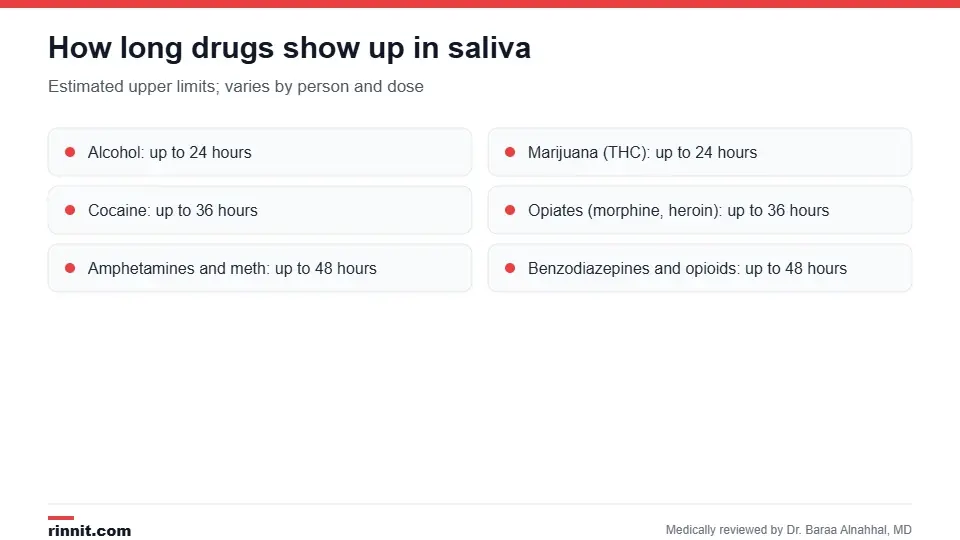
Detection windows are estimates and vary by person.
Substance | Detectable in saliva for up to |
Alcohol | 24 hours |
Marijuana (THC) | 24 hours |
Cocaine | 36 hours |
Opiates (morphine, heroin) | 36 hours |
Amphetamines and methamphetamine | 48 hours |
Benzodiazepines | 48 hours |
Opioids (oxycodone, fentanyl) | 48 hours |
These are estimates. How long a drug shows up depends on the amount, how often it's used, your metabolism and the test's sensitivity. Sources: [1]
How do I prepare?
Don't eat, drink, smoke or chew gum for at least 10 minutes before the test, because food and drink in the mouth can affect the result. Tell the tester about any prescription medicines you take. Sources: [1]
What happens during the test?
The tester opens a sealed swab collection kit in front of you.
The swab is placed inside your mouth and moved along your cheeks and gums to soak up saliva.
The sample is tested on a handheld device for a quick result or sealed and sent to a lab. Sources: [1]
On-site results are ready within minutes and are often confirmed by a lab, which takes 24 to 48 hours. Sources: [1]
How accurate is it?
The best oral fluid tests are around 97% accurate. Cocaine and opioids are easier to detect in saliva, while THC is harder. Accuracy depends on time since use, how often a drug is used, metabolism, the quality of the test and food or drink in the mouth. Research shows saliva testing for cannabis is less reliable than for other drugs, so roadside results are usually confirmed with a blood test. Sources: [1, 2, 3]
False positives can happen. If you believe a result is wrong, you can ask for lab confirmation and/or a second sample to be tested. Sources: [1]
Saliva vs other drug tests

Saliva tests detect recent use; urine covers a longer window.
Feature | Saliva | Urine |
Collection | Observed mouth swab | Private urine sample |
Detection window | Hours to about 2 days | Days to weeks for some drugs |
Tampering | Harder | Easier |
Same-day use | Detects well | May be missed |
Saliva tests are fast, convenient and hard to cheat, but they have a shorter detection window than urine or hair tests, can miss low levels and often need lab confirmation. A urine drug test remains the most common workplace test, while a blood alcohol test measures how much alcohol is in the blood. Sources: [1]
Conclusion
An oral drug test is a quick, observed way to check for recent drug or alcohol use. It works best for detecting use within the past day or two, and positive screens should be confirmed in a lab. If you take prescription medicines, tell the tester before the test, and ask for confirmation if a result seems wrong.
Keep learning: read about substance use disorder and opioid use disorder.
Frequently asked questions
How does a mouth swab drug test work?
A swab collects saliva from your cheeks and gums, which is tested for drugs and alcohol.
How long before the test can I eat or drink?
Not for at least 10 minutes before.
How far back does a saliva test detect drugs?
Usually from a few hours to about two days, depending on the drug.
How long does THC stay in saliva?
Up to about 24 hours, though THC is harder to detect in saliva than other drugs.
How fast are results?
Minutes for on-site tests; 24 to 48 hours for lab confirmation.
How accurate are saliva drug tests?
The best are about 97% accurate, but accuracy varies by drug and device.
Can a saliva test show impairment?
No. It shows a drug is present, not how much or whether you're impaired.
Can a saliva test be wrong?
Yes. False positives can happen; ask for lab confirmation or a second sample.
Is a saliva test better than a urine test?
It's better for detecting recent use and harder to cheat, but its detection window is shorter.
Where are saliva drug tests used?
Workplaces, addiction treatment programs and roadside testing of drivers.
Related Reading
Drug Test: Types, What It Detects, How It's Done and What Results Mean an overview of urine, blood, hair and saliva drug tests.
Drug Addiction (Substance Use Disorder): Symptoms, Causes & Treatment — Complete Guide the condition drug testing helps monitor.
What Is Opioid Use Disorder (OUD)? Symptoms, Causes, and Recovery opioid use, often monitored with drug tests.
Alcohol Use Disorder: The Complete Guide to Recognizing, Understanding, and Recovering alcohol use that saliva tests can detect.
Understanding Marijuana Withdrawal: Symptoms, Timeline, and Support what happens when regular cannabis use stops.
References
Cleveland Clinic. Oral Drug Test (Mouth Swab). Cleveland Clinic. Last updated August 11, 2025. https://my.clevelandclinic.org/health/diagnostics/oral-drug-test
Robertson MB, Li A, Yuan Y, et al. Correlation between oral fluid and blood THC concentration: a systematic review and discussion of policy implications. Accid Anal Prev. 2022;173:106694. PMID 35640367. https://doi.org/10.1016/j.aap.2022.106694
Dobri SCD, Moslehi AH, Davies TC. Are oral fluid testing devices effective for the roadside detection of recent cannabis use? A systematic review. Public Health. 2019;171:57-65. PMID 31102828. https://doi.org/10.1016/j.puhe.2019.03.006
Medical disclaimer
This article is for general education only and does not replace advice from a qualified healthcare professional. Talk to your doctor about your own diagnosis and treatment, and seek emergency care right away for severe or sudden symptoms.



Comments