Blood Alcohol Content (BAC): What It Measures, BAC Levels and Effects, and What Results Mean

Written and medically reviewed by Dr. Baraa Alnahhal, MD · Last reviewed: November 2026 · How we review
Quick Answer: What is blood alcohol content (BAC)?
Blood alcohol content (BAC) is the amount of alcohol in your blood. It ranges from 0%, meaning no alcohol, to over 0.4%, a level that can be fatal. A BAC blood test is used to diagnose alcohol poisoning and for workplace and legal testing, and the blood draw usually takes less than five minutes. [1]
What the research says
Breath readings track blood alcohol closely in the emergency room. In 54 emergency department patients suspected of alcohol intoxication, breath alcohol measured with a handheld infrared analyzer correlated very strongly with blood alcohol measured in a vein sample (r = 0.95). The real blood-to-breath ratio was about 30% higher than France's legal conversion ratio, so the authors recommended a different conversion for hospital screening. (Sebbane et al., The Journal of Emergency Medicine, 2012) [2]
Judging intoxication by appearance alone is often wrong. In 4,798 injured emergency room patients across 12 countries, a clinician's assessment of intoxication agreed with breath-measured blood alcohol 86% of the time overall, but only 39% of the time in people who had been drinking in the six hours before their injury. (Cherpitel et al., Emergency Medicine Journal, 2005) [3]
Key takeaways
BAC is the amount of alcohol in your blood, from 0% (sober) to over 0.4%, which can be fatal. [1]
Your liver can process about one standard drink per hour; BAC rises when you drink faster than that. [1]
A BAC of 0.30% to 0.40% likely means alcohol poisoning, which can be life-threatening. [1]
In most U.S. states, the legal driving limit for adults 21 and older is 0.08% BAC; in Utah it is 0.05%. [1]
People with a tolerance to alcohol may feel fewer effects, but their BAC is not lower. [1]
A BAC blood test is accurate only within six to 12 hours after your last drink. [1]
What is blood alcohol content?
Blood alcohol content (BAC) is the amount of alcohol in your blood. Levels range from 0% (no alcohol) to over 0.4%, which can be fatal. [1]
The alcohol in beer, wine and liquor is ethanol. After you drink, it is absorbed through your stomach and small intestine into your bloodstream, and your liver then breaks it down. [1]
Alcohol is a central nervous system depressant, and it affects every organ in your body. [1]
How fast your body clears alcohol
Your liver can process about one alcohol-containing drink per hour. When you drink faster than your liver can process it, your BAC goes up. [1]
Standard drink | Amount |
Beer | 12 ounces |
Wine | 5 ounces |
Liquor | 1.5 ounces |
Sources: [1]
Beers and wines vary in their alcohol percentage, so one glass or can is not always one standard drink. [1]
What affects your BAC
Several things change how high your BAC rises: [1]
How much alcohol you drink
How fast you drink it
Whether you have eaten beforehand
Your age and weight
BAC levels and their effects on the body
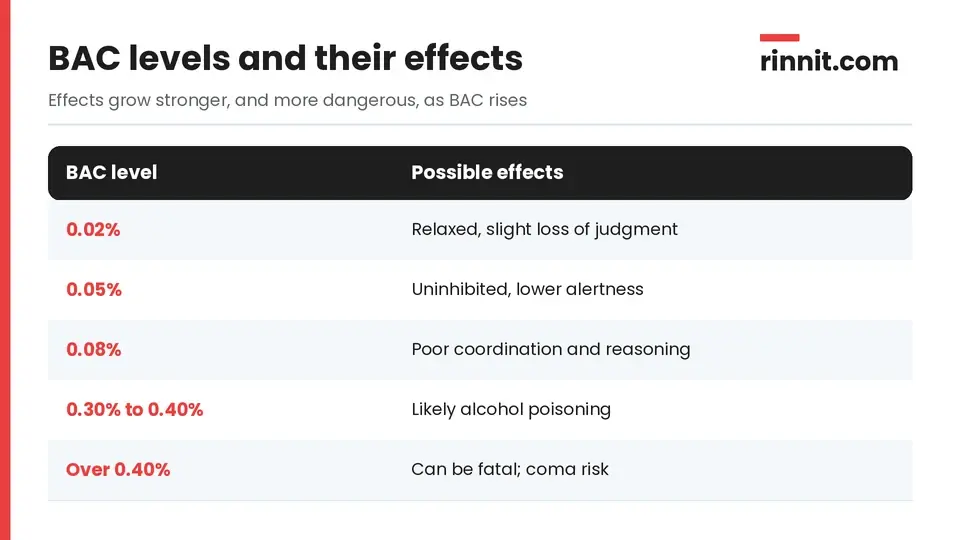
Effects grow stronger, and more dangerous, as BAC rises.
As your BAC rises, alcohol affects your judgment, coordination and, at high levels, your breathing and consciousness. [1]
BAC level | Possible effects |
0.0% | No alcohol in the blood (sober) |
0.02% | Altered mood, relaxation, slight loss of judgment |
0.05% | Feeling uninhibited, lower alertness, impaired judgment |
0.08% | Reduced muscle coordination, harder to detect danger, impaired judgment and reasoning |
0.10% | Slower reaction time, slurred speech, slowed thinking |
0.15% | Altered mood, nausea, vomiting, loss of balance, some loss of muscle control |
0.15% to 0.30% | Confusion, vomiting, drowsiness |
0.30% to 0.40% | Likely alcohol poisoning, which can be life-threatening, and loss of consciousness |
Over 0.40% | Can be fatal; risk of coma and death from respiratory arrest (breathing stops) |
Sources: [1]
Some people develop a tolerance and feel less of an effect from the same amount of alcohol. This does not mean their BAC is lower. [1]
When to get emergency help
High BAC levels can cause alcohol poisoning, loss of consciousness, coma and death from respiratory arrest. [1] If someone who has been drinking is confused, keeps vomiting, is very drowsy, cannot be woken or is breathing poorly, these can be signs of a dangerous BAC. [1] Get emergency medical help right away.
Why is a BAC test done?
A BAC test can be used for several reasons: [1]
Medical care: To diagnose alcohol poisoning.
Alcohol use disorder treatment: To check for continued drinking during treatment or recovery.
Workplace testing: For new job applicants, during employment or after a workplace accident.
Legal testing: To check for underage drinking, to monitor people on parole and to find out whether someone drove while legally intoxicated.
A BAC test looks only for alcohol. Tests for other substances are covered in our guide to the drug test.
What happens during a BAC blood test?

The blood draw usually takes less than five minutes.
A phlebotomist usually draws your blood, although any trained healthcare provider can do it. A medical laboratory scientist then analyzes the sample on lab machines. [1]
You sit in a chair while the provider finds a vein, usually on the inside of your arm.
The provider cleans and disinfects the skin.
A small needle goes into the vein. You may feel a small pinch.
Blood collects in a test tube.
The provider removes the needle and presses on the spot with cotton or gauze.
A bandage goes over the site.
The whole draw usually takes less than five minutes. [1]
Risks of a BAC blood test
The risks are very low. You may have slight tenderness or a bruise where the needle went in, which usually goes away quickly. [1]
What do BAC test results mean?
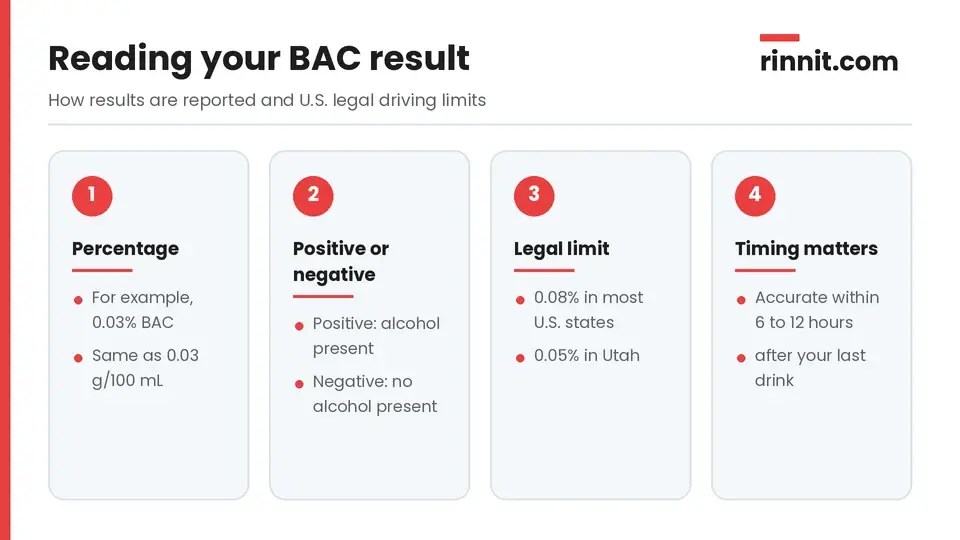
Results can be given as a percentage or as a positive or negative result.
Results can take a few hours to several business days, depending on why you were tested. [1]
Your result is usually reported as a percentage, such as 0.03% BAC, or in grams per milliliter. For example, 0.03% is the same as 0.03 g/100 mL. Some reports simply say positive (alcohol is present) or negative (no alcohol is present). [1]
Result format | Example | What it means |
Percentage | 0.03% BAC | The amount of alcohol in your blood |
Grams per volume | 0.03 g/100 mL | The same value as 0.03% |
Positive | Alcohol present | Alcohol was found in your blood |
Negative | No alcohol present | No alcohol was found in your blood |
Sources: [1]
The test is accurate only within six to 12 hours after your last alcohol-containing drink. [1]
Legal driving limits
In most U.S. states, the legal limit for drivers 21 and older is 0.08% BAC. Utah's limit is lower, at 0.05%. Legal limits can change. [1]
Judgment and reasoning are already impaired at 0.08%, and reduced alertness begins around 0.05%. [1]
Questions about your results
Talk with your healthcare provider about what your result means. Depending on why you were tested, you may also want to speak with a lawyer. [1]
If you are worried about your drinking
Moderate drinking can be acceptable for adults of legal drinking age. Drinking heavily in a short time, or drinking large amounts often, can put your health at risk. If you are concerned about your drinking, contact a healthcare provider or a specialist. [1]
Conclusion
A BAC test measures how much alcohol is in your blood. It helps diagnose alcohol poisoning, supports alcohol use disorder treatment and is used for workplace and legal testing.
The higher your BAC, the more alcohol affects your judgment, coordination and breathing. If someone may have alcohol poisoning, get emergency help, and if you are worried about your own drinking, talk with a healthcare provider.
Keep learning: Read our guide to alcohol use disorder or our guide to hangovers. For more trusted, doctor-reviewed health guides, visit Rinnit.com.
FAQ
What is blood alcohol content (BAC)?
BAC is the amount of alcohol in your blood, from 0% (no alcohol) to over 0.4%, which can be fatal.
What is a BAC test used for?
It is used to diagnose alcohol poisoning, monitor alcohol use disorder treatment, and for workplace and legal testing.
What is the legal BAC limit for driving?
In most U.S. states it is 0.08% for drivers 21 and older; in Utah it is 0.05%.
What BAC level is dangerous?
A BAC of 0.30% to 0.40% likely means alcohol poisoning, and over 0.40% can lead to coma or death.
How fast does the body process alcohol?
Your liver can process about one standard drink per hour.
What counts as one standard drink?
12 ounces of beer, 5 ounces of wine or 1.5 ounces of liquor.
Does tolerance lower your BAC?
No. People with tolerance may feel fewer effects, but their BAC is not lower.
How long does a BAC blood test take?
The blood draw usually takes less than five minutes.
How long after drinking is a BAC test accurate?
It is accurate only within six to 12 hours after your last drink.
How are BAC results reported?
As a percentage, such as 0.03%, in grams per volume, or as positive or negative.
Related Reading
Alcohol Use Disorder: The Complete Guide to Recognizing, Understanding, and Recovering explains how to recognize alcohol use disorder and the paths to recovery.
Hangover: What Causes It, and Why Time Is the Only Sure Cure covers what happens in your body the day after heavy drinking.
Alcoholic Hepatitis: What Heavy Drinking Does to Your Liver, and Whether the Damage Can Be Reversed describes liver inflammation caused by heavy drinking.
Holiday Heart Syndrome: Understanding Alcohol-Induced Atrial Fibrillation explains how binge drinking can trigger an irregular heartbeat.
Alcoholic Cardiomyopathy: The Heart Damage Behind Long-Term Heavy Drinking — Symptoms, Treatment, and Recovery covers how years of heavy drinking can weaken the heart muscle.
Alcohol-Related Dementia: The Non-Progressive Brain Damage Caused by Years of Heavy Drinking explains the brain damage that long-term heavy drinking can cause.
References
Cleveland Clinic. Blood Alcohol Content (BAC): What It Is & Levels. Cleveland Clinic. Last updated April 11, 2022. https://my.clevelandclinic.org/health/diagnostics/22689-blood-alcohol-content-bac
Sebbane M, Claret PG, Jreige R, et al. Breath analyzer screening of emergency department patients suspected of alcohol intoxication. J Emerg Med. 2012;43(4):747-753. PMID 22406024. https://doi.org/10.1016/j.jemermed.2011.06.147
Cherpitel C, Bond J, Ye Y, et al. Clinical assessment compared with breathalyser readings in the emergency room: concordance of ICD-10 Y90 and Y91 codes. Emerg Med J. 2005;22(10):689-695. PMID 16189028. https://doi.org/10.1136/emj.2004.016865
Medical disclaimer
This article is for general education only and does not replace advice from a qualified healthcare professional. Talk to your doctor about your own diagnosis and treatment, and seek emergency care right away for severe or sudden symptoms.



Comments