Comprehensive Metabolic Panel (CMP): What It Tests, How to Prepare and What Results Mean

Updated: 2 days ago
Written and medically reviewed by Dr. Baraa Alnahhal, MD · Last reviewed: November 2026 · How we review
Quick Answer: What is a comprehensive metabolic panel (CMP)?
A comprehensive metabolic panel (CMP) is a common blood test that measures 14 substances in the blood, including proteins, enzymes, electrolytes and blood sugar. Together, these results give a snapshot of how the liver and kidneys are working, how fluid and acid balance looks and how the body handles glucose. It's often part of routine care. [1]
What the research says
Lower kidney filtering is linked with higher risk of death. In a pooled analysis of more than 105,000 people from general population studies, risk of death was flat at eGFR (estimated glomerular filtration rate, a measure of kidney filtering) of 75 to 105 and rose at lower levels. Compared with an eGFR of 95, risk of death was 18% higher at 60, 57% higher at 45 and about 3 times higher at 15. (Chronic Kidney Disease Prognosis Consortium, The Lancet, 2010) [2]
Fasting glucose above 100 mg/dL was tied to higher risk of death. Data on 820,900 people from 97 studies showed that fasting glucose above 100 mg/dL (5.6 mmol/L) was associated with death, while levels of 70 to 100 mg/dL (3.9 to 5.6 mmol/L) were not. People with diabetes had an 80% higher risk of death from any cause, and a 50-year-old with diabetes died about 6 years earlier on average. (Rao Kondapally Seshasai et al., The New England Journal of Medicine, 2011) [3]
The link between ALT and long-term survival depends on age. A review of 12 studies with 206,678 people found that in younger adults, each 5 U/L rise in ALT raised the risk of death from liver disease by about 24%. In older adults, very low ALT was linked with higher risk of death from any cause, heart disease and cancer. (Liu et al., PLoS One, 2014) [4]
Key takeaways
A CMP measures 14 substances in one blood sample, covering liver function, kidney function, electrolytes, glucose and calcium. [1]
Providers use it to diagnose conditions, screen during routine checkups and monitor treatment or medication side effects. [1]
You may need to fast for 10 to 12 hours, so follow your provider's instructions and consider a morning appointment. [1]
The blood draw usually takes 5 to 10 minutes, and results typically come back in 1 to 2 business days. [1]
An abnormal value does not automatically mean you have a disease, because diet, medicines and other conditions can affect results. [1]
Large studies link reduced kidney filtering and higher fasting glucose with higher long-term risk of death. [2] [3]
What is a comprehensive metabolic panel?
A CMP is a group of blood tests run on a single sample. It measures proteins, enzymes (proteins that speed up specific chemical reactions), electrolytes, minerals and other substances. [1]
Because it looks at so many markers at once, a CMP helps your provider see how several organs and body systems are working. It is one of the blood tests most often ordered as part of routine healthcare. [1]

What does a CMP measure?
The 14 substances in a CMP fall into four broad groups: liver tests, kidney tests, electrolytes, and two others (glucose and calcium). The table below lists each one and what it tells your provider. [1]
Component | Group | What it checks |
Albumin | Liver | A protein made by the liver that carries substances through the blood and helps keep fluid inside blood vessels |
Total protein | Liver | The combined amount of albumin and globulins (another group of proteins) in your blood |
Bilirubin | Liver | A waste product made when red blood cells break down, which the liver processes |
Alkaline phosphatase (ALP) | Liver | A liver enzyme |
Alanine transaminase (ALT) | Liver | A liver enzyme |
Aspartate aminotransferase (AST) | Liver | A liver enzyme |
Blood urea nitrogen (BUN) | Kidney | Urea nitrogen, a waste product your kidneys remove from the blood |
Creatinine | Kidney | A byproduct of muscle activity that your kidneys filter out |
Sodium | Electrolyte | Supports fluid balance and nerve and muscle function |
Potassium | Electrolyte | Supports nerve and muscle function |
Chloride | Electrolyte | Helps maintain fluid and acid-base (pH) balance |
Carbon dioxide (bicarbonate) | Electrolyte | Reflects carbon dioxide in your blood and helps keep acid-base (pH) balance |
Glucose | Other | Blood sugar, the main fuel for your body and brain |
Calcium | Other | A mineral needed for healthy nerve, muscle and heart function |
Sources: [1]
Liver tests
Albumin, total protein, bilirubin and the three liver enzymes (ALP, ALT and AST) give clues about how well your liver is working. [1]
Kidney tests
BUN and creatinine are both waste products. Healthy kidneys filter them out of your blood, so their levels help show how well your kidneys are doing that job. [1]
Electrolytes, glucose and calcium
Electrolytes help your nerves and muscles work and keep your fluid and acid-base levels steady. Glucose shows how much sugar is in your blood, and calcium supports your nerves, muscles and heart. [1]
Why is a CMP done?
Providers order a CMP for three main reasons: [1]
Diagnosis: to help find out whether you have a certain medical condition. [1]
Screening: to catch possible problems early, often during a routine checkup and sometimes before you have symptoms. [1]
Monitoring: to check whether a treatment is working, or whether a medicine is causing side effects, especially medicines that can affect the liver or kidneys. [1]
Your provider may also suggest a CMP if you have symptoms that point to a kidney, liver or metabolism problem, general symptoms such as fatigue, an earlier abnormal result, or if you are starting a medicine that can affect your kidneys or liver. [1]
How do I prepare for a CMP?
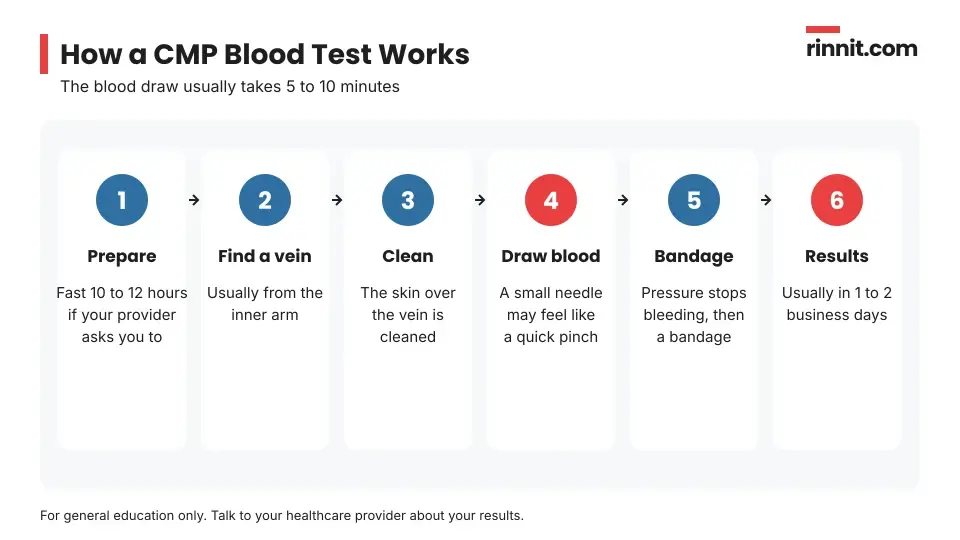
Sometimes you will need to fast (go without food or drink) for 10 to 12 hours before the test. Your provider will tell you whether fasting is needed and what you can or can't have beforehand. [1]
If you do need to fast, booking the test first thing in the morning means most of your fasting happens while you sleep, and you can eat right after the blood draw. [1]
What happens during a CMP?
A CMP needs a small blood sample, usually drawn from a vein on the inside of your arm at your provider's office or a lab. The whole process typically takes 5 to 10 minutes. [1]
A healthcare professional looks for a suitable vein in your arm. [1]
They clean the skin over the vein. [1]
They insert a small needle into the vein, which may feel like a quick pinch. [1]
Blood flows into a tube until there is enough for testing. [1]
They remove the needle and press on the spot to stop any bleeding. [1]
A bandage goes over the site. [1]
Does a CMP hurt, and what are the risks?
Most people feel only a small pinch or sting when the needle goes in. Blood tests like a CMP carry very little risk. [1]
As with anything that breaks the skin, there is a slight chance of infection. You may also notice tenderness or a bruise where the needle went in, which usually fades within a few days to a week. [1]
How long does it take to get CMP results?
Results usually come back within 1 to 2 business days, though sometimes they take longer. [1]
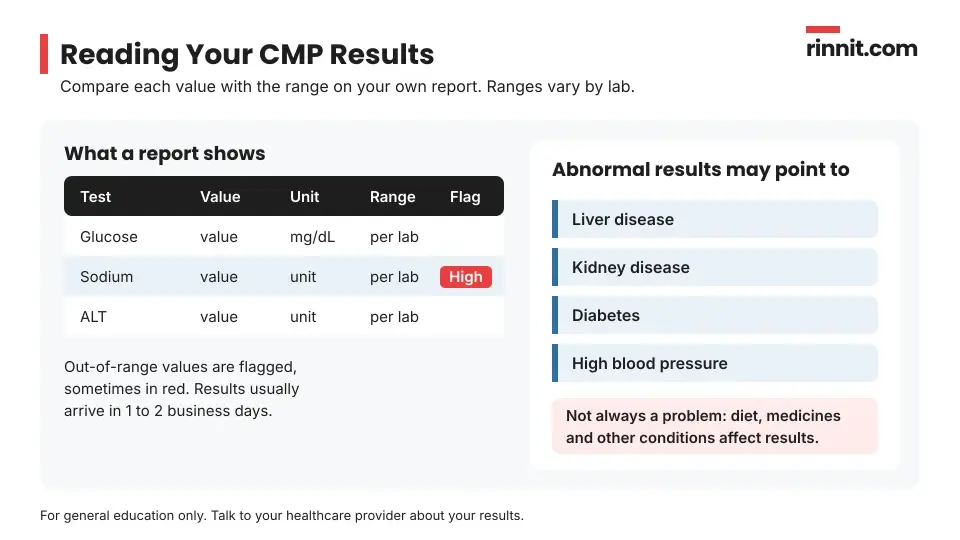
Your report may be laid out as a list or a table. For each test, it usually shows the test name, your measured value, the unit (for example, mg/dL, meaning milligrams per deciliter), the normal range, and a flag or note when a value is outside that range. Out-of-range results are sometimes shown in red. [1]
What you see on the report | What it means |
Test name | The substance that was measured, such as sodium or ALT |
Result or value | Your measured level |
Unit | How the result is measured, such as mg/dL |
Reference or normal range | The range the lab considers typical; ranges vary by lab |
Flag or note | A marker, sometimes in red, showing a value outside the range |
Sources: [1]
What do normal and abnormal CMP results mean?
There is no single normal range that applies everywhere. Ranges vary slightly by lab, so always compare your results with the range printed on your own report. [1]
Results outside the normal range may point to: [1]
An abnormal result does not always mean something is wrong. What you ate, the medicines you take and other health conditions can all shift your numbers, so your provider may order more tests to confirm or rule out a diagnosis. [1]
Why some CMP values matter over the long term
Research supports paying attention to kidney and glucose markers over time. In large population studies, lower kidney filtering was linked with a steadily higher risk of death once it fell below about 75, and the risk was roughly 3 times higher at very low levels. [2]
Similarly, fasting glucose above 100 mg/dL (5.6 mmol/L) was associated with a higher risk of death, while levels between 70 and 100 mg/dL (3.9 to 5.6 mmol/L) were not. [3] For ALT, the picture depends on age: higher values were tied to liver-related deaths in younger adults, while very low values were linked with higher risk in older adults. [4]
When should I call my provider?
Contact your provider if you have any questions about why you need a CMP, how to prepare, or what your results mean. [1]
You haven't heard back about your results after a few business days.
Your report shows flagged values and you aren't sure what they mean.
The bruise or soreness at the needle site gets worse or doesn't fade within a week. [1]
You notice signs of infection at the site, such as increasing redness, warmth or swelling.
How often should I get a CMP?
There is no fixed schedule for everyone. Because a CMP is often part of routine care and is used to monitor treatment, how often you need one depends on your health, your symptoms and the medicines you take. [1]
If you take a medicine that can affect your liver or kidneys, or you are being treated for a condition, your provider may repeat the test to track changes over time. [1]
Questions to ask your provider
Why are you ordering a CMP for me?
Do I need to fast, and can I drink water or take my medicines beforehand?
When and how will I get my results?
Which of my values are outside the normal range, and what might explain them?
Could my diet, medicines or other conditions be affecting my results?
Do I need any follow-up tests?
How often should I have this test repeated?
Conclusion
A comprehensive metabolic panel is a quick, low-risk blood test that checks 14 substances at once. It gives your provider a broad look at your liver, kidneys, electrolytes, blood sugar and calcium, and it helps with diagnosis, screening and monitoring. [1]
If your results are flagged, try not to panic. Many things can nudge a value outside the range, and your provider will look at your results alongside your symptoms and history before deciding on next steps. [1]
Keep learning: Read our guides to chronic kidney disease, low blood sodium (hyponatremia) and diabetes. For more, see MedlinePlus's page on the comprehensive metabolic panel.
FAQ
What is a comprehensive metabolic panel (CMP)?
It is a blood test that measures 14 substances, including proteins, enzymes, electrolytes and glucose, to check your liver, kidneys and metabolism. [1]
Why would my doctor order a CMP?
To help diagnose a condition, screen for problems during routine care, or monitor treatment and medication side effects. [1]
Do I need to fast before a CMP?
Sometimes. You may be asked to fast for 10 to 12 hours, so follow your provider's instructions. [1]
Does a CMP blood test hurt?
Most people feel only a small pinch when the needle goes in. [1]
How long does a CMP take?
The blood draw usually takes 5 to 10 minutes. [1]
How long do CMP results take?
Results usually come back in 1 to 2 business days, though sometimes longer. [1]
What are normal CMP values?
Normal ranges vary by lab, so compare your results with the range printed on your report. [1]
What can abnormal CMP results mean?
They may point to liver disease, kidney disease, diabetes or high blood pressure, but diet, medicines and other conditions can also affect results. [1]
Are there risks to a CMP?
Risks are very low. You may have slight bruising or tenderness, and there is a small chance of infection. [1]
When should I call my doctor about a CMP?
Call if you have questions about the test, how to prepare, or what your results mean. [1]
Related Reading
AST Blood Test (Aspartate Transferase): Normal Range and Results explains the AST liver enzyme blood test.
Acetaminophen Level Test: Checking for Tylenol Overdose explains the blood test used to diagnose and treat acetaminophen overdose.
Electrolyte Panel: What It Tests, Normal Ranges and What Results Mean explains the blood test that measures sodium, potassium, chloride and bicarbonate.
Learn more in our guide to Chronic Kidney Disease: What It Is, Its 5 Stages, Causes, and How It's Treated.
Learn more in our guide to Acute Kidney Injury: What Causes Sudden Kidney Failure, and How It Is Treated.
Learn more in our guide to Hyponatremia: Complete Guide to Low Blood Sodium, Symptoms, Causes, and Treatment.
Learn more in our guide to Hyperkalemia (High Blood Potassium): A Complete Guide to Causes, Symptoms, and Treatment.
Learn more in our guide to Hypercalcemia: Symptoms, Causes & Treatment — A Complete Guide.
Learn more in our guide to Diabetes: Symptoms, Types, Causes, Diagnosis & Treatment — Complete Guide.
References
Cleveland Clinic. Comprehensive Metabolic Panel (CMP): What It Is & Results. Cleveland Clinic. Last updated July 3, 2024. https://my.clevelandclinic.org/health/diagnostics/22058-comprehensive-metabolic-panel-cmp
Chronic Kidney Disease Prognosis Consortium, Matsushita K, van der Velde M, et al. Association of estimated glomerular filtration rate and albuminuria with all-cause and cardiovascular mortality in general population cohorts: a collaborative meta-analysis. Lancet. 2010;375(9731):2073-2081. PMID 20483451. https://doi.org/10.1016/S0140-6736(10)60674-5
Rao Kondapally Seshasai S, Kaptoge S, Thompson A, et al. Diabetes mellitus, fasting glucose, and risk of cause-specific death. N Engl J Med. 2011;364(9):829-841. PMID 21366474. https://doi.org/10.1056/NEJMoa1008862
Liu Z, Ning H, Que S, et al. Complex association between alanine aminotransferase activity and mortality in general population: a systematic review and meta-analysis of prospective studies. PLoS One. 2014;9(3):e91410. PMID 24633141. https://doi.org/10.1371/journal.pone.0091410
Medical disclaimer
This article is for general education only and does not replace advice from a qualified healthcare professional. Talk to your doctor about your own diagnosis and treatment, and seek emergency care right away for severe or sudden symptoms.



Comments