AST Blood Test (Aspartate Transferase): Normal Range and Results

Updated: 2 days ago
Written and medically reviewed by Dr. Baraa Alnahhal, MD · Last reviewed: November 2026 · How we review
Quick Answer
An aspartate transferase (AST) test is a blood test that measures AST, an enzyme found mostly in the liver. It's most often used to check liver health, usually alongside the ALT test. One common normal range is 8 to 33 U/L, though it varies by lab. High AST can point to hepatitis, cirrhosis or alcohol-related liver injury.
What the research says
AST helps estimate liver scarring: a review of 40 studies with 8,739 people found the APRI score, based on AST and platelets, moderately accurate for hepatitis C scarring and cirrhosis (Lin ZH et al., Hepatology, 2011) [2]
It can help avoid a biopsy: in 832 people with HIV and hepatitis C, the FIB-4 score, which uses AST and ALT, predicted significant liver scarring well enough to avoid a biopsy in 71% (Sterling RK et al., Hepatology, 2006) [3]
Key takeaways
AST is an enzyme found mainly in the liver, heart and muscles.
The test is mostly used to check liver health.
A common normal range is 8 to 33 U/L.
High AST can come from liver, heart or muscle damage.
AST alone can't diagnose a specific condition.
What is AST?
AST helps your cells process amino acids. Small amounts in the blood are normal. Because AST is found in many tissues, it's less specific to the liver than ALT. Doctors often compare the two: an AST higher than ALT can suggest alcohol-related liver disease or cirrhosis. AST is also used in scores such as APRI and FIB-4, which estimate liver scarring without a biopsy. Sources: [1, 2, 3]
Why it's done

AST is often tested with other liver tests.
Screening if you drink heavily, have a family history of liver disease, have diabetes or obesity, or have shared needles.
Monitoring a known liver condition or a medicine that may affect the liver.
Diagnosing liver problems when you have jaundice, belly pain, nausea or fatigue. Sources: [1]
How to prepare
If AST is part of a comprehensive metabolic panel (CMP), fast for 10 to 12 hours, drinking only water.
No fasting is needed for AST alone or a liver panel.
Tell your provider about all medicines and supplements, but don't stop any unless told to. Sources: [1]
What happens during the test
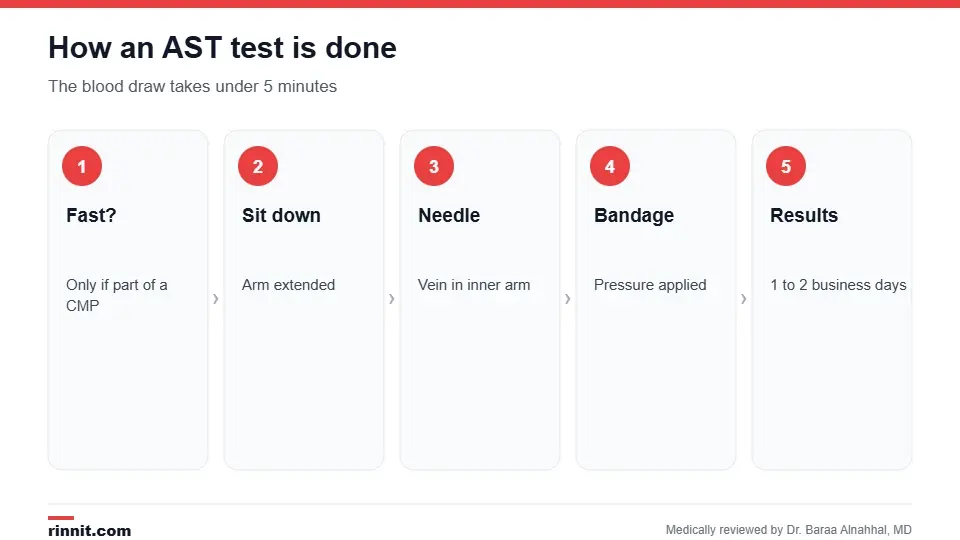
The blood draw usually takes under 5 minutes.
You sit in a chair.
A needle draws blood from a vein, usually in your inner arm; you may feel a small pinch.
Pressure and a bandage are applied. Sources: [1]
Risks
Risks are very small. You may have slight tenderness or a bruise that clears quickly. Sources: [1]
What the results mean

About 1 in 20 healthy people have a result outside the range.
Result | Possible causes |
Within range (about 8 to 33 U/L) | Normal |
High, liver causes | Hepatitis, cirrhosis, alcohol-related liver injury |
High, non-liver causes | Heart attack, pancreatitis, muscle disease |
Temporary rise | Burns, seizures, surgery, intense exercise, pregnancy |
Ranges vary by lab and by age, sex and weight. About 1 in 20 healthy people will have a result outside the normal range. Your provider may repeat the test or order other blood tests, imaging or a biopsy. Results usually take 1 to 2 business days. Sources: [1]
Conclusion
The AST test is a simple blood test that helps check your liver and spot tissue damage. Interpreted with ALT and other tests, it helps your provider find and track liver disease.
Keep learning: read about the ALT test and liver function tests.
Frequently asked questions
What is an AST test?
A blood test that measures an enzyme found mainly in the liver.
Is AST the same as SGOT?
Yes.
What is a normal AST level?
One common range is 8 to 33 U/L.
What does high AST mean?
Possible liver, heart or muscle damage.
What's the difference between AST and ALT?
ALT is more specific to the liver.
Do I need to fast?
Only if it's part of a CMP.
Can exercise raise AST?
Yes, intense exercise can raise it temporarily.
Can AST diagnose liver disease alone?
No. It's used with other tests.
How long does the test take?
Usually under 5 minutes.
When will I get results?
Usually in 1 to 2 business days.
Related Reading
Enzyme Markers: Blood Tests for Heart, Liver and Muscle Damage explains blood tests that detect heart, liver and muscle damage.
ALT Blood Test: What It Measures, Normal Range and What High Levels Mean the companion liver enzyme test.
Liver Function Tests (LFTs): What They Measure, Normal Ranges and Results the full liver blood panel.
Comprehensive Metabolic Panel (CMP): What It Tests, How to Prepare and What Results Mean a broad blood chemistry panel.
Bilirubin Test: Normal Levels, High Bilirubin Causes and Newborn Jaundice another liver blood test.
Cirrhosis of the Liver: What It Is, How Permanent Scarring Damages Your Liver, and What Treatment Involves a condition that can raise AST.
References
Cleveland Clinic. Aspartate Transferase (AST) Blood Test: What It Is, Procedure & Results. Cleveland Clinic. Last updated November 24, 2021. https://my.clevelandclinic.org/health/diagnostics/22147-aspartate-transferase-ast
Lin ZH, Xin YN, Dong QJ, et al. Performance of the aspartate aminotransferase-to-platelet ratio index for the staging of hepatitis C-related fibrosis: an updated meta-analysis. Hepatology. 2011;53(3):726-736. PMID 21319189. https://doi.org/10.1002/hep.24105
Sterling RK, Lissen E, Clumeck N, et al. Development of a simple noninvasive index to predict significant fibrosis in patients with HIV/HCV coinfection. Hepatology. 2006;43(6):1317-1325. PMID 16729309. https://doi.org/10.1002/hep.21178
Medical disclaimer
This article is for general education only and does not replace advice from a qualified healthcare professional. Talk to your doctor about your own diagnosis and treatment, and seek emergency care right away for severe or sudden symptoms.



Comments