Electrolyte Panel: What It Tests, Normal Ranges and What Results Mean

Updated: 2 days ago
Written and medically reviewed by Dr. Baraa Alnahhal, MD · Last reviewed: November 2026 · How we review
Quick Answer
An electrolyte panel is a blood test that measures the main electrolytes in the blood, minerals that help control fluid balance, nerves, muscles and heart rhythm. It usually checks sodium, potassium, chloride and bicarbonate. Abnormal levels can point to dehydration, kidney disease, heart problems, diabetes or medicine side effects. It's a simple blood draw, usually with no fasting.
What the research says
Even mildly low sodium matters: a meta-analysis found that hyponatremia was linked to a higher risk of death, including in hospitalized patients (relative risk about 2.5), and risk rose as sodium fell; people who died averaged about 4.8 mmol/L lower sodium than survivors (Corona G et al., PLoS One, 2013) [2]
Potassium outside 4.0–5.0 raises risk: in a large cohort, death rates rose for every 0.1 mEq/L step below 4.0 or above 5.0 mEq/L, and the risk was much greater in people with heart failure, chronic kidney disease or diabetes (Collins AJ et al., Am J Nephrol, 2017) [3]
Key takeaways
Electrolytes control fluid balance, nerves, muscles and heart rhythm.
The core panel checks sodium, potassium, chloride and bicarbonate.
Usually no fasting is needed.
Abnormal results can reflect dehydration, kidney or heart disease, diabetes or medicines.
Your provider may add an anion gap or blood gas test to explain results.
What is an electrolyte panel?
Electrolytes are minerals that dissolve in your blood and other body fluids. They keep the right amount of water inside and outside your cells, keep your blood's acid level balanced and help nerves and muscles, including your heart, work properly. An electrolyte panel shows whether any of them are too high or too low. It's often part of a basic metabolic panel (BMP) or comprehensive metabolic panel (CMP). Sources: [1]
Normal ranges
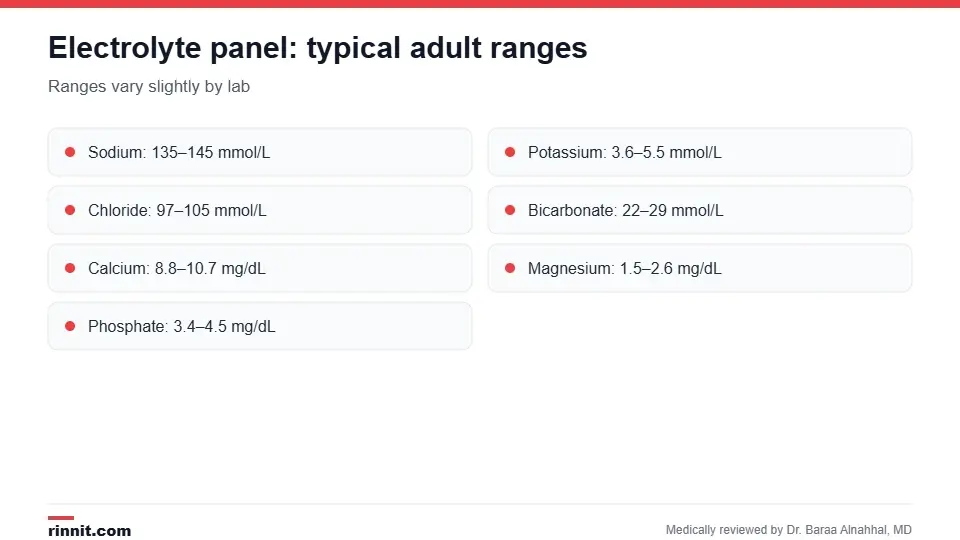
Reference ranges vary slightly between labs.
Electrolyte | Typical adult range | Main job |
Sodium | 135–145 mmol/L | Fluid balance, nerves and muscles |
Potassium | 3.6–5.5 mmol/L | Heart rhythm and muscle function |
Chloride | 97–105 mmol/L | Fluid and acid–base balance |
Bicarbonate (CO2) | 22–29 mmol/L | Keeps blood pH balanced |
Calcium | 8.8–10.7 mg/dL | Bones, muscles and nerves |
Magnesium | 1.5–2.6 mg/dL | Muscles, nerves and heart rhythm |
Phosphate | 3.4–4.5 mg/dL | Bones and energy use |
Your lab report shows its own reference range. Sources: [1]
Why it's done
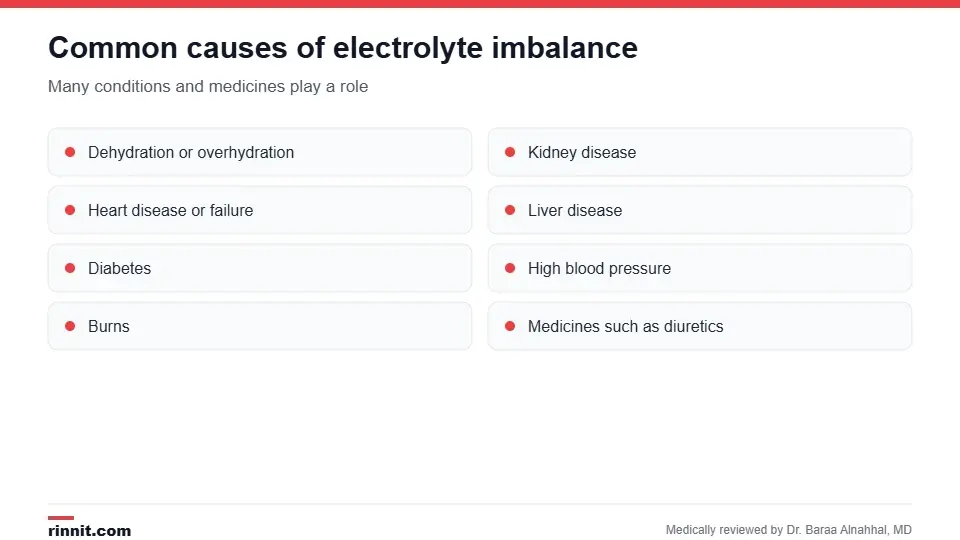
Many conditions and medicines can shift electrolyte levels.
Providers order the panel during routine checkups, in the emergency room and to monitor conditions and medicines. It can help find the cause of symptoms such as confusion, weakness, muscle cramps, irregular heartbeat, nausea or swelling. Common causes of imbalance include dehydration or too much fluid, burns, diabetes, high blood pressure, heart, kidney or liver disease, and medicines such as diuretics. Sources: [1]
How to prepare and what to expect
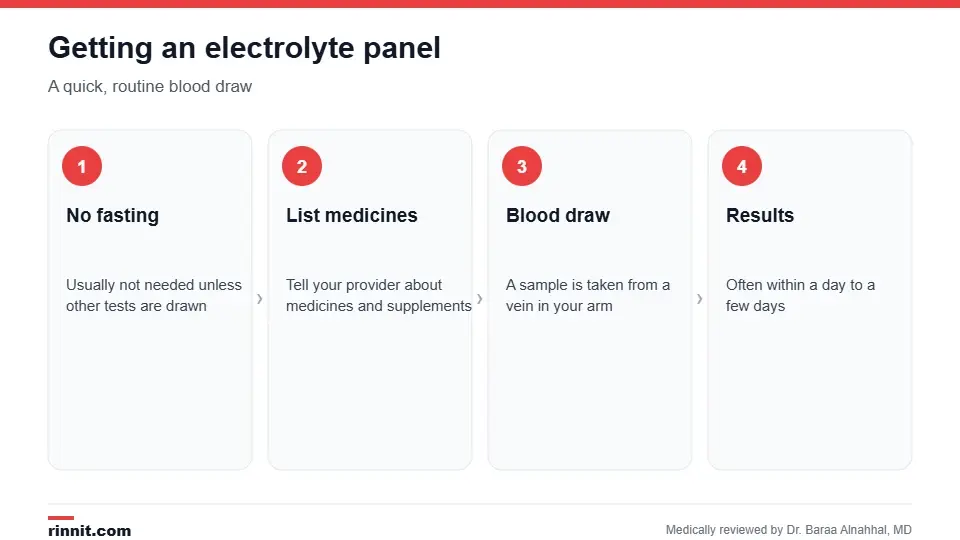
The test is a routine blood draw.
You usually don't need to fast unless other tests are drawn at the same time.
Tell your provider about medicines and supplements you take.
Avoid nicotine beforehand if instructed, since it can affect some results.
A provider draws blood from a vein in your arm in a few minutes; you may feel a brief sting. Sources: [1]
Understanding results
High or low levels have many possible causes. For example, low sodium (hyponatremia) can come from heart failure, kidney or liver disease or some medicines. Low potassium is common with vomiting, diarrhea or diuretics, while high potassium often relates to kidney disease or certain blood pressure medicines. Abnormal chloride or CO2 levels can signal acid–base problems. Sources: [1, 2, 3]
If results are abnormal, your provider may calculate the anion gap or order an arterial blood gas test. Sources: [1]
Conclusion
An electrolyte panel is a quick, common blood test that gives a snapshot of your fluid and mineral balance. Abnormal results are a clue, not a diagnosis, so your provider will interpret them with your symptoms and other tests.
Keep learning: read about electrolytes and the basic metabolic panel.
Frequently asked questions
What does an electrolyte panel test for?
Usually sodium, potassium, chloride and bicarbonate; sometimes calcium, magnesium and phosphate.
Do I need to fast?
Usually not, unless other tests are drawn at the same time.
How long do results take?
Often within a day to a few days.
What causes an electrolyte imbalance?
Dehydration, kidney, heart or liver disease, diabetes, burns and some medicines.
What are symptoms of an imbalance?
Weakness, cramps, confusion, nausea or an irregular heartbeat.
Is an electrolyte panel the same as a BMP?
No. A BMP includes electrolytes plus glucose and kidney tests.
Can medicines affect results?
Yes. Diuretics and some blood pressure medicines commonly do.
What is a normal sodium level?
About 135 to 145 mmol/L.
What is a normal potassium level?
About 3.6 to 5.5 mmol/L, depending on the lab.
What happens if my results are abnormal?
Your provider may repeat the test or order more tests to find the cause.
Related Reading
Electrolytes and Electrolyte Panel: Test, Normal Ranges and Imbalances what each electrolyte does in your body.
Basic Metabolic Panel (BMP): What It Tests, Normal Ranges and What Results Mean the routine panel that includes electrolytes.
Comprehensive Metabolic Panel (CMP): What It Tests, How to Prepare and What Results Mean a broader panel with liver tests too.
Hyponatremia: Complete Guide to Low Blood Sodium, Symptoms, Causes, and Treatment the most common electrolyte problem.
Anion Gap Blood Test: What It Measures and What High or Low Results Mean a calculation made from electrolyte results.
References
Cleveland Clinic. Electrolyte Panel: What It Is, Purpose, Procedure & Results. Cleveland Clinic. Last updated November 7, 2024. https://my.clevelandclinic.org/health/diagnostics/22358-electrolyte-panel
Corona G, Giuliani C, Parenti G, et al. Moderate hyponatremia is associated with increased risk of mortality: evidence from a meta-analysis. PLoS One. 2013;8(12):e80451. PMID 24367479. https://doi.org/10.1371/journal.pone.0080451
Collins AJ, Pitt B, Reaven N, et al. Association of serum potassium with all-cause mortality in patients with and without heart failure, chronic kidney disease, and/or diabetes. Am J Nephrol. 2017;46(3):213-221. PMID 28866674. https://doi.org/10.1159/000479802
Medical disclaimer
This article is for general education only and does not replace advice from a qualified healthcare professional. Talk to your doctor about your own diagnosis and treatment, and seek emergency care right away for severe or sudden symptoms.



Comments