CO2 Blood Test (Bicarbonate): Purpose, Procedure, Normal Levels and What Results Mean

Written and medically reviewed by Dr. Baraa Alnahhal, MD · Last reviewed: November 2026 · How we review
Quick Answer: What is a CO2 blood test?
A CO2 blood test measures your level of bicarbonate, which shows how much carbon dioxide (CO2) is in your blood. It is often done as part of an electrolyte panel. A standard level is 20 to 29 mmol/L, and a result outside this range may point to a problem with your kidneys or lungs. [1]
What the research says
Bicarbonate from a vein closely matches bicarbonate from an artery. A review of emergency department studies found that venous bicarbonate was on average only 1.03 mmol/L higher than arterial bicarbonate, with 10 studies reporting on it. Agreement was best when values were in the normal range. (Bloom et al., European Journal of Emergency Medicine, 2014) [2]
Treating low bicarbonate in kidney disease did not raise blood pressure. In 14 randomized trials with 2,110 people with chronic kidney disease (average serum bicarbonate 22 mmol/L), sodium bicarbonate did not change systolic blood pressure or increase the need for blood pressure medicines. (Beynon-Cobb et al., Clinical Journal of the American Society of Nephrology, 2023) [3]
Key takeaways
A CO2 blood test measures bicarbonate, an indicator of how much CO2 is in your blood. [1]
It is often part of an electrolyte panel and may be ordered for vomiting, diarrhea, fatigue, weakness or trouble breathing. [1]
You do not need to fast for the CO2 test itself, but other tests done at the same time may require it. [1]
A standard level is 20 to 29 mmol/L, although the range can vary slightly between labs. [1]
An abnormal result usually leads to more tests, because a CO2 test alone usually cannot diagnose a condition. [1]
What is a CO2 blood test?
CO2 is a natural waste product of your body. Your blood carries it to your lungs, where you breathe it out. [1]
A CO2 blood test measures your level of bicarbonate, an indicator of how much CO2 is in your blood. Having too little or too much CO2 may be a sign of a more serious health problem. [1]
Why would you need a CO2 blood test?
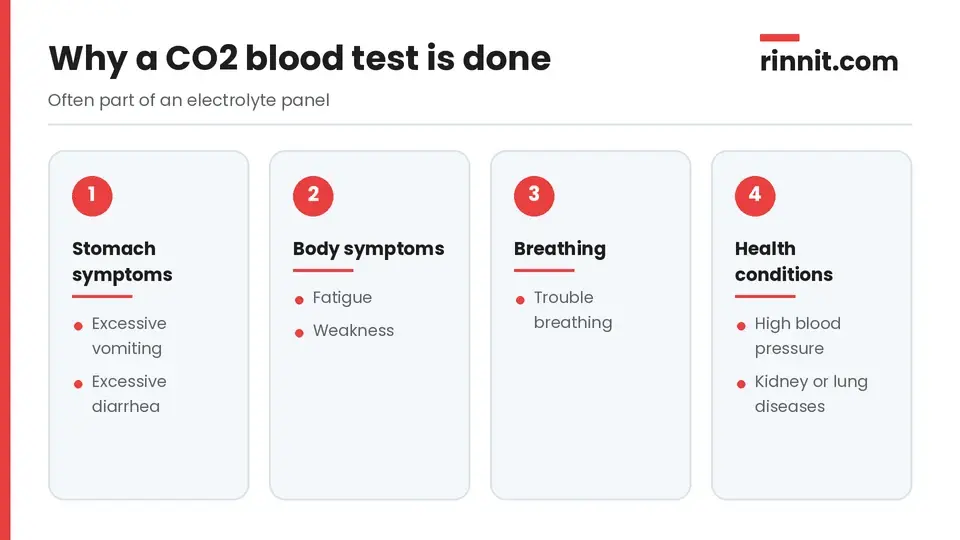
Symptoms and certain health conditions can lead to a CO2 test.
A CO2 blood test is often done as part of an electrolyte panel, a type of blood test. Your provider may order it if you have symptoms such as: [1]
Excessive vomiting or diarrhea
Fatigue
Trouble breathing
Weakness
It can also help check for electrolyte imbalances linked to health conditions such as high blood pressure, kidney diseases and lung diseases. [1]
Reason for testing | Examples |
Symptoms | Excessive vomiting or diarrhea, fatigue, trouble breathing, weakness |
Conditions that can cause electrolyte imbalances | High blood pressure, kidney diseases, lung diseases |
Routine bloodwork | Often done as part of an electrolyte panel |
Sources: [1]
How do you prepare for a CO2 blood test?
You do not need to fast before a CO2 test. However, your provider may order other blood tests at the same time that do require fasting, so ask in advance. [1]
Ask your provider whether you should stop any medications, vitamins or supplements before the test. Do not stop any medication without asking first. [1]
What happens during a CO2 blood test?

The blood draw usually takes about one minute.
A phlebotomist (a person trained to draw blood) usually does the test. They take a blood sample from a vein, usually on the top of your hand or the inside of your elbow. [1]
You may feel a sharp prick as the needle goes in.
The blood draw usually takes about one minute.
Afterward, light pressure is applied and a bandage is placed over the site.
A medical laboratory technician then runs your sample through a machine to get your result. [1]
What do CO2 blood test results mean?
Results usually take a few days to come back and are reported as a number in millimoles per liter (mmol/L). [1]
Result | Level | What it may mean |
Standard | 20 to 29 mmol/L | Within the usual range (may vary slightly by lab) |
Higher than normal | Above 29 mmol/L | The body may not be properly removing CO2 |
Lower than normal | Below 20 mmol/L | The body may be removing too much CO2 |
Sources: [1]
Your provider will compare your result with the reference range used by your lab. An abnormal result usually leads to more tests, because a CO2 test alone usually cannot diagnose a condition. [1]
What causes high or low CO2 levels?

A high or low result is a clue that needs more testing.
High CO2 levels
Higher-than-normal CO2 levels in your blood could point to a health problem such as: [1]
Metabolic alkalosis
Cushing's syndrome
Hormonal disorders
Kidney disorders
Lung diseases, such as chronic obstructive pulmonary disease (COPD)
Low CO2 levels
Low CO2 levels in your blood are sometimes a sign of a health problem such as: [1]
Addison's disease
Ketoacidosis, which can affect people with type 1 or type 2 diabetes
Kidney disorders
Metabolic acidosis (too much acid in the blood)
Shock
Level | Possible causes |
High | Metabolic alkalosis, Cushing's syndrome, hormonal disorders, kidney disorders, lung diseases such as COPD |
Low | Addison's disease, ketoacidosis, kidney disorders, metabolic acidosis, shock |
Sources: [1]
What happens after an abnormal result?
Treatment depends on the cause, so talk with your provider about your options. [1]
For conditions like COPD, oxygen therapy, pulmonary rehabilitation and certain medications can sometimes help. [1]
For metabolic acidosis, some studies show that sodium bicarbonate or sodium citrate pills can help. Eating more fruits and vegetables and fewer meats, eggs, cheese and cereal grains may also help. [1]
Ask your provider which options are safe for you before making changes. [1]
Conclusion
A CO2 blood test is a quick blood draw that measures bicarbonate and helps your provider check your body's balance of electrolytes and acids, often as part of an electrolyte panel.
A high or low result is a clue, not a diagnosis. If you have fatigue, weakness, trouble breathing or ongoing vomiting or diarrhea, talk with your provider about testing and what your results mean.
Keep learning: Read our guide to metabolic acidosis or learn how an electrolyte panel checks your body's minerals. For more trusted, doctor-reviewed health guides, visit Rinnit.com.
FAQ
What does a CO2 blood test measure?
It measures bicarbonate, an indicator of how much carbon dioxide is in your blood.
Is a CO2 blood test the same as a bicarbonate test?
Yes. The CO2 blood test measures your bicarbonate level.
What is a normal CO2 level?
A standard level is 20 to 29 mmol/L, though the range can vary slightly by lab.
Why would my doctor order a CO2 blood test?
It is often part of an electrolyte panel and may be ordered for vomiting, diarrhea, fatigue, weakness or trouble breathing.
Do I need to fast for a CO2 blood test?
No, but other tests done at the same time may require fasting, so ask your provider.
How long does the blood draw take?
Usually about one minute.
How long do CO2 test results take?
Results usually come back in a few days.
What does a high CO2 level mean?
It can point to problems such as metabolic alkalosis, Cushing's syndrome, kidney disorders or lung diseases like COPD.
What does a low CO2 level mean?
It can be a sign of Addison's disease, ketoacidosis, kidney disorders, metabolic acidosis or shock.
Can a CO2 test diagnose a condition on its own?
Usually not. An abnormal result typically leads to more tests.
Related Reading
Understanding Metabolic Acidosis: Causes, Symptoms, and Treatment explains too much acid in the blood, a common cause of low CO2 levels.
Understanding Metabolic Alkalosis: Causes, Symptoms, and Management covers a condition that can raise CO2 levels.
Diabetic Ketoacidosis (DKA): Signs, Triggers, and What To Do in an Emergency describes the diabetes emergency that can lower CO2 levels.
Addison's Disease Guide: Symptoms, Causes, Diagnosis, and Treatment explains an adrenal condition linked to low CO2 results.
Cushing Syndrome: What High Cortisol Does to Your Body and How It Is Treated covers a hormone condition linked to high CO2 levels.
What Is Chronic Obstructive Pulmonary Disease (COPD)? Symptoms, Causes, Stages, and Treatment explains a lung disease that can cause high CO2 levels.
Understanding Hypercapnia: Causes, Symptoms, and Management describes what happens when the body does not remove CO2 properly.
References
Cleveland Clinic. CO2 Blood Test: Purpose, Procedure, Levels & Results. Cleveland Clinic. Last updated June 13, 2022. https://my.clevelandclinic.org/health/diagnostics/23247-co2-blood-test
Bloom BM, Grundlingh J, Bestwick JP, et al. The role of venous blood gas in the emergency department: a systematic review and meta-analysis. Eur J Emerg Med. 2014;21(2):81-88. PMID 23903783. https://doi.org/10.1097/MEJ.0b013e32836437cf
Beynon-Cobb B, Louca P, Hoorn EJ, et al. Effect of Sodium Bicarbonate on Systolic Blood Pressure in CKD: A Systematic Review and Meta-Analysis. Clin J Am Soc Nephrol. 2023;18(4):435-445. PMID 36758154. https://doi.org/10.2215/CJN.0000000000000119
Medical disclaimer
This article is for general education only and does not replace advice from a qualified healthcare professional. Talk to your doctor about your own diagnosis and treatment, and seek emergency care right away for severe or sudden symptoms.



Comments