Addison's Disease Guide: Symptoms, Causes, Diagnosis, and Treatment

Updated: 2 days ago
Medically reviewed by Dr. Baraa Alnahhal, MD · Last reviewed: September 2026
Addison's disease is a rare condition in which the adrenal glands do not make enough of the hormones cortisol and, often, aldosterone. Symptoms usually appear slowly over months — extreme tiredness, salt craving, weight loss, and darkened skin patches — and the condition becomes life-threatening if untreated. The cure is not possible, but daily hormone replacement lets most people live full lives. The biggest danger is adrenal crisis, a medical emergency triggered by physical stress, that requires immediate treatment.
Quick Answer
What it is. A rare condition, also called primary adrenal insufficiency, in which the adrenal glands make too little cortisol and often too little aldosterone.
What causes it. Damage to the outer layer of the adrenal glands, most often from the immune system attacking its own tissue; infections like tuberculosis and certain medicines can also cause it.
How it starts. Symptoms develop slowly over months and include extreme fatigue, dizziness on standing, salt craving, weight loss, and darkened skin patches.
How it is diagnosed. Through blood tests measuring sodium, potassium, cortisol, and ACTH, and confirmed with an ACTH stimulation test that compares cortisol levels before and after an ACTH shot.
How it is treated. Daily corticosteroid pills replace cortisol on a schedule that mimics the body's natural 24-hour rhythm, a separate pill replaces aldosterone, and stress doses protect the body during illness, surgery, and infection.
What this guide is based on: Specialist-reviewed hospital clinical guidance published December 21, 2024, with underlying references drawn from the Merck Manual, the National Institute of Diabetes and Digestive and Kidney Diseases, Current Medical Diagnosis and Treatment (2024), UpToDate clinical reviews of adrenal insufficiency, and the Endocrine Society patient guidance. This article is for general educational purposes only and is not medical advice. Always consult a qualified healthcare professional for diagnosis and treatment decisions.
What is Addison's disease, exactly?
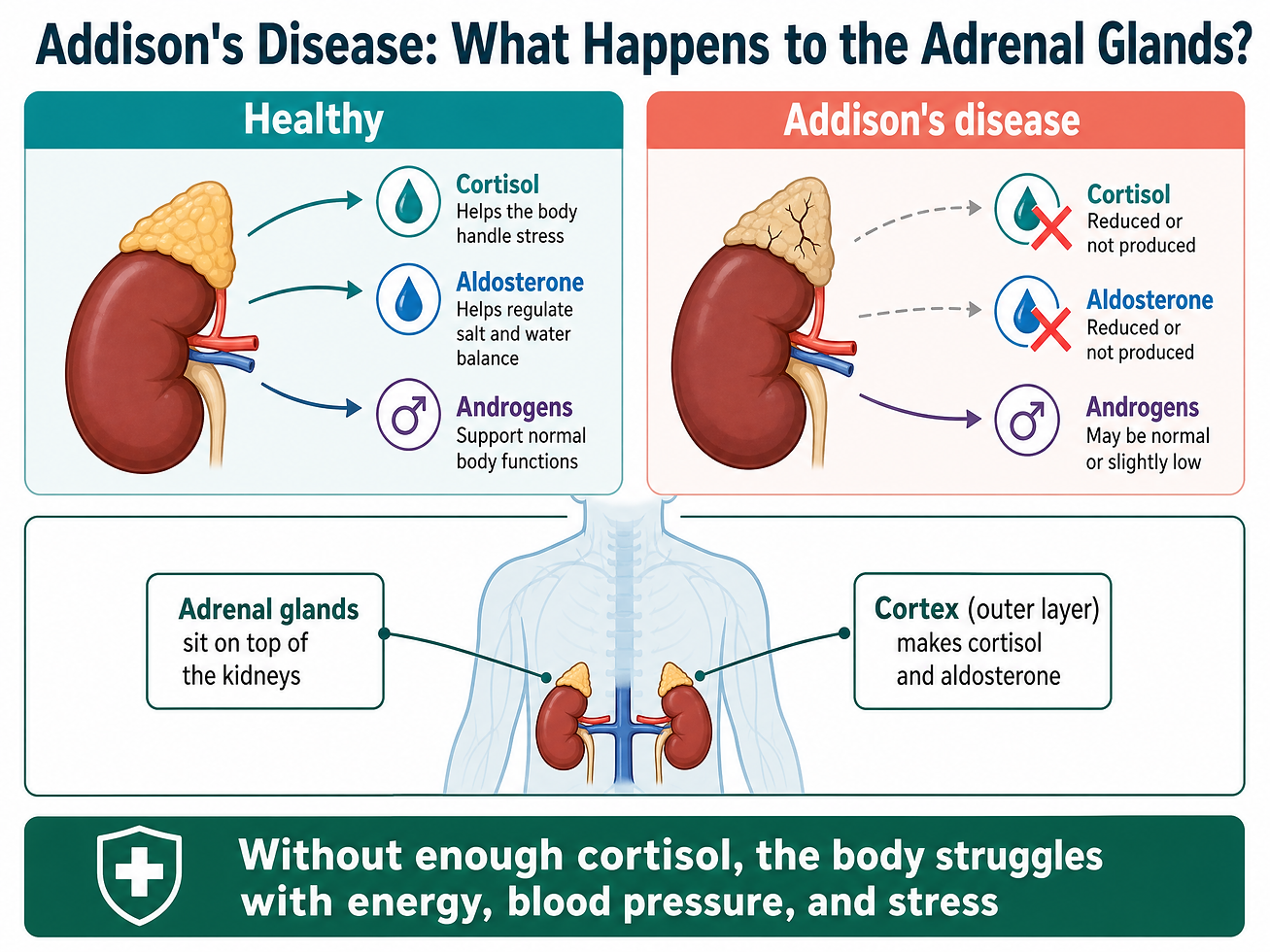
Addison's disease is a rare condition that happens when the body does not make enough of certain hormones. Its other name, primary adrenal insufficiency, describes what goes wrong: the adrenal glands cannot produce enough of the hormone cortisol, and often not enough of another hormone called aldosterone either.
The adrenal glands are two small organs sitting on top of the kidneys. Despite their size, they control much of what happens in the body, because they belong to the endocrine system — the network of glands and organs that produces hormones affecting nearly every organ and tissue.
The outer layer of each adrenal gland, called the cortex, makes a group of hormones called corticosteroids. These include cortisol, which helps the body turn food into energy and respond to stress; aldosterone, which balances sodium and potassium to keep blood pressure in a healthy range; and small amounts of androgens, which affect muscle mass, body hair, and a sense of well-being in everyone.
When the cortex is damaged, it cannot make enough of these hormones. Without treatment, Addison's disease can be life-threatening. With treatment — lab-made hormones that replace the missing ones — most people can manage the condition.
What causes Addison's disease?
The most common cause is an autoimmune disease, in which the immune system attacks healthy tissue by mistake and damages the outer layer of the adrenal glands. People with Addison's disease are more likely than others to have another autoimmune disease as well.
Beyond autoimmunity, the source material identifies several other causes. A serious infection called tuberculosis, which mainly affects the lungs, can also destroy the adrenal glands. Other adrenal infections, the spread of cancer to the adrenal glands, and bleeding into the adrenal glands can all produce the same result. Some people are born with genetic conditions that affect the glands, such as congenital adrenal hyperplasia. Certain medicines block the body's ability to make glucocorticoids — examples include ketoconazole, mitotane, and etomidate — or block glucocorticoid action, such as mifepristone. Cancer treatment with checkpoint inhibitors is another recognized cause.
How is Addison's disease different from secondary adrenal insufficiency?
A related and more common condition is secondary adrenal insufficiency. The problem is not in the adrenal glands at all — instead, the pituitary gland near the brain fails to send the signal that prompts cortisol production. That signal is a hormone called ACTH (adrenocorticotropic hormone), and too little of it leaves the adrenal cortex underproducing its hormones.
The two conditions share many symptoms but differ in important ways, which is why doctors test carefully before treating.
Feature | Addison's disease (primary) | Secondary adrenal insufficiency |
Where the problem starts | Adrenal glands are damaged | Pituitary gland makes too little ACTH |
Darkened skin | Yes, patches often on scars and moles | No |
Dehydration and low blood pressure | More likely to be serious | Less likely |
Low blood sugar | Possible | More likely |
Common causes | Autoimmune disease, tuberculosis, infections, cancer spread, bleeding, genetics, certain medicines | Noncancerous pituitary tumors, pituitary surgery or radiation, brain injury, suddenly stopping corticosteroid medicines |
How common | Rare | More common |
Notably, suddenly stopping corticosteroid medicines — commonly used for asthma and arthritis — instead of tapering off can trigger secondary adrenal insufficiency, which is why long-term corticosteroid users should never stop abruptly without medical guidance.
What are the early signs and symptoms?
Symptoms of Addison's disease usually appear slowly, often over months. The disease can develop so gradually that people ignore the symptoms at first. Physical stress such as an illness or injury can then make the symptoms worsen fast.
The early symptoms group into three patterns.
Body area affected | Early symptoms |
Energy and comfort | Extreme tiredness (fatigue); dizziness or fainting when standing up, called postural hypotension; sweating from low blood sugar (hypoglycemia); upset stomach, diarrhea, or vomiting; abdominal pain; muscle cramps, weakness, widespread pain, or joint pain |
Appearance | Body hair loss; darkened areas of skin, especially on scars and moles (harder to see on Black or brown skin); weight loss from reduced appetite |
Mood and drives | Depression; irritable mood; lower sex drive in women; craving for salt |
The salt craving deserves attention because it is unusual and distinctive. Together with fatigue, weight loss, and darkened skin, it forms a pattern that should prompt a medical evaluation rather than a self-managed fix.
When should you see a doctor?
See a healthcare professional if you experience long-lasting fatigue, muscle weakness, loss of appetite, darkened skin areas, weight loss that is not intentional, serious upset stomach or stomach pain, lightheadedness or fainting when standing, or salt cravings.
Adrenal crisis is an emergency. Sometimes the symptoms worsen fast — this is adrenal crisis, also called addisonian crisis or acute adrenal failure, and it demands an immediate call to 911 or the local emergency number.
Adrenal crisis warning signs | What to do |
Serious weakness | Call 911 or your local emergency number |
Sudden, terrible pain in the lower back, stomach, or legs | Call 911 or your local emergency number |
Severe upset stomach, vomiting, or diarrhea | Call 911 or your local emergency number |
Extreme dehydration | Call 911 or your local emergency number |
Fever | Call 911 or your local emergency number |
Confusion or greatly reduced awareness | Call 911 or your local emergency number |
Loss of consciousness | Call 911 or your local emergency number |
Low blood pressure and fainting | Call 911 or your local emergency number |
Without fast treatment, an adrenal crisis can lead to death.
Why does adrenal crisis happen, and who is at higher risk?
Normally, the adrenal glands make two to three times the usual amount of cortisol in response to physical stress such as injury, infection, or illness. With adrenal insufficiency, the damaged glands cannot meet this need — and the result is adrenal crisis: low blood pressure, low blood sugar, and high potassium levels. It requires immediate treatment.
Most people who develop Addison's disease have no factors that put them at higher risk. The factors that may raise the risk of adrenal insufficiency include a history of disease or surgery affecting the pituitary or adrenal glands, genetic changes affecting these glands (including those that cause congenital adrenal hyperplasia), other autoimmune endocrine conditions such as hypothyroidism or type 1 diabetes, and traumatic brain injury.
Addison's disease cannot be prevented. But you can lower the risk of adrenal crisis by asking for testing when you always feel tired or weak or are losing weight without trying, learning from your healthcare team how to adjust your medicine when you are sick (including when a shot of medicine is needed), and going to an emergency room if you become very sick — especially if vomiting prevents you from taking your medicine.
How is Addison's disease diagnosed?
Diagnosis begins with a conversation about your medical history and symptoms. Your healthcare team may then order several tests that check for Addison's disease or for secondary adrenal insufficiency.
Diagnostic test | What it checks |
Blood test | Levels of sodium, potassium, cortisol, and ACTH in the blood; can also measure antibodies related to autoimmune Addison's disease |
ACTH stimulation test | Measures blood cortisol before and after a shot of lab-made ACTH — ACTH tells the adrenal glands to make cortisol, so a weak response points to insufficiency |
Insulin-induced hypoglycemia test | Checks blood sugar and cortisol after a shot of insulin to find out whether the pituitary gland is causing secondary adrenal insufficiency |
Imaging tests | A CT scan of the stomach area checks the size of the adrenal glands and looks for other issues; an MRI of the pituitary gland can spot damage that may cause secondary adrenal insufficiency |
Results are reviewed together with your history and symptoms, not in isolation.
How is Addison's disease treated?
Treatment involves taking medicines that correct the steroid hormone levels the body is not making enough of. Some treatments are corticosteroid medicines taken by mouth.
Treatment | What it replaces or does |
Hydrocortisone (Cortef), prednisone (Rayos, Prednisone Intensol), or methylprednisolone (Medrol) | Replaces cortisol; taken on a schedule that mimics the natural 24-hour rise and fall of cortisol levels |
Fludrocortisone acetate | Replaces aldosterone |
Extra sodium in the diet | Needed during heavy exercise, hot weather, and digestive trouble such as diarrhea |
Higher dose during stress | The dose is raised for a short time when the body is stressed by surgery, infection, or minor illness; shots of corticosteroids may be needed if vomiting prevents you from keeping pills down |
Living with Addison's disease also involves daily habits that protect against crisis. Carry a medical alert card and bracelet at all times, plus a written action plan, so emergency professionals know what care you need. Keep extra medicine handy — missing even one day of medicine can be dangerous — with a small supply at work and extra when traveling. Carry a corticosteroid injection kit containing a needle, syringe, and injectable corticosteroids for emergencies. Stay in contact with your healthcare team, which monitors hormone levels and adjusts doses or timing when needed. Have yearly checkups with a doctor who treats hormone conditions; yearly screening tests for autoimmune diseases may be recommended.
People with Addison's disease who worry about corticosteroid side effects can take some reassurance from the source material: the prescribed dose is much lower than the high doses used for other diseases and only replaces what is missing, so the side effects of high-dose corticosteroids are unlikely. Regular follow-up confirms the dose is not too high.
What happens during an adrenal crisis?
An Addisonian crisis is a medical emergency treated with medicines or solutions given through a vein. The treatment typically includes corticosteroids, saline solution, and sugar. This combination addresses the three problems the crisis creates at once — missing cortisol, severe dehydration and low blood pressure, and low blood sugar.
How should you prepare for your appointment?
You will likely start with your primary healthcare professional, who may refer you to an endocrinologist — a doctor who treats hormone conditions.
Before the appointment, take a family member or friend with you if you can, since that person can help you remember the information you receive. Make a list of your symptoms and when they began, key personal information including major stresses or recent life changes, all medicines, vitamins, and other supplements you take with their doses, and the questions you want to ask. Useful questions include what is likely causing your symptoms, which tests you need, whether the condition is short-term or long-lasting, the best course of action, how to manage other health conditions alongside it, and what restrictions apply.
Your healthcare professional may ask whether your symptoms are constant or occasional, how severe they are, and what makes them better or worse.
Conclusion
Addison's disease is a rare but serious condition in which damaged adrenal glands cannot make enough cortisol and often enough aldosterone. Its early signs — extreme fatigue, salt craving, weight loss, darkened skin — develop so slowly over months that they are easy to dismiss, which is exactly why they deserve attention. Diagnosis rests on blood tests and the ACTH stimulation test, and treatment is daily hormone replacement timed to the body's natural rhythm. Living with the condition means planning ahead: stress dosing, an emergency injection kit, and a medical alert card, because an adrenal crisis can be fatal without fast treatment.
While no cure exists, hormone replacement lets most people manage the condition and live full lives.
This article is for general educational purposes only and is not medical advice. Always consult a qualified healthcare professional for diagnosis and treatment decisions.
Frequently Asked Questions
What is the main difference between Addison's disease and secondary adrenal insufficiency?
Addison's disease starts in the adrenal glands themselves — they are damaged and cannot produce enough cortisol. Secondary adrenal insufficiency starts in the pituitary gland, which fails to send the ACTH signal that tells the adrenals to work. Addison's causes darkened skin; secondary does not.
Can Addison's disease be cured?
No. The damage to the adrenal cortex cannot be reversed. But treatment with lab-made hormones replaces what the body is missing, and most people manage the condition long term.
Why is salt craving a sign of Addison's disease?
Aldosterone normally balances sodium in the body. When the adrenal glands make too little aldosterone, sodium is lost and the body craves salt to replace it — an unusual early signal most other conditions do not cause.
How fast do symptoms appear?
Usually very slowly, often over months. People may ignore the early symptoms at first. Physical stress such as illness or injury can then make symptoms worsen quickly and trigger adrenal crisis.
How is Addison's disease confirmed?
Blood tests measure sodium, potassium, cortisol, and ACTH, and may check for autoimmune antibodies. The key confirmatory test is the ACTH stimulation test, which compares cortisol levels before and after a shot of lab-made ACTH.
What medicines treat Addison's disease?
Hydrocortisone, prednisone, or methylprednisone replace cortisol on a daily schedule that mimics the body's natural 24-hour rhythm. Fludrocortisone acetate replaces aldosterone. Doses rise briefly during surgery, infection, or illness.
Is it dangerous to miss a day of medicine?
Yes. Missing even one day can be dangerous, which is why people with Addison's disease keep extra medicine at work and when traveling, and carry an injectable corticosteroid kit for emergencies.
What triggers an adrenal crisis?
Physical stress the body cannot respond to — injury, infection, illness, or surgery — because the adrenal glands cannot produce the two to three times the usual cortisol that stress demands. The result is low blood pressure, low blood sugar, and high potassium, and it is fatal without fast treatment.
References
This guide is based on specialist-reviewed hospital clinical guidance, with underlying references drawn from the Merck Manual, the National Institute of Diabetes and Digestive and Kidney Diseases, Current Medical Diagnosis and Treatment (McGraw Hill, 2024), UpToDate clinical reviews of adrenal insufficiency, the Endocrine Society patient guidance, and AskMayoExpert (2022).
Comments