Anion Gap Blood Test: What It Measures and What High or Low Results Mean

Updated: 2 days ago
Written and medically reviewed by Dr. Baraa Alnahhal, MD · Last reviewed: November 2026 · How we review
Quick Answer: What is an anion gap blood test?
The anion gap is a value calculated from routine electrolyte results that shows whether the blood's acid-base balance is normal. Labs work it out from your sodium, chloride and CO2 (bicarbonate) levels. Providers use it to spot metabolic acidosis, when the blood has more acid than normal. There's no universal normal range, so your lab's own range applies. [1]
What the research says
Low albumin can hide a high anion gap. In critically ill patients, 49% had serum albumin below 20 g/L, and each 1 g/L fall in albumin made the anion gap underestimate unmeasured acids by 0.25 mEq/L (2.5 mEq/L for every 1 g/dL). (Figge et al., Critical Care Medicine, 1998) [2]
The anion gap is not a stand-in for a lactate test. In 286 critically ill adults, the anion gap predicted high blood lactate poorly (area under the curve 0.55), so lactate should be measured directly when poor blood flow is suspected. (Chawla et al., Journal of Intensive Care Medicine, 2008) [3]
Key takeaways
The anion gap is calculated from sodium, chloride and CO2 results; it isn't a separate blood draw. [1]
It's included with the basic and comprehensive metabolic panels, the electrolyte panel and the renal function panel. [1]
A high anion gap often points to acidosis, from causes ranging from dehydration to diabetic ketoacidosis. [1]
A low anion gap is rare and most often reflects low albumin. [1] [2]
An abnormal result doesn't always mean disease; your provider weighs your history, medicines and other tests. [1]
What is the anion gap?
The anion gap, or serum anion gap, is a measurement that checks how acidic your blood is. Too much or too little acid can be a sign of certain health conditions. [1]
It's the difference between the negatively charged and positively charged electrolytes in your blood. Your provider uses results from other blood tests to work it out, mainly the comprehensive metabolic panel (CMP), the basic metabolic panel (BMP) and the electrolyte panel. Learn more about the minerals involved in our electrolytes guide. [1]
How is the anion gap calculated?

The anion gap comes from numbers that are already on your metabolic or electrolyte panel.
Laboratory scientists calculate the anion gap from any blood panel that includes sodium, chloride and CO2: [1]
Anion gap = sodium − (chloride + CO2/bicarbonate)
Because albumin is one of the main negatively charged proteins in blood that isn't measured directly, a low albumin level lowers the anion gap. Some providers correct the value for albumin, especially in very ill patients. [2]
Why is an anion gap test done?
The anion gap shows whether your blood has an electrolyte imbalance or is too acidic or too basic. Too much acid is called acidosis; blood that's too basic may mean alkalosis. Both can be dangerous, so your provider uses the result to look for the underlying cause. [1]
You may have it checked if you have signs and symptoms of an acid-base imbalance. It's also often included in routine bloodwork done for other reasons, such as: [1]
Basic metabolic panel (BMP)
Comprehensive metabolic panel (CMP)
Electrolyte panel
Renal function panel (RFP)
How do you prepare for the test?
Your provider will tell you if you need to prepare. You may need to fast for several hours before the blood draw. Tell your provider about any medicines you take, because some can change the results. [1]
What happens during the blood draw?
You sit in a chair while a phlebotomist finds an easy-to-reach vein, usually on the inside of your arm opposite your elbow. They may tie an elastic band around your arm.
They clean and disinfect the area.
They insert a small needle into the vein, which may feel like a small pinch.
A small amount of blood collects in a test tube.
They remove the needle, press gauze or a cotton ball on the site and place a bandage.
The whole draw usually takes less than five minutes. The risks are very small: you may have slight tenderness or a bruise that fades within a day or two. [1]
What do anion gap results mean?
Your report will list the test name, your result, the normal range and whether your result is normal, high or low. There's no universal normal anion gap: each lab reports its own range, and normal values vary with factors such as medicines. For example, people who take lithium carbonate for bipolar disorder may have a lower anion gap. [1]
What does a high anion gap mean?
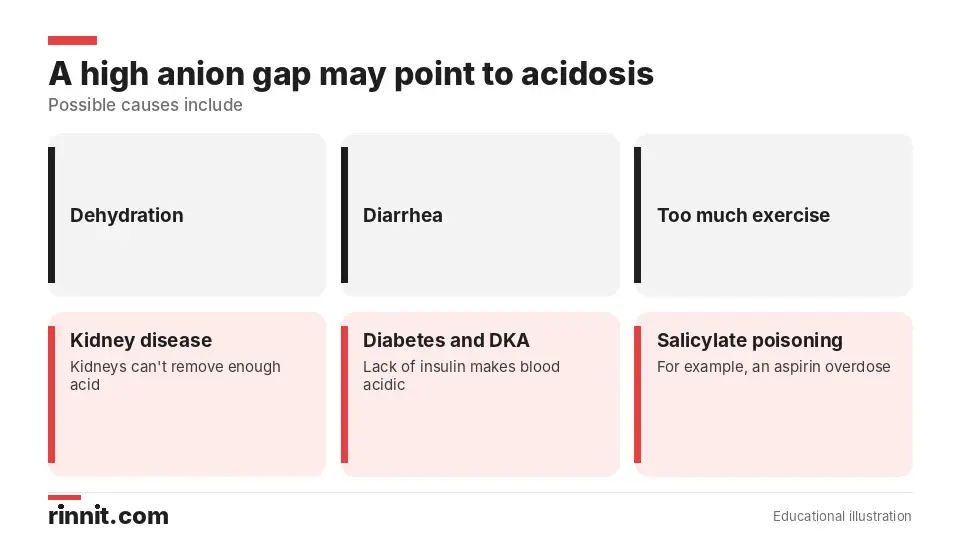
A high anion gap usually points toward acidosis, so the next step is finding its source.
A high anion gap may mean acidosis, a higher-than-normal level of acid in your blood (a lower blood pH). It can be a sign of: [1]
Dehydration
Severe diarrhea (though it usually causes acidosis with a normal anion gap)
Too much exercise
It may also point to more serious conditions: [1]
Kidney disease: healthy kidneys remove acid in urine, but damaged kidneys can't remove enough, which can lead to metabolic acidosis.
Diabetes: acidosis can signal undiagnosed type 1 diabetes, when the pancreas no longer makes enough insulin.
Diabetes-related ketoacidosis (DKA): a life-threatening complication caused by lack of insulin.
Salicylate poisoning: too much of a salicylate medicine, most commonly aspirin, which is life-threatening.
What does a low anion gap mean?

Because a low anion gap is so rare, the first step is often simply to repeat the test.
A low anion gap is rare, so your provider will likely repeat the test to make sure it's accurate. If it's confirmed, it may mean you have a low level of albumin (hypoalbuminemia), an important blood protein. Low albumin may point to: [1]
Kidney problems
Heart disease
Liver disease
Certain types of cancer
Should you be worried about an abnormal result?
Not necessarily. Many factors affect your electrolytes and anion gap, and errors can happen when blood is collected, transported or processed. Your provider looks at your medical history and medicines and may order more tests before making a diagnosis. [1]
How long do results take?
If you have signs of acidosis, such as shortness of breath and vomiting, your blood is drawn right away and results are usually ready within a few hours. If the anion gap is part of routine bloodwork, results may take one to two business days. [1]
Conclusion
The anion gap is a simple calculation that can flag a serious acid-base problem early, from dehydration to diabetic ketoacidosis or kidney disease. It works best as a clue, not a diagnosis. [1]
If your result is high or low, ask your provider what else they'll check, such as albumin, lactate or kidney function, since these can change how the number should be read. [2] [3]
Keep learning: Read our metabolic acidosis guide or our diabetic ketoacidosis guide.
FAQ
What is the anion gap in a blood test?
A calculated value from your sodium, chloride and CO2 results that shows how acidic your blood is and whether your electrolytes are balanced. [1]
How is the anion gap calculated?
Sodium minus the sum of chloride and CO2 (bicarbonate). [1]
What is a normal anion gap?
There's no universal normal. Each lab reports its own range, so compare your result with the range on your report. [1]
What does a high anion gap mean?
It may mean acidosis, which can come from dehydration, heavy exercise, kidney disease, diabetes, DKA or salicylate poisoning. [1]
What does a low anion gap mean?
It's rare and often reflects low albumin, which can point to kidney, heart or liver disease or some cancers. [1]
Do I need to fast for an anion gap test?
Sometimes. Your provider may ask you to fast for several hours before the blood draw. [1]
Can medicines affect the anion gap?
Yes. For example, lithium carbonate can lower the anion gap. Tell your provider about all your medicines. [1]
Which blood tests include the anion gap?
The basic and comprehensive metabolic panels, the electrolyte panel and the renal function panel. [1]
How long do anion gap results take?
A few hours in urgent cases, or one to two business days with routine bloodwork. [1]
Does an abnormal anion gap mean I'm sick?
Not always. Many factors and lab errors can affect it, so your provider may repeat the test or order others. [1]
Related Reading
Electrolyte Panel: What It Tests, Normal Ranges and What Results Mean explains the blood test that measures sodium, potassium, chloride and bicarbonate.
Understanding Metabolic Acidosis: Causes, Symptoms, and Treatment explains the acid buildup a high anion gap most often points to.
Diabetic Ketoacidosis (DKA): Signs, Triggers, and What To Do in an Emergency covers a life-threatening cause of a high anion gap.
Chronic Kidney Disease: What It Is, Its 5 Stages, Causes, and How It's Treated explains how failing kidneys can raise acid levels.
Hypoalbuminemia: A Comprehensive Guide to Symptoms, Causes, and Management covers the low albumin behind most low anion gap results.
Understanding Metabolic Alkalosis: Causes, Symptoms, and Management explains the opposite problem, when blood becomes too basic.
References
Cleveland Clinic. Anion Gap Blood Test: What It Is, Purpose, Risks & Results. Cleveland Clinic. Last updated October 28, 2024. https://my.clevelandclinic.org/health/diagnostics/22041-anion-gap-blood-test
Figge J, Jabor A, Kazda A, et al. Anion gap and hypoalbuminemia. Crit Care Med. 1998;26(11):1807-1810. PMID 9824071. https://doi.org/10.1097/00003246-199811000-00019
Chawla LS, Jagasia D, Abell LM, et al. Anion gap, anion gap corrected for albumin, and base deficit fail to accurately diagnose clinically significant hyperlactatemia in critically ill patients. J Intensive Care Med. 2008;23(2):122-127. PMID 18431828. https://doi.org/10.1177/0885066607312985
Medical disclaimer
This article is for general education only and does not replace advice from a qualified healthcare professional. Talk to your doctor about your own diagnosis and treatment, and seek emergency care right away for severe or sudden symptoms.



Comments